
报行合一

Search documents
11月起实施,非车险“报行合一”落地:明确“见费出单”
Nan Fang Du Shi Bao· 2025-10-11 08:16
Core Viewpoint - The National Financial Regulatory Administration has issued a notification to extend the "reporting and implementation" regulatory system from the auto insurance sector to the non-auto insurance market, effective November 1, 2025, while abolishing the old regulations from 2007 [2][3]. Industry Background - Non-auto insurance has seen rapid growth, with its premium share increasing from 37.1% in 2019 to 47.4% in 2024, according to Guosen Securities [2][3]. - Major insurance products like liability and corporate property insurance are facing underwriting losses, prompting the need for regulatory changes to curb irrational competition and shift focus towards product innovation and service enhancement [2][3]. Regulatory Changes - The notification defines non-auto insurance as all property insurance excluding vehicle insurance, with specific provisions for agricultural and export credit insurance [3]. - The notification mandates property insurance companies to strengthen premium rate management and adhere to approved insurance products, establishing a "reporting and implementation" requirement for non-auto insurance [3][4]. Financial Management Improvements - The notification addresses the issue of non-standard premium receivable management, emphasizing that insurance companies must issue policies and invoices only after receiving premiums [6]. - It aims to reduce financial risks and bad debt pressure on property insurance companies, promoting a shift from extensive competition to a focus on service and quality [6]. Collaborative Efforts - The notification emphasizes the need for regulatory bodies to monitor operational indicators of property insurance institutions and conduct timely regulatory interviews and inspections for those exceeding approved fee levels [7]. - Industry organizations are required to assist in enhancing non-auto insurance regulation, including developing industry standard clauses and self-regulatory guidelines [8][9].


一直亏本赚吆喝,非车险业务“报行合一”来了!
Jing Ji Guan Cha Wang· 2025-10-11 07:47
Core Viewpoint - The non-auto insurance sector is facing stricter regulatory policies due to issues of irregular operations and irrational competition, as highlighted in the recent notification from the National Financial Supervision Administration [2][3][8]. Summary by Relevant Sections Regulatory Changes - The notification emphasizes the need for "reporting and operation integration," requiring insurance companies to align their product pricing assumptions with actual operational behaviors to prevent discrepancies [3][8]. Non-Auto Insurance Business Overview - Non-auto insurance refers to all property insurance business outside of vehicle insurance within property insurance companies. The growth of non-auto insurance has been significant, with premium income share increasing from 37.1% in 2019 to 47.4% in 2024 [4][5]. Market Challenges - Despite rapid growth, the non-auto insurance sector is experiencing severe competition, leading to practices such as splitting coverage and altering the nature of insured items to reduce costs. This has resulted in distorted expense structures and pressure on underwriting profits [5][7]. Losses in Non-Auto Insurance - The sector is currently in a state of underwriting losses, exacerbated by high claims rates from certain insurance products and a lack of historical pricing and claims experience. For instance, by the end of 2024, the comprehensive cost ratio for liability and guarantee insurance at China Ping An exceeded 100% [7][9]. Implementation of New Regulations - The notification outlines specific requirements for insurance companies, including the need to establish fair and reasonable pricing, adhere strictly to approved insurance products, and avoid any form of disguised fee adjustments [9][10]. Impact on Industry Practices - The new regulations will enforce stricter requirements on the pricing and issuance of insurance policies, mandating that companies issue policies only after receiving full premium payments. This aims to improve financial management and reduce market disruptions [11][12]. Long-term Industry Outlook - The regulatory changes are expected to guide the non-auto insurance sector towards more rational competition, enhance underwriting capabilities, and ultimately provide better risk management services while reducing the risk of premium receivables [12].

非车险“报行合一”新规11月落地
Huan Qiu Wang· 2025-10-11 04:08
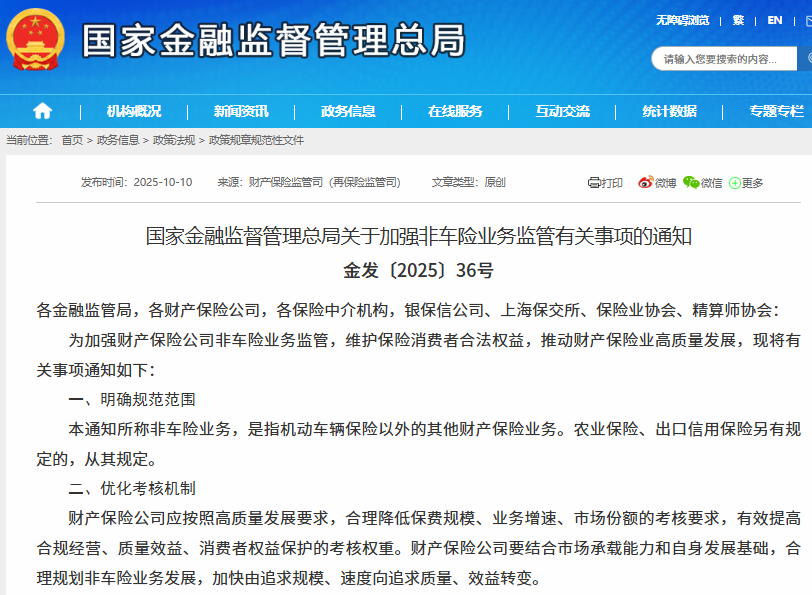
【环球网财经综合报道】国家金融监督管理总局于10月10日发布《关于加强非车险业务监管有关事项的通知》,标 志着备受关注的"报行合一"监管将全面延伸至非车险领域。这项旨在规范市场秩序、防范经营风险的新规,将于 2025年11月1日正式实施,为近年来快速扩张但承保亏损问题凸显的非车险市场踩下"刹车",引导其回归高质量发 展轨道。 所谓"报行合一",即保险公司实际执行的保险条款和保险费率,必须与向监管部门报送的备案材料保持一致,严禁 通过虚列费用、拆分保费等手段突破备案标准。此前,该原则主要在车险领域得到严格执行。 近年来,非车险业务已成为财产险市场的重要增长引擎。据国信证券数据,其保费占比已从2019年的37.1%攀升至 2024年的47.4%,占据财险市场"半壁江山"。然而,规模的扩张伴随着承保亏损的隐忧。在2025年中期业绩发布会 上,中国人保副总裁于泽曾一针见血地指出,非车险长期亏损的根源在于脱离了保险定价的大数法则,部分产品通 过差异化竞争变相降低费率、提高手续费,导致定价失真。 为扭转这一局面,《通知》首先从源头上要求财产保险公司优化考核机制,合理降低对保费规模、业务增速的考核 权重,转而提高合规经营、 ...
优化考核机制 加强费率管理 非车险业务将于11月1日起实施“报行合一”
Xin Hua Wang· 2025-10-11 01:22
《通知》还要求,财产保险公司应持续加强主险和附加险条款费率的规范使用,严格执行经备案的 保险条款和保险费率。财产保险公司和保险中介机构不得通过特别约定、批单、协议、备忘录等方式实 质改变经备案的保险条款责任,不得通过违规拆分保险标的、拆分保险金额、更改被保险人属性、更改 标的使用性质、提高或降低免赔额(率)等形式变相调整保险费率。 《通知》还要求强化保险中介管理。财产保险公司应履行对保险中介机构的管理责任,不得委托不 具备合法资质的机构从事保险销售活动,不得向不具备合法资质的机构支付手续费。保险中介机构应配 合财产保险公司执行各项监管要求,设置与所提供服务价值相匹配的手续费水平,真实、合理核算各项 收入支出,严禁账外经营。 金融监管总局表示,《通知》的发布是对非车险监管政策的全面梳理和系统优化。《通知》坚持问 题导向,把握市场规律,引导理性竞争,能够有效促进非车险业务高质量发展,为人民群众和经济社会 提供更加充分有效的保险保障。下一步,金融监管总局将指导各派出机构和财产保险公司做好政策落 实,稳步推进非车险监管要求落地见效,更好维护保险消费者合法权益,实现非车险业务高质量发展。 继车险、人身险业务实行"报行合 ...
优化考核机制、加强费率管理 非车险业务将于11月1日起实施“报行合一”
Zhong Guo Zheng Quan Bao· 2025-10-10 23:29
继车险、人身险业务实行"报行合一"之后,非车险业务"报行合一"也将正式落地。金融监管总局10月10 日消息,金融监管总局近日发布《关于加强非车险业务监管有关事项的通知》,自2025年11月1日起实 施。《通知》聚焦非车险领域经营不规范、非理性竞争等问题,重点在六方面强化要求,包括优化考核 机制、规范产品开发使用、规范保费收入管理、强化市场行为监管、推动改进非车险承保理赔服务、发 挥行业组织支撑服务作用等。 "报行合一"是指保险公司应严格执行经备案的保险条款和保险费率,确保备案内容与实际经营行为完全 一致。 《通知》明确非车险业务是指机动车辆保险以外的其他财产保险业务。农业保险、出口信用保险另有规 定的,从其规定。 《通知》要求,财产保险公司应按照高质量发展要求,合理降低保费规模、业务增速、市场份额的考核 要求,有效提高合规经营、质量效益、消费者权益保护的考核权重。财产保险公司要结合市场承载能力 和自身发展基础,合理规划非车险业务发展,加快由追求规模、速度向追求质量、效益转变。 《通知》还要求,财产保险公司应持续加强主险和附加险条款费率的规范使用,严格执行经备案的保险 条款和保险费率。财产保险公司和保险中介机构 ...
金融监管总局最新发布!非车险“报行合一”新规11月正式落地
券商中国· 2025-10-10 23:27
Core Viewpoint - The Financial Regulatory Bureau has issued a notification to strengthen the regulation of non-auto insurance business, requiring property insurance companies to optimize their assessment mechanisms, standardize product development, and enhance premium rate management, effective from November 1, 2025 [1][2]. Group 1: Regulatory Changes - The notification emphasizes the "reporting and execution consistency" principle, meaning that the actual insurance terms and premium rates must align with the submitted materials to the regulatory authority, extending this regulation to non-auto insurance [1]. - The non-auto insurance business, which excludes motor vehicle insurance, has seen its share of total property insurance premiums rise from 37.1% in 2019 to 47.4% in 2024, contributing nearly half of the total premium scale [2]. Group 2: Industry Shift - The notification aims to shift the focus of property insurance companies from pursuing scale and speed to prioritizing quality and efficiency in their non-auto insurance operations [2]. - The long-term losses in non-auto insurance are attributed to deviations from the law of large numbers in pricing, with many products lowering rates through differentiation, undermining the application of this principle [2]. Group 3: Detailed Requirements - The notification outlines specific requirements for premium rate management, including the need for reasonable settings of additional premium rates and service fees, and mandates that companies establish mechanisms for periodic review and dynamic adjustment of rates [3][4]. - Property insurance companies are prohibited from altering the terms and rates of insurance through special agreements or other means that deviate from the approved filings [3][4]. Group 4: Role of Industry Organizations - Industry organizations are tasked with developing standard clauses and self-regulatory guidelines for underwriting and claims in the non-auto insurance sector, enhancing the overall regulatory framework [5]. - The notification is seen as a comprehensive restructuring of non-auto insurance regulations, aimed at promoting high-quality development and better protection for consumers [5].

优化考核机制 加强费率管理——非车险业务将于11月1日起实施“报行合一”
Zhong Guo Zheng Quan Bao· 2025-10-10 23:04
新华财经北京10月11日电 继车险、人身险业务实行"报行合一"之后,非车险业务"报行合一"也将正式落 地。金融监管总局10月10日消息,金融监管总局近日发布《关于加强非车险业务监管有关事项的通 知》,自2025年11月1日起实施。《通知》聚焦非车险领域经营不规范、非理性竞争等问题,重点在六 方面强化要求,包括优化考核机制、规范产品开发使用、规范保费收入管理、强化市场行为监管、推动 改进非车险承保理赔服务、发挥行业组织支撑服务作用等。 《通知》还要求,财产保险公司应持续加强主险和附加险条款费率的规范使用,严格执行经备案的保险 条款和保险费率。财产保险公司和保险中介机构不得通过特别约定、批单、协议、备忘录等方式实质改 变经备案的保险条款责任,不得通过违规拆分保险标的、拆分保险金额、更改被保险人属性、更改标的 使用性质、提高或降低免赔额(率)等形式变相调整保险费率。 《通知》还要求强化保险中介管理。财产保险公司应履行对保险中介机构的管理责任,不得委托不具备 合法资质的机构从事保险销售活动,不得向不具备合法资质的机构支付手续费。保险中介机构应配合财 产保险公司执行各项监管要求,设置与所提供服务价值相匹配的手续费水平, ...
非车险业务将于11月1日起实施“报行合一”
Zhong Guo Zheng Quan Bao· 2025-10-10 20:57
● 本报记者 陈露 继车险、人身险业务实行"报行合一"之后,非车险业务"报行合一"也将正式落地。金融监管总局10月10 日消息,金融监管总局近日发布《关于加强非车险业务监管有关事项的通知》,自2025年11月1日起实 施。《通知》聚焦非车险领域经营不规范、非理性竞争等问题,重点在六方面强化要求,包括优化考核 机制、规范产品开发使用、规范保费收入管理、强化市场行为监管、推动改进非车险承保理赔服务、发 挥行业组织支撑服务作用等。 "报行合一"是指保险公司应严格执行经备案的保险条款和保险费率,确保备案内容与实际经营行为完全 一致。 《通知》还要求,财产保险公司应持续加强主险和附加险条款费率的规范使用,严格执行经备案的保险 条款和保险费率。财产保险公司和保险中介机构不得通过特别约定、批单、协议、备忘录等方式实质改 变经备案的保险条款责任,不得通过违规拆分保险标的、拆分保险金额、更改被保险人属性、更改标的 使用性质、提高或降低免赔额(率)等形式变相调整保险费率。 《通知》还要求强化保险中介管理。财产保险公司应履行对保险中介机构的管理责任,不得委托不具备 合法资质的机构从事保险销售活动,不得向不具备合法资质的机构支付手续 ...
非车险业务“报行合一”新规落地 财产保险行业“反内卷”再强化
Shang Hai Zheng Quan Bao· 2025-10-10 18:20
Core Viewpoint - The recent notification from the Financial Regulatory Bureau aims to strengthen the regulation of non-auto insurance business, promoting rational competition and enhancing the quality and efficiency of the property insurance industry [1][2]. Group 1: Regulatory Measures - The notification outlines measures to optimize assessment mechanisms, strengthen rate management, and enforce strict usage of terms and rates for non-auto insurance [1][2]. - Property insurance companies are required to set reasonable additional rates and fee levels, ensuring that fees align with the services provided [2][3]. - Companies must establish a mechanism for periodic review and dynamic adjustment of rates, with necessary product suspensions if discrepancies between actuarial assumptions and actual operations are significant [2][3]. Group 2: Addressing Industry Issues - The notification addresses irrational competition in the non-auto insurance market, which has led to high costs and ongoing underwriting losses, negatively impacting cash flow and financial stability [2][3]. - It emphasizes that companies and intermediaries must not alter approved insurance terms through informal agreements or other means, ensuring compliance with established fee limits [3][4]. - The industry is expected to see a reduction in costs and an improvement in operational quality and efficiency as a result of these measures [3][4]. Group 3: Product and Market Adjustments - The notification mandates a phased cleanup of existing products and encourages the standardization of non-auto insurance products [4][5]. - Companies are advised to lower the emphasis on premium scale and growth rates, shifting focus towards compliance, quality, and consumer protection [4][5]. - Regulatory bodies will implement mechanisms for monitoring and reporting, as well as intelligent checks on reported products to ensure adherence to the new regulations [4][5].
非车险“报行合一”新规11月起实施
Zheng Quan Shi Bao· 2025-10-10 18:12
Core Viewpoint - The National Financial Regulatory Administration has issued a notice to strengthen the regulation of non-auto insurance business, requiring property insurance companies to optimize their assessment mechanisms and ensure compliance with approved insurance products and rates, effective from November 1, 2025 [1][4]. Group 1: Regulatory Changes - The notice mandates that the actual insurance terms and rates executed by insurance companies must align with the materials submitted to regulatory authorities, extending the "reporting and execution consistency" regulation to non-auto insurance [1]. - Non-auto insurance, as defined in the notice, refers to all property insurance business excluding motor vehicle insurance, with specific provisions for agricultural insurance and export credit insurance [1]. Group 2: Industry Trends - Non-auto insurance has been expanding, with its share of total property insurance premiums rising from 37.1% in 2019 to 47.4% in 2024, contributing nearly half of the total property insurance premium scale [2]. - The industry is facing significant underwriting losses, attributed to deviations from the law of large numbers in insurance pricing, as highlighted by the president of PICC Property and Casualty [2]. Group 3: Fee Management and Compliance - The notice specifies that property insurance companies must not set high fees that do not correspond to the services provided and must establish a mechanism for periodic review and dynamic adjustment of rates [3]. - Insurance companies and intermediaries are prohibited from altering approved insurance terms and rates through various means, including special agreements or modifications to policy details [3]. - The notice emphasizes that intermediaries must align their fees with the value of services provided and accurately account for all income and expenses, prohibiting off-the-books operations [3]. Group 4: Enforcement and Implementation - The notice outlines that regulatory bodies will take measures against companies that fail to comply with the approved terms and rates, including administrative penalties [4]. - The regulatory authority will guide local agencies and property insurance companies to ensure the effective implementation of these new regulations, aiming for high-quality development in the non-auto insurance sector [4].
