
农业农村现代化

Search documents
经济日报金观平:把解决好三农问题作为重中之重
Xin Lang Cai Jing· 2026-01-10 02:56
Core Viewpoint - Agricultural modernization is essential for China's overall modernization, with a focus on creating a modern agricultural industry and improving rural living conditions to enhance farmers' quality of life [1] Group 1: Agricultural Modernization Goals - The Central Rural Work Conference emphasizes the need to build agriculture into a modernized large industry and ensure that rural areas meet modern living standards [1] - Ensuring stable supply of grain and important agricultural products is the top priority in agricultural modernization [1] Group 2: Food Security and Production Capacity - Although current food security is generally assured, long-term demand for food is expected to continue growing [1] - The government aims to implement a new round of actions to increase grain production capacity by a billion jin, promoting high-yield and efficient agricultural practices [1] Group 3: Farmer Income and Policy Support - Increasing farmers' income is a central task in the "three rural issues" (agriculture, rural areas, and farmers) [1] - To achieve agricultural modernization, there is a need for stronger policies to support farmers and ensure that prices of important agricultural products remain reasonable, thereby incentivizing farmers to grow grain profitably [1]
金观平:把解决好“三农”问题作为重中之重
Jing Ji Ri Bao· 2026-01-10 02:51
Group 1 - The modernization of agriculture and rural areas is essential for China's overall modernization, with a focus on creating a modern agricultural industry and improving living conditions for farmers [1] - Recent years have seen positive developments in China's agricultural sector, including stable grain production and the mechanization of major crops, leading to improved rural living conditions and the growth of new industries such as rural tourism and e-commerce [1] - Despite progress, challenges remain, including a weak agricultural foundation and the need for continued income growth for farmers, highlighting the strategic importance of agricultural modernization in China's development [1] Group 2 - Ensuring stable supply of grain and important agricultural products is a top priority for agricultural modernization, with a need for increased production capacity and effective farming practices to secure food safety [2] - Increasing farmers' income is central to agricultural and rural work, requiring supportive policies and measures to maintain reasonable prices for key agricultural products, thus incentivizing farmers to cultivate [2] - The transition from poverty alleviation to rural revitalization must continue with targeted assistance to prevent large-scale poverty, emphasizing the importance of sustainable development in rural areas [2] Group 3 - Building beautiful homes and improving the quality of life for farmers is a key aspiration, necessitating tailored rural development strategies that consider local conditions and population changes [3] - Optimizing county-level industrial structures and spatial layouts is crucial for enhancing rural living and working conditions, promoting the integration of resources and development across urban and rural areas [3] - Achieving agricultural and rural modernization is a systematic and strategic task that requires focused efforts and a commitment to addressing agricultural issues as a priority for advancing China's modernization [3]
经济日报金观平:把解决好“三农”问题作为重中之重
Xin Lang Cai Jing· 2026-01-09 22:40
Core Viewpoint - Agricultural modernization is essential for China's overall modernization, as emphasized by the recent Central Rural Work Conference, which aims to transform agriculture into a modern industry and improve living conditions in rural areas [1] Group 1: Agricultural Development - The situation of "three rural issues" (agriculture, rural areas, and farmers) has improved significantly in recent years, with stable grain production and continuous increases in economic crops [1] - Major crops have achieved full mechanization in planting and harvesting, enhancing productivity and efficiency [1] Group 2: Rural Transformation - There have been substantial changes in rural landscapes, with the development of advantageous specialty industries in poverty alleviation areas, indicating strong growth potential [1] - New industries such as rural tourism and e-commerce are thriving, contributing to improved production and living conditions in rural areas [1]
把解决好“三农”问题作为重中之重
Jing Ji Ri Bao· 2026-01-09 22:04
Core Viewpoint - The modernization of agriculture and rural areas is essential for China's overall modernization, with a focus on improving living conditions for farmers and enhancing agricultural productivity [1] Group 1: Agricultural Modernization - The recent Central Rural Work Conference emphasized the need to build a modern agricultural industry and improve rural living conditions, aiming for a prosperous life for farmers [1] - Despite recent successes in agricultural production, challenges remain, including the need for stronger agricultural foundations and addressing the income pressures faced by farmers [1][2] Group 2: Food Security - Ensuring stable supply of food and important agricultural products is a top priority for agricultural modernization, with a focus on increasing grain production capacity and promoting efficient agricultural practices [2] - The government aims to maintain reasonable prices for key agricultural products to incentivize farmers and prevent large-scale poverty [2] Group 3: Rural Development - The construction of beautiful homes and improved living standards for farmers is a key aspiration, requiring tailored approaches to rural development based on local conditions [3] - Optimizing county-level industrial structures and resource allocation is crucial for enhancing rural living and working conditions, promoting integrated development across urban and rural areas [3] Group 4: Strategic Importance - Achieving agricultural and rural modernization is a systematic and strategic task that requires urgent and sustained efforts, with a focus on addressing "three rural issues" as a priority [3]
研究做好“三农”等工作
Xin Lang Cai Jing· 2026-01-09 18:42
Group 1 - The meeting emphasized the importance of implementing Xi Jinping's directives on "Three Rural Issues" and aimed to modernize agriculture and rural areas, promoting comprehensive rural revitalization and urban-rural integration [1][2] - The focus is on consolidating agricultural advantages, enhancing production capacity and quality, and ensuring stable income growth for workers through tailored economic development strategies [1][2] - The meeting highlighted the need for a people-centered urban development approach, fostering a harmonious urban-rural community and promoting high-quality urban development [2] Group 2 - The meeting called for a collaborative urban work structure involving unified leadership from the Party, government cooperation, and community participation to build a modernized city with unique characteristics [2] - It stressed the importance of planning and innovation in developing industrial parks and enhancing the management of chemical parks to transition from standard construction to high-quality development [2] - The meeting also underscored the necessity of risk prevention and safety measures in development, promoting green and safe growth [2]
稳中求进、提质增效 实现“十五五”良好开局|坚持协调发展,促进城乡融合和区域联动
Ren Min Ri Bao· 2026-01-09 03:29
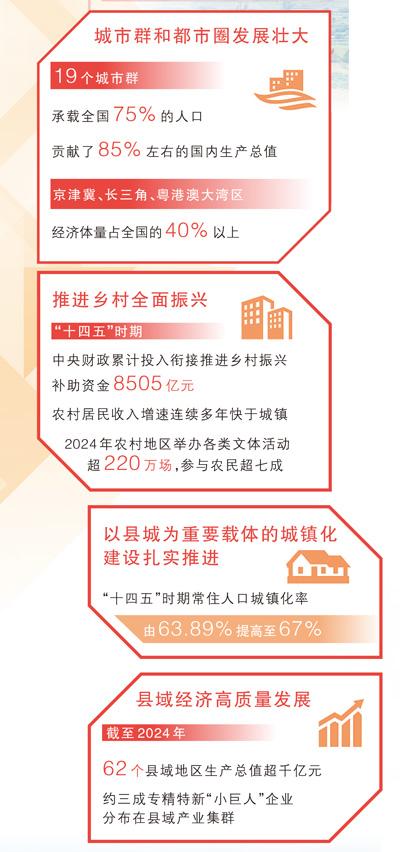
Core Viewpoint - Regional coordinated development is an inherent requirement of Chinese-style modernization, emphasizing the need for urban-rural and regional integration to enhance domestic circulation [1][4]. Group 1: Regional Development Strategies - The Central Economic Work Conference highlights the importance of promoting coordinated development and urban-rural integration, implementing regional coordination strategies, and leveraging multiple national development strategies [1][7]. - Key urban agglomerations like Beijing-Tianjin-Hebei, Yangtze River Delta, and Guangdong-Hong Kong-Macao Greater Bay Area are crucial for driving high-quality national development, contributing to 75% of the population and approximately 85% of GDP [7]. Group 2: Infrastructure and Connectivity - "Hard connectivity" through major transportation networks supports regional development, with 1-2 hour traffic circles established in key regions, covering about 90% of the national economy and population [5]. - "Soft connectivity" initiatives, such as ecological protection agreements and shared public services, are enhancing collaborative governance and breaking down administrative barriers [6]. Group 3: Agricultural Modernization - Agricultural modernization is accelerating, with a focus on food security and poverty alleviation, as highlighted by the Central Economic Work Conference [8][10]. - The resilience of agricultural supply chains has improved, with grain production achieving high yields despite adverse weather conditions, and average yield per mu increasing by 4.4 kg [10]. Group 4: Rural Development and Quality of Life - Rural living conditions are improving, with sanitation facilities reaching a 76% coverage rate and over 90% of villages having waste management systems [11]. - The "14th Five-Year Plan" emphasizes tailored rural revitalization strategies to address regional disparities and enhance living standards [12]. Group 5: Economic Growth in Counties - County-level economies are experiencing significant growth, with the number of counties exceeding 100 billion yuan in GDP increasing to 62, and those nearing this threshold reaching 21 [14]. - Counties are diversifying their economic activities, focusing on industries such as light manufacturing, new energy, and tourism, leading to unique development paths [14]. Group 6: Urban-Rural Integration - The urbanization rate is projected to reach 67% by the end of 2024, with policies being implemented to facilitate the integration of rural populations into urban areas [15]. - The establishment of integrated medical systems in over 90% of counties by the end of 2025 is expected to enhance the overall capacity of county-level services [15].

坚持协调发展,促进城乡融合和区域联动
Ren Min Ri Bao· 2026-01-09 01:19
Group 1: Regional Development Strategy - The core viewpoint emphasizes that regional coordinated development is an inherent requirement of Chinese-style modernization, as highlighted by President Xi Jinping [5][6] - The Central Economic Work Conference stresses the importance of promoting urban-rural integration and regional linkage to enhance domestic circulation [5][6] - Various regions are implementing strategies to advance urbanization and rural revitalization, focusing on building a high-quality regional economic structure [6][10] Group 2: Infrastructure and Connectivity - "Hard connectivity" is being accelerated through the construction of cross-regional transportation networks, facilitating economic and population movement across major urban clusters [8][10] - Major urban clusters like Beijing-Tianjin-Hebei, Yangtze River Delta, and Guangdong-Hong Kong-Macao Greater Bay Area are becoming key drivers of high-quality national development [10] - The establishment of a national comprehensive transportation network is nearly complete, serving about 90% of the country's economic and population total [8] Group 3: Agricultural Modernization - Agricultural modernization is crucial for the overall modernization of China, with a focus on ensuring food security and consolidating poverty alleviation achievements [11][13] - The resilience of the agricultural supply chain has improved, with grain production achieving high levels despite adverse weather conditions, resulting in an increase in average yield by 4.4 kg per mu [13] - The development of agricultural industries in major grain-producing areas is transforming them from "value depressions" to thriving economic zones [14] Group 4: Rural Development and Quality of Life - Rural living conditions are improving, with sanitation facilities reaching a coverage rate of approximately 76% and over 90% of villages having access to waste collection services [15] - Cultural and recreational activities in rural areas are flourishing, with over 70% of farmers participating in cultural and sports events in 2024 [15] - The "14th Five-Year Plan" suggests a tailored approach to rural revitalization, promoting quality living spaces and addressing regional disparities [15] Group 5: Economic Growth and County Development - The county-level economy is experiencing significant growth, with the number of counties exceeding 100 billion yuan in GDP increasing to 62 [17] - Counties are diversifying their economic activities, focusing on industries such as light manufacturing, new energy, and tourism to enhance local development [17] - The integration of urban and rural areas is being facilitated, with policies aimed at improving the living conditions of migrant workers and enhancing their sense of belonging in cities [19]

省委常委会召开会议 传达学习习近平总书记重要讲话精神 研究巡视巡察工作等事项
Da Zhong Ri Bao· 2026-01-09 01:06
Core Points - The meeting of the Provincial Standing Committee focused on conveying the important speech of General Secretary Xi Jinping and reviewing relevant work matters [2][3] - The meeting emphasized the need for all levels of party organizations and members to deeply learn and implement the spirit of Xi Jinping's speeches, ensuring a commitment to ideals, practical actions, responsibility, and self-discipline [3] Group 1: Key Discussions - The meeting highlighted the importance of self-examination and party character analysis as a standard for the entire party, showcasing the significance of self-revolution and responsibility in party building [3] - It was stressed that the achievements in the development of the party and the country should be deeply understood to boost confidence and maintain a proactive approach [3] - The meeting called for the implementation of Xi Jinping's important instructions to promote stable and healthy economic and social development, ensuring a good start for the "14th Five-Year Plan" [3] Group 2: Inspection and Governance - The meeting discussed strengthening village inspection work, emphasizing the need to address issues that hinder rural revitalization and agricultural modernization, thereby improving grassroots governance [4] - A report on the 2025 provincial inspection work and the 2026 work plan was reviewed, highlighting the importance of deepening political inspections and enhancing the application of results [4] - The meeting aimed to establish a coordinated inspection and supervision framework to support the construction of a modernized strong province [4]
传达学习习近平总书记重要指示精神 研究“十五五”规划《纲要草案》编制等工作
Zheng Zhou Ri Bao· 2026-01-09 00:50
Group 1 - The meeting emphasized the importance of modernizing agriculture and rural areas, aiming for comprehensive rural revitalization and urban-rural integration [1] - It highlighted the need to ensure food security, maintain arable land boundaries, and enhance agricultural production capacity and quality [1] - The meeting discussed the importance of consolidating poverty alleviation achievements and implementing policies to increase farmers' income while preventing large-scale poverty [1] Group 2 - The meeting addressed the preparation of the city's "14th Five-Year" planning outline, stressing the incorporation of national and local strategic intentions [2] - It called for setting indicators, arranging policies, and planning projects to achieve qualitative and reasonable quantitative economic growth [2] - The meeting focused on addressing wage arrears, emphasizing a people-centered development approach and the need for coordinated actions to resolve wage disputes [2]
坚持协调发展 促进城乡融合和区域联动——着力推进全年经济工作八大重点任务⑤(稳中求进、提质增效 实现“十五五”良好开局)
Ren Min Ri Bao· 2026-01-08 23:09
Group 1 - The core viewpoint emphasizes that regional coordinated development is an inherent requirement of Chinese-style modernization, as highlighted by Xi Jinping's statement on the importance of urban-rural and regional coordination for expanding domestic circulation [1] - The Central Economic Work Conference advocates for promoting urban-rural integration and regional linkage, with a focus on implementing regional development strategies and enhancing urbanization and rural revitalization [1][5] - The development of key urban agglomerations is crucial, as they currently house 75% of the population and contribute approximately 85% of the GDP, with regions like Beijing-Tianjin-Hebei, Yangtze River Delta, and Guangdong-Hong Kong-Macau Greater Bay Area leading high-quality development [5] Group 2 - "Hard connectivity" is being accelerated through the establishment of cross-regional transportation networks, creating 1 to 2-hour travel circles in major regions, which supports economic and population mobility [3] - "Soft connectivity" is expanding with collaborative agreements among provinces for ecological protection and shared public services, breaking down administrative barriers to enhance coordinated development [4] - The agricultural modernization process is advancing, with a focus on food security and the continuous improvement of rural living conditions, as evidenced by increased grain production and infrastructure development [6][8][9] Group 3 - The county-level economy is increasingly recognized as a vital unit for socio-economic development, with initiatives to promote urbanization and rural revitalization through industrial support [11] - Specific counties are implementing strong chain projects in various industries, showcasing successful local economic strategies and growth [12] - The integration of urban and rural areas is being facilitated by policies aimed at improving the living conditions of migrant populations, contributing to a rising urbanization rate [13]