
中药

Search documents
“支付松绑+技术出海+需求刚性”黄金三角驱动,药ETF(562050)逆市涨1%!丽珠集团、华东医药领涨
Xin Lang Ji Jin· 2025-07-16 03:27
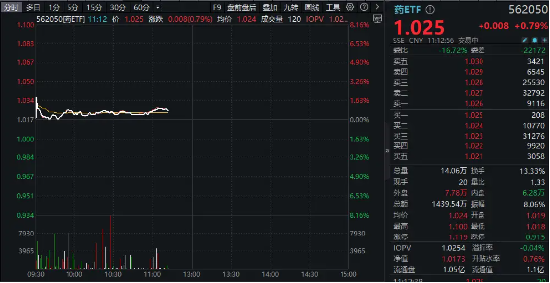
Core Viewpoint - The pharmaceutical sector remains active, with a focus on leading pharmaceutical companies and the performance of the drug ETF (562050), which tracks the CSI Pharmaceutical Index and has shown significant gains recently [1][3]. Group 1: Pharmaceutical Sector Performance - The drug ETF (562050) opened significantly higher, rising nearly 1% and achieving over 14 million yuan in real-time transactions [1]. - Innovation drug stocks are leading the market, with Lijun Group rising over 6% and Huahai Pharmaceutical increasing over 4% [3]. - The first dynamic adjustment of the medical insurance and commercial insurance innovative drug catalog is set to launch, addressing the high-cost payment challenges for innovative drugs [3]. Group 2: Policy and Market Drivers - The policy emphasizes commercial health insurance as a key payer for innovative drugs, with the first catalog expected to be implemented in October [3]. - The total transaction value of innovative drug License-out deals in China surpassed 66 billion USD in the first half of 2025, with cutting-edge technologies like ADC and bispecific antibodies accounting for over 60% [3]. - The pharmaceutical sector is experiencing a "golden triangle" of drivers: relaxed payment policies, technology export, and rigid demand [3]. Group 3: Earnings Forecasts - All eight constituent stocks of the drug ETF that have released mid-year earnings forecasts are expected to report profits, with expected net profit growth rates exceeding 200% for companies like Buchang Pharmaceutical and Darentang [3][4]. - Specific forecasts include Buchang Pharmaceutical with a lower net profit estimate of 488 million yuan and a growth rate of 110.88%, while Darentang is expected to have a lower estimate of 1.84 billion yuan with a growth rate of 180% [4].


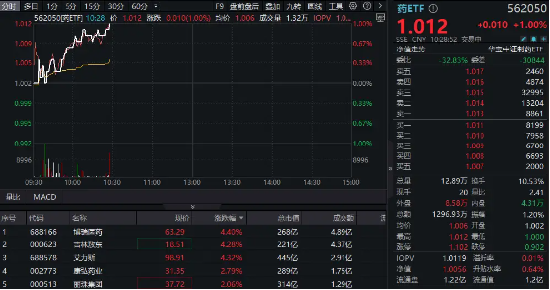
中报最高预增140%,吉林敖东大涨逾4%!药ETF(562050)放量涨1%,溢价频现!
Xin Lang Ji Jin· 2025-07-14 02:39
Group 1 - The A-share pharmaceutical sector experienced a strong rally, with the drug ETF (562050) rising by 1% and nearly 13 million yuan in trading volume, indicating strong buying interest [1] - The drug ETF (562050) is the first ETF in China tracking the CSI Pharmaceutical Index, focusing on innovative drugs and traditional Chinese medicine, while excluding medical and CXO sectors [1] - Key stocks in the ETF, such as Borui Pharmaceutical, Jilin Aodong, and Ailisi, saw gains exceeding 4%, while companies like Sanofi and BeiGene adjusted downwards [2][3] Group 2 - Jilin Aodong announced a significant profit increase for the first half of the year, projecting a net profit of 1.236 billion to 1.29 billion yuan, representing a year-on-year growth of 130% to 140% [3] - Other constituent stocks of the drug ETF, including Ganli Pharmaceutical and New Hecheng, also forecasted substantial profit increases, with growth rates of up to 114.12% and 70% respectively [3] - The policy environment is favorable, with the National Healthcare Security Administration confirming that the adjustment of the basic medical insurance drug list will align with the development of innovative drug lists by 2025 [3] - The pharmaceutical industry is supported by both policy and demand, with expectations of improved corporate profitability due to optimized negotiation rules for medical insurance and a steady increase in medical spending driven by aging and consumption upgrades [3]

科创医药指数ETF(588700)年内涨幅暂居同标的第一,机构:以创新药为首的医药板块强势表现有望贯穿全年
2 1 Shi Ji Jing Ji Bao Dao· 2025-05-12 02:19
Group 1 - The core viewpoint of the articles highlights the performance and outlook of the biopharmaceutical sector, particularly focusing on the innovation-driven and consumer healthcare segments [1][2] - The ChiNext Medical Index ETF (588700) has shown a year-to-date increase, outperforming its peers, with a current drop of 1.88% and a trading volume exceeding 8.29 million yuan [1] - The biopharmaceutical index comprises 50 large-cap companies from various sectors, reflecting the overall performance of representative biopharmaceutical companies in the ChiNext market [1] Group 2 - Wanlian Securities predicts a decline in revenue and net profit for the pharmaceutical sector in Q1 2024 and 2025, with performance differentiation among sub-sectors [1] - The sectors expected to perform well in terms of revenue include medical research outsourcing, hospitals, and other bioproducts, while those with profit growth include medical research outsourcing, hospitals, raw materials, and other bioproducts [1] - Huafu Securities emphasizes the strong performance of the innovative drug segment throughout the year, recommending a focus on leading companies and those with clear catalysts [2]
港股创新药ETF(159567)盘中涨逾4%,药明康德涨超13%,机构:继续关注港股Biotech方向
2 1 Shi Ji Jing Ji Bao Dao· 2025-03-18 03:52
Group 1 - The Hong Kong stock market saw a significant rise, with the Hang Seng Technology Index increasing by 3% and the Hang Seng Index up by over 2.1%, particularly in the healthcare sector [1] - The Hong Kong Innovative Drug ETF (159567) experienced a rise of over 4% during trading, with a turnover rate exceeding 20%. WuXi AppTec saw a peak increase of over 15%, currently up by 13.3%, along with other stocks like WuXi Biologics and Kanglongda-B rising over 5% [1] - The ETF attracted a capital inflow of 3.46 million yuan on March 17, with a latest circulation scale of 534 million yuan and a circulation share of 464 million, both reaching historical highs [1] Group 2 - Minsheng Securities highlighted the recovery of the biotech sector in Hong Kong, driven by improving fundamentals and supportive policies, focusing on high-quality assets in pharmaceutical consumption and innovation [2] - Zhongtai Securities suggested a shift in market style, recommending attention to performance-driven sectors, particularly in CRO & CDMO, upstream research, and specialty raw materials, anticipating a dual recovery in performance and valuation [2] - Everbright Securities analyzed three payment channels in the pharmaceutical industry, expressing optimism about policy support for innovative drugs and devices, expanding consumer demand, and the upward cycle of overseas sales [2]
