
以武谋独

Search documents
国台办:“以武谋独”、铤而走险,只会自掘坟墓!
Xin Hua She· 2025-12-03 07:52
张晗答问时还指出,民进党当局为一党私利,将本可以用来改善民生、发展经济的钱浪费在讨好外部势 力上,买武器不仅买不来"安全",反而加速把台湾推入险境。正告民进党当局,奴颜婢膝、穷兵黩武是 绝路一条。 她强调,我们坚决反对美国与中国台湾地区开展任何形式的军事联系。美方应切实恪守一个中国原则和 中美三个联合公报规定,慎重妥善处理涉台问题,停止向"台独"分裂势力发出任何错误信号。 台媒报道,岛内民众走上街头,表达反对战争、要求和平、反对民进党当局掏空台湾讨好美国、反对提 高防务预算等诉求。张晗就此表示,民进党当局为谋取"台独"私利,加紧"以武谋独""倚外谋独",遭到 越来越多台湾民众的反对。赖清德当局一意孤行,下场注定可悲。 新华社北京12月3日电(记者许晓静、李寒芳)国务院台办发言人张晗3日在例行新闻发布会上表 示,"台独"意味着战争。希望广大台湾同胞认清赖清德"台独引战"的极端危险性、危害性,坚决反 对"台独"分裂和外来干涉,同我们一道推动两岸关系重回和平发展正轨,切实维护台海和平稳定和自身 安全福祉。正告赖清德及民进党当局,不要玩火,玩火者必自焚;"以武谋独"、铤而走险,只会自掘坟 墓! 近日,赖清德在美媒投书 ...
台当局要追加400亿美元军费 “美国在台协会”表态欢迎,外交部:台湾民进党当局“以武拒统”“以武谋独”也是不可能成功的
Ge Long Hui· 2025-11-26 08:06
Core Viewpoint - The Chinese government maintains a consistent stance against official and military ties between the U.S. and Taiwan, emphasizing that Taiwan's Democratic Progressive Party's (DPP) attempts to resist unification through military means will ultimately fail [1] Group 1 - The U.S. Taipei Economic and Cultural Office's head,谷立言, welcomed Taiwan's announcement of a $40 billion supplemental defense budget [1] - The Chinese Foreign Ministry spokesperson, 毛宁, reiterated China's opposition to U.S.-Taiwan military relations [1] - The DPP's strategy of using military force to seek independence is deemed unfeasible by the Chinese government [1]
美对台3.3亿美元军售,国台办回应
财联社· 2025-11-19 03:09
Group 1 - The article discusses the recent announcement by the U.S. Department of Defense regarding a military sale to Taiwan valued at approximately $330 million, indicating a commitment to assist Taiwan's military in maintaining its operational readiness [1] - The spokesperson for the Taiwan Affairs Office, Zhu Fenglian, firmly opposes the U.S. providing weapons to Taiwan, urging adherence to the One China principle and the three joint communiqués between China and the U.S., particularly the August 17th communiqué [1] - The article criticizes the Democratic Progressive Party (DPP) for allegedly using military purchases for political gain, describing it as a waste of the Taiwanese people's resources and warning that reliance on external forces for protection will lead to greater danger for Taiwan [1]


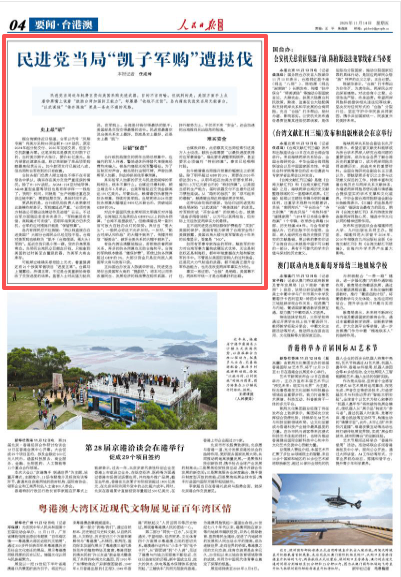
民进党当局“凯子军购”遭挞伐
Ren Min Ri Bao Hai Wai Ban· 2025-11-13 22:52
Core Points - The Taiwanese government has spent significant amounts on advanced weaponry from the United States, but has faced severe delays in delivery, leading to public criticism of the government's effectiveness [1][2] - The procurement of 66 F-16V fighter jets, originally ordered during Tsai Ing-wen's administration for $8 billion, has yet to deliver any aircraft despite over 80% of the payment being made [2][4] - The Taiwanese defense department has acknowledged serious delays in delivery from the U.S., with other projects like AGM-154 missiles also experiencing similar issues [2][4] - Public sentiment in Taiwan has turned against the government, with many viewing the military purchases as a waste of taxpayer money, often receiving outdated equipment [3][4] - The Taiwanese government plans to increase its defense budget significantly, exceeding 3% of GDP, despite criticism that such spending does not improve security and primarily benefits U.S. arms manufacturers [4][6] - The military purchases are seen as a misguided strategy to seek independence through reliance on U.S. support, which many believe is unreliable [6][7] Summary by Sections Military Procurement - The Taiwanese military's procurement of F-16V jets has faced delays, with no deliveries made as of now, despite substantial payments [2][4] - Other military projects are also experiencing delays, attributed to production line issues and supply chain disruptions [2][4] Public Sentiment and Criticism - There is growing public frustration over the military spending, with many questioning the effectiveness of the purchases and labeling Taiwan as a "sucker" in these transactions [3][4] - Criticism is directed at the government for prioritizing military spending over social welfare for military personnel [4] Budget and Spending - The Taiwanese government plans to increase its defense budget to over 3% of GDP, with future goals of reaching 5% by 2030 [6] - The proposed budget includes a special allocation of 1.3 trillion NTD, which is expected to lead to further delays in weapon deliveries [6] Strategic Implications - The reliance on U.S. military support is viewed as a flawed strategy, with experts suggesting that Taiwan's military capabilities cannot match the strength of the Chinese military [7] - The notion that increased military spending can ensure security is challenged, with calls for improved cross-strait relations as a more viable path to peace [7]
国防部:彻底放弃“台独”分裂图谋,才能给台湾带来真和平
Zhong Guo Xin Wen Wang· 2025-11-07 13:31
Core Viewpoint - The spokesperson of the Ministry of National Defense emphasizes that pursuing "Taiwan independence" through military means is futile, and true peace for Taiwan can only be achieved by abandoning separatist ambitions and aligning with the historical trend of cross-strait unification [1] Group 1: Military Posture and Statements - The spokesperson commented on Taiwan's recent military activities, specifically the induction ceremony of M1A2T tanks, suggesting that such displays are merely attempts by Taiwan's leadership to bolster morale and mislead the public [1] - The spokesperson asserts that the determination and capability of the People's Liberation Army (PLA) to defend national sovereignty and territorial integrity cannot be challenged by Taiwan's military displays of U.S. weaponry [1] Group 2: Political Implications - The spokesperson warns Taiwan's leadership, particularly Lai Ching-te, that the path of "using military means to pursue independence" is a dead end, and emphasizes the need to abandon separatist plots for the sake of genuine peace in Taiwan [1]
赖清德妄称台强化防务是为维护台海和平稳定,国防部回应
Xin Jing Bao· 2025-11-07 07:40
Core Viewpoint - The spokesperson from the Ministry of National Defense emphasizes that Taiwan's military actions and rhetoric are attempts to bolster morale and mislead the public, asserting that the Chinese military's resolve and capability to defend national sovereignty cannot be challenged by Taiwan's military displays [1] Group 1 - The spokesperson criticizes Taiwan's military showmanship, stating it is a facade to boost the morale of "Taiwan independence" forces and deceive the Taiwanese public [1] - The Chinese military's determination and capability to safeguard national sovereignty and territorial integrity are highlighted as unchallengeable by Taiwan's military enhancements [1] - A warning is issued to Taiwan's leadership, indicating that pursuing independence through military means is futile and that true peace can only be achieved by abandoning separatist ambitions and aligning with the historical trend of reunification [1]
国台办:台当局妄图“以武谋独”“倚外谋独”是痴人说梦
Yang Shi Xin Wen Ke Hu Duan· 2025-10-29 06:20
Core Viewpoint - The Taiwanese defense department faces challenges in delivering F-16 fighter jets and domestically produced submarines, leading to accusations of budget inflation and corruption within the defense spending [1] Group 1: Defense Procurement Issues - The Taiwanese defense department has acknowledged difficulties in the timely delivery of F-16 fighter jets purchased from the U.S. and the completion of domestically produced submarines [1] - There are claims that the defense budget is excessively inflated, with officials suggesting that "a few pieces of paper can deceive billions" [1] Group 2: Political Context - The spokesperson from the State Council Taiwan Affairs Office criticized the Democratic Progressive Party (DPP) for its persistent "Taiwan independence" stance, asserting that their attempts to strengthen defense are merely a facade for corruption [1] - The DPP's defense spending is characterized as a misuse of taxpayer money, with the public expressing strong discontent towards these actions [1]
两岸观察丨为何搞“台独”分裂只会将台湾推入灾难深渊?
Yang Shi Xin Wen Ke Hu Duan· 2025-10-28 02:09
Core Viewpoint - The article argues that the pursuit of "Taiwan independence" will lead Taiwan into disaster, emphasizing that any form of "Taiwan independence" will not bring peace or security to the region [2][4]. Military and Security Implications - The DPP government, particularly under Lai Ching-te, is pushing for military independence, increasing defense spending to 3%-5% of GDP, which is seen as escalating tensions and risks of conflict [2] - Mainland China's military exercises and air-sea patrols have created a situation of comprehensive pressure on Taiwan, with the DPP's reliance on U.S. support being questioned as unreliable [4][6]. Economic Consequences - In response to the DPP's provocations, mainland China has suspended tariff concessions under the ECFA for various products, indicating a potential for further economic retaliation [6][8]. - The DPP's policies, such as the "New Southbound Policy," aimed at reducing economic dependence on mainland China, have resulted in economic damage rather than diversification [8][10]. International Relations and Space - The DPP's attempts to expand Taiwan's international space through various exchanges have been ineffective against the backdrop of the One China principle, with 183 countries recognizing this principle [10][12]. - The denial of the "1992 Consensus" has led to Taiwan losing participation in international organizations, which previously was achieved through cross-strait negotiations [12]. Social and Youth Impact - The DPP's education policies promoting "de-Sinicization" have created a divide among Taiwanese youth regarding cross-strait relations, leading to a lack of understanding and increased hostility [14]. - Polls indicate a growing wariness among the Taiwanese public, particularly the youth, towards the idea of "Taiwan independence," with many preferring dialogue over conflict [14]. Conclusion - The article concludes that the path of "Taiwan independence" is fraught with risks and will not yield positive outcomes for Taiwan, advocating for peaceful development of cross-strait relations as the only viable future [2][14].
国台办:“倚美谋独”“以武谋独”注定是螳臂当车、自取灭亡
Zhong Guo Xin Wen Wang· 2025-10-22 10:50
Core Viewpoint - The Chinese government firmly opposes the sale of weapons by the United States to Taiwan, criticizing the Taiwanese authorities for prioritizing political gains over the welfare of its citizens [1] Group 1: Military Sales and Political Implications - The U.S. and Taiwan recently held a "defense industrial conference," with Taiwan's representative indicating that significant military sales are expected following a special budget for military purchases [1] - The spokesperson emphasized that the Taiwanese government's actions to seek military support from the U.S. will only lead to increased danger and suffering for the Taiwanese people [1] Group 2: Economic Concerns - The spokesperson criticized the Taiwanese authorities for wasting funds that could be used for improving living standards and economic development, instead opting to seek external military support [1] - The statement warns that the approach of relying on the U.S. for military protection is misguided and will ultimately lead to failure [1]
“以武谋独”只会加速自取灭亡 国台办回应赖清德打造所谓“台湾之盾”
Zhong Guo Xin Wen Wang· 2025-10-15 12:41
Core Viewpoint - The Taiwan Affairs Office criticizes Lai Ching-te's proposal to increase Taiwan's defense spending to 3%-5% of GDP, labeling it as a move driven by a separatist agenda that threatens the safety and interests of the Taiwanese people [1] Group 1 - Lai Ching-te's administration is accused of stubbornly adhering to a "Taiwan independence" stance for personal political gain [1] - The proposal to enhance defense spending is seen as a waste of public funds that could be better utilized for improving livelihoods and economic development [1] - The Taiwan Affairs Office warns that such military spending will not bring security but rather escalate tensions and risks of conflict for Taiwan [1] Group 2 - The spokesperson emphasizes that relying on the United States for military support will ultimately lead to failure in achieving independence [1] - The approach of using military means to pursue independence is described as a path to self-destruction [1]