
公共服务均等化

Search documents
专家:加快构建中国特色的新区域经济学
Zhong Guo Xin Wen Wang· 2025-08-01 05:27
Core Viewpoint - The development of a new regional economic theory with Chinese characteristics is essential, as Western economic theories do not fully apply to China's unique context [1][2]. Group 1: Characteristics of Chinese Regional Economics - Chinese regional economics should emphasize three main characteristics: adherence to objective laws, reflection of Chinese characteristics, and establishment of a holistic perspective [1]. - The research object of Chinese regional economics is based on national conditions, utilizing Marxist principles to summarize experiences and theories relevant to regional economic construction [1]. Group 2: New Theoretical Framework - A new scientific normative theory for regional economics is needed, focusing on the concept of "equality promoting efficiency" [2]. - The two key concepts introduced are "public service equalization" and "infrastructure equalization," which are crucial for the comprehensive development of central and western regions [2]. - The aim is to enhance human capital and social stability through equal access to education, healthcare, and social security, while optimizing infrastructure to ensure reasonable resource allocation [2]. Group 3: Microeconomic Foundations - The theory of regional economics should be grounded in microeconomic theories, particularly the concept of location and the theory of firm location [3]. - This approach allows for the application of economic principles to address macroeconomic issues related to regional development [3].
城市发展,如何更加以人为本?
Yang Shi Xin Wen Ke Hu Duan· 2025-07-17 01:38
Core Insights - The central urban work conference held in Beijing emphasized the goal of building modern, innovative, livable, beautiful, resilient, civilized, and smart cities, marking a shift from rapid urbanization to stable development [1] Group 1: Urban Development Transition - China's urbanization is transitioning from a phase of rapid growth to stable development, focusing on improving existing urban spaces rather than expanding them [1] - The conference highlighted the need for new ideas and methods to address the challenges faced by over 900 million urban residents in the context of urban space optimization and quality enhancement [1][3] Group 2: Urban Safety Initiatives - Urban safety is identified as a fundamental aspect of city development, necessitating simultaneous efforts in both above-ground and underground infrastructure [2] - There is a need for significant updates and renovations of aging underground pipelines and improved emergency response systems to address urban disasters [2] Group 3: Urban Renewal Focus - The renewed emphasis on urban renewal is seen as a critical strategy for enhancing urban quality and efficiency, moving beyond just the renovation of old neighborhoods to include optimizing urban spatial structures and promoting green, low-carbon development [3] Group 4: Public Service Improvement - The conference underscored the importance of expanding public services to non-resident populations, addressing the disparity in service availability between urban and rural areas [4][5] - There is a call for more diverse and accessible public service facilities, particularly in the context of an aging population, to support community-based elder care [4][5] Group 5: Shift in Development Philosophy - A significant shift in development philosophy is required, moving from a focus on construction to governance and management, emphasizing the importance of people in urban development [7] - The conference advocates for a people-centered approach, recognizing that urban development should prioritize the needs and contributions of its residents [7]

中央高规格发文惠民生,背后有何深意?
Yang Shi Xin Wen· 2025-06-14 09:12
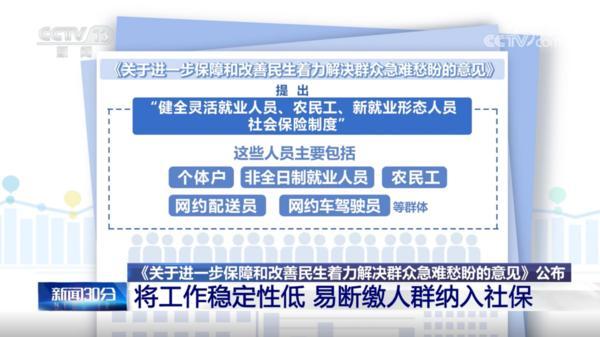
Group 1 - The central government has issued a comprehensive policy document aimed at improving and safeguarding people's livelihoods, marking the first such initiative since the 18th National Congress of the Communist Party [1] - The document addresses new challenges arising from economic structural transformation and population aging, emphasizing the need for top-level design and institutional arrangements to tackle deep-seated issues [1] - It proposes to establish a social insurance system for flexible workers, migrant workers, and new employment forms, and to eliminate household registration restrictions for social insurance participation, thereby expanding coverage [1] Group 2 - Rapid urbanization has led to many individuals moving to cities, but many cities are unprepared to accommodate these "new citizens," resulting in challenges related to education and healthcare access [2] - As of 2024, urban residents account for 67% of the total population, while urban registered residents only make up about 50%, indicating a significant gap in access to basic public services [4] - The policy aims to provide basic public services based on residency rather than household registration, promoting equal access and facilitating the free movement of people and resources [4] Group 3 - The current economic environment is characterized by structural adjustments and imbalances between different regions and urban-rural areas, necessitating a robust social safety net to stabilize expectations [4] - Specific measures include providing social insurance subsidies for graduates and unemployed individuals, as well as covering social insurance costs for vulnerable groups, which can help them navigate difficulties [4] - The plan includes achieving standardized compulsory education coverage within five years and improving healthcare resources in rural areas, which will enhance overall public welfare [4] Group 4 - The government emphasizes the importance of investing in people's livelihoods as a means to stimulate economic growth, linking social welfare to economic development [5] - Improving public confidence through enhanced social policies is expected to boost consumption and create a positive cycle between economic growth and livelihood improvement [5] - Initiatives such as expanding childcare services, affordable elderly care, and addressing housing issues for young people are anticipated to generate new demand and growth opportunities [5]

“民生10条”发布:提高最低工资标准、退休人员基本养老金,中央财政将发力
Hua Xia Shi Bao· 2025-06-12 08:33
Group 1: Core Policy Initiatives - The central government has introduced a series of significant livelihood policies aimed at enhancing social security fairness, improving the equity of basic public services, expanding the inclusiveness of basic livelihood services, and increasing the accessibility of diverse social services [1] - The policies include the removal of household registration restrictions for participating in social insurance at the place of employment, reasonable increases in minimum wage standards, and steady progress in allowing flexible employment personnel to participate in housing provident fund systems [1][3] - The government plans to propose major strategic tasks, policy measures, and engineering projects in the livelihood sector, integrating them into the national "14th Five-Year" development blueprint [1] Group 2: Public Service Equalization - The "14th Five-Year" plan aims to significantly improve the level of basic public service equalization by 2025 and achieve full equalization by 2035 [2] - The policies focus on enhancing the quality and efficiency of basic public services, coordinating service supply with population changes, and implementing local policies for providing basic public services based on residency [2][3] Group 3: Financial Support for Livelihood Development - The central government plans to increase financial investment in the livelihood sector, with education, social security, and employment expenditures budgeted at nearly 4.5 trillion yuan, reflecting growth rates of 6.1% and 5.9% respectively [4][5] - Employment support includes a budget of 66.74 billion yuan for employment subsidies, with measures to lower unemployment and work injury insurance rates, and to support enterprises in stabilizing jobs [4] - In the healthcare sector, per capita financial subsidies for basic public health services will increase to 99 yuan annually, and for urban and rural residents' medical insurance, it will rise to 700 yuan annually [4] Group 4: Policy Tools for Economic Stability - The government is enhancing its policy toolbox to support employment and economic stability, with measures including interest rate cuts and the implementation of the "民生10条" (Ten Livelihood Policies) to address various critical areas [6][7] - The focus is on improving the living conditions of citizens, particularly vulnerable groups, and addressing urgent livelihood issues to foster a sustainable internal consumption engine [7]

一体化示范区发布第五批制度创新经验
Su Zhou Ri Bao· 2025-05-17 00:39
Group 1 - The Long Triangle Ecological Green Integration Development Demonstration Zone has released its fifth batch of institutional innovation experiences, focusing on cross-provincial collaborative legislation, administrative law enforcement, police cooperation, functional area development, and public service sharing [1] - A joint regulation titled "Regulations for Promoting High-Quality Development of the Long Triangle Ecological Green Integration Development Demonstration Zone" has been established by the local legislatures to support high-quality integrated development [1] - The demonstration zone has implemented a case guidance method for administrative law enforcement to standardize practices across the regions of Qingpu, Wujiang, and Jiashan, aiming to reduce administrative discretion and promote law enforcement innovation [1] Group 2 - A police cooperation center has been established to optimize police resource allocation and enhance social governance, contributing to a harmonious and law-based business environment [2] - The overall spatial planning for the demonstration zone includes a 35.8 square kilometer area at the intersection of the three regions, aimed at developing a "water town living room" with a comprehensive management system [2] - The demonstration zone has launched a full-cycle management approach for public service projects, resulting in a list of 63 projects across nine fields, including health, education, and cultural tourism [2] Group 3 - Over the past five years, the demonstration zone has focused on eight key areas, resulting in 154 institutional innovation achievements, with 57 of these experiences being promoted nationwide [3]