
行政执法

Search documents
深化集中整治 让老百姓可感可及丨为优化营商环境赋能增效
Zhong Yang Ji Wei Guo Jia Jian Wei Wang Zhan· 2026-02-26 00:53
Core Viewpoint - The article emphasizes the importance of optimizing the business environment through effective administrative law enforcement, highlighting the need for strict supervision and the elimination of irregular practices that harm private enterprises and entrepreneurs [2][3]. Group 1: Administrative Law Enforcement - Administrative law enforcement is a crucial aspect of showcasing the business environment and reflects the integrity of governance [2]. - By 2025, nearly 57,000 cases of administrative law enforcement issues related to enterprises are expected to be addressed, with a year-on-year decrease of 8.2% in national penalty and confiscation revenue [2]. - The central government is focusing on rectifying issues such as illegal cross-regional enforcement and profit-driven law enforcement, with significant penalties imposed on violators [3]. Group 2: Supervision and Coordination - The Central Commission for Discipline Inspection and the National Supervisory Commission are actively engaging with various ministries to address prominent issues raised by enterprises, conducting extensive field research and discussions [3]. - A total of 4,575 cases of illegal fines were corrected nationwide in 2025, with administrative inspections decreasing by 33% and the problem detection rate increasing by 18.5% [3]. Group 3: Information Technology and Efficiency - The establishment of information platforms is crucial for standardizing enterprise-related law enforcement and regulatory behaviors, with systems like "scan to enter enterprises" being implemented to avoid redundant inspections [5]. - In Quzhou, Zhejiang Province, the number of administrative penalties decreased by 31.8%, while the number of cases not subject to penalties increased by 32.5% [6]. Group 4: Institutional Reforms - The government is focusing on institutional reforms to solidify the results of law enforcement rectification, with over 330 regulatory measures and 137 administrative discretion benchmarks established [7]. - The implementation of the "comprehensive inspection once" reform aims to streamline administrative checks and reduce interference in enterprise operations [8]. Group 5: Local Initiatives - Local governments are actively addressing issues such as illegal fees and fines, with significant amounts recovered for enterprises, such as over 90 million yuan in accounts payable in Bengbu City [8]. - Various localities are promoting measures to enhance service efficiency, including the establishment of online supervision channels and the collection of enterprise feedback [4].

2月起,一批新规施行
Zhong Guo Zheng Quan Bao· 2026-02-01 00:21
Group 1: Banking and Financial Regulations - The National Financial Supervision Administration has established the "Supervision and Management Measures for Commercial Bank Custody Business (Trial)" effective from February 1, 2026, which clarifies the concept and basic principles of custody business for commercial banks [1] - The "Financial Institutions Product Appropriateness Management Measures" will also take effect on February 1, 2026, introducing specific requirements for different product types, including risk classification and investor assessment [2] - The "Administrative Law Enforcement Supervision Regulations" will be implemented on February 1, 2026, focusing on the supervision of administrative law enforcement agencies and their adherence to legal standards [3] Group 2: Anti-Money Laundering and Payment Regulations - The "Management Measures for Special Anti-Money Laundering Preventive Measures" issued by the People's Bank of China and eight other departments will come into effect on February 16, 2026, mandating financial institutions to establish internal control systems for anti-money laundering [4] - The "Regulations on Cash Payment and Service" will be effective from February 1, 2026, ensuring that payment units respect the public's right to choose legal payment methods and maintain reasonable cash availability [5] Group 3: E-commerce and Market Regulations - The "Network Transaction Platform Rules Supervision Management Measures" will be effective from February 1, 2026, prohibiting unreasonable restrictions on operators and consumers within the platform [6] - The "Live E-commerce Supervision Management Measures" will also take effect on February 1, 2026, requiring live e-commerce platforms to adhere to principles of transparency and fairness in their operations [7] Group 4: Safety and Compliance Regulations - The "Administrative Penalty Measures for Safety Production Violations" will be implemented on February 1, 2026, detailing the types and procedures for administrative penalties related to safety violations [8]
民革广州凝聚智慧话发展 携手奋进“十五五”
Zhong Guo Fa Zhan Wang· 2026-01-14 08:19
Core Insights - The Guangzhou Municipal Committee of the Chinese Kuomintang (民革) emphasizes the importance of focusing on industrial development and manufacturing as key strategies for the city's growth, aligning with national policies and local initiatives [1] Industry Development - Recommendations include developing a "new blue ocean" for the unmanned economy to transition from a follower to a leader in this sector, focusing on policy innovation and ecosystem collaboration [2] - The proposal to enhance innovation infrastructure sharing aims to empower the development of strategic industries in Guangzhou, addressing the current lack of collaborative mechanisms compared to cities like Beijing and Shanghai [2] - The pet industry, valued at 300 billion yuan, is identified as a potential growth area, with suggestions to integrate it with other sectors such as biomedicine and fashion [2] - The low-altitude economy around Nankun Mountain is highlighted for its potential, with recommendations to address current operational challenges to transform ecological resources into economic benefits [2] - The beauty industry is urged to enhance its core competitiveness through improved brand quality and innovation [2] Government Planning and Economic Environment - The proposal for a scientific government planning approach to leverage the water economy, which has significant potential, is presented, emphasizing the need for innovative land supply and industry chain optimization [3] - Recommendations for a tiered exit mechanism for business entities aim to promote a healthier private economy by ensuring market competition and preventing systemic risks [3] Legal and Regulatory Framework - Suggestions to optimize administrative checks on enterprises through digital means aim to reduce arbitrary enforcement and improve regulatory efficiency [4] - Addressing the issue of private enterprises relocating out of Guangzhou, recommendations include differentiated rental subsidies and the establishment of a supportive policy framework to retain businesses [4] Agricultural Sector - The proposal to establish an international flower trading center in Guangzhou aims to enhance the competitiveness of the local flower industry, which currently faces challenges in supply chain and infrastructure [5] Social Welfare and Economic Growth - The development of the silver economy is proposed as a new growth engine, focusing on integrating technology and innovative services to cater to the aging population in Guangzhou [6] - Additional recommendations include improving cultural facilities to enhance community engagement and support for the elderly [6]
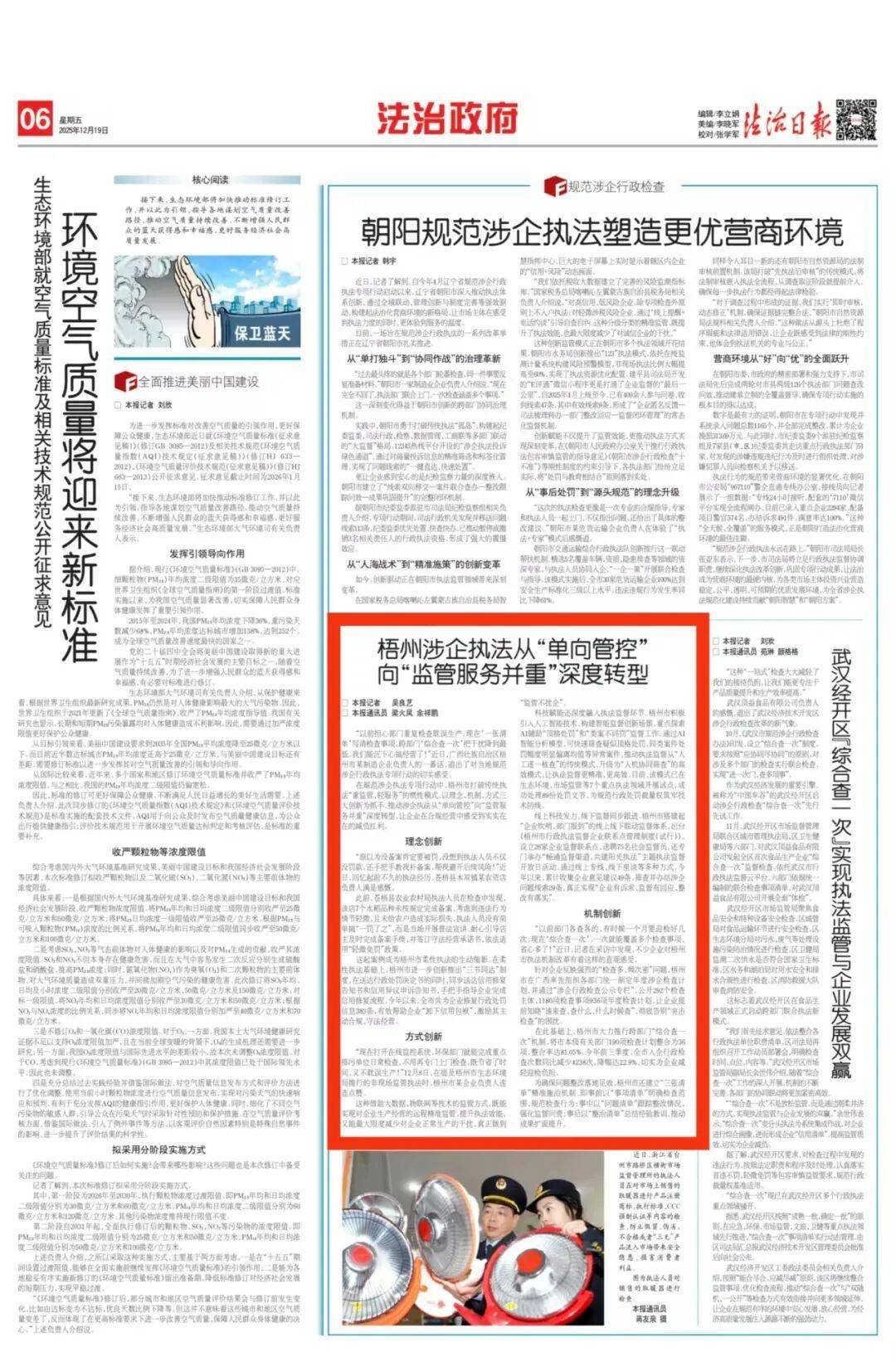
梧州涉企执法从“单向管控”向“监管服务并重”深度转型
Sou Hu Cai Jing· 2025-12-19 09:31
Group 1 - The article discusses the ongoing efforts in China to improve air quality standards and the implementation of stricter regulations to protect public health [3][4][5] - The revised air quality standards aim to reduce the annual average concentration of PM2.5 to 25 micrograms per cubic meter by 2030, with current levels in many cities exceeding this target [4][5] - The new standards will be implemented in phases, with the first phase starting in 2028 and the second phase in 2031, focusing on various pollutants including PM2.5 and nitrogen oxides [5][6] Group 2 - The article highlights the importance of public participation and transparency in the air quality improvement process, emphasizing the need for timely information dissemination regarding air quality [3][4] - It mentions the role of technology in monitoring air quality and enforcing regulations, including the use of AI for analyzing compliance and potential violations [5][6] - The article also points out the challenges faced in aligning domestic air quality standards with international benchmarks, indicating a need for further research and adjustments [5][6]

新华时评|堵住“吃拿卡要”,莫让“微权力”啃食企业利益
Xin Hua She· 2025-12-17 16:39
Core Viewpoint - The recent case involving administrative law enforcement personnel demanding bribes from small and micro enterprises highlights the urgent need to optimize the business environment and protect the legitimate rights of operating entities [1][2]. Group 1: Case Overview - A case was reported where 16 administrative law enforcement officers were held accountable for soliciting and accepting bribes from multiple small and micro enterprises [1]. - The actions of these officers, who should be guardians of a good business environment, instead created burdens for enterprises and disrupted normal market order [1]. Group 2: Economic Implications - Small and micro enterprises are described as the "capillaries" of the economy, with limited risk tolerance, making them particularly vulnerable to corrupt practices [1]. - Such behaviors not only increase the burden on enterprises but also erode public trust in law enforcement fairness, hindering the smooth circulation of the economy [1]. Group 3: Policy Recommendations - The Central Economic Work Conference emphasized the importance of creating a favorable business environment, which includes combating "micro-corruption" and standardizing law enforcement practices [1]. - Establishing a stable, fair, and transparent legal business environment is crucial for alleviating burdens on enterprises [1]. Group 4: Ongoing Measures - Various measures have been implemented to constrain law enforcement behavior, including the publication of typical cases, establishment of negative lists, and the implementation of "scan to enter enterprises" [2]. - A long-term mechanism combining self-inspection and external supervision is being gradually constructed to reduce the space for "micro-corruption" and enhance the vitality of various operating entities [2].
一财社论:纠治违规异地执法、趋利性执法须久久为功
Di Yi Cai Jing· 2025-11-19 13:15
Core Viewpoint - The recent special action to regulate law enforcement related to enterprises has effectively curbed issues such as illegal cross-regional law enforcement and profit-driven law enforcement, further standardizing law enforcement and supporting high-quality development [1][4]. Group 1: Achievements and Impact - Since the launch of the special action, over 15 billion yuan has been recovered for enterprises by addressing illegal cross-regional law enforcement and profit-driven law enforcement issues [1][3]. - The action has particularly benefited private enterprises, which have been the most affected by these illegal practices [1]. Group 2: Regulatory Improvements - There is a need to sever the profit chain associated with illegal cross-regional and profit-driven law enforcement by transferring penalty revenues from local to central government oversight [1]. - The implementation of the "Regulations on the Jurisdiction of Cross-Provincial Criminal Cases Involving Enterprises" has clarified jurisdictional authority, ensuring that cases are handled by the police in the main crime area [2]. Group 3: Corrective Mechanisms - The Supreme Court has released typical cases for retrial that protect the rights of private enterprises and entrepreneurs, emphasizing principles such as legality and equal protection [3]. - The legal framework allows victims of illegal law enforcement to seek compensation, holding responsible parties accountable through potential disciplinary and criminal penalties [3]. Group 4: Future Directions - Continued efforts are necessary to address illegal law enforcement practices, focusing on root causes, regulatory improvements, corrective measures, and accountability for responsible individuals [4].
我省综合行政执法体制改革取得积极进展
Hai Nan Ri Bao· 2025-11-17 01:07
Core Viewpoint - The comprehensive administrative law enforcement system reform in the province has made significant progress, contributing to the construction of a first-class legal business environment and the development of a free trade port with Chinese characteristics [2][4][5]. Group 1: Reform Achievements - The administrative penalty amount in Haikou City has decreased by 16.03 million yuan year-on-year since 2024, and the number of administrative reviews has dropped by 75%, indicating positive feedback from businesses and the public [2]. - The provincial judicial department has introduced a regulatory framework consisting of one local law and 18 important systems, achieving six unifications in law enforcement matters, procedures, documents, qualifications, equipment, and uniforms, thus establishing a "1+18" regulatory system [2][3]. - The first three quarters of 2025 saw a 3.89% loss rate in administrative litigation for municipal and county law enforcement departments, marking the best performance since the reform [3]. Group 2: Implementation Strategies - The provincial judicial department has developed action plans with 13 specific measures to enhance law enforcement management, institutional improvement, business training, and daily supervision [3]. - A digital approach has been adopted to strengthen regulatory enforcement collaboration, including the implementation of online transfer rules for regulatory enforcement clues, ensuring full-process management and control [4]. - The integration of the reform's institutional mechanisms into a unified administrative law enforcement platform has begun, enhancing transparency and efficiency in law enforcement processes [4]. Group 3: Future Directions - The provincial judicial department aims to deepen cross-sector and cross-departmental comprehensive administrative law enforcement reforms, focusing on industry regulation and overall coordination [5][6]. - Emphasis will be placed on institutional integration and innovation to achieve unified authority and efficiency in regulatory enforcement services, aligning with the development of the free trade port [6].
司法部曝光一地设罚款指标,罚没收入遭严监管出现下滑
Di Yi Cai Jing· 2025-10-13 03:23
Core Viewpoint - The national confiscation and penalty income has decreased by 4.3% year-on-year in the first half of this year, prompting the government to strengthen regulatory measures to curb local governments' impulse to increase penalty income through improper means [4]. Group 1: Regulatory Measures - The Ministry of Justice has exposed a case where a local government set mandatory monthly targets for administrative penalties, which led to a uniform pattern of penalties across various towns [1]. - The State Council has issued guidelines to prohibit the setting of penalty targets, emphasizing that such practices undermine the seriousness and authority of administrative law enforcement [1][2]. - Since March, a nationwide campaign has been launched to regulate administrative law enforcement, focusing on issues that businesses have strongly reported [2]. Group 2: Financial Context - Local fiscal revenue, particularly tax revenue, has been under pressure due to economic downturns, tax reductions, and a sluggish real estate market, leading some localities to engage in excessive fines and penalties to compensate for revenue shortfalls [2][3]. - The national confiscation and penalty income, which includes various forms of fines and confiscated assets, constitutes about 10% of non-tax revenue and has a relatively low share in local general public budget income [4].
广州开展涉企行政执法监督检查重点纠治扰企突出问题
Zhong Yang Ji Wei Guo Jia Jian Wei Wang Zhan· 2025-09-12 00:56
Core Insights - The article highlights the increased transparency and accountability in administrative law enforcement for businesses in Guangzhou, particularly in the Huadu District, where issues of corruption and misconduct among enforcement personnel have been addressed [1][2][3]. Group 1: Administrative Oversight and Enforcement - The Guangzhou Municipal Commission for Discipline Inspection and Supervision has initiated a series of measures to tackle corruption and misconduct in grassroots administrative law enforcement, resulting in the investigation of 489 corruption and misconduct cases and the handling of 648 individuals, with 256 receiving disciplinary actions this year [2]. - The Huadu District has seen a focus on addressing issues such as "eating, taking, and demanding" among enforcement personnel, with 170 individuals investigated and 110 cases filed over the past two years [2]. - The introduction of a "bright code" system for administrative inspections aims to enhance transparency, allowing businesses to verify the credentials of enforcement personnel through a digital platform [5]. Group 2: Case Studies and Specific Incidents - A specific case involved an enforcement officer in Huadu who was found to have accepted benefits from a management service company while improperly promoting their services to local businesses, leading to disciplinary action against the officer [1]. - In Tianhe District, an enforcement officer was penalized for using excessive inspection frequency to pressure a property management company into compliance with a rental project, demonstrating the ongoing issues of misconduct in administrative enforcement [3]. Group 3: Systematic Improvements and Recommendations - The Guangzhou Municipal Commission has issued 47 disciplinary recommendations and has pushed for the establishment of 34 new regulations to improve administrative law enforcement practices [4]. - The Huadu District has developed 17 new administrative enforcement regulations, including guidelines for auxiliary personnel, to standardize enforcement practices and improve operational efficiency [4].
安阳蹚出乡镇(街道)综合行政执法改革新路径 导师帮带助基层治理出实效
He Nan Ri Bao· 2025-09-11 23:39
Core Viewpoint - The article discusses the implementation of comprehensive administrative law enforcement reforms in Anyang, which empowers grassroots towns and streets with enforcement authority, enhancing local governance efficiency [2][4]. Group 1: Reform Implementation - The provincial government approved Anyang's initiative to reform administrative law enforcement at the grassroots level, allowing local authorities to address issues like street management and rural construction violations independently [2]. - Within 20 days of the approval, Anyang issued a plan that allocated 64 administrative penalties across six major areas to 96 towns and streets, aiming to resolve the challenges of visible but unmanageable enforcement [2][3]. Group 2: Training and Capacity Building - Anyang's strategy includes simplifying professional enforcement knowledge into accessible formats, such as "pocket books" that summarize enforcement processes and legal points for easy reference by enforcement personnel [3]. - A "mentor-apprentice" system was established to provide hands-on training for over 1,000 grassroots enforcement "apprentices," ensuring they quickly become proficient in their roles [3]. Group 3: Enforcement Effectiveness - Since the reforms began, Anyang's towns and streets have conducted approximately 99,800 administrative enforcement actions and processed 5,840 administrative penalty cases, achieving "zero litigation and zero review" [3]. - The city has implemented a comprehensive monitoring system for enforcement activities, including encrypted information handling and real-time oversight of enforcement processes [3]. Group 4: Future Directions - Anyang plans to focus on modern urban governance by integrating enforcement teams, matters, supervision, and platforms to ensure that grassroots enforcement is empowered, capable, and responsive [4].