
公募基金自购

Search documents
“真金白银”表态!基金公司自购潮再起
证券时报· 2025-05-28 23:58
Core Viewpoint - Recent announcements of self-purchases by multiple public funds demonstrate confidence in the market through substantial financial commitments [1][2][6]. Group 1: Self-Purchase Activities - Several public funds have actively engaged in self-purchase activities, with notable examples including Bosera Fund investing 10 million yuan in its equity funds and Harvest Fund contributing over 50 million yuan to its ETF [3][4]. - Other funds such as Xinhua Fund and Anxin Fund have also made significant self-purchases, indicating a strong belief in the capital market [3][4]. Group 2: Support for New Products - The self-purchases are primarily directed towards newly launched products, reflecting confidence in their future performance and the fund companies' research capabilities [2][5]. - New funds have become a key focus for public fund self-purchases, with a significant proportion of self-purchase activities in the first quarter of this year directed towards newly issued funds, particularly index funds [5][7]. Group 3: Long-term Commitment - Public fund self-purchases are seen as a manifestation of long-term investment philosophy, with companies using their own capital to support their products, thereby reinforcing the alignment of interests between fund managers and investors [6][7]. - This behavior not only enhances liquidity and stability of the funds but also serves as a signal to the market, encouraging investors to hold quality assets for the long term [5][7].

年内公募自购权益产品超18亿元
Zheng Quan Ri Bao· 2025-05-28 16:17
Group 1 - The core viewpoint of the articles highlights the trend of public fund companies in China investing their own funds into their equity funds, reflecting confidence in the long-term stability and health of the capital market [1][2] - Both Bosera Fund Management and Dongfanghong Asset Management announced plans to invest 10 million yuan each into their respective equity funds, signaling a commitment to aligning interests with investors [1] - The self-purchase behavior of public fund companies is seen as a significant measure to enhance investor confidence, with over 260 instances of self-purchases recorded this year, resulting in a net subscription amount of 1.885 billion yuan for equity funds [1] Group 2 - In the self-purchase of stock funds, index products dominate, accounting for approximately 80% of the total net subscription amount, with passive index and enhanced index funds attracting 725 million yuan and 91 million yuan respectively [2] - Among the 70 public institutions that self-purchased equity products this year, 50 had net subscription amounts exceeding 50 million yuan, with ICBC Credit Suisse Fund leading at 397 million yuan [2] - The recent regulatory framework introduced by the China Securities Regulatory Commission emphasizes the importance of self-purchases and long-term performance metrics, encouraging more fund companies to invest their own capital [2]
“真金白银”表态!基金公司自购潮再起
券商中国· 2025-05-28 13:39
Core Viewpoint - The recent surge in public fund self-purchases reflects confidence in the Chinese capital market and aims to stabilize market sentiment amid increased volatility [1][5]. Group 1: Public Fund Self-Purchases - Multiple public funds have announced self-purchases, with significant amounts directed towards newly launched products, indicating confidence in their future performance [1][2]. - On May 28, Bosera Fund announced a self-purchase of 10 million yuan in its equity funds, demonstrating a commitment to the long-term health of the capital market [2]. - Other funds, such as Harvest Fund and Orient Securities Asset Management, have also made substantial self-purchases, reinforcing their belief in the market's potential [2][3]. Group 2: Support for New Products - New funds have become a key focus for public fund self-purchases, with a notable share of self-purchases in the first quarter of this year directed towards newly launched funds [4]. - The self-purchase actions serve as a vote of confidence in the investment value of these products and aim to guide investor expectations [4]. - Public funds' self-purchases can provide essential capital support during the initial phase of new products, enhancing operational efficiency [4]. Group 3: Long-term Commitment - Data from the first quarter shows that several public funds, including China Europe Fund and Yongying Fund, have made significant self-purchases, totaling around 60 million yuan for China Europe Fund alone [5]. - Self-purchases are seen as a reflection of a fund company's overall strength and long-term values, showcasing confidence in their research capabilities and risk management [5]. - This practice not only strengthens the alignment of interests between fund managers and investors but also helps improve liquidity and stability of fund operations [5].
公募年内斥资78亿元自购 权益类基金占比逾两成
Shen Zhen Shang Bao· 2025-05-27 06:00
Core Insights - Dongfanghong Asset announced a plan to invest 10 million yuan of its own funds into the Dongfanghong Core Value Mixed Securities Investment Fund to promote high-quality development in the public fund industry [1] Group 1: Fund Subscription Statistics - As of May 27, 104 public fund institutions have conducted 2,164 subscriptions this year, with a total net subscription amount of 7.831 billion yuan [1] - Equity funds received 208 subscriptions, with a net subscription amount of 1.782 billion yuan, accounting for 22.76% of the total [1] - Money market funds emerged as the main type of self-purchase, with 1,799 subscriptions and a net subscription amount of 4.234 billion yuan, representing 54.07% [1] - Bond funds followed with 65 subscriptions and a net subscription amount of 1.216 billion yuan, accounting for 15.53% [1] - Stock and mixed funds had similar self-purchase scales, with stock funds receiving 134 subscriptions and a net subscription amount of 1.021 billion yuan (13.03%), while mixed funds had 133 subscriptions and a net subscription amount of 864 million yuan (11.03%) [1] Group 2: Detailed Fund Performance - Within stock funds, index products dominated, with passive index funds (0.725 billion yuan) and enhanced index funds (0.091 billion yuan) accounting for approximately 80% [2] - In the bond fund category, medium- to long-term pure bond products performed well, with a net subscription amount of 0.594 billion yuan, making up nearly half of that category [2] - Among the 104 public funds that implemented self-purchases, 34 funds had net subscription amounts exceeding 50 million yuan [2] - Specifically, 10 funds had net subscriptions between 5 million and 9.9 million yuan, 20 funds had net subscriptions between 1 million and 4.99 million yuan, and 4 funds had net subscriptions exceeding 5 million yuan [2] - Jingshun Great Wall Fund led with 145 self-purchases and a net subscription amount of 1.350 billion yuan, while China Europe Fund followed with 185 self-purchases and a net subscription amount of 1.229 billion yuan [2]
年内百余家公募自购533次!货币基金净申购金额占比近六成
Huan Qiu Wang· 2025-05-09 02:38
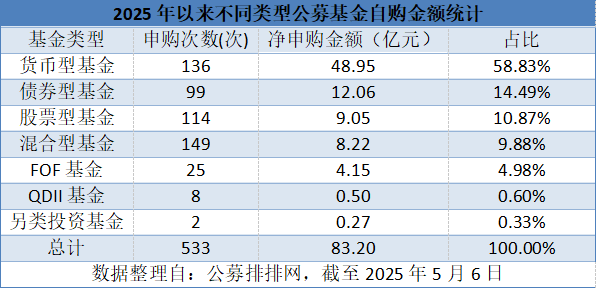
Group 1 - Public funds have been actively purchasing their own products, indicating confidence in the long-term stability of the Chinese capital market [1][3] - Anxin Fund announced a minimum investment of 20 million yuan, with fund managers contributing at least 5 million yuan, totaling a minimum of 25 million yuan for the Anxin Preferred Value Mixed Securities Investment Fund [1] - Fuguo Fund also declared a similar investment strategy, committing at least 20 million yuan from the company and 5 million yuan from fund managers, totaling a minimum of 25 million yuan for the Fuguo Balanced Investment Mixed Securities Investment Fund [3] Group 2 - As of May 7, a total of 103 public fund institutions have made 533 self-purchases, with a net subscription amount reaching 8.32 billion yuan [3] - Money market funds have been the most popular choice for public institutions, with 136 self-purchases and a net subscription amount of 4.895 billion yuan, accounting for 58.83% of the total self-purchase amount [3] - Bond funds followed closely, with 99 self-purchases and a net subscription amount of 1.206 billion yuan, representing 14.49% of the total [3] - Equity and mixed funds have similar self-purchase amounts, with 114 and 149 self-purchases respectively, and net subscription amounts of 905 million yuan and 822 million yuan, accounting for 10.87% and 9.88% of the total [3] - Other fund types, including FOF, QDII, and alternative investment funds, also saw self-purchases with net subscription amounts of 415 million yuan, 50 million yuan, and 2.7 million yuan respectively [3]

又有两家公募,官宣自购!
天天基金网· 2025-05-08 05:10
Core Viewpoint - The recent self-purchase actions by public fund companies, such as 富国基金 and 摩根基金, reflect confidence in their investment management capabilities and serve as a positive signal to investors [2][9]. Group 1: 富国基金's Self-Purchase - On May 6, 富国基金 announced a self-purchase of at least 25 million yuan for its 富国均衡投资混合型证券投资基金, with the company and senior management contributing at least 20 million yuan and the proposed fund manager contributing at least 5 million yuan [3][4]. - The proposed fund manager, 范妍, has a strong background in investment analysis and has achieved a return of 1.40% since October 2022, with a net value increase of 2.71% this year [4]. - The fund's scale increased from 520 million yuan at the end of Q3 2022 to 7.461 billion yuan at the end of Q1 2023, representing a growth of over 13 times [4]. Group 2: 摩根基金's Self-Purchase - On April 30, 摩根基金 announced a self-purchase of at least 54 million yuan for its new equity public fund, with 30 million yuan allocated to the 摩根中证A500增强策略ETF [5]. - The 摩根中证A500增强策略ETF is designed to enhance returns through a quantitative multi-factor model and aims to meet the dual needs of flexible trading and return enhancement for investors [5]. - The total scale of passive index and enhanced index funds linked to the 中证A500 index reached 256.3 billion yuan by March 31, 2025, indicating its growing significance in the A-share market [6]. Group 3: Overall Market Self-Purchase Trends - As of May 6, 114 fund companies have collectively self-purchased over 108 billion yuan in their funds this year, with money market funds accounting for the majority at approximately 103.79 billion yuan [8]. - In April alone, several fund companies, including 安信 and 博时, engaged in self-purchases totaling 4.94 billion yuan, demonstrating a widespread trend among fund managers to invest in their own products [8]. - The self-purchase behavior of public funds not only stabilizes market confidence but also conveys a message of shared risk and reward between fund managers and investors [9].
公募基金接连出手自购,年内已豪掷逾80亿元
Sou Hu Cai Jing· 2025-05-08 01:10
Group 1 - Two public funds announced self-purchases of their new equity funds shortly after the May Day holiday, indicating confidence in the long-term stability of the Chinese capital market [1][2] - Anxin Fund committed at least 25 million yuan to subscribe to the Anxin Preferred Value Mixed Fund, which will be available for sale on May 12, with a minimum holding period of one year [1] - The fund manager, Zhang Ming, has a strong track record, with his previous fund achieving a cumulative return of 120% since its inception in March 2017, significantly outperforming the CSI 300 Index [1] Group 2 - Fuguo Fund also announced a self-purchase of at least 25 million yuan for the Fuguo Balanced Investment Mixed Fund, which will be managed by new hire Fan Yan [2][3] - Since joining Fuguo Fund, Fan Yan has significantly increased the scale of the Fuguo Steady Growth Mixed Fund, which grew from 520 million yuan to 7.461 billion yuan within a year [3] Group 3 - Public funds have collectively made self-purchases exceeding 8.32 billion yuan in 2025, with 103 institutions participating in 533 transactions [4] - Money market funds are the primary focus of these self-purchases, accounting for 58.83% of the total amount, followed by bond funds at 14.49% [4] - Equity and mixed funds have seen similar self-purchase amounts, with 9.05 billion yuan and 8.22 billion yuan respectively, while other fund types like FOF and QDII also saw self-purchases [4]
又有两家公募,官宣自购!
券商中国· 2025-05-07 04:56
Core Viewpoint - The recent self-purchase actions by public fund companies, such as FuGuo Fund and Morgan Fund, reflect confidence in their investment management capabilities and serve as a positive signal to investors [2][3][5]. Group 1: FuGuo Fund's Self-Purchase - FuGuo Fund announced a self-purchase of at least 25 million yuan for its balanced investment mixed securities fund, with contributions from the company and its senior management [3][4]. - The fund manager, Fan Yan, has a strong track record, with a return of 1.40% since October 2022 and a net asset value increase of 2.71% this year [4]. - The fund's scale increased significantly from 520 million yuan at the end of Q3 last year to 7.461 billion yuan at the end of Q1 this year, representing a growth of over 13 times [4]. Group 2: Morgan Fund's Self-Purchase - Morgan Fund plans to invest at least 54 million yuan in its newly launched equity public fund, with 30 million yuan allocated to the Morgan CSI A500 Enhanced Strategy ETF [5][6]. - The CSI A500 Enhanced Strategy ETF is designed to leverage a quantitative multi-factor model to select stocks, aiming for higher returns and better trading flexibility for investors [5]. - The total market size of passive index and enhanced index funds linked to the CSI A500 index reached 256.3 billion yuan as of March 31, 2025, indicating its growing importance in the A-share market [6]. Group 3: Overall Market Self-Purchase Trends - As of May 6, 2023, 114 fund companies have collectively purchased over 108 billion yuan in their own funds this year, surpassing the 100 billion yuan mark [7]. - The majority of self-purchases were in money market funds, totaling approximately 103.79 billion yuan, while equity funds saw self-purchases of 9.27 million yuan [8]. - The self-purchase actions by various fund companies, including Anxin and CCB Fund, demonstrate a commitment to market stability and a shared risk-reward approach with investors [8].
又有两家公募官宣自购;公募基金总规模站稳32万亿元丨天赐良基
Mei Ri Jing Ji Xin Wen· 2025-05-06 02:06
Group 1 - Yu Haichun has been appointed as the new chairman of Huafu Fund, succeeding Zhao Wanli who left due to work adjustments. Yu has 34 years of experience in the securities industry [1] - Morgan Fund announced an investment of no less than 54 million RMB in its newly launched equity public fund, demonstrating confidence in the long-term potential of the Chinese capital market [2] - Fangzheng Fubon Fund will invest 5 million RMB of its own funds in the Fangzheng Fubon CSI All Share Free Cash Flow ETF, also committing to hold for at least one year [2] Group 2 - As of March 2025, the total net asset value of public funds in China reached 32.22 trillion RMB, with 163 fund management institutions [3] - In March, various types of funds saw net subscriptions, with stock funds reaching 3.4 trillion shares, a 1.29% increase from the previous month [3] - QDII funds experienced the highest subscription activity in March, with a 3.57% increase in shares, totaling 562.68 billion shares [3] Group 3 - Over 70% of actively managed equity funds have increased their holdings in Hong Kong stocks, with a total market value increase of 98.25 billion RMB in the first quarter, reaching a three-year peak [4] - The average allocation to Hong Kong stocks among these funds rose to 25.79%, the highest level in five years [4] Group 4 - Wanminyuan has slightly reduced its holdings in Dongfang Biology, with the number of shares held decreasing from 4.71 million to 4.22 million in the first quarter of 2025 [5] - The fund managed by Wanminyuan is identified as the Rongtong Health Industry Fund [5] Group 5 - The Yi Nuo Si company has seen an increase in holdings by the Zhongou Medical Health Mixed Fund managed by Ge Lan, which now holds 403,100 shares, up from 99,500 shares at the end of the previous year [7] - Yi Nuo Si specializes in providing comprehensive R&D services for high-quality innovative drugs in the biopharmaceutical sector [7] Group 6 - On April 30, the market showed mixed performance, with the Shanghai Composite Index down 0.23% and the Shenzhen Component Index up 0.51% [8] - The total trading volume in the Shanghai and Shenzhen markets reached 1.17 trillion RMB, an increase of 147.2 billion RMB from the previous trading day [8] - AI-related ETFs in the Sci-Tech Innovation Board saw significant gains, while bank stocks collectively adjusted downwards [8]