
公募基金自购

Search documents
2025年公募自购3375亿创纪录,非货产品净申购87亿
Sou Hu Cai Jing· 2026-01-05 11:21
Core Insights - The public fund industry demonstrated strong confidence in the capital market by investing a record amount in self-purchases, totaling 337.51 billion yuan in 2025, significantly surpassing the previous year's 109.53 billion yuan [1][2]. Group 1: Self-Purchase Trends - In 2025, 118 fund companies executed 7,491 self-purchases, with a total transaction amount reaching 337.51 billion yuan, marking a historical high [1]. - The structure of self-purchases shifted notably, with non-monetary products becoming the focus, achieving a net subscription scale of 8.70 billion yuan, compared to 3.51 billion yuan in 2024 [2]. - Bond funds emerged as the mainstay of self-purchases, with a net subscription amount of 4.21 billion yuan, reflecting a year-on-year increase of over 227% [2]. Group 2: Product Preferences - Index products gained popularity, with passive index bond funds and mixed equity funds leading in self-purchase amounts [3]. - E Fund's index products received a self-purchase amount of 1.80 billion yuan, while several other index products also exceeded 100 million yuan in self-purchases [3]. - A total of 22 public fund managers had net subscription amounts exceeding 1 billion yuan, with Invesco Great Wall Fund leading at 2.77 billion yuan [3]. Group 3: Market Outlook for 2026 - Multiple public fund institutions expressed optimism for 2026, anticipating a more balanced market style driven by corporate earnings and liquidity [4]. - The market is expected to avoid extreme styles, with cyclical and value sectors poised for opportunities amid policy support [4]. - Analysts suggest that investors should focus on sectors benefiting from supply-side reforms and those with strong dividend capabilities, while also considering technology growth sectors despite potential volatility [5].

年内公募非货自购金额近百亿元 债券型基金稳居自购主力地位
Zheng Quan Shi Bao Wang· 2025-12-16 02:57
Group 1 - The core viewpoint of the articles highlights a significant surge in public fund self-purchases in 2025, with net subscription amounts reaching 9.876 billion yuan, a 163.08% increase compared to 3.754 billion yuan in 2024 [1] - Bond funds remain the primary driver of self-purchases, with net subscriptions of 4.211 billion yuan, accounting for 42.65% of total net subscriptions, marking a 272.65% increase from 1.130 billion yuan in the previous year [1] - Mixed funds have shown a notable recovery, achieving net subscriptions of 2.155 billion yuan, a significant turnaround from a net redemption of 0.512 billion yuan in 2024 [1] Group 2 - The positive policy environment and optimistic market expectations are key factors driving the self-purchase enthusiasm among public funds, as institutions aim to convey confidence and solidify investment strategies [2] - Regulatory guidance and improved industry mechanisms have deepened the alignment of interests between fund managers and investors, making self-purchase a more institutionalized and normalized practice [2] - The overall recovery of the A-share market and intensified industry competition have increased investor willingness to enter the market through public funds, prompting fund managers to enhance brand trust and product appeal through self-purchases [2] Group 3 - The self-purchase behavior of fund managers during market fluctuations sends a positive signal, directly expanding fund asset sizes and boosting investor confidence, which can lead to a virtuous cycle of capital inflow [3] - Fund managers' actual investment actions demonstrate their confidence in the capital market, which can uplift market sentiment and encourage more investments [3] - This "knowledge-action unity" in investment behavior allows companies to share in long-term market growth benefits while driving research and investment teams to focus more on performance improvement [3]
“强制跟投”影响几何?年内公募已豪掷42亿自购股混基金
2 1 Shi Ji Jing Ji Bao Dao· 2025-12-10 13:20
Core Viewpoint - The newly proposed "Guidelines for Performance Assessment and Compensation Management of Fund Management Companies" aims to materialize the principle of "prioritizing the interests of investors" through a series of reforms in compensation management within the fund industry [1][2]. Group 1: Key Changes in Compensation Management - The new guidelines enhance the "follow investment" (跟投) requirements for fund managers and executives, mandating that they invest a significant portion of their performance-based compensation into the funds they manage [1][4]. - Specifically, fund executives must invest at least 30% of their total performance compensation in their company's public funds, with at least 60% of that in equity funds. Fund managers are required to invest at least 40% of their performance compensation in the funds they manage, subject to certain exceptions [4][5]. - Compared to the previous guidelines from 2022, the new rules have increased the follow investment requirements for key personnel, which were previously set at 20% for executives and 30% for fund managers [5]. Group 2: Impact on Industry Practices - The guidelines are expected to reverse the short-term incentive trends in the fund industry, thereby deeply binding the interests of fund managers with those of investors, promoting stable operations and sustainable development within the industry [2][6]. - The requirement for a minimum holding period of one year for follow investments is anticipated to prevent aggressive strategies aimed at short-term rankings, enhancing product stability and investor experience [5][6]. - The increase in self-purchase activities by public funds, which reached a net purchase amount of 4.211 billion yuan in 2025, reflects a growing confidence in the long-term prospects of the capital market and the fund's research capabilities [7][8]. Group 3: Trends in Self-Purchase Activities - In 2025, public funds significantly increased their self-purchase of stocks and mixed funds, with net purchases amounting to 4.211 billion yuan, a 165% increase compared to the previous year [7][8]. - The self-purchase behavior of fund companies has shown a preference for flexible mixed funds and passive index funds, indicating a strategic focus on long-term investments and stability during market fluctuations [10][11]. - Major fund companies, including ICBC Credit Suisse, Guotai Junan, and Yongying Fund, have led in self-purchase amounts, with several companies exceeding 300 million yuan in net purchases [9][10].
年末公募自购热情升温 真金白银支持权益市场
Shang Hai Zheng Quan Bao· 2025-11-30 18:29
Group 1 - Public fund net subscriptions for equity funds reached 2.1 billion yuan in November, with total net subscriptions exceeding 4.5 billion yuan for the year, more than double the amount from the same period last year [1][3] - Fund managers are increasingly purchasing their own funds, demonstrating confidence in the market and aligning their interests with investors [1][2] - The trend of self-purchase by fund companies is rising, with significant amounts being invested in newly launched equity funds, indicating a strategic move to enhance brand exposure and attract external investments [2][3] Group 2 - Three factors contributing to the increase in self-purchase include regulatory changes, strong market performance, and industry dynamics [3][4] - The China Securities Regulatory Commission's new guidelines have encouraged self-purchase behavior among public funds, making it a more normalized practice [3] - The performance of equity funds has been strong, with stock fund indices rising over 25% this year, further motivating fund managers to invest in their own products [3][4]
公募机构加速自购权益基金,超26亿元资金买了什么
Di Yi Cai Jing· 2025-08-26 13:22
Group 1 - The core viewpoint of the articles highlights the accelerated self-purchase actions by public fund institutions in the A-share market, indicating a strong confidence in the capital market's recovery and growth potential [1][2][4] - In August, public fund institutions have collectively announced self-purchases exceeding 3.29 billion yuan, with notable contributions from firms like Huatai Securities Asset Management and Southern Fund [2][3] - The net subscription amount for equity funds by institutions in the third quarter has reached 6.11 billion yuan, a 30% increase compared to the previous quarter, indicating a significant uptick in market participation [1][3][5] Group 2 - The self-purchase actions are characterized by a commitment to hold investments for at least one year, reflecting a long-term investment strategy rather than a short-term market rescue [2][3][4] - A total of 127 fund managers have reported net subscription amounts exceeding 109.2 billion yuan, with equity funds alone surpassing 26.49 billion yuan, indicating a robust interest in equity investments [5][6] - The articles note that over 97% of the equity products purchased have yielded positive returns this year, with several funds significantly outperforming their benchmarks [5][6] Group 3 - The self-purchase trend is seen as a response to the current market conditions, where institutions are expressing confidence in the long-term opportunities rather than reacting to market downturns [7][8] - Regulatory encouragement from the China Securities Regulatory Commission has also played a role in promoting self-purchases among public funds, aiming for high-quality development in the industry [8] - Despite the positive signals from self-purchases, industry experts caution that these actions should not be interpreted as direct buy signals for investors, emphasizing the need for careful judgment [9]

年内已有127家公募机构启动自购权益基金
Zheng Quan Ri Bao· 2025-08-25 16:12
Group 1 - The core viewpoint of the articles highlights the trend of public fund institutions actively purchasing their own equity products to convey confidence in the market and their investment capabilities [1][2][3] - Huatai Securities Asset Management announced plans to invest up to 32 million yuan of its own funds into its equity public funds, with a holding period of no less than one year, reflecting a commitment to long-term investment [1] - The public fund industry has seen a significant increase in self-purchases, with 127 public fund institutions initiating self-purchases this year, and equity funds making up a substantial portion of these investments [2] Group 2 - The positive market environment, characterized by low valuations in the A-share market, is driving public fund institutions to recognize the long-term value of equity assets [2] - Policy initiatives, such as the "Action Plan for Promoting the High-Quality Development of Public Funds," are encouraging institutions to increase their investments in their own products [2] - Self-purchase actions by public fund institutions are expected to boost market confidence, align interests with investors, and promote the sustainable development of the public fund industry [3]
公募基金机构掀起自购热
Jing Ji Ri Bao· 2025-08-23 00:20
Group 1 - The core viewpoint of the article highlights a surge in self-purchase activities by public fund institutions, driven by policy guidance, market valuation recovery, and industry transformation, reflecting confidence in their investment research capabilities and market prospects [1][2][3] - As of August 21, over 130 public fund companies have initiated self-purchases totaling over 5 billion yuan, with equity fund products, particularly stock and mixed funds, making up a significant portion of this amount [1] - The China Securities Regulatory Commission's action plan encourages self-purchases of equity funds, enhancing the scoring criteria for long-term performance and stability, which has contributed to the self-purchase trend [1][2] Group 2 - Market confidence has significantly improved, with the A-share market showing a positive trend, as evidenced by the continuous rise of the Shanghai Composite Index [2] - The current valuation of China's stock market is considered attractive, with the price-to-earnings ratios of the CSI 300 and Hang Seng Index being 13.73 and 11.46, respectively, both lower than major mature markets [2] - Equity funds are seen as having long-term allocation value, especially when market valuations are low, providing greater long-term return potential [2][3] Group 3 - The self-purchase trend is viewed as a necessary choice for industry transformation, enhancing the alignment of interests between investors and fund managers, and injecting long-term stability into the capital market [3] - Self-purchases are expected to alleviate selling pressure and repair valuations, particularly in the context of improving economic recovery expectations, thus attracting long-term capital into the market [3] - While self-purchases are a positive signal, investors are advised to approach them with caution, considering the underlying logic of the products and the capabilities of fund managers [3]
今年以来公募基金自购呈现新特点
Zheng Quan Shi Bao Wang· 2025-08-15 23:39
Group 1 - The core viewpoint of the article highlights the significant increase in public fund self-purchases in 2023, with over 130 fund companies announcing self-purchase plans totaling more than 5 billion yuan [1] - Nearly half of the self-purchased products are stock and equity-oriented funds, indicating a strong interest in these types of investments [1] - Notably, Southern Fund has announced a self-purchase plan of 230 million yuan, entirely allocated to stock ETFs, with several funds committing to hold their purchases for no less than one year [1] Group 2 - The trend of large-scale self-purchases in stock funds, coupled with a voluntary lock-in period of over one year, is unprecedented and warrants attention from investors [1]
又一家自购破亿!年内公募豪掷自购权益类基金,“真金白银”流向哪些产品?
Sou Hu Cai Jing· 2025-08-13 16:25
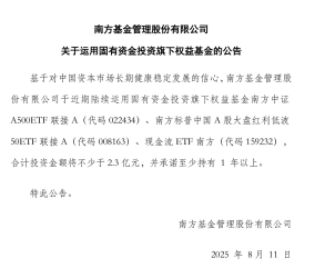
Group 1 - Southern Fund announced an investment of no less than 230 million yuan in its products, including Southern CSI A500 ETF and Southern S&P China A-share Large Cap Dividend Low Volatility ETF, with a holding period of at least one year [1] - This marks the second public fund this year to conduct a single round of self-purchase exceeding 100 million yuan [1] - In April, Jianxin Fund also announced an investment of no less than 180 million yuan in its equity public fund products [3] Group 2 - Multiple public funds have joined the self-purchase of equity products in the second half of the year, with ICBC Credit Suisse Fund and Taikang Fund also announcing their respective investments [3] - As of August 12, the net subscription amount for public fund self-purchases in equity products has exceeded 2.7 billion yuan this year [3] - Leading funds in net subscription amounts include Tianhong Fund, ICBC Credit Suisse Fund, Huatai-PB Fund, and Guotai Fund [3] Group 3 - The top 10 public fund self-purchase amounts for equity products show significant investments from Tianhong Fund, with the highest being 1.39999 billion yuan in Tianhong Hang Seng Shanghai-Shenzhen Hong Kong Innovative Drug Selection 50 ETF [4] - Other notable funds include ICBC Modern Service Industry Fund and Tianhong Cultural Emerging Industry Fund, with net subscription amounts of 999.90 million yuan and 1 billion yuan respectively [4] - The collective self-purchase by public funds reflects confidence in their products and is influenced by supportive policies [5]
公募基金年内自购“申赎清单”:谁受宠?谁被弃?
3 6 Ke· 2025-08-12 11:19
Core Viewpoint - The recent surge in public fund self-purchases reflects a growing confidence in the Chinese capital market, with significant investments occurring as the market heats up rather than at traditional low points [1][2][3]. Fund Self-Purchase Trends - Southern Fund announced a self-purchase of at least 230 million yuan in its equity funds, demonstrating a strong commitment to the market [2]. - Other fund companies, including Huashang Fund and Dachen Fund, have also engaged in substantial self-purchases, indicating a broader trend of confidence among fund managers [4]. - The self-purchase trend is characterized by a focus on newly launched products, suggesting a promotional aspect alongside genuine market optimism [4]. Self-Purchase and Redemption Data - In the first half of the year, 126 fund managers engaged in self-purchases totaling 243.07 billion yuan, while 114 fund managers executed redemptions amounting to 133.42 billion yuan [5]. - The net self-purchase amount for public funds was 109.66 billion yuan, with non-monetary products contributing 5.25 billion yuan [6]. - Debt funds led the net self-purchase category with 2.83 billion yuan, while equity funds followed with 1.32 billion yuan [7]. Specific Fund Performance - Notable self-purchases included Tianhong Fund's equity products, which saw over 100 million yuan in self-purchases [7]. - Mixed funds also experienced significant self-purchases, with several funds exceeding 100 million yuan in net self-purchases [7]. - In contrast, certain funds faced significant redemptions, highlighting a mixed sentiment in specific segments of the market [8].