农信系统改革

Search documents
又见国有大行出手!中小银行合并潮持续
券商中国· 2025-10-15 04:41
Group 1 - The core viewpoint of the articles highlights the ongoing consolidation of rural commercial banks by major state-owned banks in China, indicating a trend towards the restructuring of the banking sector [1][2][3] - Agricultural Bank of China has acquired 102 rural commercial bank outlets in Jilin province, transforming them into its branches, which reflects a strategic move to expand its network [2][3] - The consolidation includes not only rural commercial banks but also village banks, with Agricultural Bank of China participating in multiple acquisitions throughout the year, enhancing its branch presence [3][5] Group 2 - In addition to Agricultural Bank, other major banks like Industrial and Commercial Bank of China and Bank of Communications have also engaged in acquiring village banks, with a total of 5 village banks being acquired and converted into 11 branches [5][6] - The restructuring of rural banks is expected to continue, with weaker institutions likely facing elimination as the market undergoes a significant reshuffle [1][7] - The reform in Sichuan province involves the merger of 12 county-level rural commercial banks, indicating a deeper push towards unifying and strengthening the local banking system [7][8]



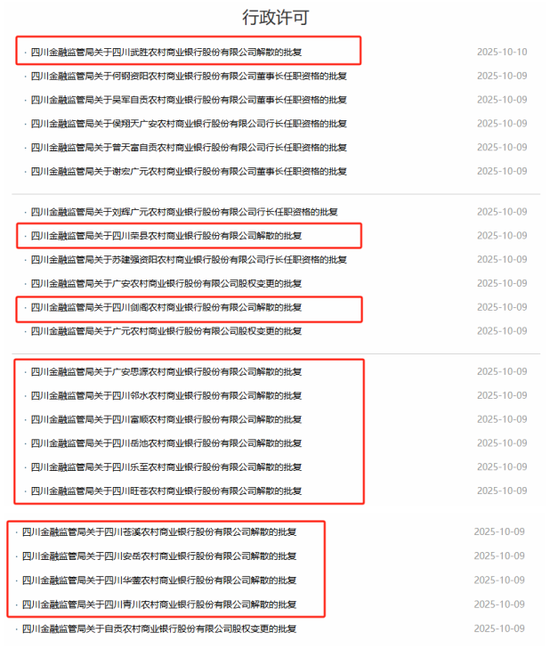
四川农信改革进入深水区!13家县级农商行解散
Xin Lang Cai Jing· 2025-10-13 01:13
Core Viewpoint - The Sichuan Financial Regulatory Bureau has approved the dissolution of 13 county-level rural commercial banks, with four city-level banks inheriting all their business, assets, debts, and rights. This reform aims to enhance the control and risk management of the rural financial system in Sichuan [1][2][3]. Group 1: Dissolution and Inheritance - Thirteen county-level rural commercial banks, including Wusheng, Rongxian, and Jiange, have been approved for dissolution due to absorption and merger, with their operations being taken over by four city-level banks [3][7]. - The city-level banks involved are: - Zigong Rural Commercial Bank, which will absorb Rongxian and Fushun banks - Ziyang Rural Commercial Bank, which will absorb Lezhi and Anyue banks - Guangyuan Rural Commercial Bank, which will absorb Jian'ge, Wangcang, Cangxi, and Qingchuan banks - Guang'an Rural Commercial Bank, which will absorb Guang'an Siyuan, Linshui, Yuechi, Huaying, and Wusheng banks [7][8]. Group 2: Governance and Management Changes - The Sichuan Financial Regulatory Bureau has approved the qualifications of the chairpersons and presidents for the newly formed banks, ensuring a swift establishment of new governance structures [8][10]. - Specific appointments include: - He Gang and Su Jianqiang as chairman and president of Ziyang Rural Commercial Bank - Wu Jun and Zeng Tianfu as chairman and president of Zigong Rural Commercial Bank - Xie Hong and Liu Hui as chairman and president of Guangyuan Rural Commercial Bank - Hou Xiangtian as president of Guang'an Rural Commercial Bank [8][10]. Group 3: Involvement of Sichuan Rural Commercial Union Bank - Sichuan Rural Commercial Union Bank has played a significant role in the reform by optimizing the shareholding structure of Zigong, Guangyuan, and Guang'an banks through share transfers and new subscriptions [10][11]. - After the mergers, Sichuan Rural Commercial Union Bank will hold 22.76% of Zigong Rural Commercial Bank, 14.61% of Guangyuan Rural Commercial Bank, and 16.02% of Guang'an Rural Commercial Bank, enhancing its control over these institutions [10][11][13]. Group 4: Reform Pathway and Implications - The reform follows an "upward participation and downward integration" model, where the provincial bank leads the integration of county resources, reducing management layers and improving fund allocation efficiency [1][18]. - This model is seen as a low-risk and manageable approach, with similar implementations in other provinces like Shanxi and Guangxi [18][19].
农信系统改革稳步推进 河南农商行吸收合并82家机构
Xin Lang Cai Jing· 2025-09-30 00:33
Core Insights - The core viewpoint of the news is that Henan Rural Commercial Bank has officially absorbed and merged 82 institutions, marking a significant step in the reform of the rural credit system in Henan Province [1][9]. Summary by Sections Announcement of Merger - On September 28, Henan Rural Commercial Bank announced the approval from the National Financial Supervision Administration of Henan to absorb and merge 82 institutions, including rural commercial banks and village banks from nine cities [1][2]. Implications of the Merger - This merger is seen as a crucial measure in the ongoing reform of the rural credit system, reflecting the "one province, one policy" approach and the practice of a unified legal entity model [1][9]. Details of the Merger - Following the merger, Henan Rural Commercial Bank will inherit all assets, liabilities, businesses, personnel, branches, and other rights and obligations of the absorbed institutions, with existing customer accounts and services remaining unchanged [3]. Historical Context of Reforms - The reform of the rural credit system in Henan has been gradual, with previous adjustments including the approval of a reform plan in 2022 and the establishment of Henan Rural Commercial Bank in 2023 [4][5]. Shift in Reform Strategy - The reform strategy has shifted from a "joint bank" model to a "unified legal entity" model, which is more comprehensive and suitable for provinces with fewer legal entities [7][8]. Broader Trends in Other Provinces - Other provinces, such as Xinjiang and Gansu, are also transitioning from a joint bank model to a unified legal entity model, indicating a broader trend in the reform of rural credit systems across China [8][9].
河南农商银行一次性“并表”9地82家机构 金融资源整合提速
2 1 Shi Ji Jing Ji Bao Dao· 2025-09-28 11:56
Core Viewpoint - The merger of 82 rural commercial banks and village banks into Henan Rural Commercial Bank marks a significant step in the reform of the rural financial system in Henan Province, aiming to consolidate financial resources and enhance risk management capabilities [2][3]. Group 1: Merger Details - Henan Rural Commercial Bank has officially absorbed and merged 82 rural commercial banks and village banks across nine cities, inheriting all assets, liabilities, and operations of these institutions [2]. - This merger is the first major public consolidation since the establishment of Henan Rural Commercial Bank in February 2025, reflecting a shift towards a unified legal entity under the "one province, one policy" reform strategy [2][3]. - The new entity will enhance its asset scale and service capacity, supporting agriculture, small enterprises, and county economies more effectively [3]. Group 2: Historical Context and Transition - The reform process has evolved from a "joint bank" model to a "provincial rural commercial bank" model, with the latter emphasizing centralized management [3]. - The establishment of Henan Rural Commercial Bank was part of the provincial government's key tasks for financial reform, with a registered capital of approximately 29.25 billion and total assets of 2.58 trillion [3]. Group 3: Challenges and Solutions - The merger presents challenges, particularly concerning the high non-performing loan rates of some merged institutions, which will require focused asset management [4]. - Strategies for addressing these challenges include utilizing local Asset Management Companies (AMCs) for asset disposal and potential capital supplementation through special bonds issued by local governments [4][5]. - Establishing a unified risk control system, enhancing training and assessment, and promoting digital transformation are essential for a smooth transition [5].
破解发展困局,为省级农商银行组建铺路农商银行受让区域内同业股权藏深意
Zheng Quan Ri Bao· 2025-09-27 15:51
Core Viewpoint - The recent approval of share transfers between rural commercial banks in Xinjiang signifies a strategic move towards enhancing collaboration among small financial institutions, facilitating the establishment of a unified legal entity for rural commercial banks in the region, and improving the quality and efficiency of agricultural financial services [1][4]. Group 1: Share Transfer Details - The Xinjiang Financial Regulatory Bureau approved the transfer of 91.96 million shares from 285 individual shareholders of Beitun Rural Commercial Bank to Bole Rural Commercial Bank at a price of 1 yuan per share, resulting in Bole holding a 61.31% stake in Beitun [1]. - Bole Rural Commercial Bank also acquired 102.90 million shares from 141 individual shareholders of Bohu Rural Commercial Bank at the same price, leading to a 69.26% ownership [1]. Group 2: Industry Collaboration and Support - The trend of "strong institutions supporting weaker ones" has emerged as a key strategy for overcoming development bottlenecks in the rural financial system, with stronger banks injecting management and risk control capabilities into weaker counterparts [2][3]. - This collaborative model has been successfully replicated in other regions, such as Yunnan, where stronger banks have supported the establishment of new institutions by providing capital and expertise [2]. Group 3: Benefits of the Collaboration Model - The share transfer and collaboration model helps to resolve issues of fragmented ownership and varying shareholder qualifications, enhancing the risk management capabilities of the involved institutions [2][3]. - By optimizing the ownership structure and sharing resources, the model allows for improved operational efficiency and better service delivery to local economies [3]. Group 4: Foundation for Unified Legal Entity - The recent share integration lays the groundwork for the establishment of a unified legal entity for rural commercial banks across Xinjiang, with ongoing reforms aimed at enhancing the overall financial system [4][5]. - The gradual integration approach minimizes potential risks and simplifies the process of forming a provincial-level bank by consolidating numerous small shareholders into a single strategic shareholder [5].
48家发债主体中报延期:审计梗阻、系统改革、经营挑战
2 1 Shi Ji Jing Ji Bao Dao· 2025-09-18 12:21
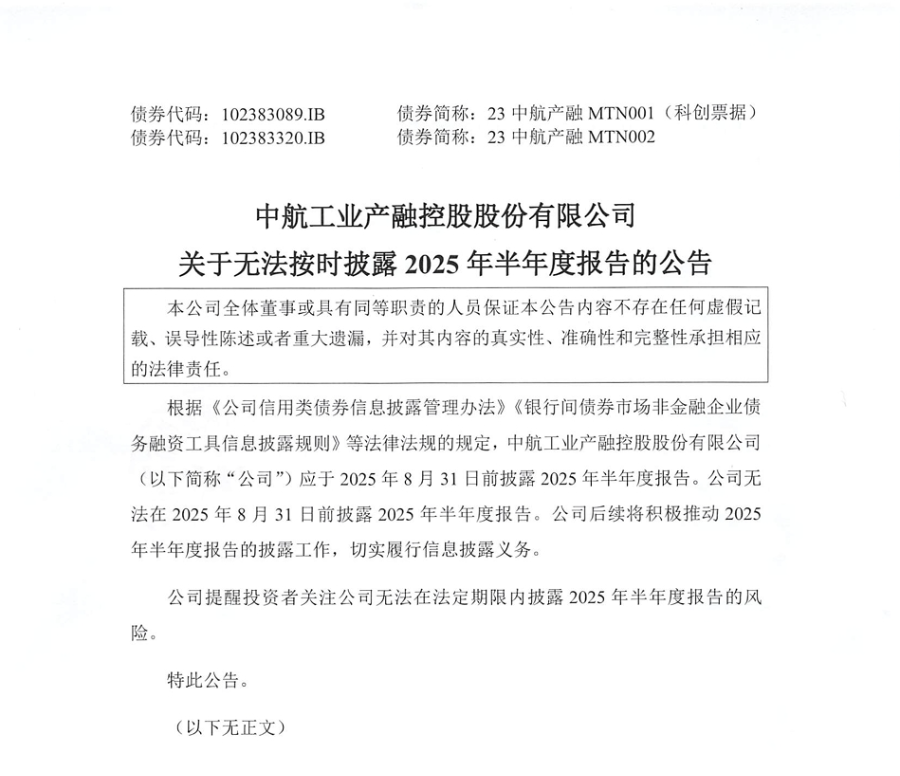
Core Insights - A significant number of bond-issuing companies failed to disclose their semi-annual reports on time, with 48 companies identified, of which 15 cited audit-related issues as a primary reason for the delay [1][2] - The delays are attributed to various factors, including incomplete audits from previous years, management's inability to obtain accurate financial information, and ongoing debt restructuring or bankruptcy processes [1][4] Group 1: Audit-Related Issues - 31.25% of the companies that failed to disclose their reports mentioned audit-related problems, such as incomplete audits from previous years and difficulties in hiring new audit firms [1] - Specific reasons for delays include the need for more time to gather information, financial personnel shortages, and the discovery of issues in financial data that require re-evaluation [1][3] Group 2: Debt Restructuring and Financial Health - 13 out of the 48 companies indicated that they or their affiliates are undergoing debt restructuring, mergers, or bankruptcy processes, contributing to the delays in report disclosures [1][2] - China Minsheng Investment Co., Ltd. announced a delay in its semi-annual report due to ongoing debt restructuring efforts, highlighting the impact of financial health on reporting timelines [2] Group 3: Financial Institutions and Regional Reforms - Several insurance companies, including Baidian Life and Guohua Life, announced delays in their financial report disclosures due to the need for accurate and complete information [3] - Local rural credit systems' reforms are cited as a reason for delays among various rural commercial banks, as they align with provincial planning for financial restructuring [4][5] Group 4: Industry-Specific Challenges - Guanghui Automotive, once a leading car dealer, has faced significant operational challenges leading to delays in both annual and semi-annual report disclosures [6][7] - The company has experienced a loss of manufacturer-authorized dealerships, resulting in management and financial personnel turnover, complicating the audit process [6][7] Group 5: Market Reactions and Future Outlook - The ongoing financial struggles of companies like Guanghui Automotive have raised concerns among investors, particularly following a public default involving significant amounts [6][7] - The financial health of companies undergoing restructuring or facing operational challenges will likely remain under close scrutiny from investors in the upcoming reporting periods [2][4]

全国第七家农商联合银行即将组建
3 6 Ke· 2025-08-04 02:42
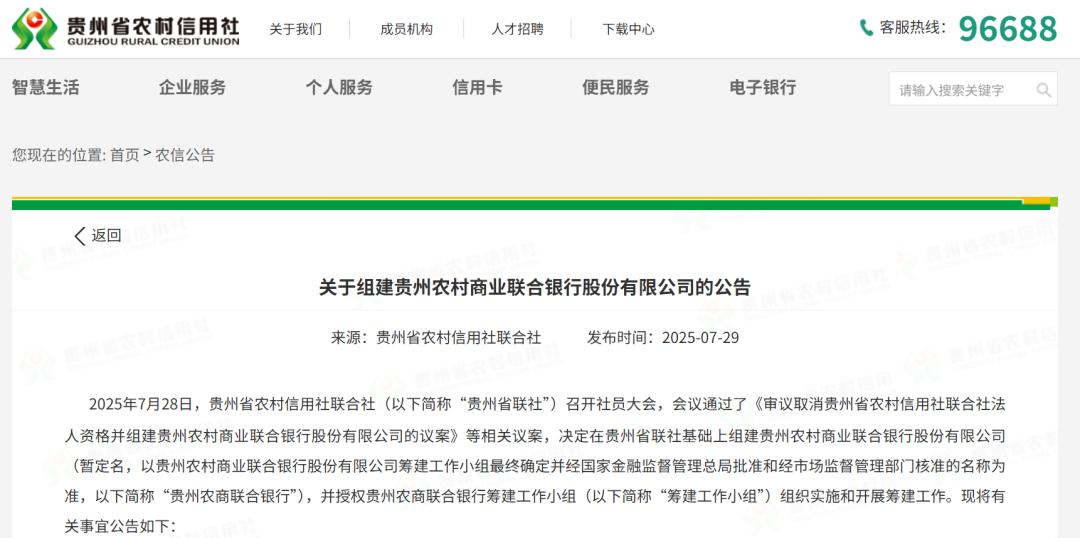
值得一提的是,组建后的贵州农商联合银行也将成为继浙江农商联合银行、山西农商联合银行、广西农商联合银行、四川农商联合银行、江苏农商联合银 行、江西农商联合银行之后,全国的第七家农商行联合银行。 此外,吉林省也获批筹建吉林农商银行,全国各地的农信改革依然在火热进行中。 第七家农商联合银行 和过去六个省的农商联合银行筹建进程一样,贵州农商联合银行成立后,原贵州省联社的业务、资产,以及债权债务等权利义务均由贵州农商联合银行承 接。 官网显示,贵州农信由省联社及所辖84家农商银行(农信联社)组成,营业网点2293个,员工2.8万名,存款突破9229亿元,贷款突破7095亿元,已成为 省内业务规模最大、服务覆盖最广、从业人员最多的银行业金融机构。 | 贵州省农村信用社 | 关于我们 | 成员机构 | 人才招聘 | 下载中心 | | & 客服热线: 96688 | | | --- | --- | --- | --- | --- | --- | --- | --- | | 智慧生活 企业服务 | 个人服务 | | 信用卡 | 便民服务 | 电子银行 | 请输入搜索关键字 | 0 | | 您现在的位置: 首页 > 农信公告 | ...
贵州农信改革重要动向!筹建农商联合银行,这些股东将入股
券商中国· 2025-07-31 13:58
Core Viewpoint - The establishment of the Guizhou Rural Commercial Union Bank is officially underway, aiming to enhance local financial institutions and support rural credit reforms in Guizhou province [1][3]. Group 1: Establishment and Structure - The Guizhou Rural Commercial Union Bank will be formed by canceling the legal status of the Guizhou Rural Credit Cooperative Union and establishing a new joint-stock company [3]. - The new bank will inherit all business, assets, and liabilities from the Guizhou Rural Credit Cooperative Union, pending approval from financial regulatory authorities [3]. - The establishment process will involve hiring qualified intermediaries for asset evaluation and financial audits [3]. Group 2: Financial Performance and Scale - Guizhou Rural Credit has a network of 2,293 branches and over 28,000 employees, with deposits exceeding 922.9 billion and loans surpassing 709.5 billion [4]. - The total assets of Guizhou Rural Credit exceeded 1 trillion, reaching 1,070.45 billion [4]. Group 3: Involvement of State-Owned Enterprises - Guizhou Financial Holding Group and Qiansheng State-owned Assets will play significant roles in the reform process [5][8]. - Guizhou Financial Holding Group, established in December 2016, operates across various financial sectors, including banking and asset management [6]. - Qiansheng State-owned Assets focuses on capital operation management and holds stakes in several companies, enhancing its financial capabilities [7]. Group 4: Reform Models and Trends - The joint bank model is seen as a cost-effective reform that maintains a multi-level governance structure, suitable for provinces with many quality rural commercial banks [9][10]. - The "upward participation" model allows the provincial bank to optimize the equity structure of rural financial institutions, improving governance [10]. Group 5: Broader Context of Rural Bank Reforms - Other provinces, such as Jilin, are also advancing their rural bank reforms, with Jilin Rural Commercial Bank's establishment approved recently [11][12]. - The trend of establishing provincial rural commercial banks is accelerating, with several banks already launched in 2024 [14]. - The Xinjiang region is also working towards establishing a unified rural commercial bank, aiming for completion by 2025 [15].

股本预计400亿元 吉林农商行要来了
经济观察报· 2025-07-29 11:12
Core Viewpoint - The reform of the Jilin rural credit system is making significant progress, with the establishment of the Jilin Rural Commercial Bank expected to enhance its operational strength and support sustainable business development, ultimately reaching a capital of 40 billion yuan [2][5][10]. Group 1: Reform and Financial Support - The Jilin provincial government has issued 260 billion yuan in special bonds to support the development of small and medium-sized banks, with a total of 346 billion yuan allocated for the reform of the Jilin rural credit system [2][5]. - The Jilin Financial Holding Group is investing in the newly established Jilin Rural Commercial Bank to improve its capital adequacy and risk resistance [5][6]. - The special bonds have a 10-year term and an interest rate of 1.76%, marking the first issuance of such bonds in 2025 [6][7]. Group 2: Financial Performance and Market Position - As of the end of December 2023, the total assets of the Jilin rural credit system reached 1,007.24 billion yuan, with total liabilities of 953.59 billion yuan, reflecting increases of 53.77 billion yuan and 57.57 billion yuan respectively [10]. - The balance of various deposits was 790.31 billion yuan, up by 59.76 billion yuan, representing an 8.2% growth, while the balance of loans was 497.29 billion yuan, increasing by 17.45 billion yuan, or 3.6% [10]. - The market shares for deposits and loans in the Jilin rural credit system are 23.3% and 22.3%, respectively, making it the largest in the province [10]. Group 3: National Context and Future Outlook - If the reform proceeds smoothly, the Jilin Rural Commercial Bank may become the tenth provincial-level rural commercial bank established in the country [12]. - The reform model chosen by Jilin is the "unified legal person" model, which aims to consolidate operations and enhance risk management [12][14]. - Other provinces are also advancing their rural credit system reforms, with various models being implemented across the country [11][14].

农信系统“上参下”,江西有了进展!
券商中国· 2025-07-28 23:28
Core Viewpoint - Jiangxi Rural Commercial Bank is advancing its "upward investment and downward support" model, with plans to acquire existing equity in local rural commercial banks, marking a significant step in its operational strategy [1][6]. Group 1: Background and Structure - Jiangxi Rural Commercial Bank was established from the Jiangxi Provincial Federation of Credit Cooperatives and adopted the "upward investment and downward support" model during its formation [2][3]. - The bank aims to enhance governance and risk management across its 85 subordinate rural commercial banks under the leadership of provincial authorities [3][4]. Group 2: Recent Developments - The annual shareholders' meeting of Yushan Rural Commercial Bank will discuss the proposal for Jiangxi Rural Commercial Bank to acquire existing equity, indicating the bank's first move towards investing in local rural banks [6][7]. - Several rural commercial banks in the province, including Yushan, are set to pursue capital increases and expansions, potentially paving the way for Jiangxi Rural Commercial Bank's investments [7]. Group 3: Financial Metrics - As of March 2025, Jiangxi Rural Commercial Bank's total assets across its rural banks reached approximately 1.4 trillion yuan, with deposits and loans exceeding 2.1 trillion yuan, making it the largest local financial institution in terms of network coverage and tax contributions [8]. Group 4: Broader Industry Context - The "upward investment and downward support" model has been implemented in other provinces, such as Guangxi, Sichuan, and Shanxi, where provincial rural commercial banks have begun investing in local rural financial institutions [11][14][17]. - The trend of mergers and restructuring in the banking sector is driven by the need for risk management and operational stability, with various provinces implementing tailored reform strategies [18][19].