司法重整

Search documents
*ST金科重整计划执行完毕 将申请撤销退市风险警示
Zheng Quan Ri Bao Wang· 2025-12-16 14:06
Core Viewpoint - The successful completion of the restructuring plan for *ST Jinke (000656) is expected to restore market confidence and improve the company's financial health, allowing it to apply for the removal of delisting risk warnings from the Shenzhen Stock Exchange [1][2]. Group 1: Restructuring Process - The restructuring process began in May 2023 when the company proposed to apply for restructuring and pre-restructuring [2]. - In February 2024, *ST Jinke officially filed for restructuring, which was accepted by the Chongqing Fifth Intermediate People's Court in April 2024 [2]. - The restructuring investors were finalized in November 2024, with a total investment of 2.628 billion yuan from various parties, including Shanghai Pinqi Management Consulting Co., Ltd. and Beijing Tianjiao Lvyuan Real Estate Development Co., Ltd. [2]. Group 2: Financial and Operational Improvements - The completion of the restructuring plan is expected to significantly improve the company's asset-liability structure and enhance its core competitiveness and profitability [3]. - The restructuring is projected to have a positive impact on the company's financial status in 2025, with specific amounts to be determined by audited financial statements [3]. Group 3: Industry Implications - The restructuring of *ST Jinke serves as a reference for the real estate industry in addressing challenges and finding new pathways for risk resolution [4]. - The case demonstrates that large real estate companies can effectively mitigate risks through judicial restructuring, providing a replicable success model for the industry [4][6]. - The company plans to restructure its business model around four key areas: investment management, development services, operational management, and special assets, incorporating technology and innovative practices [4].

房企最大重整案完成!金科股份卸下千亿债务负担
Nan Fang Du Shi Bao· 2025-12-16 06:25
历时两年半,全国首家大型上市房企司法重整案顺利完成。 12月15日,金科股份发布《关于公司及控股子公司重整计划执行完毕的公告》。公告称,经管理人监督 报告及律师事务所法律意见书确认,公司及重庆金科重整计划均已执行完毕。这标志着金科股份成为全 国首家通过司法重整实现风险化解的千亿级上市房企。 根据重整计划,重整投资人共计26.28亿元的投资款已全额支付到位;破产费用、职工债权及普通债权 对应的清偿资金均已支付或完成专项预留;通过资本公积转增的约52.94亿股股票已转增并划转至指定 账户;破产服务信托合同、资产管理协议已正式签署并生效。后续,公司将持续推进偿债资源分配等收 尾工作,确保债权人公平受偿。 值得关注的是,在金科股份发布上述公告后,金科股份(*ST金科)的股价早盘涨停。 历时两年半完成重整 据公开信息显示,金科股份最早于2023年5月提出主动向法院申请重整及预重组的设想,同年7月31日, 金科股份董事会与监事会审议通过相关议案,同意公司向有管辖权的人民法院申请重整及预重整;2024 年2月21日,金科股份以不能清偿到期债务且明显缺乏清偿能力为由,正式向法院提交破产重整申请。 2024年4月22日,重庆市 ...

房企司法重整第一股诞生!涉及债务规模达1470亿元,债权人数量超8400家,金科股份历时两年半完成重整
Mei Ri Jing Ji Xin Wen· 2025-12-16 04:30
每经记者|陈利 每经编辑|陈柯名 陈梦妤 根据重整计划,重整投资人共计26.28亿元投资款已全额支付到位;破产费用、职工债权及普通债权对应的清偿资金均已支付或完成专项预留;通过资本 公积转增的约52.94亿股股票已转增并划转至指定账户;破产服务信托合同、资产管理协议已正式签署并生效。后续,公司将持续推进偿债资源分配等收 尾工作,确保债权人公平受偿。 官网截图 12月15日晚间,金科股份发布《关于公司及控股子公司重整计划执行完毕的公告》。公告称,经管理人监督报告及律师事务所法律意见书确认,公司及重 庆金科重整计划均已执行完毕,重整工作终于画上圆满句号。这标志着金科股份成为全国首家通过司法重整实现风险化解的"千亿级"上市房企。 历时两年半完成司法重整 金科股份的重整之路可追溯至2023年5月,彼时公司提出了主动向法院申请重整及预重组的设想。 但直到2024年2月,金科股份才正式向法院申请重整,两个月后被重庆市第五中级人民法院(以下简称重庆市五中院)裁定受理。 此后金科股份收到了中金资本联合体、长城国富置业、深圳招商平安资管等12家意向重整投资人的报名材料,且所有重整投资人均缴纳了保证金。 令人意外的是,2024年 ...
重整计划执行完毕!这家公司涨停!
Zheng Quan Ri Bao Wang· 2025-12-16 04:04
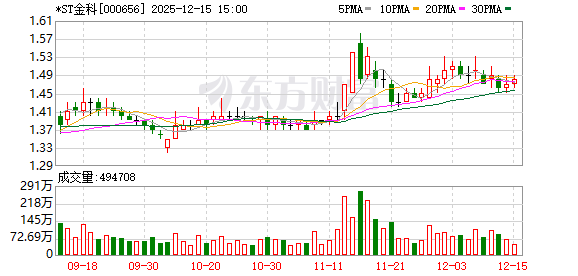
12月16日,*ST金科(000656)股价开盘大幅拉升,最终封于涨停,最新股价报1.55元/股,市值164.8亿 元。12月12日、12月15日、12月16日,该个股股价已连续三个交易日持续上涨,累计涨幅6.16%。 12月15日晚间,*ST金科发布《关于公司及控股子公司重整计划执行完毕的公告》。公告称,经管理人 监督报告及律师事务所法律意见书确认,公司及控股子公司重庆金科房地产开发有限公司(以下简 称"重庆金科")重整计划均已执行完毕。 回顾重整历程,2024年4月份,*ST金科及重庆金科的重整申请被重庆市第五中级人民法院正式裁定受 理。如今,重整计划执行完毕,标志着公司成为全国首家通过司法重整实现风险化解的上市房企,步入 发展新阶段。 根据公司发布的《金科地产集团股份有限公司重整计划》执行情况的监督报告,重整投资人共计26.28 亿元投资款已全额支付到位。 *ST金科在公告中披露,公司及重庆金科的司法重整工作得到了重庆市委、市政府高度重视,专门成立 金科工作专班,会同法院、监管部门对公司进行了必要的、持续的、系统性的督促和指导。在重整程序 中,公司及重庆金科通过引入重整投资人、实施出资人权益调整、争取债 ...
房企重整第一股诞生 金科股份顺利完成司法重整
Mei Ri Jing Ji Xin Wen· 2025-12-15 15:33
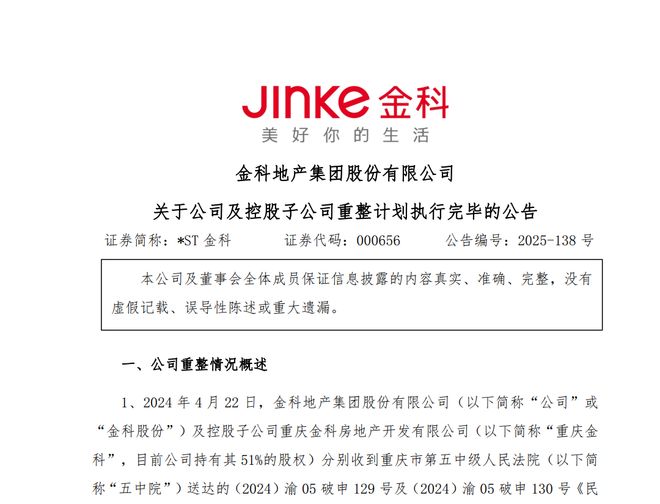
12月15日晚间,金科股份发布《关于公司及控股子公司重整计划执行完毕的公告》。公告称,经管理人 监督报告及律师事务所法律意见书确认,公司及重庆金科重整计划均已执行完毕,重整工作终于画上圆 满句号。这标志着金科股份成为全国首家通过司法重整实现风险化解的"千亿级"上市房企。 根据重整计划,重整投资人共计26.28亿元投资款已全额支付到位;破产费用、职工债权及普通债权对 应的清偿资金均已支付或完成专项预留;通过资本公积转增的约52.94亿股股票已转增并划转至指定账 户;破产服务信托合同、资产管理协议已正式签署并生效。后续,公司将持续推进偿债资源分配等收尾 工作,确保债权人公平受偿。 历时两年半完成重整 金科股份的重整之路可追溯至2023年5月,彼时公司提出了主动向法院申请重整及预重组的设想。 但直到2024年2月,金科股份才正式向法院申请重整,两个月后被重庆市第五中级人民法院(以下简称 重庆市五中院)裁定受理。 5月11日,重庆金科第二次债权人会议表决通过草案。同时,重庆市五中院裁定批准金科股份及重庆金 科的重整计划并终止重整程序,正式进入执行环节。 如今,经过7个月的执行,金科股份重整计划顺利完成。 事实上,对陷 ...
金科重整案,中国房地产风险化解的成功样本
Jin Rong Jie· 2025-12-15 14:02
历时两年半,全国首家大型上市房企司法重整案顺利完成。 12月15日晚间,金科股份发布《关于公司及控股子公司重整计划执行完毕的公告》。公告称,经管理人 监督报告及律师事务所法律意见书确认,公司及重庆金科重整计划均已执行完毕,重整工作终于画上圆 满句号。这标志着金科股份成为全国首家通过司法重整实现风险化解的千亿级上市房企。 据了解,根据重整计划,重整投资人共计26.28亿元的投资款已全额支付到位;破产费用、职工债权及 普通债权对应的清偿资金均已支付或完成专项预留;通过资本公积转增的约52.94亿股股票已转增并划 转至指定账户;破产服务信托合同、资产管理协议已正式签署并生效。后续,公司将持续推进偿债资源 分配等收尾工作,确保债权人公平受偿。 通过"司法重整+战投赋能+业务转型"的创新模式,金科在保障8400余家债权人权益的同时,还为行业 风险化解与金融稳定提供了一个具有里程碑意义的范本。 风险化解履责担当,开创多方共赢新格局 对社会与行业而言,金科重整成功证明了通过市场化、法治化纾困的可行性,为困境企业提供了可复制 的完整操作范本,对稳定市场预期、推动行业探索发展新模式起到了示范作用。 对金科自身而言,重整是一次根 ...
“沉痛打击”!“法国工业象征”之一破产,自明日起无法支付工资
Mei Ri Jing Ji Xin Wen· 2025-12-14 10:41
Core Viewpoint - Brandt, a renowned French appliance manufacturer, has been officially placed into judicial liquidation, marking the end of its operations and putting approximately 700 employees at risk of unemployment [1][3][10] Group 1: Company Background - Brandt was founded in 1902 and has over a century of brand history, entering the home appliance market in 1946 [3] - The company was the largest home appliance manufacturer in France and the fourth largest high-end appliance brand in Europe as of 2020 [3] - Brandt operates in 36 countries and regions, with an annual revenue of €260 million [8] Group 2: Recent Developments - The Nanterre Commercial Court's decision to liquidate Brandt was met with sadness from the French Ministry of Economy and Finance, and it was described as a "painful blow" to French industry [3][10] - Despite efforts to implement a cooperative takeover plan, the court did not approve it, and the company is projected to be unable to pay salaries after December 15 [10] Group 3: Market Challenges - Brandt has faced severe financial difficulties due to declining sales linked to a sluggish real estate market and competition from foreign brands and smaller kitchen appliances favored by younger consumers [8][10] - The situation reflects the increasing difficulty for the home appliance industry in France and Europe to remain competitive against low-cost products [10]
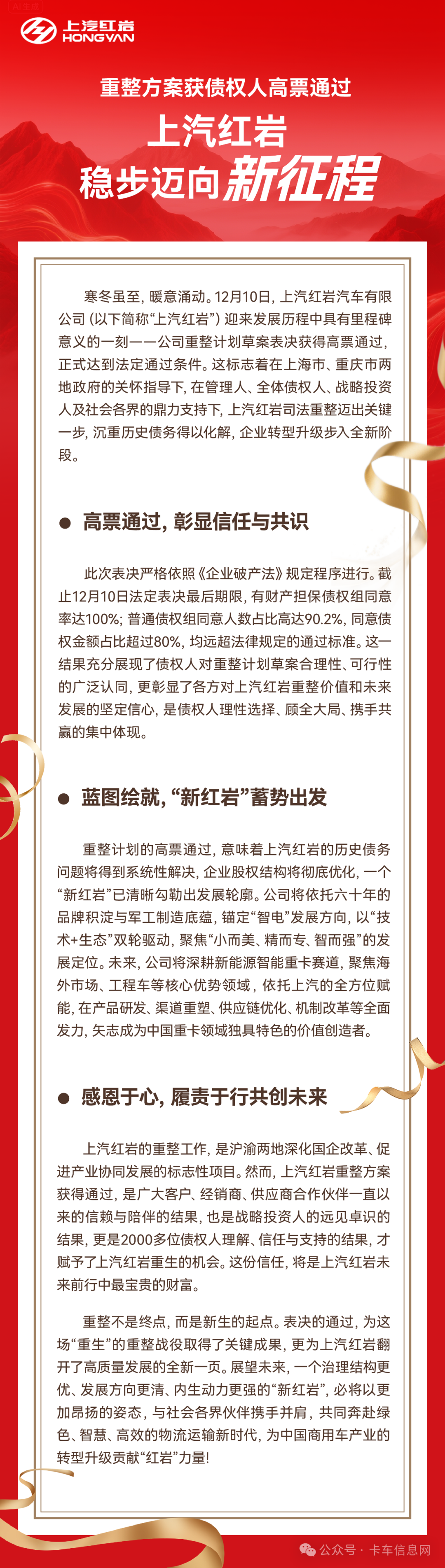
上汽红岩重整方案高票通过!
Xin Lang Cai Jing· 2025-12-11 10:10
Core Viewpoint - The judicial restructuring plan of SAIC Hongyan has received overwhelming support from creditors, marking a significant step towards alleviating the company's historical debt burden and enabling a fresh start for the enterprise [1][10]. Group 1: Voting Results and Consensus - The restructuring plan was approved with a 100% consent rate from the secured creditors and over 90.2% from the ordinary creditors in terms of the number of agreeing parties, with over 80% in terms of the amount of debt [2][7][14]. - This high level of support reflects the creditors' recognition of the plan's reasonableness and feasibility, showcasing a collective trust in the future development of SAIC Hongyan [7][14]. Group 2: State-Owned Capital and Structural Reshaping - The restructuring is driven by a joint investment of 3 billion yuan (approximately 0.46 billion USD) from a consortium led by Shanghai Automotive Industry Corporation and Chongqing Liangjiang New Area Industry Development Group, which will acquire 66% of the restructured company [3][11]. - The remaining 34% of the equity will be held by creditors through a debt-to-equity swap, indicating a shift towards a mixed-ownership model that integrates capital and resources from both Shanghai and Chongqing [3][11]. Group 3: Future Development Plans - The company aims to focus on "smart electric" development, adopting a dual-driven strategy of "technology + ecology," and positioning itself as "small yet beautiful, precise yet bright, intelligent yet strong" [4][15]. - Future business strategies will concentrate on overseas markets and traditional strengths in engineering vehicles, supported by comprehensive empowerment from the SAIC Group in product development, supply chain, and channel restructuring [4][15]. Group 4: Challenges Ahead - Despite the successful restructuring, the company faces significant challenges as the heavy truck market in China has entered a phase of intense competition, with projected sales around 900,000 units in 2025 [12]. - The ability to translate the restructuring plan into tangible market competitiveness and profitability will be crucial for the company's revival [12].
中国工业母机之光沈阳机床,做完一场大手术
经济观察报· 2025-11-30 06:39
Core Viewpoint - The article discusses the successful restructuring of Shenyang Machine Tool Co., highlighting the role of China International Capital Corporation (CICC) in facilitating the judicial reorganization process, which alleviated nearly 50 billion yuan of debt and attracted strategic investors [3][4][17]. Group 1: Background and Challenges - Shenyang Machine Tool, established in the 1930s, faced severe financial difficulties by 2019, including high debt ratios and operational challenges, leading to its judicial reorganization [2][3]. - The company was once a leader in the machine tool industry, achieving 18 billion yuan in revenue in 2011, but fell into continuous losses post-2015, prompting government intervention [6][11]. Group 2: Restructuring Process - CICC was appointed as the financial advisor for the restructuring project, opting for judicial reorganization over a negotiated agreement to effectively manage the debt [7][8]. - The restructuring involved a layered approach, addressing 12 legal entities and utilizing various methods such as cash settlements, debt extensions, and debt-to-equity swaps, achieving a 94% approval rate for the restructuring plan [8][12]. Group 3: Post-Reorganization Developments - Following the restructuring, strategic investor China General Technology Group injected substantial capital to restore production and improve financial health, focusing on upgrading products and operations [11][12]. - The company has since shifted towards high-end machine tools, implementing smart manufacturing technologies that significantly enhance operational efficiency [13][17]. Group 4: Broader Impact and Future Plans - CICC has facilitated over 800 billion yuan in funding for distressed enterprises in Northeast China, preserving approximately 65,000 jobs and restructuring debts totaling 800 billion yuan [17]. - The company aims to replicate the successful restructuring model across various industries in the region, establishing a strong presence and support system for local enterprises [17].



中金“操盘” 百年机床厂化债重生
Jing Ji Guan Cha Wang· 2025-11-30 03:30
Core Viewpoint - The article discusses the restructuring of Shenyang Machine Tool Co., which faced significant financial difficulties, including a debt burden of nearly 50 billion yuan, and how it successfully navigated through judicial reorganization with the help of China International Capital Corporation (CICC) and strategic investor China General Technology Group [2][3][5]. Group 1: Company Background and Challenges - Shenyang Machine Tool, established in the 1930s, has a rich history in the machine tool industry, producing significant machinery for China [2]. - By 2011, the company achieved revenues of 18 billion yuan, becoming a leader in the global machine tool industry, but faced continuous losses and a debt crisis after 2015 [5]. - In 2019, the company entered judicial reorganization due to high debt ratios, lack of operating funds, and increasing risks of debt defaults [2][5]. Group 2: Restructuring Process - CICC was appointed as the financial advisor to assist in selecting the optimal restructuring plan and attracting strategic investors [2][6]. - The restructuring involved a judicial process that allowed for systematic debt restructuring and reduced burdens for the acquiring party, China General Technology Group [6][8]. - The restructuring plan was approved with a 94% average approval rate, ensuring the interests of creditors were protected [8]. Group 3: Strategic Investment and Operational Changes - After the restructuring, China General Technology Group injected billions into Shenyang Machine Tool to restore production and repay debts [10]. - The company underwent significant operational changes, including the separation of non-core assets and the implementation of performance-based compensation for employees [10][12]. - The introduction of smart manufacturing technologies has significantly improved operational efficiency, allowing fewer workers to manage more machines [12]. Group 4: Broader Implications and Future Outlook - CICC has been involved in multiple restructuring projects in Northeast China, helping to introduce over 80 billion yuan in new funds and safeguard 65,000 local jobs [15]. - The successful restructuring of Shenyang Machine Tool serves as a model for other distressed enterprises in the region, with CICC planning to replicate this approach in future projects [15][16].