
实物再通胀

Search documents
华创策略姚佩:3500以上的新趋势:增量资金、高低切、中盘成长占优
Sou Hu Cai Jing· 2025-08-03 23:42
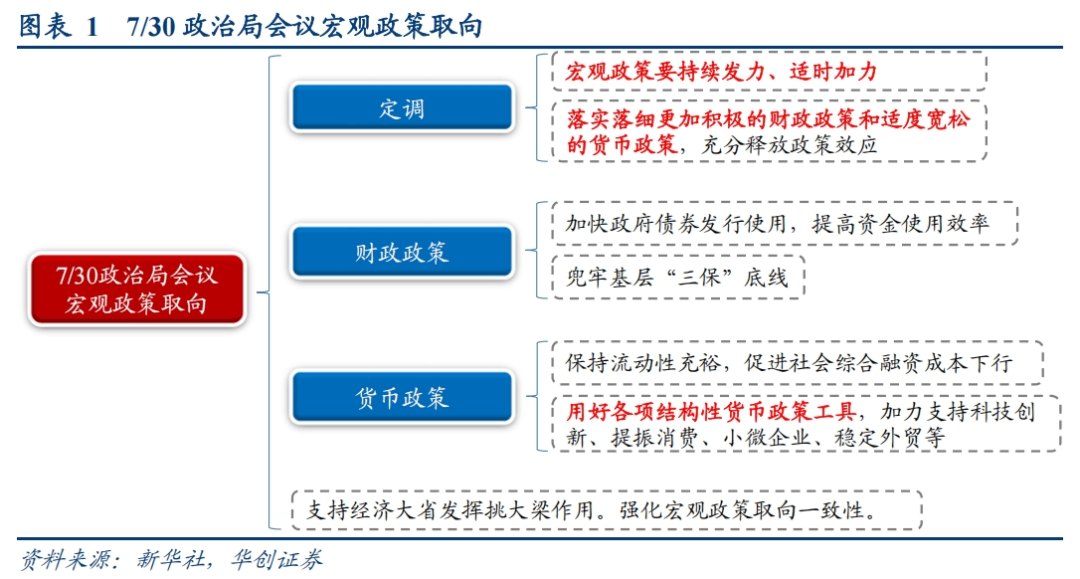
Core Viewpoint - The economic cycle is improving as M1 and PPI turn positive, indicating a recovery in EPS, with a focus on three key sectors: cyclical resources, growth industries with high earnings expectations, and leading consumer manufacturers [3][4][38]. Group 1: Policy and Market Trends - The July Politburo meeting provides a stabilizing factor for the bull market, emphasizing that policy stability is beneficial for market conditions [4][7]. - The shift from total quantity increase to structural optimization suggests that supply-side adjustments may precede demand stimulation [4][7]. - The bull market is expected to transition from financial re-inflation to real asset re-inflation, supported by excess savings and declining cash asset yields [4][7]. Group 2: Capital Inflows and Market Performance - Significant capital inflows are observed, with margin financing and active equity funds contributing to a surge in trading volume, leading to a new high in the A-share market [11][24]. - The Shanghai Composite Index reached a closing price of 3616, marking a new high since January 2022, with a notable increase in trading volume [11][13]. - The proportion of leveraged funds in A-share trading has risen from 8.6% to 10.7%, indicating increased market participation [11][15]. Group 3: Sector Performance and Investment Focus - The cyclical resource sector is highlighted as a potential leader, with low valuation levels and positive price expectations due to government policies [24][43]. - Growth industries such as biopharmaceuticals and electronics are expected to see significant earnings growth, driven by technological advancements and policy support [25][44]. - Leading consumer manufacturers are positioned to benefit from real asset re-inflation, with a focus on companies with low valuations and strong cash flow generation [44][45].

策略周聚焦:如何看银行与微盘新高
Huachuang Securities· 2025-05-18 11:13
Group 1 - The report highlights that global stock indices have recovered to levels prior to the tariff shocks on April 2, with significant rebounds observed across major economies [10][11][18] - The domestic market is currently facing a contradiction between liquidity-driven valuation recovery and the downward pressure on earnings due to tariff impacts, with liquidity being the dominant factor in the short term [2][29][31] - The report anticipates a range-bound market in the second quarter, with limited potential for upward or downward breakthroughs, influenced by state support and the need for fundamental and policy developments [3][41][50] Group 2 - The investment strategy maintains a focus on financial re-inflation in the first half of the bull market, advocating for a "barbell" allocation of dividend stocks and small-cap growth [4][51][52] - The banking sector is expected to benefit from increased allocations due to public fund reforms and the entry of long-term capital, positioning banks favorably as creditors compared to private debtors in a low-price environment [4][52] - Dividend assets are highlighted for their stable cash flow generation and shareholder returns, with a focus on sectors such as banking, ports, highways, non-ferrous metals, liquor, and telecommunications [5][51]