
幼儿园收费政策

Search documents
国家发展改革委 教育部 财政部关于完善幼儿园收费政策的通知 发改价格〔2025〕1644号
蓝色柳林财税室· 2025-12-23 14:23
Core Viewpoint - The article discusses the recent notification issued by the National Development and Reform Commission, the Ministry of Education, and the Ministry of Finance regarding the improvement of kindergarten charging policies, emphasizing the public welfare nature of preschool education and the need for standardized fee structures and management practices [1][2]. Group 1: Standardization of Charging Items - Kindergarten charging items include care education fees, accommodation fees, service fees, agency fees, and care fees for toddlers in classes [3]. - Care education fees refer to the costs for providing preschool education, while accommodation fees are for boarding services [3]. Group 2: Classification and Improvement of Charging Management - Public kindergartens and non-profit private kindergartens will have their care education and accommodation fees regulated by government guidance prices, while for-profit private kindergartens will set prices based on market conditions [4][5]. - The management of care fees for toddler classes will refer to the management of care education fees [5]. Group 3: Principles for Setting Charging Standards - Charging standards for non-profit kindergartens should be based on costs after deducting government funding and donations, considering local economic conditions and community affordability [6]. - Service fees should be charged based on cost compensation principles, while agency fees should reflect actual expenditures without profit margins [6]. Group 4: Evaluation and Optimization Mechanism - Local authorities are required to monitor kindergarten fees and conduct regular evaluations of charging management practices, with a review cycle not exceeding three years [7]. Group 5: Establishment of Directory Lists - A directory list for service and agency fees must be established, and any fees not included in the list cannot be charged [8]. Group 6: Strengthening Fee Regulation - Local authorities must guide kindergartens in establishing financial management systems and ensure compliance with charging standards, including prohibiting fees under various pretexts [9]. Group 7: Supporting Measures - Local governments should coordinate financial support and charging policies to enhance the quality of preschool education and ensure the sustainability of kindergartens [10]. Group 8: Implementation and Coordination - Collaboration among local development, education, and finance departments is essential for the effective implementation of the new charging policies [11].


幼儿园收费新规!明年起施行
Xin Lang Cai Jing· 2025-12-23 13:55
Core Viewpoint - The recent notification issued by the National Development and Reform Commission, Ministry of Education, and Ministry of Finance aims to enhance the management of kindergarten fees, ensuring the affordability and quality of preschool education while promoting the development of a supportive policy framework for childbirth [1][2]. Summary by Sections Fee Regulation - The notification specifies five types of fees that kindergartens can charge: care and education fees, accommodation fees, care fees for childcare services, service fees, and agency fees [1]. Fee Management - Public kindergartens and non-profit private kindergartens will have their care and education fees and accommodation fees guided by government pricing, while for-profit private kindergartens will have market-regulated prices for these fees and other service charges [1][2]. Fee Standard Principles - The principles for setting fee standards include considering local economic conditions, community affordability, market demand, institution type, and service type, with government-guided prices based on costs after deducting government funding and donations [2]. Policy Evaluation Mechanism - Local authorities are required to enhance fee monitoring through cost surveys and evaluations, ensuring timely adjustments to fee management policies [2]. Directory Management - A directory management system will be established for kindergarten fees, requiring public disclosure of service and agency fees, with no charges allowed outside the published lists [2]. Regulatory Oversight - Local departments must guide kindergartens in establishing sound financial management systems and set clear requirements for fee standardization and refunds [2]. Future Actions - The National Development and Reform Commission will collaborate with relevant departments to expedite the formulation of local kindergarten fee management methods and ensure the smooth implementation of these policies [2].
三部门完善幼儿园收费政策
Xin Lang Cai Jing· 2025-12-23 13:55
Core Viewpoint - The recent notice issued by the National Development and Reform Commission, Ministry of Education, and Ministry of Finance aims to enhance the accessibility, affordability, and quality of preschool education while reducing the financial burden on families and improving the fertility support policy framework [1][2]. Group 1: Key Aspects of the Notice - The notice emphasizes the public welfare nature of preschool education and outlines six main areas for improvement in fee policies [1]. - It specifies five categories of fees that kindergartens can charge, including care and education fees, accommodation fees, care fees for childcare services, service fees, and agency fees [1]. - Public kindergartens and non-profit private kindergartens will have their fees guided by government pricing, while for-profit private kindergartens will have market-regulated fees [2]. Group 2: Fee Management and Regulation - The principles for setting fee standards include considering local economic conditions, community affordability, market demand, and the nature of the institution [2]. - A mechanism for evaluating and optimizing fee policies will be established, requiring regular assessments of fee management practices and adjustments based on findings [2]. - A directory management system for kindergarten fees will be implemented, ensuring that only fees listed in the directory can be charged, with a focus on transparency [2]. Group 3: Oversight and Implementation - The notice calls for enhanced supervision of fee practices, requiring kindergartens to establish sound financial and asset management systems [2]. - The National Development and Reform Commission will collaborate with relevant departments to expedite the formulation of local fee management regulations and ensure alignment with free education policies [2].
三部门明确,幼儿园只能收五类费用
21世纪经济报道· 2025-12-23 13:20
Core Viewpoint - The article discusses the recent notification issued by the National Development and Reform Commission, the Ministry of Education, and the Ministry of Finance regarding the standardization of kindergarten fee policies, aiming to eliminate irregular charging practices and reduce the financial burden on families [1][3]. Summary by Sections Notification Highlights - The notification introduces flexible government-guided pricing for public kindergartens instead of fixed government pricing, allowing for differentiated pricing in nursery classes to enhance the quality of education and care [1]. - It strictly regulates private kindergarten fees, particularly targeting irregular charges, thereby lowering the cost of childcare education for families [1]. Fee Structure - The notification outlines various fee items for kindergartens, including education fees (保教费), accommodation fees, service fees, and additional charges for nursery classes [2]. - A directory list system is established, requiring local areas and kindergartens to create two lists: one for service and additional fees that can be charged, and another for the specific fees of each kindergarten, which must be publicly disclosed [2]. Addressing Irregular Charges - The notification aims to tackle the root causes of irregular charges by prohibiting fees for items like textbooks and access cards, which are banned by regulatory authorities [5]. - It also forbids charging fees under the guise of transition classes, interest classes, after-school training, and parent-child specialty classes [5]. Fee Management Classification - The notification categorizes fee management for different types of kindergartens, with public and non-profit private kindergartens subject to government-guided pricing, while for-profit private kindergartens can set market-adjusted prices [7]. - The shift from government-fixed pricing to government-guided pricing for public kindergartens allows for slight fee increases to reflect cost and demand changes [7]. Encouragement of Nursery Services - The notification emphasizes the need for kindergartens to provide nursery services, addressing the current shortage of such services nationwide [10]. - It allows kindergartens to set nursery fees based on education fee standards and cost differences, promoting the establishment of nursery classes [10]. Financial Support for Nursery Services - The article mentions that there are approximately 126,000 nursery service institutions in China, with over 6.6 million available spots, but a lack of a long-term financial support system for nursery services remains a challenge [11]. - The proposed nursery service law aims to integrate nursery service development into national economic and social planning, ensuring budget allocation for these services [11].
有效降低人民群众保育教育成本——国家发展改革委新闻发言人解读《关于完善幼儿园收费政策的通知》
Xin Hua She· 2025-12-23 12:11
新华社北京12月23日电 题:有效降低人民群众保育教育成本——国家发展改革委新闻发言人解读 《关于完善幼儿园收费政策的通知》 国家发展改革委、教育部、财政部三部门联合印发的《关于完善幼儿园收费政策的通知》23日对外 发布。为何印发通知?如何保障通知落地?国家发展改革委新闻发言人当日进行了解读。 问:通知出台的背景是什么? 答:科学合理的幼儿园收费政策是办好学前教育的重要保障,是学前教育公益属性的重要体现。近 年来,随着经济社会发展,人民群众对适龄儿童"上得起""上好园"的诉求越来越强烈,幼儿园收费政策 需要与时俱进,更好回应人民群众关切。 2025年6月起施行的学前教育法对幼儿园收费管理方式、标准制定原则、收费监督管理等作出明确 规定。为细化落实法律要求,有效降低人民群众保育教育成本,推动完善生育支持政策体系,国家发展 改革委会同教育部、财政部等部门在深入调研基础上,形成了通知。 问:通知的主要内容是什么? 答:通知主要包括:一是规范收费项目,明确幼儿园可以收取保育教育费、住宿费、提供托育服务 的保育费、服务性收费、代收费等五类项目,并明确了其内涵。 二是分类完善收费管理方式,公办幼儿园、普惠性和其他非营利性 ...
官方出手!幼儿园收费新规出台,哪些费用可以收?怎么收?一图读懂
Xin Lang Cai Jing· 2025-12-23 12:09
Group 1 - The core message of the notification is to improve the kindergarten fee policy to promote the development of preschool education, reduce costs for families, and support the birth policy system [1] - The notification outlines the types of fees that can be charged by kindergartens, including education fees, accommodation fees, service fees, and agency fees [2][29] - It specifies that public and non-profit private kindergartens will have their fees regulated by government guidance, while for-profit private kindergartens will set fees based on market conditions [3][30] Group 2 - The principles for setting fee standards include considering local economic conditions, community affordability, and the nature of the institution, with costs being monitored and adjusted regularly [4][31] - A mechanism for evaluating and optimizing fee policies will be established, with assessments conducted every three years to ensure the policies remain effective [5][32] - A directory system for service and agency fees will be implemented, requiring kindergartens to publicly disclose their fee structures and adhere to approved lists [6][33] Group 3 - Regulatory bodies will oversee the financial management of kindergartens, ensuring accurate record-keeping and compliance with fee regulations [7][34] - Support measures will be put in place to align fee policies with free education policies, ensuring the sustainability of kindergartens through financial assistance and tax relief [8][35] - Coordination among various government departments is emphasized to ensure the effective implementation of the new fee policies and to address any violations [9][36]
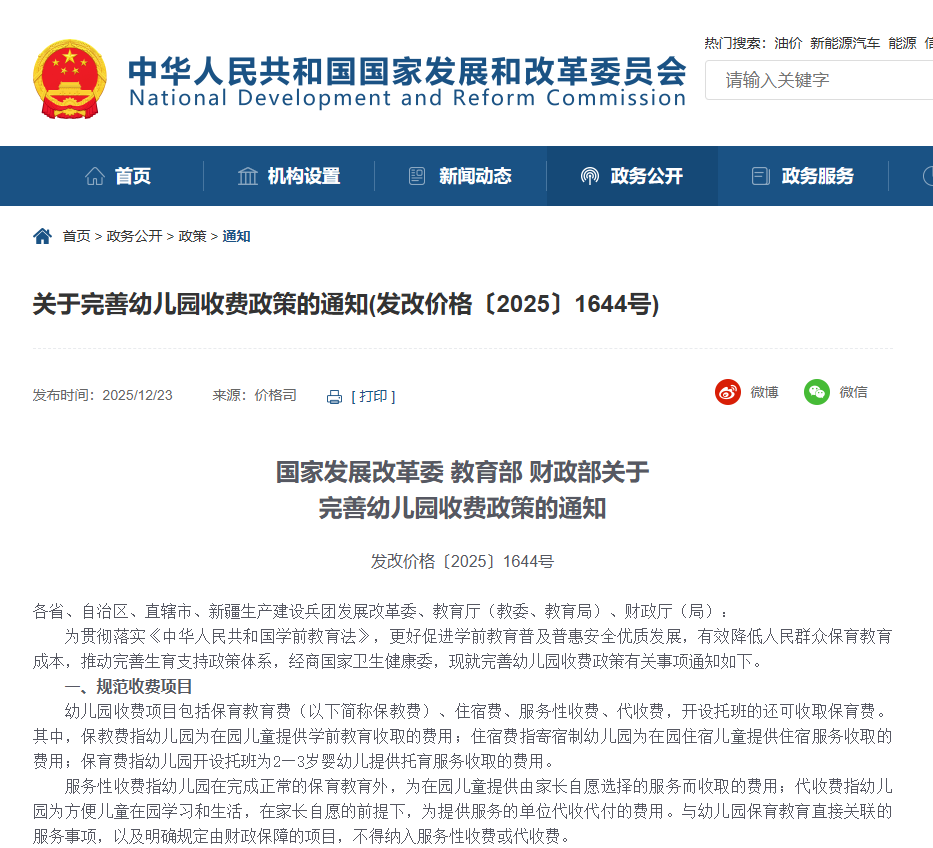
三部门联合印发关于完善幼儿园收费政策的通知
Xin Lang Cai Jing· 2025-12-23 12:08
Core Viewpoint The National Development and Reform Commission, along with the Ministry of Education and the Ministry of Finance, has issued a notification to improve the kindergarten charging policy, aiming to standardize fees and enhance transparency in the early childhood education sector [1][11]. Group 1: Standardization of Charging Items - Kindergarten charging items include care education fees, accommodation fees, service fees, and agency fees, with care fees applicable for toddler classes [2][12]. - Care education fees refer to the costs for providing preschool education, while accommodation fees are for boarding services in kindergartens [2][12]. Group 2: Classification and Management of Fees - Public and non-profit private kindergartens will have their care and accommodation fees regulated by government guidance prices, while for-profit private kindergartens will set fees based on market conditions [3][13]. - The management of care fees for toddler classes will follow the same principles as care education fees, ensuring that the standards are reasonable and meet community needs [3][13]. Group 3: Principles for Setting Fee Standards - Fee standards for public and non-profit private kindergartens should be based on cost audits, considering local economic conditions and community affordability [4][14]. - Costs included in fee calculations must exclude non-normal operating expenses, ensuring that only regular operational costs are considered [4][14]. Group 4: Evaluation and Optimization Mechanism - Local development and reform departments are tasked with monitoring kindergarten fees and conducting regular evaluations of the charging policies, with a review cycle not exceeding three years [5][15]. - Reports on kindergarten operations and fee adjustments must be submitted annually to relevant government departments [5][15]. Group 5: Establishment of a Directory System - A directory of service and agency fees must be established, requiring approval from local education and financial departments before implementation [6][16]. - Kindergartens are required to publicly disclose their fee directories, ensuring transparency and compliance with regulations [6][16]. Group 6: Strengthening Fee Regulation - Local authorities must guide kindergartens in establishing financial management systems and ensure accurate record-keeping of costs and revenues [7][17]. - Agreements between kindergartens and parents must clearly outline fee structures and refund policies, prohibiting additional fees under various pretexts [7][18]. Group 7: Supporting Measures - Coordination between financial support and charging policies is essential to enhance the cost-sharing mechanism in early childhood education [8][19]. - Local education departments are responsible for recognizing and updating lists of various types of kindergartens to ensure compliance with standards [8][19]. Group 8: Implementation and Coordination - Local development, education, and finance departments must collaborate to implement the new policies effectively, ensuring compliance and addressing public concerns [9][20]. - The notification will take effect on January 1, 2026, superseding any previous inconsistent regulations [10][20].
三部门:完善幼儿园收费政策 规范收费项目和明确收费标准制定原则等
Zhi Tong Cai Jing· 2025-12-23 11:23
Core Viewpoint - The National Development and Reform Commission, along with two other departments, has issued a notice to improve the kindergarten fee policy, emphasizing market regulation for profit-oriented private kindergartens and the need for effective supervision to prevent excessive charges [1][2]. Group 1: Fee Structure and Management - Kindergarten fees will include education fees, accommodation fees, service fees, and agency fees, with specific definitions for each type [3]. - Public and non-profit private kindergartens will have their education and accommodation fees regulated by government guidance, while profit-oriented private kindergartens will set fees based on market conditions [4]. - The fee standards for public kindergartens will be managed as administrative charges, with local governments having the authority to set specific rates within defined ranges [4][5]. Group 2: Fee Standard Principles - Fee standards for public and non-profit private kindergartens will be based on a cost audit, considering local economic conditions and community affordability [5]. - Normal operating costs will be included in the fee calculations, while extraordinary costs such as disaster losses will not be considered [6]. Group 3: Policy Evaluation and Optimization - Local development and reform departments will monitor kindergarten fees and conduct regular evaluations of the fee management system, with adjustments made at least every three years [7]. - A directory of service and agency fees will be established, requiring public disclosure to ensure transparency and accountability [8]. Group 4: Regulatory Oversight - Local authorities will guide kindergartens in establishing financial management systems and ensure accurate record-keeping of costs and revenues [9]. - Agreements between kindergartens and parents must clearly outline fee structures and refund policies, prohibiting additional fees under various pretexts [9]. Group 5: Supportive Measures - Local governments are encouraged to align financial support with fee policies to enhance the quality of early childhood education and ensure the sustainability of kindergartens [10]. - Coordination among development, education, and finance departments is essential for the effective implementation of these policies [11]. Group 6: Implementation Timeline - The new fee policy will take effect on January 1, 2026, superseding any previous inconsistent regulations [12].
三部门发通知完善幼儿园收费
Xin Lang Cai Jing· 2025-12-23 10:49
【[话筒]#三部门发通知完善幼儿园收费#】国家发展改革委、教育部、财政部发布关于完善幼儿园收费 政策的通知。详↓↓ #遏制幼儿园过高收费# (人民日报) ...
幼儿园收费实行目录清单管理,任何未列入清单的项目家长均有权拒绝
Xin Lang Cai Jing· 2025-12-23 10:48
近日,国家发展改革委、教育部、财政部三部门联合印发《关于完善幼儿园收费政策的通知》(《通 知》)。 《通知》坚持学前教育的公益属性定位,通过规范收费项目、分类完善收费管理方式、明确收费标准制 定原则、健全收费政策评估优化机制、建立目录清单制度、加强收费行为监管等,促进收费标准合理形 成,更好发挥收费政策对优质普惠供给的牵引撬动作用。 2024年全国教育事业发展统计公报数据显示,2024年全国普惠性幼儿园数为22.10万所,占全国幼儿园 的87.26%。普惠性幼儿园在园幼儿3283.19万人,占全国在园幼儿的91.61%。2025年我国明确免除公办 园大班保教费,惠及1200万幼儿。 中国教育科学研究院教育理论研究所副研究员金紫薇认为,学前教育的普惠性,本质是"可及性+可负 担性"的双重实现。尽管绝大多数幼儿都能在普惠性幼儿园就读,但"入园贵""收费不规范"等问题仍不 同程度或不同形式存在。从国家层面出台规范幼儿园收费的政策,能够进一步厘清学前教育市场化边 界,凸显学前教育公益底色,让普惠性学前教育资源成为学前教育资源供给的主体。 具体看《通知》内容,在规范收费项目方面,明确幼儿园可以收取保育教育费(简称保教费 ...