
保育教育服务

Search documents
幼儿园收费划“红线” 今后只能收5项“费”
Xin Lang Cai Jing· 2025-12-24 00:16
Core Viewpoint - The joint notice issued by the National Development and Reform Commission, Ministry of Education, and Ministry of Finance aims to enhance the accessibility, affordability, and quality of preschool education while reducing the financial burden on families and improving the fertility support policy system [1][2]. Group 1: Policy Framework - The notice emphasizes the public welfare nature of preschool education and aims to standardize fee items, improve fee management methods, clarify principles for setting fee standards, establish a mechanism for evaluating and optimizing fee policies, and strengthen supervision of fee practices [1]. - It allows kindergartens to charge five types of fees: care and education fees, accommodation fees, care fees for childcare services, service fees, and agency fees [1]. Group 2: Fee Regulation - Public kindergartens and non-profit private kindergartens will have their care and education fees and accommodation fees set according to government guidance prices, while for-profit private kindergartens will have their fees determined by market regulation [1]. - The government-guided fee standards should be based on costs after deducting government funding and social donations, taking into account local economic and social development levels and the affordability of the public [1]. Group 3: Monitoring and Evaluation - Local development and reform departments are required to collaborate with education, finance, and health departments to monitor kindergarten fees, understand industry dynamics, and assess operational conditions [2]. - The notice mandates regular evaluations of fee management methods, items, and standards through cost surveys and third-party assessments, with a review cycle not exceeding three years [2].
官方出手!幼儿园收费新规出台,哪些费用可以收?怎么收?一图读懂
Xin Lang Cai Jing· 2025-12-23 12:09
Group 1 - The core message of the notification is to improve the kindergarten fee policy to promote the development of preschool education, reduce costs for families, and support the birth policy system [1] - The notification outlines the types of fees that can be charged by kindergartens, including education fees, accommodation fees, service fees, and agency fees [2][29] - It specifies that public and non-profit private kindergartens will have their fees regulated by government guidance, while for-profit private kindergartens will set fees based on market conditions [3][30] Group 2 - The principles for setting fee standards include considering local economic conditions, community affordability, and the nature of the institution, with costs being monitored and adjusted regularly [4][31] - A mechanism for evaluating and optimizing fee policies will be established, with assessments conducted every three years to ensure the policies remain effective [5][32] - A directory system for service and agency fees will be implemented, requiring kindergartens to publicly disclose their fee structures and adhere to approved lists [6][33] Group 3 - Regulatory bodies will oversee the financial management of kindergartens, ensuring accurate record-keeping and compliance with fee regulations [7][34] - Support measures will be put in place to align fee policies with free education policies, ensuring the sustainability of kindergartens through financial assistance and tax relief [8][35] - Coordination among various government departments is emphasized to ensure the effective implementation of the new fee policies and to address any violations [9][36]

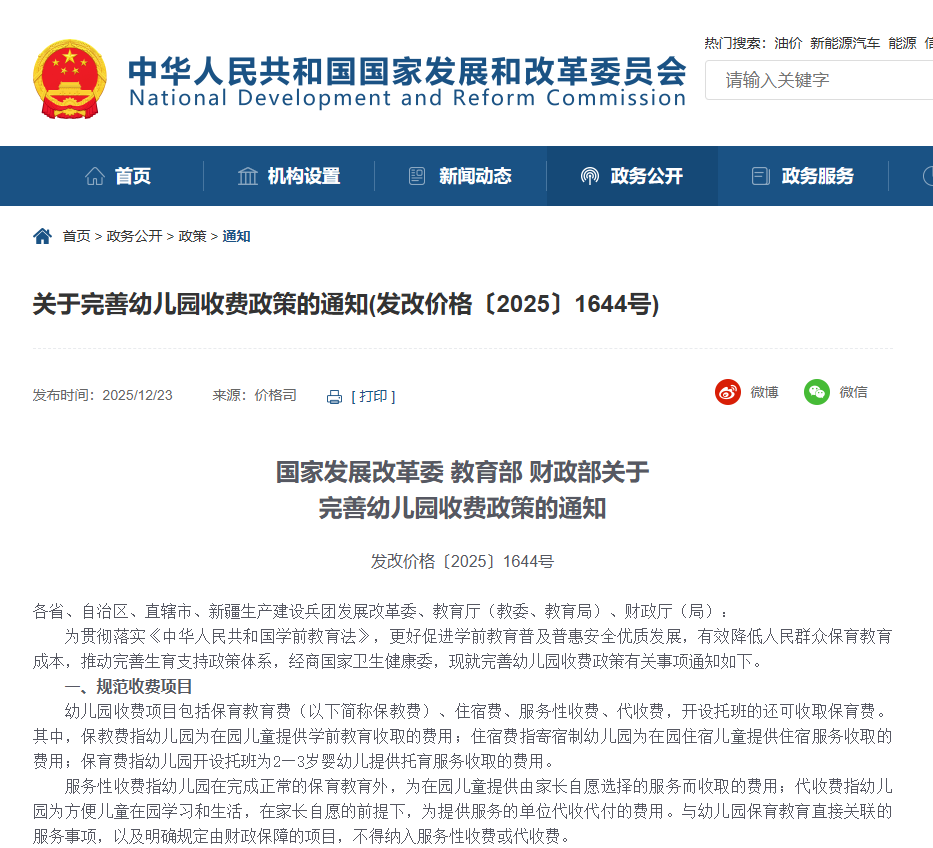
三部门联合印发关于完善幼儿园收费政策的通知
Xin Lang Cai Jing· 2025-12-23 12:08
Core Viewpoint The National Development and Reform Commission, along with the Ministry of Education and the Ministry of Finance, has issued a notification to improve the kindergarten charging policy, aiming to standardize fees and enhance transparency in the early childhood education sector [1][11]. Group 1: Standardization of Charging Items - Kindergarten charging items include care education fees, accommodation fees, service fees, and agency fees, with care fees applicable for toddler classes [2][12]. - Care education fees refer to the costs for providing preschool education, while accommodation fees are for boarding services in kindergartens [2][12]. Group 2: Classification and Management of Fees - Public and non-profit private kindergartens will have their care and accommodation fees regulated by government guidance prices, while for-profit private kindergartens will set fees based on market conditions [3][13]. - The management of care fees for toddler classes will follow the same principles as care education fees, ensuring that the standards are reasonable and meet community needs [3][13]. Group 3: Principles for Setting Fee Standards - Fee standards for public and non-profit private kindergartens should be based on cost audits, considering local economic conditions and community affordability [4][14]. - Costs included in fee calculations must exclude non-normal operating expenses, ensuring that only regular operational costs are considered [4][14]. Group 4: Evaluation and Optimization Mechanism - Local development and reform departments are tasked with monitoring kindergarten fees and conducting regular evaluations of the charging policies, with a review cycle not exceeding three years [5][15]. - Reports on kindergarten operations and fee adjustments must be submitted annually to relevant government departments [5][15]. Group 5: Establishment of a Directory System - A directory of service and agency fees must be established, requiring approval from local education and financial departments before implementation [6][16]. - Kindergartens are required to publicly disclose their fee directories, ensuring transparency and compliance with regulations [6][16]. Group 6: Strengthening Fee Regulation - Local authorities must guide kindergartens in establishing financial management systems and ensure accurate record-keeping of costs and revenues [7][17]. - Agreements between kindergartens and parents must clearly outline fee structures and refund policies, prohibiting additional fees under various pretexts [7][18]. Group 7: Supporting Measures - Coordination between financial support and charging policies is essential to enhance the cost-sharing mechanism in early childhood education [8][19]. - Local education departments are responsible for recognizing and updating lists of various types of kindergartens to ensure compliance with standards [8][19]. Group 8: Implementation and Coordination - Local development, education, and finance departments must collaborate to implement the new policies effectively, ensuring compliance and addressing public concerns [9][20]. - The notification will take effect on January 1, 2026, superseding any previous inconsistent regulations [10][20].
三部门印发《关于完善幼儿园收费政策的通知》
Xin Hua She· 2025-12-23 11:03
Core Viewpoint - The notification aims to improve the charging policy for kindergartens, promoting the development of inclusive and high-quality preschool education while reducing the cost of care and education for the public [1][2] Group 1: Charging Policy Framework - The notification emphasizes the public welfare nature of preschool education and aims to standardize charging items, improve management methods, clarify principles for setting charging standards, and enhance the evaluation and optimization mechanism for charging policies [1] - Kindergartens are allowed to charge five types of fees: care and education fees, accommodation fees, care fees for childcare services, service fees, and agency fees [1] - Public kindergartens and non-profit private kindergartens will have their fees guided by the government, while for-profit private kindergartens will have market-regulated fees [1] Group 2: Monitoring and Evaluation - Local development and reform departments are required to collaborate with education, finance, and health departments to monitor kindergarten fees and understand industry dynamics [2] - The notification mandates regular evaluations of charging management methods, items, and standards, with a review cycle not exceeding three years [2] - The National Development and Reform Commission will guide local authorities in revising regional kindergarten charging management methods and ensuring the smooth implementation of policies [2]
“零税率”与“免税”有什么区别?一图看懂
蓝色柳林财税室· 2025-10-30 01:02
Group 1 - The article discusses the differences between "zero tax rate" and "exemption" in value-added tax (VAT) policies, emphasizing that zero tax rate allows for tax refunds while exemption does not [4][11]. - Zero tax rate applies to exported goods, enabling businesses to not only avoid tax but also reclaim input tax [4][12]. - Exemption applies to specific projects such as medical and educational services, where businesses are not required to pay VAT but cannot reclaim any input tax [6][9]. Group 2 - The article highlights practical considerations for businesses regarding invoicing, stating that zero tax rate invoices must show a 0% tax rate, while exemption invoices must indicate VAT exemption [12]. - It clarifies that for exemption, taxpayers can directly report without needing to calculate refunds, whereas zero tax rate requires accurate calculation of refundable tax amounts [12].

200亿保育费减免落地,一图了解历年幼儿园学生人数
天天基金网· 2025-08-08 12:28
Core Viewpoint - The article discusses the implementation of a national policy for free childcare education fees, which is expected to benefit approximately 12 million children in the upcoming autumn semester, resulting in a financial impact of around 20 billion yuan for both the government and families [3]. Group 1: Policy Implementation - The Ministry of Finance announced that the free childcare education fee policy will cover all kindergarten large class children, with an estimated 12 million beneficiaries this autumn semester [3]. - The financial impact for the current semester includes an increase in national expenditure of approximately 20 billion yuan, which will correspondingly reduce family expenses by the same amount [3]. - Each child will receive a subsidy of nearly 1,667 yuan for the autumn semester [3]. Group 2: Enrollment and Birth Rate Trends - As of 2024, the number of kindergarten students is projected to be 35.84 million, a decrease from the peak of 48.18 million in 2020 [3]. - The birth rate has significantly declined from 17.86 million in 2016 to 9.02 million in 2023, representing a nearly 50% drop [3]. - However, there was a slight recovery in the birth rate last year, with 9.54 million births recorded [3]. Group 3: Future Plans for Free Education - The State Council has released an opinion on gradually promoting free preschool education, stating that from the autumn semester of 2025, public kindergartens will waive childcare education fees for children in their final year [3]. - Private kindergartens approved by education departments will also have their fees reduced in accordance with local public kindergarten standards [3]. - The government will provide financial support to kindergartens affected by the reduction in income due to the waiver of fees, with funding sourced from both central and local finances [3].
免保育教育费政策覆盖所有大班儿童(权威发布)
Ren Min Ri Bao· 2025-08-07 22:40
Core Viewpoint - The Chinese government is implementing a policy to gradually promote free preschool education, which is expected to significantly reduce the financial burden on families and improve access to quality education for children [1][2]. Group 1: Free Preschool Education Implementation - Starting from the upcoming autumn semester, the government will waive the childcare education fees for children in their final year of preschool in public kindergartens, benefiting approximately 12 million children [2]. - The total financial impact of this policy is estimated to increase national fiscal expenditure by about 20 billion yuan, with a corresponding reduction in family education expenses [2]. - The policy applies to all eligible children in both public and private kindergartens, ensuring equitable access across urban and rural areas [2]. Group 2: Funding Sources - The financial support for the free preschool education initiative will be jointly funded by central and local governments, with the central government covering 80%, 60%, and 50% of the costs for western, central, and eastern regions, respectively [4]. - The Ministry of Finance has allocated the necessary funds for the implementation of this policy and is working with local governments to establish specific financial assistance standards [4][5]. Group 3: Quality Assurance in Preschool Education - The implementation of free preschool education will not compromise the quality of education, as the Ministry of Education is committed to enforcing regulations that ensure high standards in kindergarten operations [7]. - A comprehensive approach will be taken to enhance the quality of preschool education, including strict regulations on staff qualifications, funding, and operational practices [7]. - The government will also strengthen oversight and evaluation mechanisms to ensure that the quality of preschool education continues to improve, moving from merely providing access to ensuring quality education [8].
保教费减免,山东1.9万所大班幼儿先受益
Qi Lu Wan Bao· 2025-08-07 21:11
Core Viewpoint - The Chinese government is set to gradually implement free preschool education, starting with the exemption of care and education fees for children in their final year of preschool from the fall semester of 2025, which is expected to benefit families financially and promote birth rates [1][2]. Group 1: Policy Implementation - The policy will initially exempt care and education fees for children in the final year of preschool, directly benefiting approximately 12 million children in the upcoming fall semester [3]. - The financial impact of this policy is significant, with an expected increase in national fiscal expenditure of about 20 billion yuan for the current semester, which will correspondingly reduce family expenses by the same amount [3]. Group 2: Financial Details - For example, if a private preschool charges 600 yuan per month for care and education, and a public preschool charges 300 yuan, after the policy implementation, children in public preschools will not have to pay the fee, while those in private preschools will only need to pay the difference of 300 yuan [2]. - The policy will not cover additional fees such as bedding and meal costs, which will still need to be paid according to the preschool's standards [2]. Group 3: Future Considerations - There are discussions about the potential expansion of the fee exemption to cover all three years of preschool education, but this will require time and specific conditions to be met [3]. - The implementation of this policy is seen as a small step towards broader educational equity, with future improvements aimed at ensuring all children have equal access to preschool education funding [3].
预计今年秋季学期惠及约1200万人,免保育教育费政策将适时完善
Bei Jing Shang Bao· 2025-08-07 07:20
Group 1 - The core viewpoint of the news is the implementation of a nationwide policy to waive childcare education fees for all kindergarten senior class children, benefiting approximately 12 million children this fall semester [2][3] - The policy aims to be inclusive and equitable, covering both public and private kindergartens in urban and rural areas, ensuring all eligible children can enjoy the benefits [2] - The financial impact of the policy is significant, with an estimated reduction of family education expenses by 20 billion yuan for the fall semester, as the government will increase its spending by the same amount [4] Group 2 - The Ministry of Education will supervise local governments to develop specific implementation plans and ensure timely execution of the policy, with preparations to be completed by the end of August [3] - The funding for the waived fees will be shared between central and local governments, with the central government covering 80%, 60%, and 50% of the costs for western, central, and eastern regions respectively [4] - The Ministry of Finance has already allocated the necessary funds for the central government's share of the fee waivers and will guide local authorities in establishing their funding standards [4][5]
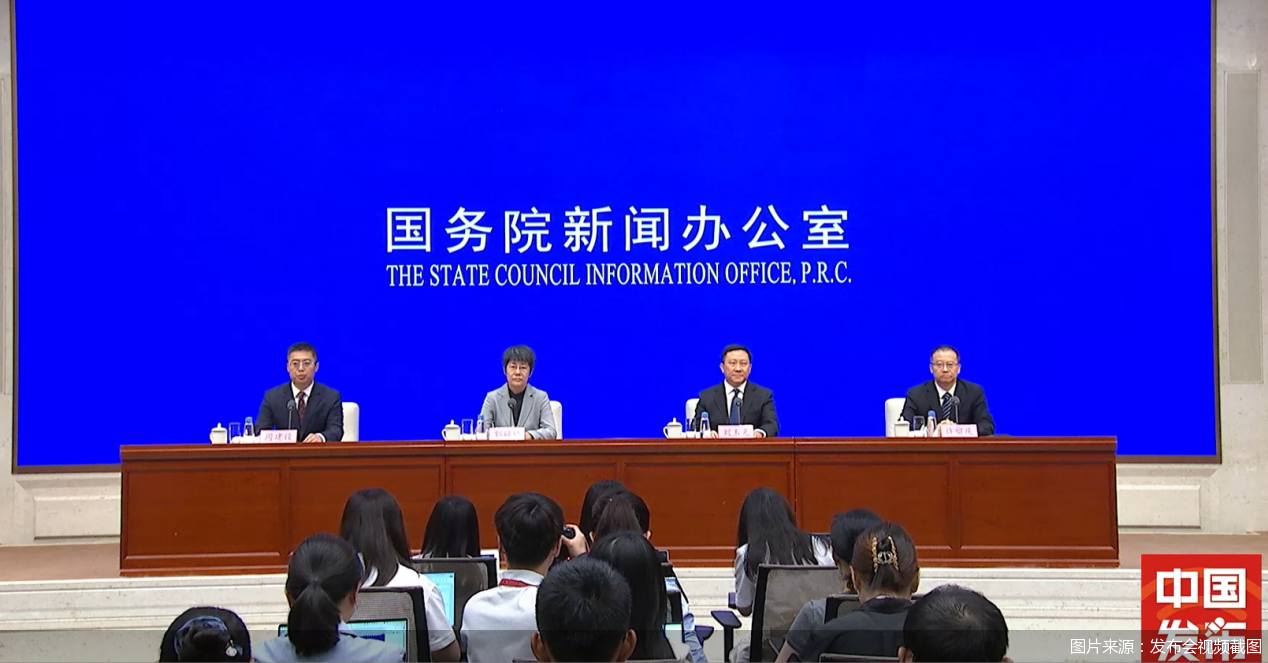
惠及约1200万人!财政部:免保教费政策将覆盖所有幼儿园大班儿童
Xin Hua Cai Jing· 2025-08-07 05:33
Core Viewpoint - The introduction of the free childcare education fee policy marks a milestone in China's preschool education development, expected to benefit approximately 12 million children in the upcoming autumn semester [1][2]. Group 1: Policy Overview - The policy will cover all kindergarten senior class children, with the aim to gradually implement free preschool education starting from the autumn semester of 2025 [1][2]. - Public kindergartens will have their childcare education fees waived for children in their final year, while private kindergartens will follow a similar fee exemption based on local public kindergarten standards [1][2]. Group 2: Financial Implications - The policy is projected to increase national fiscal expenditure by approximately 20 billion yuan for the autumn semester alone, which will correspondingly reduce family education expenses by the same amount [2]. - The funding for the fee exemption will be shared between central and local governments, with a significant portion covered by the central government, particularly favoring central and western regions [2]. Group 3: Implementation and Oversight - The Ministry of Finance has allocated the necessary funds for the fee exemption and will guide local authorities in developing detailed implementation measures [2][3]. - There will be a strong emphasis on supervision and management of the subsidy funds to ensure proper usage and accountability, with measures in place to address any misuse of funds [3].