
掩饰

Search documents
废品收购者注意,这类行为可能触犯掩隐罪
Xin Jing Bao· 2025-08-25 06:30
Group 1 - The article discusses a case where an individual, Chen, was convicted for concealing and hiding criminal proceeds through the recycling of scrap metal, highlighting the judicial efforts to combat such crimes [1][2] - From July 2018 to March 2021, Li, who was previously convicted of contract fraud, deceived victims into leasing steel plates under false pretenses, leading to the acquisition of over 5,000 steel plates, which were then sold to Chen [1] - Chen knowingly purchased these steel plates at prices significantly below their actual value, resulting in illegal profits of over 6 million yuan from a total expenditure of over 16 million yuan [1] Group 2 - The article emphasizes that criminals often exploit the scrap metal recycling industry to engage in receiving and selling stolen goods, which is a common method of concealing criminal proceeds [2] - According to regulations, operators of scrap metal recycling companies are obligated to verify the legality of the sources of the metals they acquire, especially when the items are clearly not scrap and priced below market value [2] - The judicial authorities stress that Chen's actions not only involved significant illegal profits but also contributed to the underlying contract fraud, thereby undermining market order and the legal business environment [2]
“两高”发布司法解释进一步严密我国反洗钱刑事法网 来看典型案例→
Yang Shi Wang· 2025-08-25 04:18
Core Viewpoint - The Supreme People's Court and the Supreme People's Procuratorate jointly released an interpretation regarding the handling of criminal cases related to concealing and disguising criminal proceeds, which aims to strengthen the legal framework against money laundering and related crimes, particularly in the context of rising telecommunications fraud and online gambling [1][3]. Summary by Sections Legal Framework - The interpretation consists of 12 articles and will take effect on August 26, 2025, providing clearer judicial guidelines for handling cases of concealing and disguising criminal proceeds [3]. - Article 312 of the Criminal Law defines the crime of concealing and disguising criminal proceeds, with penalties ranging from less than three years of imprisonment to seven years for serious cases [1]. Key Changes - The interpretation tightens the legal net by expanding the definition of "other methods" to include various actions that can conceal or disguise criminal proceeds, such as intermediary transactions, fund transfers, and cross-border asset transfers [5]. - It emphasizes the strict requirement of subjective knowledge, ensuring that individuals are only prosecuted if they knowingly handle criminal proceeds, thus preventing overreach in legal interpretations [5][6]. Adjustments in Penalties - The threshold for "serious circumstances" has been adjusted to 500,000 and 5 million yuan, depending on the type of upstream crime, to ensure proportionality in sentencing [8][10]. - The adjustment addresses discrepancies in sentencing between upstream and downstream crimes, particularly in cases involving illegal mining and related activities [12]. Encouragement for Cooperation - The interpretation includes provisions for leniency in sentencing for individuals who actively cooperate with judicial authorities in tracing upstream crimes, promoting a collaborative approach to law enforcement [12]. - Special consideration is given to minors and students involved in such crimes, allowing for potential dismissal or non-prosecution based on the specifics of the case [12]. Impact on Crime Statistics - From 2020 to 2024, prosecutors initiated 230,200 cases of concealing and disguising criminal proceeds, with courts concluding 220,900 first-instance cases, indicating a significant deterrent effect on telecommunications fraud and online gambling [14]. Case Example - A notable case involved a jewelry store owner who facilitated large purchases of gold with funds from telecommunications fraud, resulting in a sentence of three years and six months, highlighting the practical application of the new interpretation [15][21].

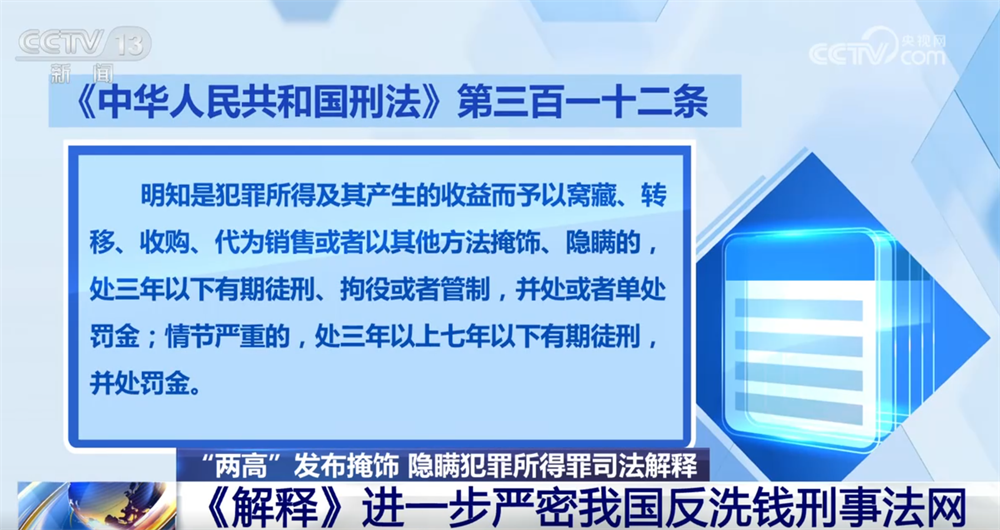
明起施行 “两高”发布掩饰、隐瞒犯罪所得罪司法解释
Yang Shi Xin Wen· 2025-08-25 02:42
Core Viewpoint - The Supreme People's Court and the Supreme People's Procuratorate jointly issued an interpretation regarding the handling of criminal cases related to concealing and disguising criminal proceeds, effective from August 26, 2025, aiming to strengthen the legal framework against money laundering and related crimes [1][2]. Group 1: Legal Framework Enhancement - The interpretation consists of 12 articles, focusing on tightening the criminal law network to address evolving and hidden criminal methods [2]. - It clarifies that the methods of crime under Article 312 of the Criminal Law include any actions that can conceal or disguise criminal proceeds, guiding judicial authorities to punish various forms of such behaviors [2]. Group 2: Standards and Definitions - The interpretation emphasizes strict criteria for determining "knowledge" of criminal proceeds, aiming to prevent the over-expansion of criminal liability by ensuring that judicial authorities adhere to evidence-based principles [2][3]. - It introduces a comprehensive standard for determining criminality, allowing for prosecution even if the amount involved does not meet previous thresholds, focusing on the nature of the upstream crime and the severity of the concealment actions [3][4]. Group 3: Penalty Optimization - The interpretation optimizes the standards for aggravated penalties based on the type of upstream crime, establishing different monetary thresholds for serious crimes, such as 5 million for severe cases and 500,000 for less severe cases [4]. - It addresses inconsistencies in sentencing between upstream and downstream crimes, ensuring that penalties are proportionate and aligned with the severity of the underlying offenses [4]. Group 4: Encouragement for Cooperation - The interpretation introduces provisions for leniency in sentencing for individuals who actively cooperate with judicial authorities in tracing upstream crimes, promoting efforts to recover losses for the public [4].
“两高”发布掩饰、隐瞒犯罪所得罪司法解释 明起施行
Yang Shi Xin Wen· 2025-08-25 02:41
Core Viewpoint - The Supreme People's Court and the Supreme People's Procuratorate jointly issued an interpretation regarding the handling of criminal cases related to concealing and disguising criminal proceeds, effective from August 26, 2025, aiming to strengthen the legal framework against money laundering and related crimes [1]. Group 1: Legal Framework - The interpretation consists of 12 articles, focusing on tightening the criminal legal network to address evolving and hidden criminal methods, ensuring that all actions that conceal or disguise criminal proceeds are punishable [2]. - It emphasizes strict criteria for determining "knowledge" of criminal proceeds, aiming to prevent the over-expansion of criminal liability by ensuring that judicial authorities adhere to evidence-based principles [2]. Group 2: Crime Definition and Standards - The interpretation establishes a comprehensive recognition standard for crimes, moving away from a strict monetary threshold previously set between 3,000 to 10,000 yuan, allowing for prosecution even if the amount is below this range under certain severe circumstances [3]. - It optimizes the standards for aggravated punishment, differentiating between various types of upstream crimes, with thresholds set at 5 million yuan for serious crimes and 500,000 yuan for less severe crimes [4]. Group 3: Sentencing and Cooperation - The interpretation addresses sentencing inconsistencies between upstream and downstream crimes, raising the threshold for serious cases of concealing criminal proceeds to 500,000 yuan for high-severity upstream crimes [4]. - It introduces leniency for individuals who actively cooperate with judicial authorities in tracing upstream crimes, encouraging collaboration to recover losses for the public [5].
浦江说法丨“黄金投资”梦碎,牵出幕后隐秘犯罪链条
Sou Hu Cai Jing· 2025-08-18 08:57
Group 1 - The case involves individuals, Liang and Zhang, who were engaged in the illegal transfer of gold that was obtained through criminal activities, with a total value exceeding 2.02 million RMB [2][3] - Liang received gold from victims and was instructed to verify its authenticity by burning it before handing it over to Zhang, who then facilitated its transfer to an overseas buyer [2][3] - Both individuals were aware that the gold they were handling was criminal proceeds, yet they continued to assist in its transfer, leading to their conviction under the law [3] Group 2 - The court sentenced Liang and Zhang to prison terms ranging from two years to seven months, along with fines between 20,000 RMB and 5,000 RMB [3] - According to Article 312 of the Criminal Law of the People's Republic of China, individuals who knowingly conceal or transfer criminal proceeds can face imprisonment of up to seven years, depending on the severity of the case [5]

涉“两卡”犯罪案件数量仍处高位 两高一部发文惩治电诈“帮凶”
Zheng Quan Shi Bao Wang· 2025-07-28 11:47
Core Viewpoint - The Supreme People's Court, the Supreme People's Procuratorate, and the Ministry of Public Security have issued guidelines to combat information network crimes, particularly focusing on organized, professional, and cross-border assistance in such crimes, emphasizing strict penalties for key offenders [1][2]. Group 1: Trends in Cybercrime - Since 2020, the number of cases related to assistance in information network crimes has been increasing, with over 100,000 cases reported in 2023, despite a significant decrease in the first half of 2024 compared to previous years [1]. - The rise in cases involving "two cards" (bank cards used for illicit activities) has also been noted, indicating a persistent high level of related criminal activity [1]. Group 2: Characteristics of Offenders - Current offenders in assistance crimes exhibit a "three lows and one high" profile: low age, low education, low income, and a high proportion of first-time offenders, with over 80% of defendants under 35 years old and one-third under 25 [2]. - There is a notable issue with minors and students being involved in these crimes, raising significant social concerns [2]. Group 3: Legal Framework and Enforcement - The guidelines clarify the criteria for determining whether an individual knowingly assisted in a crime, emphasizing the need to assess the severity of the crime and the involvement of the accused [3]. - The guidelines advocate for a balanced approach in enforcement, suggesting leniency for minors and those at the lower end of the criminal chain while ensuring strict penalties for serious offenders [3]. - Collaboration among various governmental departments is encouraged to enhance the comprehensive governance of information network crimes, focusing on both prevention and punishment [3].
为规避追查,诈骗分子“谍战片”式运输黄金
Bei Jing Ri Bao Ke Hu Duan· 2025-06-04 03:55
Core Viewpoint - A significant investment fraud scheme has emerged, involving multiple victims across Jiangsu, Jiangxi, and Guangdong, where individuals lost over 400,000 yuan in gold investments through a fraudulent investment app that became inaccessible after the gold was supposedly signed for [1][6]. Group 1: Fraud Mechanism - Victims were lured into a fraudulent investment scheme through a WeChat stock trading group, where they were promised high returns by a supposed expert [2][3]. - The scheme involved purchasing gold as a form of "physical deposit" to bypass investment limits, with victims instructed to send the gold to a designated address [3][4]. - Once the gold was sent, victims' accounts showed inflated balances, but access was restricted, leading to further demands for more gold purchases to "unfreeze" accounts [3][6]. Group 2: Criminal Operations - The criminal operation involved a network of individuals, including a key figure named Huang, who coordinated the collection and transfer of gold from victims [4][5]. - The operation utilized a method of disguising the transfer of funds by converting them into gold, which was then physically moved to evade law enforcement [7][8]. - Evidence collection focused on the logistics of gold purchasing, shipping, and signing for deliveries, which was crucial for prosecuting the involved parties [7][8]. Group 3: Legal Proceedings - The case has led to the prosecution of individuals involved in the scheme, with Huang receiving a sentence of two years and three months, along with a fine of 12,000 yuan [8]. - Ongoing investigations are targeting additional accomplices and the mastermind behind the scheme, indicating a broader network of fraud [8].