
智慧水务

Search documents
炬华科技涨2.02%,成交额3.25亿元,主力资金净流出1126.16万元
Xin Lang Cai Jing· 2026-01-12 05:58
Core Viewpoint - The stock of Juhua Technology has shown a positive trend with a 4.43% increase since the beginning of the year, reflecting strong market interest despite some recent net outflows of capital [1][2]. Group 1: Stock Performance - As of January 12, Juhua Technology's stock price rose by 2.02%, reaching 18.16 CNY per share, with a trading volume of 325 million CNY and a turnover rate of 3.63% [1]. - The stock has increased by 3.53% over the last five trading days, 14.21% over the last 20 days, and 14.14% over the last 60 days [1]. Group 2: Financial Performance - For the period from January to September 2025, Juhua Technology reported a revenue of 1.25 billion CNY, a year-on-year decrease of 19.14%, and a net profit attributable to shareholders of 480 million CNY, down 11.45% year-on-year [2]. - The company has distributed a total of 1.31 billion CNY in dividends since its A-share listing, with 818 million CNY distributed over the last three years [3]. Group 3: Shareholder Information - As of December 31, the number of shareholders for Juhua Technology was 34,700, a decrease of 4.06% from the previous period, while the average circulating shares per person increased by 4.23% to 14,418 shares [2]. - Among the top ten circulating shareholders, Hong Kong Central Clearing Limited holds 7.57 million shares, a decrease of 7.80 million shares from the previous period [3].

江南水务:公司技术团队助力新疆霍城开展智慧水务业务的合作
Zheng Quan Ri Bao Wang· 2026-01-08 12:13
Core Viewpoint - Jiangnan Waterworks (601199) demonstrates its technical strength and cross-regional service capability through its collaboration with Xinjiang Huo City in the smart water management business, laying a solid foundation for future cross-regional cooperation [1] Group 1 - The company’s technical team is actively involved in the smart water management business in Xinjiang Huo City [1] - This collaboration highlights the company's ability to provide services beyond its traditional operational areas [1] - The initiative is expected to enhance the company's reputation and operational capabilities in the water management sector [1]

亨通光电跌2.01%,成交额17.23亿元,主力资金净流出2.14亿元
Xin Lang Cai Jing· 2026-01-08 06:43
Group 1 - The core viewpoint of the news is that Hengtong Optic-Electric has experienced fluctuations in its stock price and trading volume, with a recent decline of 2.01% on January 8, 2025, and a total market capitalization of 602.38 billion yuan [1] - As of January 8, 2025, Hengtong Optic-Electric's stock price has decreased by 1.25% year-to-date, with a 0.16% decline over the past five trading days, but a 19.71% increase over the past 20 days and a 17.23% increase over the past 60 days [1] - The company reported a revenue of 496.21 billion yuan for the period from January to September 2025, representing a year-on-year growth of 17.03%, and a net profit attributable to shareholders of 23.76 billion yuan, which is a 2.64% increase year-on-year [2] Group 2 - Hengtong Optic-Electric's main business segments include smart grids (36.98%), copper conductors (25.02%), industrial and new energy intelligence (11.28%), optical communication (10.94%), marine energy and communication (9.57%), and others (5.33%) [1] - The company has distributed a total of 26.14 billion yuan in dividends since its A-share listing, with 11.21 billion yuan distributed in the last three years [3] - As of September 30, 2025, the number of shareholders increased by 18.60% to 191,800, while the average circulating shares per person decreased by 15.68% to 12,747 shares [2]

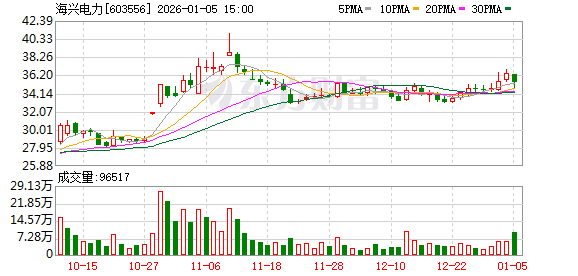
海兴电力:公司已明确以“电”和“水”为两大核心发展方向
Zheng Quan Ri Bao· 2026-01-05 14:27
Core Viewpoint - The company aims to become a global leader in digital energy and smart water solutions, focusing on "electricity" and "water" as its two core development directions [2] Group 1: Electric Power Sector - The company will continue to strengthen its leading position in the smart grid market and expand its business from smart metering and distribution automation to digital energy management [2] - The goal is to not only be a supplier of equipment and solutions but also to assist power customers in their digital and energy transitions as a long-term partner [2] - The company plans to seize significant opportunities arising from global grid upgrades, high integration of distributed green electricity, and energy efficiency improvements to provide more efficient and reliable system solutions [2] Group 2: Water Sector - The strategic vision in the water sector has expanded from smart metering to broader water resource management [2] - In addition to continuing to expand its global smart water meter business, the company is strategically positioning itself in the seawater desalination market, which is a key solution for water resource management [2] - Leveraging its core technologies in energy efficiency management, automatic control, and system integration, the company aims to provide efficient and energy-saving seawater desalination facilities and overall operational solutions for regions facing water shortages [2] Group 3: Strategic Synergy - The electric power and water sectors will form a strong strategic synergy in technology, market, and resource management, jointly constructing a sustainable growth engine for the company's future [2]


金卡智能涨2.42%,成交额3075.08万元,主力资金净流入359.31万元
Xin Lang Cai Jing· 2025-12-31 01:57
Core Viewpoint - JinKa Intelligent has shown a positive stock performance with a year-to-date increase of 12.28% and a market capitalization of 6.171 billion yuan as of December 31 [1] Group 1: Stock Performance and Market Data - On December 31, JinKa Intelligent's stock price rose by 2.42% to 14.79 yuan per share, with a trading volume of 30.75 million yuan and a turnover rate of 0.56% [1] - The net inflow of main funds was 3.5931 million yuan, with large orders accounting for 19.46% of purchases and 19.55% of sales [1] - The stock has increased by 3.79% over the last five trading days, 9.39% over the last 20 days, and 19.47% over the last 60 days [1] Group 2: Company Overview - JinKa Intelligent Group Co., Ltd. was established on July 28, 2004, and went public on August 17, 2012, located in Hangzhou, Zhejiang Province [1] - The company specializes in the research, production, and sales of smart gas meters and gas measurement management systems, providing comprehensive solutions for gas companies [1] - The main revenue composition includes smart residential gas terminals and systems (64.49%), smart commercial gas terminals and systems (20.73%), smart public utility management systems and others (7.70%), and smart water terminal systems (7.09%) [1] Group 3: Financial Performance - For the period from January to September 2025, JinKa Intelligent achieved an operating income of 2.355 billion yuan, a year-on-year increase of 5.52%, while the net profit attributable to the parent company was 207 million yuan, a decrease of 30.49% year-on-year [2] - The company has distributed a total of 1.248 billion yuan in dividends since its A-share listing, with 456 million yuan distributed in the last three years [3] - As of September 30, 2025, the top ten circulating shareholders included Hong Kong Central Clearing Limited, which increased its holdings by 772,500 shares [3]

中山公用水环境公司:攻坚厂网一体化 双区域树治水新标杆
Nan Fang Du Shi Bao· 2025-12-30 06:13
Core Viewpoint - The company is implementing a comprehensive water pollution control strategy in Zhongshan, focusing on integrated water management in non-central urban areas, particularly through the Torch Development Zone and Sanjiao Town projects, aiming to create replicable models for water governance [1][2][4]. Group 1: Torch Development Zone Project - The Torch Development Zone project represents a significant practice in expanding the company's water governance efforts, with a goal to enhance water quality and operational efficiency by 2025 [2]. - The project has achieved a 35.52 percentage point increase in sewage collection rates, exceeding municipal targets, and has improved the average BOD concentration entering the Yangguan sewage treatment plant by 34.17% year-on-year [2]. - A three-pronged governance mechanism has been established to improve river water quality, resulting in a reduction of Class V rivers from 16 to 6, with quarterly assessments showing a stable 31.25% of rivers in this category, outperforming the municipal standard of 46% [2]. Group 2: Flood Prevention and Smart Water Management - The company has implemented a comprehensive flood prevention system, reducing the number of flood-prone areas in Zhongshan Port from 30 to 14, a decrease of 53.3% [3]. - A smart drainage platform has been developed to enhance operational efficiency, transitioning from manual operations to remote control for 86 electric gates, marking a significant advancement in water management technology [3]. Group 3: Sanjiao Town Project - The Sanjiao Town project focuses on breaking down barriers between water treatment facilities and networks, establishing a joint venture to enhance local water governance [4]. - A comprehensive survey of 297.55 kilometers of pipelines has been conducted, leading to the creation of a digital management system that supports targeted governance [4]. - The Sanjiao sewage treatment plant has increased its capacity from 40,000 tons per day to 70,000 tons per day, addressing inefficiencies caused by traditional segmented management [4]. Group 4: Key Highlights of Governance Experience - The company has developed a replicable governance model that integrates resources from state-owned enterprises and local areas, enhancing overall governance efficiency [7]. - A targeted approach to problem-solving has been adopted, focusing on specific issues rather than a one-size-fits-all solution, which has led to quicker and more effective outcomes [7]. - The use of digital technologies has modernized water management practices, improving operational efficiency and responsiveness to flooding [7]. - A focus on public satisfaction has been established, ensuring that all complaints are addressed promptly, thereby enhancing community trust and engagement [8]. Group 5: Future Directions - The company plans to continue expanding its water governance initiatives, leveraging its successful projects as benchmarks, and aims to innovate in asset-light operational models tailored to local needs [8].

粤澳供水从单一水源到双源保障转变 对澳供水日均可达70万立方米
Nan Fang Ri Bao Wang Luo Ban· 2025-12-29 09:01
Core Viewpoint - The water supply system between Guangdong and Macau has been significantly enhanced, ensuring a stable and sufficient water supply despite environmental challenges, with a daily supply capacity reaching 700,000 cubic meters and historical supply volumes expected to reach 105 million cubic meters in 2024 [1][2] Group 1: Water Supply Infrastructure - Guangdong has established a four-dimensional guarantee system for water supply, focusing on infrastructure, technology, emergency collaboration, and cooperation with Macau [1] - The water supply capacity to Macau has exceeded 2.9 billion cubic meters since the Zhuhai Zhuxiandong Reservoir began supplying water in 1960 [1] - The construction of the Zhuhai-Doumen Pinggang Pump Station Phase II is in the pre-production testing phase, which will increase its daily water intake capacity to 3.6 million cubic meters [2] Group 2: Technological Advancements - Advanced technologies such as electromagnetic non-destructive testing and pipeline internal inspection are being utilized to enhance the health of the water supply network [2] - The Smart Water Management Phase II project in the Hengqin Guangdong-Macau Deep Cooperation Zone is under rapid construction, integrating IoT, big data, and AI to create a digital twin platform for the entire water supply chain [2] Group 3: Emergency Response and Management - The emergency water supply system has been upgraded to improve response capabilities to sudden water quality pollution events, allowing for rapid switching between water sources [2] - The Zhuxiandong Reservoir, with a capacity of 40.18 million cubic meters, can ensure water supply for over 40 days for both Guangdong and Macau [2] - A cross-regional scheduling mechanism has been established between the water authorities of Zhuhai and Macau to ensure stable water supply [2]
不锈钢水管发展趋势分析:乐观基调背后的真相
Sou Hu Cai Jing· 2025-12-29 08:41
Market Drivers - The global market for stainless steel pipes is growing at an annual rate of 12%, expected to exceed $4.5 billion by 2025, driven by the dual forces of global water resource crises and health-conscious consumer upgrades [1] - Health concerns are leading to a rigid replacement of traditional pipes, as 80% of diseases are linked to drinking water pollution. Stainless steel pipes, with zero chemical leaching and over 99% antibacterial rate, are becoming the preferred choice in high-end residential, hospitals, and schools [2] - Policy mandates in China are promoting the widespread adoption of corrosion-resistant pipes, with significant subsidies for old pipe replacements. The market potential for replacing outdated pipes exceeds trillions of yuan [3] Technological Breakthroughs - Innovations in material technology are enabling stainless steel pipes to adapt to extreme environments, such as anti-freeze pipes for cold regions and corrosion-resistant pipes for coastal areas, enhancing their lifespan and efficiency [5] - The integration of IoT and big data is transforming stainless steel pipes from mere water transport tools to smart water management systems, significantly reducing leakage rates and maintenance costs [6] Policy Benefits - China's urban water supply network renovation is projected to create a market space worth trillions, with mandatory use of stainless steel pipes in new constructions and significant subsidies for retrofitting old systems [8] - Internationally, legislation in the U.S. and Germany is mandating the use of stainless steel for drinking water systems, further driving market growth [9] Potential Risks - The initial procurement cost of stainless steel pipes remains 2-3 times higher than that of traditional materials, posing challenges in price-sensitive markets [10] - The lack of standardized construction practices and compatibility issues among different brands complicate installation and maintenance, affecting market efficiency [11] - The industry is characterized by low concentration, with high-end products still reliant on imports, reflecting a technological gap in domestic production [12] Future Outlook - The long-term prosperity of the stainless steel pipe industry will depend on technological innovation, green transformation, and ecological collaboration to meet the evolving demands of various sectors [14]

2025-2030年中国二次供水设备行业研究及前瞻分析报告
Sou Hu Cai Jing· 2025-12-29 06:30
Industry Overview - The secondary water supply system utilizes municipal water supply and self-built facilities for water storage and pressurization, addressing the insufficient pressure in municipal pipelines to meet daily water needs for high-rise residents and other users [1] - Secondary water supply equipment is designed to solve residential water issues, characterized by low investment costs, small footprint, high flexibility, and ease of operation, suitable for various high-rise residential areas, urban squares, campuses, and hospitals [1] Equipment Classification - Traditional secondary water supply methods involve using pumps and water tanks, which can lead to water quality contamination and high construction costs [2] - Advanced non-negative pressure secondary water supply systems directly draw water from municipal pipelines, reducing contamination risks and improving energy efficiency [2] Industry Chain - The top of the secondary water supply industry chain consists of raw materials like cast iron, steel, and key components such as pumps and control systems, which significantly impact the performance and lifespan of the equipment [3] - The midstream is dominated by manufacturers responsible for the design and production of various types of secondary water supply equipment [3] - The downstream involves sales to real estate developers, property management companies, and end-users in residential, commercial, and institutional settings [3] Current Industry Status - China faces immense water demand due to its large population and rapid urbanization, with total water usage reaching 5,906.5 billion cubic meters in 2023 [4] - Government policies aimed at water resource protection and efficiency have been implemented, promoting a water-saving society and alleviating supply pressures [4] Market Demand - The real estate sector's increasing project openings and completions have stimulated demand for secondary water supply equipment [5] - Infrastructure investments and urbanization efforts have led to a growing need for secondary water supply systems in high-rise and mid-rise residential areas [5] Market Size - The market size of China's secondary water supply equipment industry grew from 24.51 billion yuan in 2019 to 44.15 billion yuan in 2023 [6] - The market is expected to continue expanding, with projections indicating a market size of 135.34 billion yuan by 2031 [8] Competitive Landscape - The secondary water supply market in China is highly competitive, with numerous manufacturers across different tiers, including specialized manufacturers and local companies [6] - Leading companies with extensive networks and strong market presence are expected to capture larger market shares as industry standards rise [8] Future Trends - The industry is moving towards smart water management, integrating technologies like IoT and big data to enhance operational efficiency and water safety [8] - Innovations in high-efficiency and energy-saving systems are crucial for meeting increasing environmental standards and consumer demands [9][10] - Smaller manufacturers lacking R&D capabilities may struggle to compete, leading to increased industry consolidation [10]
本市农村自来水普及率达99.9%
Bei Jing Qing Nian Bao· 2025-12-28 18:23
完成55处城乡供水提升工程,对各区农村供水设施进行运维补贴,65万名农村居民享受"喝好水"……北 京青年报记者从市水务局获悉,2025年北京市重要民生实事项目中涉及供水任务均已超额完成。截至目 前,本市农村自来水普及率已达99.9%。 怀柔慕田峪长城景区边,北沟村村民李凤田家中暖意融融:正房花盆里栽种的绿植郁郁葱葱,厨房里清 水哗哗地从水龙头流进洗菜盆里……"现在有了新的供水站,水流更冲、水质也好了。"李凤田开心地 说。北青报记者了解到,李凤田所说的"供水站"是指北沟村供水二站,这个供水站"住"在一个青砖灰瓦 的小院里,今年完成了全部改造升级,泵房、消毒设备间一应俱全。 11年前,南水北调中线水到达北京市南水北调团城湖调节池,标志着北京水资源利用开启了新篇章。11 年来,北京精心守护工程安全、供水安全、水质安全,统筹利用好水资源,全力保障首都水安全。北京 青年报记者从市水务局了解到,截至12月27日,进京"南水"累计达115.7亿立方米,首都水资源供需矛 盾得到有效缓解,水生态环境状况持续向好。 据了解,近年来,北京聚焦中心城区供水弱项,加快城市副中心及拓展区、平原新城等区域供水设施布 局,掀起一股水厂建设的 ...