机构资金流向

Search documents
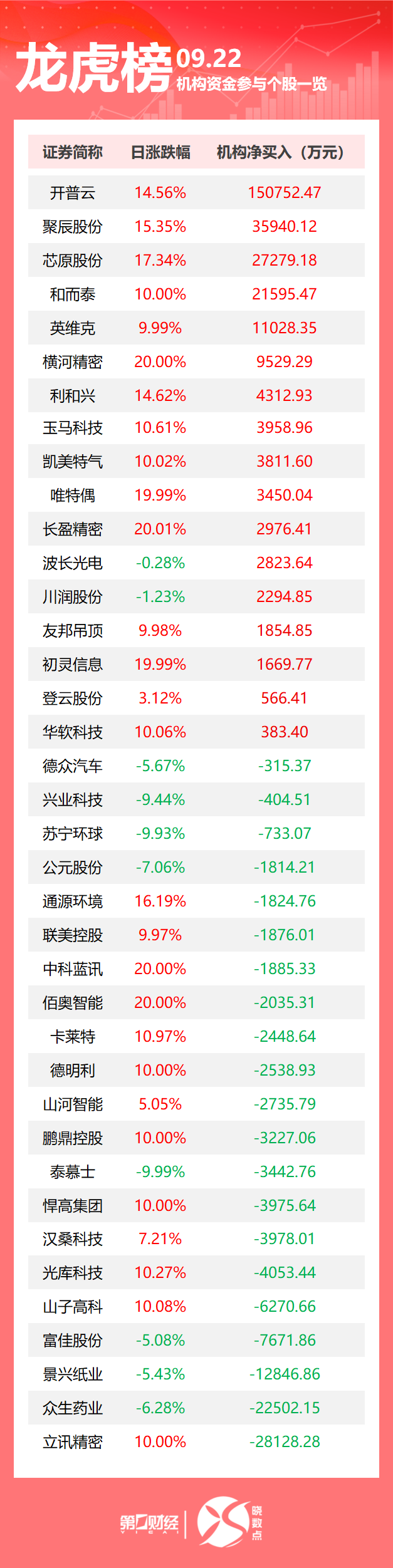
龙虎榜丨机构今日抛售这21股,买入开普云15.08亿元
Di Yi Cai Jing· 2025-09-22 10:13
Core Viewpoint - On September 22, a total of 38 stocks were involved with institutional investors, with 17 stocks showing net buying and 21 stocks showing net selling [1][2]. Institutional Net Buying - The top three stocks with the highest net buying by institutions were: - Kaipu Cloud: Net buying amount of 1.507 billion yuan, with a price increase of 14.56% [2] - Jucheng Co., Ltd.: Net buying amount of 359 million yuan, with a price increase of 15.35% [2] - Chip Origin: Net buying amount of 273 million yuan, with a price increase of 17.34% [2] Institutional Net Selling - The top three stocks with the highest net selling by institutions were: - Luxshare Precision: Net outflow amount of 281 million yuan [1] - Zhongsheng Pharmaceutical: Net outflow amount of 225 million yuan [1] - Jingxing Paper: Net outflow amount of 129 million yuan [1]





融资净买入31亿!机构却在偷偷做这件事
Sou Hu Cai Jing· 2025-09-18 08:43
Group 1 - The market appears vibrant with 22 out of 31 industries experiencing growth, highlighted by significant capital inflow into companies like CATL and SMIC [1] - Despite the surface-level excitement, underlying market dynamics suggest a more complex reality, where institutional trading behaviors significantly influence stock prices [3][4] - The concept of "washing the plate" is introduced, where institutional investors intentionally depress stock prices to create a false sense of market correction, leading retail investors to sell prematurely [3] Group 2 - Performance metrics such as earnings growth are not the sole determinants of stock success; rather, active participation from institutional funds is crucial [4] - The analysis of stock charts indicates that stocks with active institutional involvement tend to perform better, contrasting with those where institutional interest is waning [10] - The recommendation is made to focus on quantitative data to understand the true flow of capital and institutional intentions, rather than following popular stocks blindly [10]

ETF资金撤离 XBIT最新以太坊今日价格人民币机构信号明显
Sou Hu Cai Jing· 2025-08-07 14:09
Core Viewpoint - Ethereum is at a critical juncture as it experiences the largest single-day outflow from its ETF, leading to a price drop below the psychological level of $3600, shifting market sentiment from optimism to caution [1][3]. Group 1: Market Dynamics - The single-day outflow from Ethereum ETFs exceeded $500 million, marking a historical record and indicating a dramatic shift in institutional investor sentiment from stable inflows in July to widespread withdrawals [3]. - Major institutions like Fidelity have begun transferring their holdings, with 14,978 ETH (valued at $53.6 million) moved to Coinbase Prime, suggesting profit-taking or risk aversion among professional investors [3]. - The number of whale addresses has decreased by 164 in the past 30 days, indicating a reduction in market liquidity as large holders continue to sell off their positions [3]. Group 2: Price Action and Technical Indicators - Ethereum has retraced 10% from its peak of $3900 to below $3600, which appears to be a typical correction but may conceal deeper risks [4]. - The total open interest has suffered a significant loss, with over $10 billion evaporated in just ten days, reflecting a rapid exit of leveraged funds [4]. - Technical indicators show that Ethereum has formed its first significant bearish candle in months, with a weekly pullback of 9.67%, and the $3900 level is becoming a strong resistance [6]. Group 3: Market Sentiment and Future Outlook - The current market displays a contradiction between bullish positions and bearish capital flows, with Binance showing over 60% long positions while institutions continue to withdraw [7]. - The battle for the $3600 level is critical, as a sustained outflow from ETFs and whale sell-offs could trigger a liquidity cascade around the $3500 mark, where approximately $60 million in positions are concentrated [6][7]. - The outcome of the struggle at the $3600 level will significantly influence whether Ethereum can regain its upward trajectory or enter a deeper correction [9].

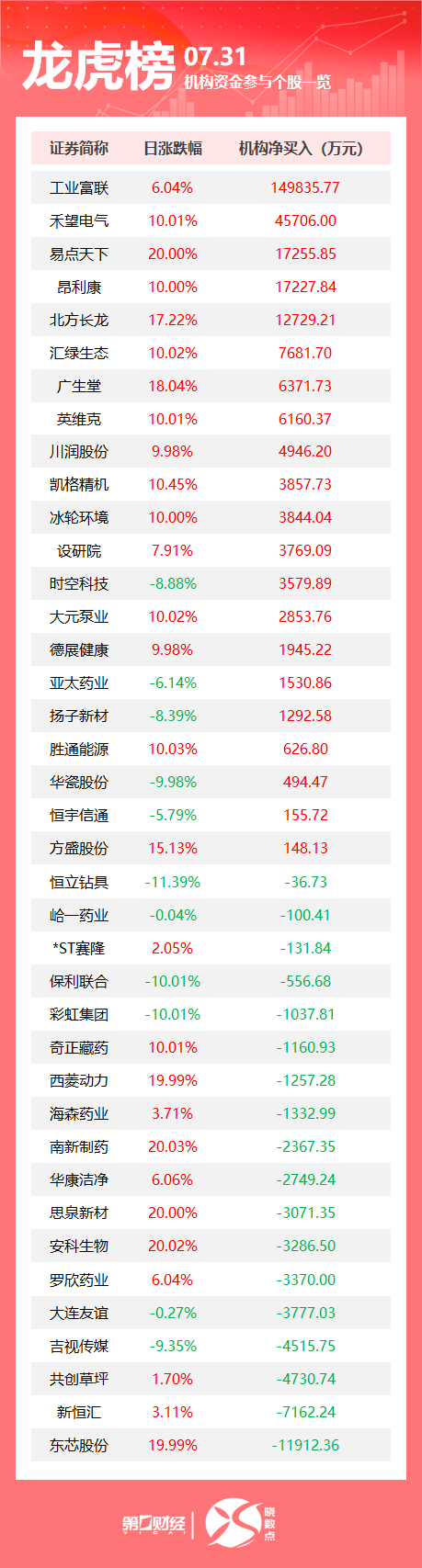
龙虎榜丨机构今日抛售这18股,买入工业富联14.98亿元
Di Yi Cai Jing· 2025-07-31 09:56
Core Insights - On July 31, institutional investors showed significant activity in the stock market, with a total of 39 stocks being involved, of which 21 experienced net buying and 18 faced net selling [1][2]. Group 1: Institutional Buying - The top three stocks with the highest net buying by institutions were Industrial Fulian, Hewei Electric, and Yidian Tianxia, with net buying amounts of 1.498 billion, 457 million, and 173 million respectively [1][2]. - Other notable stocks with institutional net buying included Anglikang (172 million), Beifang Changlong (127 million), and Huilv Ecology (76.81 million) [2]. Group 2: Institutional Selling - The top three stocks with the highest net selling by institutions were Dongxin Co., New Henghui, and Gongchuang Turf, with net selling amounts of 119 million, 71.62 million, and 47.31 million respectively [1][3]. - Additional stocks that faced net selling included Hai Sen's Industry (2.37 million) and Ji Shi Media (4.51 million) [3].



机构调研、股东增持与公司回购策略周报-20250707
Yuan Da Xin Xi· 2025-07-07 14:59
Group 1: Institutional Research Highlights - The top twenty companies with the most institutional research in the past 30 days include Ice Wheel Environment, Boshi Jie's, Jun Ding Da, Huichuan Technology, and Dazhu Laser[5] - In the last five days, the most researched companies include Hu Dian Co., Guilin Sanjin, Ice Wheel Environment, Mankalon, and Xingrong Environment[5] - Among the top twenty companies in the past 30 days, five had ten or more rating agencies, namely Ice Wheel Environment, Boshi Jie's, Jun Ding Da, Huichuan Technology, and Dazhu Laser[5] Group 2: Shareholder Increase and Buyback Situations - From June 30 to July 4, 2025, two companies announced significant shareholder increases, both having ten or more rating agencies: Renfu Pharmaceutical and Suzhou Bank[7] - From January 1 to July 4, 2025, 234 companies announced shareholder increases, with 64 having ten or more rating agencies[24] - In the same period, 288 companies announced buyback progress, with 78 having ten or more rating agencies, including Xiamen Xiangyu, Huafa Shares, Changhong Meiling, Pingmei Shares, and Mengbaihe[28] Group 3: Financial Metrics and Recommendations - The average expected buyback amount as a percentage of the market value on the announcement date exceeded 1% for companies like Xiamen Xiangyu (6.42%), Huafa Shares (3.21%), and Changhong Meiling (3.03%)[29] - For the year 2025, 1,573 companies announced buyback progress, with 345 having ten or more rating agencies, and 93 companies had a buyback amount exceeding 1% of their market value[30]


全球放水洪峰将至,抢筹倒计时!
Sou Hu Cai Jing· 2025-06-09 07:31
Group 1 - The core viewpoint is that the Federal Reserve's hesitation in lowering interest rates is seen as a strategic move, contrasting with other central banks that have acted more decisively [2][4] - The potential shift to a rate-cutting cycle by the Federal Reserve could lead to a significant change in global capital flows, historically associated with rising asset prices [4][5] - A-shares are positioned as a potential beneficiary of international capital inflows due to their valuation, but retail investors may struggle to profit despite overall market gains [5][6] Group 2 - The complexity of modern markets leads to rapid sector rotations, making it difficult for retail investors to capitalize on opportunities while incurring high transaction costs [9] - Understanding the underlying data is crucial for making informed investment decisions, as market movements can be misleading without considering institutional participation [10][12] - Institutions often create panic to induce retail investors to sell at low prices, which can be identified through specific signals in market data [13][15] Group 3 - Data serves as a reliable guide in a noisy market, allowing investors to discern the true dynamics at play rather than relying on emotional reactions [16][18] - The current global monetary policy environment is at a critical turning point, and understanding the flow of institutional capital is essential for navigating market changes [18]