
金融AI

Search documents
红杉连续领投两家AI丨投融周报
投中网· 2025-10-27 06:47
Focus Review - The hard technology sector is witnessing significant financing activities, with Jiusi Intelligent completing a $100 million B4 round led by Ant Group, raising a total of $400 million in B rounds to date [4][10]. - New Stone Technology, a provider of L4 level unmanned city distribution solutions, announced over $600 million in D round financing, led by Stone Venture from the UAE [4][21]. Health Sector - Saina Biotechnology completed a new round of financing exceeding 100 million RMB, led by Shunxi Fund and Yizhuang Guotou [5][28]. - Zhongzhi Keyi, a company specializing in ultra-fast time-resolved imaging technology, also announced over 100 million RMB in A round financing, with strong backing from various funds [5][29][30]. Internet Sector - In the AI field, Xunyu Technology secured over 100 million RMB in Pre-A round financing, co-led by GL Ventures and Sequoia China [5][39]. - LiblibAI, an AI application company, completed a $130 million B round financing, with participation from Sequoia China and CMC Capital [5][40]. Additional Financing Activities - Jitian Starship completed over 100 million RMB in A and A+ rounds, led by Shunrong Capital and Zhi Yi Investment [7]. - Renxin Technology, a high-speed vehicle SerDes chip company, announced over 100 million RMB in A+ round financing, bringing its total financing for the year to nearly 300 million RMB [8]. - Juzi Technology completed several hundred million RMB in B round financing, with investors including Shanghai Guotou and Songjiang Guotou [9]. - Eagle Semiconductor announced a B+ round financing exceeding 700 million RMB, setting a record for VCSEL startups in China [14].


东方财富(300059):证券经纪两融大增基金销售稳增 证券投资拖累整体业绩表现
Xin Lang Cai Jing· 2025-10-26 00:29
Core Insights - The company reported a total revenue of 11.59 billion yuan for Q3 2025, a year-on-year increase of 59%, with a net profit attributable to shareholders of 9.1 billion yuan, up 51% year-on-year [1] - The return on equity (ROE) was 10.74%, an increase of 2.60 percentage points year-on-year [1] Revenue Breakdown - In Q3 alone, total revenue reached 4.3 billion yuan, reflecting a 101% year-on-year growth and a 40% quarter-on-quarter increase, while net profit for the quarter was 3.57 billion yuan, up 78% year-on-year and 22% quarter-on-quarter [1] - The company's commission and fee income rose by 87% year-on-year, while net interest income increased by 60% [2] - The revenue structure showed that commission income, operating revenue, interest income, and proprietary trading income accounted for 48%, 18%, 17%, and 14% of total revenue, respectively [2] Market Position and Performance - The average daily trading amount for the entire A-share market was 1.6496 trillion yuan, a 107% increase year-on-year [3] - The company's net commission income from securities brokerage increased by 87% to 6.64 billion yuan [3] - The average daily balance of margin financing and securities lending rose by 30% year-on-year, with the company's market share in this area at 3.17%, a year-on-year increase of 0.11 percentage points [3] Fund Distribution and Sales - The average scale of equity funds in the market increased by 26% year-on-year, with new equity fund issuance up 200% [4] - The company's revenue from fund distribution grew by 13% to 2.54 billion yuan, although it underperformed compared to industry standards due to declining distribution fees [4] Investment Performance - The company's financial assets reached 106.95 billion yuan, a 12% increase year-on-year, but securities investment income fell by 18% to 1.97 billion yuan [5] - The annualized investment return rate was 2.53%, down 1.18 percentage points year-on-year [5] Expense Management - Sales expenses increased by 21% to 260 million yuan, while management expenses rose by 12% to 1.9 billion yuan [6] - Research and development expenses decreased by 11% to 750 million yuan, with the profit margin at 65.4%, an increase of 5.5 percentage points year-on-year [6] Investment Outlook - The company adjusted its revenue forecasts for 2025-2027 to 16.7 billion, 19.03 billion, and 21.1 billion yuan, respectively, and EPS estimates to 0.82, 0.95, and 1.10 yuan [7] - The company maintains a "buy" rating, citing strong growth potential in the capital market and advantages in internet brokerage, wealth management, and financial AI [7]

东方财富(300059):证券经纪两融大增基金销售稳增,证券投资拖累整体业绩表现
HUAXI Securities· 2025-10-25 14:57
Investment Rating - The investment rating for the company is "Buy" [6] Core Insights - The company reported a total revenue of 11.59 billion yuan for Q3 2025, a year-on-year increase of 59%, and a net profit attributable to shareholders of 9.10 billion yuan, up 51% year-on-year [1] - The revenue structure shows that commission income, operating income, interest income, and proprietary trading income accounted for 48%, 18%, 17%, and 14% of total revenue, respectively [2] - The company’s market share in financing business increased year-on-year, with a daily average balance of margin financing and securities lending reaching 1.94 billion yuan, a 30% increase year-on-year [3] - The company’s fund distribution revenue increased by 13% year-on-year to 2.54 billion yuan, although it underperformed compared to industry standards [4] - The company’s financial assets reached 106.95 billion yuan, a 12% increase year-on-year, but investment income decreased by 18% to 1.97 billion yuan [5] Revenue and Profitability Analysis - The company’s total revenue for 2025 is projected to be 16.70 billion yuan, with a year-on-year growth of 44% [9] - The net profit for 2025 is expected to be 12.89 billion yuan, reflecting a 34% increase year-on-year [11] - The profit margin for the reporting period was 65.4%, an increase of 5.5 percentage points year-on-year [8] Financial Forecast - The earnings per share (EPS) for 2025 is projected to be 0.82 yuan, with a price-to-earnings (P/E) ratio of 31.7 [9][11] - The company’s return on equity (ROE) is expected to reach 15% by 2025 [11]
同花顺(300033):9M25业绩点评:业绩超预期 景气上行+AI赋能驱动成长
Xin Lang Cai Jing· 2025-10-23 10:36
Core Viewpoint - Tonghuashun's Q3 2025 performance exceeded expectations, driven by high trading activity and growth in value-added telecom services and advertising business [1][2] Financial Performance - For the first nine months of 2025, the company achieved total revenue of 3.26 billion yuan, a year-on-year increase of 39.7%, and a net profit attributable to shareholders of 1.21 billion yuan, up 85.3% year-on-year [1] - In Q3 2025, the company reported revenue of 1.48 billion yuan, a year-on-year increase of 56.7%, and a net profit of 700 million yuan, up 144.5% year-on-year [1] - The company's cash inflow from sales of goods and services for the first nine months of 2025 was 4.5 billion yuan, a year-on-year increase of 77.8% [2] Business Segments - The value-added telecom services and advertising business are expected to maintain high growth momentum due to sufficient orders and strong customer advantages [2] - The average daily trading volume in the stock market reached 2.06 trillion yuan in Q3 2025, a year-on-year increase of 155.4%, boosting demand for financial information services [1] Cost Management - The company has effectively controlled expenses in 2025, with R&D expenses, sales expenses, and management expenses recorded at 860 million, 530 million, and 200 million yuan respectively [1] - The R&D expense ratio, sales expense ratio, and management expense ratio were 26.5%, 16.3%, and 6.2%, showing a decrease compared to the previous year [1] AI Strategy - The company is advancing its AI strategy, integrating large models with business operations, and continuously innovating products and strategic partnerships [2] - In July 2025, the company upgraded its AI product, significantly improving its capabilities and reducing errors [2] Investment Outlook - As a leader in financial AI, the company is expected to achieve net profits of 2.97 billion, 3.50 billion, and 3.82 billion yuan from 2025 to 2027, with respective year-on-year growth rates of 63%, 18%, and 9% [3] - The current closing price corresponds to a dynamic PE of 72.5x, 61.5x, and 56.5x for 2025-2027E [3]

【风口研报】布局机器人领域轴向磁通电机+数据中心SOFC,这家传统电机公司打造新增长曲线,估值有望重塑
财联社· 2025-09-22 10:34
Group 1 - The article highlights the potential of a traditional motor company that is venturing into the robot sector with axial flux motors and data center SOFC, indicating a new growth curve and a potential revaluation of its stock [1] - A bank is exploring significant growth opportunities in the credit market by collaborating with Ant Group, focusing on financial AI agents, which could lead to geometric growth in net profit next year [1]

马斯克转发字节Seed&哥大商学院新基准:大模型搞金融,连查个股价都能出错
Sou Hu Cai Jing· 2025-09-21 02:34
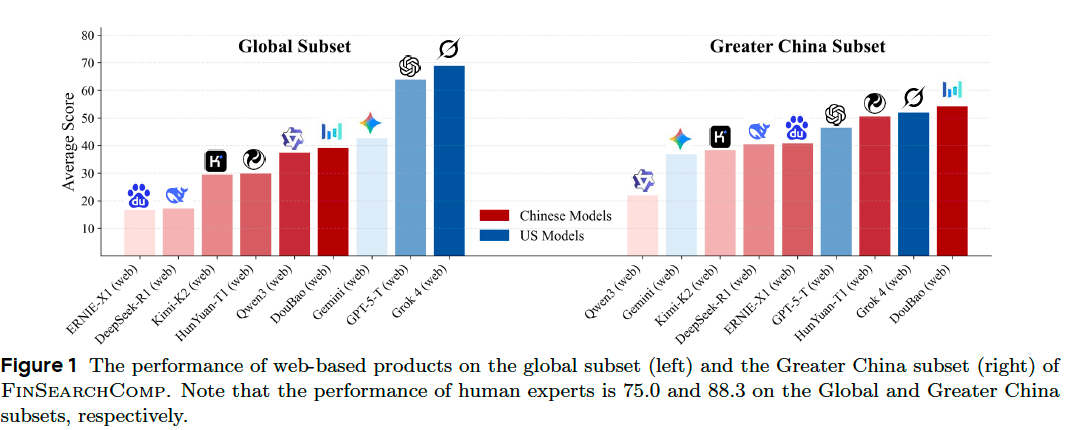
Core Insights - The article discusses the launch of FinSearchComp, an open-source financial search and reasoning benchmark developed by ByteDance's Seed team in collaboration with Columbia Business School, aimed at evaluating AI's performance in financial analysis tasks [1][3][5] Evaluation Results - The best-performing model, Grok 4 (web), achieved an accuracy of 68.9% on the global dataset, which is still 6.1 percentage points behind human experts. In the Greater China dataset, Doubao (web) led with an accuracy of 53.3%, falling short by over 34 percentage points compared to human experts' 88.3% [1][11] Task Design - FinSearchComp includes three progressively challenging task categories that reflect the complexity of financial analysts' daily work: 1. Time-sensitive data fetching, focusing on real-time data like stock prices [7] 2. Simple historical lookup, requiring fixed-point fact retrieval [7] 3. Complex historical investigation, demanding multi-period aggregation and analysis [7] Data Reliability - The benchmark's quality is supported by ByteDance's Xpert platform, which provides expert knowledge and high-quality AI training data. The project involved 70 financial experts, ensuring data reliability through cross-validation from official sources and professional financial databases [9][10] Importance of Search Capability - The evaluation highlighted the critical role of search capabilities, with models equipped with web search functionality showing significant performance improvements across tasks. Models without search capabilities scored zero on time-sensitive tasks, emphasizing the necessity of real-time data access for accurate financial analysis [12][11] Industry Implications - The findings suggest that while AI can assist in financial data retrieval, it still has considerable room for improvement. The article advocates for the establishment of a comprehensive evaluation system for financial AI, akin to a "driving license" for AI products, to ensure reliability before they can fully replace human analysts [13]
恒生聚源总经理吴震操:未来金融AI发展的突破口在于场景化应用
2 1 Shi Ji Jing Ji Bao Dao· 2025-09-18 08:05
Core Viewpoint - The current domestic engineering models, particularly in core technologies like graph computing, are at a globally leading level, but many excellent results remain in the laboratory stage. The breakthrough for future financial AI development lies in "scenario-based applications" [1] Group 1: Scenario-Based Applications - To promote scenario-based applications, it is suggested to leverage capital markets and equity investment mechanisms to establish effective channels for transforming scientific research achievements into enterprises [1] - There is a need to connect scientific research capabilities, industry demands, and capital through a collaborative chain, clarifying the roles and functions of each party involved [1] - The goal is to facilitate the transition of high-quality research results from laboratories to practical applications within the industry [1]
智能金融新纪元:大模型重塑行业生态的深度观察
Guan Cha Zhe Wang· 2025-09-05 07:09
Group 1: Core Insights - The financial industry is undergoing an unprecedented intelligent transformation in 2025, marking a critical turning point for the practical application of financial large models [1] - Four core elements—regulatory policy improvement, significant reduction in GPU computing costs, continuous enhancement of foundational model performance, and a richer application ecosystem—are redefining the industry landscape [1] - The focus of industry discussions has shifted from "whether to adopt" to "how to implement faster and better" [1] Group 2: Evaluation Framework - A new evaluation framework is being explored to accurately assess the performance of intelligent systems in real business scenarios, moving beyond traditional superficial testing methods [2] - This new assessment system extracts key elements from the daily operations of financial institutions, transforming specific business pain points into systematic testing projects [2][4] - The advanced evaluation benchmarks typically include tens of thousands to hundreds of thousands of test samples, reflecting the complexity and diversity of information processing in financial work [3] Group 3: Application in Investment Advisory and Research - Large model technology is profoundly changing traditional work patterns in investment advisory and research, significantly improving service quality and decision-making accuracy [5] - Leading fintech platforms are supporting millions of daily active users through a robust "tools + services + compliance" capability architecture [5] - Smart investment advisory platforms utilize a multi-channel deployment strategy, allowing financial institutions to reach users effectively across various platforms [6] Group 4: Smart Financial Terminals - The emergence of smart financial terminals signifies a fundamental transformation in research workflows, integrating financial large models with professional data services [6][7] - These systems inherit comprehensive coverage capabilities for various financial data and ensure rapid verification and retrieval of data indicators [7] - The "data-logical-outcome" three-stage transition model enhances research efficiency and ensures that every conclusion is traceable and substantiated [7]
阿里“通义点金”重磅出击!32B模型霸榜金融AI,2000亿美元市场蛋糕谁来分?
Sou Hu Cai Jing· 2025-08-26 06:47
Core Insights - The launch of "Tongyi Dianjin" by Alibaba Cloud is set to revolutionize the financial AI landscape, providing a one-stop development platform tailored for financial scenarios [1][4] - The platform's core technology, the DianJin-R1 pre-trained model series, includes versions of 7B, 13B, and 32B, which excel in interpreting complex financial data and analyzing financial news [1][3] - The integration of over 25TB of financial data and the introduction of version 2.0 significantly enhance the platform's capabilities, allowing for rapid customization and deployment of financial applications [3][4] Technology and Data Resources - The DianJin-R1 model series has demonstrated exceptional performance in financial reasoning tasks, particularly the 32B model, which has consistently ranked at the top in industry evaluations [1] - The platform offers a rich dataset that includes financial news, research reports, and meeting records, providing a robust foundation for developers to create various financial applications [1][3] - Standardized API interfaces facilitate easy integration of functionalities into web pages, mini-programs, or enterprise systems, enhancing development efficiency [3] Market Potential - A McKinsey report indicates that generative AI technology could generate an additional value of $200 billion to $340 billion for the global financial industry, highlighting the significant market opportunity for Tongyi Dianjin [4] - The collaboration between Tongyi Dianjin and Alibaba Cloud's Bailian platform creates an open product ecosystem, offering diverse model choices and component configurations, which lowers technical barriers for clients [5] Strategic Vision - The product's core philosophy emphasizes simplifying complex underlying technology for financial institutions, allowing them to focus on optimizing business logic and achieving cost reduction and efficiency [3] - The comprehensive advantages of Tongyi Dianjin are expected to drive significant energy in the financial technology sector, especially as the industry accelerates its digital transformation [5] - Tongyi Dianjin represents not only Alibaba Cloud's technological prowess but also a significant step for the financial industry in embracing the future of artificial intelligence [5]
同花顺(300033):好于预期 交投业绩弹性显现
Xin Lang Cai Jing· 2025-08-24 14:39
Core Viewpoint - The company reported better-than-expected results for the first half of 2025, driven by high trading activity and growth in value-added telecommunications and advertising services [1][4]. Financial Performance - In 1H25, the company achieved total revenue of 1.78 billion yuan, a year-on-year increase of 28.1%, and a net profit attributable to shareholders of 500 million yuan, up 38.3% year-on-year [1]. - For Q2 2025, the net profit attributable to shareholders was 380 million yuan, reflecting a year-on-year increase of 47.3% and a quarter-on-quarter increase of 217% [1]. - Revenue contributions from various segments in 1H25 included value-added telecommunications services (860 million yuan, +11.9% YoY), software sales and maintenance (110 million yuan, +7.7% YoY), advertising and internet services (640 million yuan, +83.2% YoY), and fund sales and other services (170 million yuan, -0.04% YoY) [1]. Profitability and Cost Management - The gross profit margins for different business segments in 1H25 were as follows: value-added telecommunications services (83.2%), software sales and maintenance (81.1%), advertising and internet services (93.4%), and fund sales and other services (85.4%) [2]. - The company effectively managed expenses, with R&D expenses at 580 million yuan (down 1.9% YoY), sales expenses at 330 million yuan (up 38.2% YoY), and management expenses at 120 million yuan (up 8.8% YoY) [2]. - The expense ratios for R&D, sales, and management were 32.6%, 18.8%, and 7.0%, respectively, with R&D expenses decreasing by 9.98 percentage points YoY [2]. Business Outlook - The company has a strong order backlog in value-added telecommunications, and customer base advantages are expected to drive continued revenue growth in the second half of 2025 [3]. - The cash inflow from sales of goods and services in 1H25 was 2.72 billion yuan, a year-on-year increase of 73.1%, with contract liabilities at 2.31 billion yuan, up 55.7% from the end of 2024 [3]. - The active user base for the company's stock trading app reached 35.01 million in July 2025, a slight decrease of 3.5% from the beginning of the year, maintaining its position as a leader in the securities service application sector [3]. Technological Advancements - The company has integrated advanced large model technology into its financial information services, enhancing product applications [4]. - Significant upgrades to intelligent products were made in 1H25, including the evolution of the "Wencai Investment Assistant" into a self-planning reasoning intelligent agent [4]. - The company established and open-sourced the world's first evaluation benchmark for large language models designed for real financial scenarios, covering over 100,000 high-quality Chinese financial Q&A data [4]. Investment Analysis - The company is positioned as a leader in financial AI, with strong growth potential in its core businesses due to high trading activity and ongoing investments in AI [4]. - Projected net profits for the company from 2025 to 2027 are 2.66 billion yuan, 3.01 billion yuan, and 3.37 billion yuan, representing year-on-year growth rates of 46%, 13%, and 12%, respectively [4].