
金融AI

Search documents
讯兔科技(Alpha派)完成近2亿元A轮融资:金融行业是AI垂直落地的最优赛道
IPO早知道· 2026-03-26 10:24
Core Viewpoint - XunTu Technology (Alpha Pai) has successfully completed nearly 200 million RMB in Series A financing, marking a significant achievement in a short span of five months since its previous funding round [2]. Group 1: Financing and Investment - The latest funding round was led by top-tier venture capital firms including Qiming Venture Partners, Sequoia China, and Hillhouse Capital, with participation from other investors such as Guangfa Qianhe and Xincheng Capital [2]. - The capital structure includes a mix of leading VCs, strategic industry capital, and continued support from existing shareholders, indicating strong confidence in the company's growth potential [2]. Group 2: Product and Market Position - Alpha Pai, as a pioneer in the financial AI sector, focuses on enhancing research efficiency for investment institutions, having served over 80,000 investment professionals and covering more than 6,000 institutions, with a penetration rate of 90% among top-tier firms [2]. - The product has evolved from a mere efficiency tool to an "AI researcher," showcasing significant growth potential and adapting to user needs [3]. Group 3: Strategic Vision and Ecosystem Development - XunTu Technology is advancing its Agent ecosystem strategy, collaborating with over 40 brokerage research institutions and data service providers to explore new service standards and business models in the Agent era [4]. - The company emphasizes the importance of collaboration and innovation in a rapidly changing market, aiming to create a value network that supports industry transformation [4]. Group 4: Industry Insights and Future Outlook - Investors believe that 2026 will be a breakout year for vertical AI applications, particularly in the financial sector, which is characterized by high data density and complex workflows [5]. - XunTu Technology is positioned to capitalize on this opportunity, having demonstrated impressive evolution and integration of AI capabilities into financial institutions' daily operations [5][6].


金融Agent再获近2亿加码!启明红杉高瓴集体押注,5个月内连获两轮融资
量子位· 2026-03-26 07:34
Core Viewpoint - Recently, financial AI leader XunTu Technology (Alpha Pai) completed nearly 200 million yuan in Series A financing, indicating strong institutional support and confidence in its business model and growth potential [1][2]. Group 1: Financing and Investment - XunTu Technology secured this round of financing from top-tier investors including Qiming Venture Partners, Sequoia China, and Hillhouse Capital, with additional participation from Guangfa Qianhe and Xincheng Capital, among others [2]. - The financing reflects the company's unique value in the financial AI sector and provides dual momentum for internal growth and external ecosystem expansion [3]. Group 2: Team and Expertise - The core team of XunTu Technology consists of members from leading asset management institutions, possessing rare investment research genes and extensive experience in digital transformation within top public funds [4][5]. - This deep understanding of investment research scenarios and the integration of financial know-how with AI capabilities are key drivers of the company's leadership in the financial AI sector [5]. Group 3: Product Development and Market Position - XunTu Technology's flagship product, Alpha Pai, has evolved from an efficiency tool to an "AI researcher," significantly enhancing the efficiency of institutional investment research [6][8]. - Alpha Pai has served over 80,000 investment research personnel and covers more than 6,000 institutions, achieving a 90% penetration rate among top institutions, establishing a long-term competitive advantage [7]. Group 4: Future Growth and Market Expansion - The company anticipates exponential growth in human-computer interaction for AI Agent applications by 2025, indicating a shift in industry research habits and positioning Alpha Pai as a new entry point for investment research [9][10]. - XunTu Technology is expanding its client base into primary markets and banking insurance, opening up broader market opportunities and reinforcing the underlying logic for continued investment in the capital market [11]. Group 5: Industry Insights and Trends - The financial sector is witnessing a significant transformation driven by AI, with XunTu Technology positioned as a leader in this vertical application, capitalizing on the industry's data-rich and complex decision-making environment [15][20]. - Investors recognize the company's core barriers and the future evolution of financial AI, highlighting the importance of deep industry knowledge and the ability to address pain points in the financial services sector [18][26].

万得 AI,个人版来了!
Wind万得· 2026-03-25 01:16
Core Viewpoint - Wind has launched Wind Alice, a professional financial AI platform aimed at individual financial professionals, marking a significant shift from its traditional focus on institutional clients [5][46]. Group 1: Introduction of Wind Alice - Wind Alice is designed for individual users in the financial sector, including financial advisors, investment bankers, and analysts, providing them with professional AI capabilities [5][6]. - This product represents Wind's first effort to extend its professional financial AI services to a broader audience beyond institutional users [4][46]. Group 2: Functionality and Features - Wind Alice is not a general chat AI; it is a native financial work platform that assists users in understanding markets, analyzing companies, and completing financial tasks [8][9]. - The platform integrates a wide range of professional data, tools, and financial analysis capabilities, enabling users to perform complex financial tasks efficiently [16][19]. - Wind Alice can automate various financial tasks, such as data retrieval, analysis, and report generation, effectively acting as a financial team condensed into a single account [10][20]. Group 3: Practical Applications - Users can leverage Wind Alice for specific financial inquiries, such as comparing stock performances or generating investment recommendations based on client needs [21][24]. - The platform can assist in deep research projects by organizing tasks, managing multiple agents, and delivering comprehensive reports [36]. - Wind Alice can also streamline the creation of presentation materials, such as investment roadshows, by automating data collection and report formatting [38][40]. Group 4: Unique Selling Proposition - Wind Alice differentiates itself from general AI by focusing on actionable insights and practical outputs rather than just conversational capabilities [16][45]. - The platform is built on Wind's extensive financial data foundation, ensuring that the information provided is accurate, timely, and relevant to financial professionals [16][46].

东吴证券晨会纪要-20260323
Soochow Securities· 2026-03-23 01:42
Macro Strategy - The March FOMC meeting maintained the policy interest rate unchanged, with only one dissenting vote, and the dot plot indicates one rate cut for the year, which initially led to a dovish market reaction. However, Powell's hawkish signals regarding inflation and geopolitical tensions have led to a withdrawal of rate cut expectations [1][13][14] - The decision on rate cuts by the Federal Reserve will depend on oil prices, with a potential second peak if the Strait is blocked for two months or more, which could eliminate the possibility of rate cuts this year [1][13][14] - The hawkish signals from Powell suggest that the Fed's rate hike decisions are more constrained by economic and political pressures, indicating that any rate hikes would be a response to uncontrollable inflation [1][13][14] Fixed Income Market - The report highlights a structural change in the bond supply in China, with a focus on the differences in debt management between China and the US, emphasizing tactical defense and strategic restructuring in the current contrasting interest rate cycles [2][15] - The bond supply structure in China is influenced by market anxiety and trading activity, which will have significant implications for monetary policy and the establishment of a pricing benchmark for RMB assets [2][15] - The report notes that the yield curve is steepening, driven by expectations of lower short-term rates due to potential adjustments in deposit rates and rising inflation expectations [3][17] Company Analysis - **Feilong Co., Ltd. (002536)**: The company's net profit forecasts for 2026-2027 have been revised down to 420 million and 556 million yuan respectively, due to increased competition and a decline in gross margins. Despite this, the company is expected to maintain a "buy" rating due to its ongoing expansion in the liquid cooling sector [6] - **Leap Motor (09863.HK)**: The net profit forecasts for 2026-2027 have been adjusted down to 2.6 billion and 4.5 billion yuan respectively, reflecting increased competition and rising raw material costs. The company is still rated as a "buy" due to the strong product cycle with new models launching [6] - **Fuyou Glass (600660)**: The company reported a revenue of 12.486 billion yuan in Q4 2025, a year-on-year increase of 14.15%. The gross margin for Q4 was 37.03%, slightly down from the previous quarter, indicating strong competitive advantages in the automotive glass market [7][8] - **Bulu Co. (00325.HK)**: The company's net profit forecasts for 2026-2027 have been revised down to 850 million and 1.11 billion yuan respectively, due to pressure on overall gross margins from increased competition. The company is still rated as a "buy" due to its strong IP commercialization capabilities [9] - **Xinquan Co. (603179)**: The net profit forecasts for 2026-2027 have been adjusted down to 1.069 billion and 1.374 billion yuan respectively, as the company accelerates its global expansion and invests in emerging industries. The company maintains a "buy" rating [10] - **Dongfang Wealth (300059)**: The net profit forecasts for 2026-2028 have been raised to 15.6 billion, 18.9 billion, and 23 billion yuan respectively, reflecting the company's strong position in the retail brokerage sector and its advantages in financial AI [11] - **Zhong An Online (06060.HK)**: The net profit forecasts for 2026-2028 have been revised down to 1.3 billion, 1.6 billion, and 1.9 billion yuan respectively, but the company is still expected to maintain a "buy" rating due to its competitive advantages in the internet insurance market [12]
同花顺:新品发布:iFind MCP+数据库+iFinD Claw,一键自提投研Agent-20260312
GOLDEN SUN SECURITIES· 2026-03-12 08:24
Investment Rating - The report maintains a "Buy" rating for the company [3] Core Insights - The company has launched the iFinD MCP product, which integrates professional financial data for AI interactions, supporting various dimensions such as stock aliases and industry classifications [1] - The self-developed iFinD Claw solution is set to be released, offering a zero-configuration, one-click deployment for users, enhancing the investment analysis environment [2] - The company's annual report exceeded expectations, with Q4 2025 revenue reaching 2.768 billion RMB, a year-on-year increase of 49.46% and a quarter-on-quarter increase of 86.85% [2] Financial Performance - The company reported a net profit of 1.999 billion RMB for Q4 2025, up 70.51% year-on-year and 183.79% quarter-on-quarter [2] - The company plans to distribute a cash dividend of 51 RMB per 10 shares, totaling 2.742 billion RMB, and to increase capital stock by 4 shares for every 10 shares held [3] - Projected revenues for 2026-2028 are estimated at 8.413 billion, 10.476 billion, and 12.354 billion RMB respectively, with net profits of 3.993 billion, 4.909 billion, and 5.772 billion RMB [3] Financial Metrics - The company’s revenue for 2025 is projected at 6.029 billion RMB, with a year-on-year growth rate of 44% [4] - The latest diluted EPS is expected to be 5.96 RMB for 2025, increasing to 10.74 RMB by 2028 [4] - The net asset return rate is projected to reach 50.9% by 2028 [4]

同花顺(300033):iFindMCP+数据库+iFinDClaw,一键自提投研Agent
GOLDEN SUN SECURITIES· 2026-03-12 08:10
Investment Rating - The report maintains a "Buy" rating for the company [3][5] Core Insights - The company has launched the iFinD MCP product, which integrates professional financial data for AI interactions, supporting various dimensions such as stock aliases and industry classifications [1] - The self-developed iFinD Claw solution is set to be released, offering a zero-configuration, one-click deployment for users, enhancing the investment research environment [2] - The company's annual report exceeded expectations, with Q4 2025 revenue reaching 2.768 billion RMB, a year-on-year increase of 49.46% and a quarter-on-quarter increase of 86.85% [2] Financial Performance - The company reported a net profit of 1.999 billion RMB for Q4 2025, up 70.51% year-on-year and 183.79% quarter-on-quarter [2] - The projected revenues for 2026, 2027, and 2028 are 8.413 billion RMB, 10.476 billion RMB, and 12.354 billion RMB respectively, with corresponding net profits of 3.993 billion RMB, 4.909 billion RMB, and 5.772 billion RMB [3][4] - The company plans to distribute a cash dividend of 51 RMB per 10 shares, totaling approximately 2.742 billion RMB, alongside a capital reserve conversion of 4 shares for every 10 shares held [3] Financial Metrics - The company's revenue for 2025 is projected at 6.029 billion RMB, with a year-on-year growth rate of 44% [4] - The latest diluted EPS is expected to be 5.96 RMB per share for 2025, with a projected P/E ratio of 54.5 [4] - The net asset return rate is projected to reach 33.8% in 2025, increasing to 50.9% by 2028 [4]
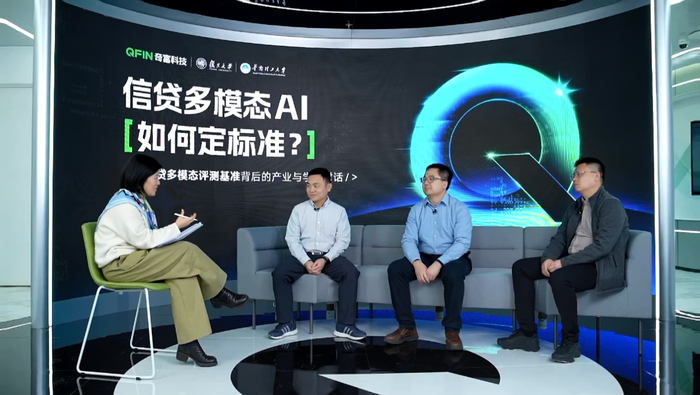
奇富科技开启直播 探讨信贷多模态AI如何定标准
Zheng Quan Ri Bao· 2026-02-06 09:44
Group 1 - The core discussion revolves around the necessity of a unified standard for the practical implementation of AI in finance, as highlighted by industry experts [1][3] - Yang Yehui from Qifu Technology emphasizes that AI serves as a tool in high-barrier industries like finance and healthcare, which are likened to fertile land for AI applications [1] - The FCMBench framework aims to create a standardized evaluation system for financial AI models, addressing the confusion among financial institutions regarding model selection [1] Group 2 - Professor Xu Yanwu from South China University of Technology points out that AI has already made significant contributions in areas such as insurance pricing, asset evaluation, and quantitative trading, although these impacts may not be visible in consumer-facing products [2] - Professor Chen Tao from Fudan University stresses the importance of developing a financial reasoning chain within AI models, moving beyond generic pre-training and fine-tuning to ensure models understand interest rates, regulations, and risks [4]
寻找金融领域的ImageNet——首个信贷多模态评测基准背后的产业与学术对话
Xin Lang Cai Jing· 2026-02-06 04:07
Core Viewpoint - The discussion centered around the establishment of a standardized evaluation benchmark for credit multi-modal AI, named FCMBench-V1.0, which aims to provide a widely recognized measurement tool for financial AI applications [1][3]. Group 1: FCMBench-V1.0 Overview - FCMBench-V1.0 is the first evaluation benchmark specifically designed for credit scenarios, developed by Qifu Technology in collaboration with researchers from Fudan University and South China University of Technology [1][3]. - The benchmark is based on real credit business scenarios and focuses on key aspects such as multi-modal perception, reasoning, and decision-making [1][3]. - It includes an open-source dataset and evaluation tools, aiming to create a reliable "ruler" for financial AI [1][3]. Group 2: Importance of Standardization - The lack of a unified standard makes it difficult for financial AI to be effectively implemented, as highlighted by industry experts during the discussion [3][5]. - Qifu Technology's multi-modal head, Dr. Yang Yehui, emphasized that without a fair and transparent evaluation system, financial institutions struggle to choose between models claiming different performance scores [5]. - FCMBench aims to level the playing field by allowing models to be tested under real business conditions, thus providing clarity in decision-making [5]. Group 3: Insights from Experts - Professor Xu Yanwu from South China University of Technology noted that AI is already deeply involved in areas like insurance pricing and asset evaluation, even if its presence in consumer-facing products is not obvious [5][6]. - He also pointed out that the shorter business iteration cycles in finance provide a conducive environment for model evaluation and updates [6]. - Professor Chen Tao from Fudan University compared the current stage of financial AI to the early days of deep learning, emphasizing the need for a significant evaluation benchmark like FCMBench to unify standards in the industry [8][11]. Group 4: Future Directions - The discussion concluded with a call for continued collaboration among industry, academia, and research institutions to scale and standardize financial AI [11]. - The host, Yang Xuan, expressed the hope for more partners to engage in dataset testing and evaluation, aiming to develop a "financial ImageNet" through collaborative efforts [11].

专访丨讯兔科技创始人李罗丹:金融AI正从“助理时代”向“师徒时代”演进
Zhong Guo Ji Jin Bao· 2026-01-26 06:38
Core Insights - Financial AI is evolving from an "assistant era" to a "mentor-mentee era," where AI will increasingly embody the implicit knowledge of experienced professionals [1][4][10] - The goal is for AI systems like Alpha to develop capabilities akin to a fund manager's assistant by around 2027, transforming into a new financial infrastructure [1][9][13] Group 1: Evolution of Financial AI - The transition from "assistant" to "mentor" signifies a shift from handling explicit knowledge to understanding implicit knowledge, which is crucial in investment research [4][5] - Implicit knowledge involves the know-how and nuances that are difficult to articulate and typically shared through long-term interactions [5][6] - AI's development will focus on deepening interactions, allowing it to learn and adapt to individual preferences and thought processes [10][11] Group 2: Current Capabilities and Future Directions - Currently, Alpha is at a "mid-level researcher" stage, with aspirations to reach "junior researcher" status by early 2025 and "senior researcher" by 2026 [9][10] - The most significant challenge in evolving to a fund manager's assistant is achieving memory and adaptability to individual fund managers' needs [10][12] - Future interactions will shift from simple Q&A to a more integrated workspace where AI can proactively provide insights and manage tasks [11][12] Group 3: Data Security and Personalization - The uniqueness of each AI "mentee" ensures that the knowledge and data remain private and tailored to individual users, enhancing data security [6][10] - Trust and data compliance are essential for establishing a true mentor-mentee relationship, as personalized data must remain accessible only to the owner [6][10] Group 4: Market Dynamics and Infrastructure - The financial industry is undergoing significant changes, necessitating new infrastructure that can handle the demands of AI and 24/7 trading environments [13][14] - Companies are increasingly viewing AI as integral to their business rather than just a tool, leading to a shift in resource allocation towards AI capabilities [15][16] - The competitive landscape will see a divide between companies focused on interaction and those providing data and capabilities, emphasizing the need for strong partnerships [16][17]

讯兔科技创始人李罗丹:金融AI正从“助理时代”向“师徒时代”演进
Zhong Guo Ji Jin Bao· 2026-01-26 06:36
Core Insights - Financial AI is evolving from an "assistant era" to a "mentor-mentee era," focusing on transforming tacit knowledge into reusable capabilities [1][2] - The company aims to develop its AI product, Alpha, into a personalized agent capable of assisting fund managers by 2027 [1][8] Group 1: Evolution of Financial AI - The transition from "assistant" to "mentor" signifies a shift from handling explicit knowledge to understanding and replicating tacit knowledge [2][3] - The future AI will learn through long-term interactions, becoming more aligned with the user's thinking and preferences [3][10] Group 2: Challenges and Development - The biggest challenge in evolving AI to a fund manager assistant is achieving memory and adaptability to individual preferences [9] - The company envisions its AI product progressing through stages, with 2023 representing an intern phase and aiming for a junior researcher level by early 2025 [8] Group 3: Data and Security - The mentor-mentee relationship relies on personalized data, which is considered a private asset that cannot be shared or utilized by others [4][5] - Data compliance and permission management are fundamental to ensuring trust and deep alignment in the mentor-mentee relationship [5] Group 4: Market Position and Infrastructure - The company aims to become a new type of infrastructure in the financial sector, addressing the need for updated systems that can handle 24/7 global investment activities [13][14] - The shift in perception among financial institutions has led to AI being viewed as integral to business rather than just a digital tool [14] Group 5: Competitive Landscape - The financial AI sector is becoming increasingly competitive, with the need for companies to establish barriers in talent, product, and data [15] - Future differentiation will depend on the ability to create interactive platforms and build strong relationships with data providers [15]