预制菜国标

Search documents
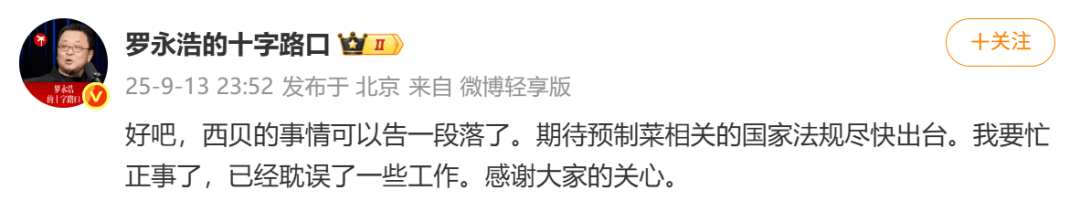
罗永浩发文:西贝的事可以告一段落了
Sou Hu Cai Jing· 2025-09-14 03:49
Core Viewpoint - The discussion around pre-prepared meals (pre-cooked dishes) has intensified, particularly following the controversy involving the restaurant chain Xibei and its use of such meals, with calls for clearer regulations in the industry [1][4]. Group 1: Industry Developments - The draft national standards for pre-prepared meals have passed review and are expected to be open for public consultation soon, indicating a move towards formal regulation in this sector [1]. - The controversy surrounding Xibei has highlighted the transparency issues regarding the use of pre-prepared meals in restaurants, with the company claiming all 370 of its locations are open to public scrutiny [4]. Group 2: Company Reactions - Luo Yonghao, a prominent figure in the discussion, expressed his support for pre-prepared meals under certain circumstances, emphasizing the need for consumer awareness regarding their use in restaurants [1]. - Following Luo's criticism of Xibei for its reliance on pre-prepared meals, the company’s representative, Jia Guolong, announced intentions to sue Luo, escalating the public dispute [4].

刚刚,罗永浩发文:太好了,万众期待!!!
第一财经· 2025-09-13 08:20
Core Viewpoint - The article discusses the approval of a national standard draft requiring restaurants to disclose the use of pre-prepared dishes, emphasizing consumer rights to know about the food they are consuming [1] Group 1 - The national standard draft has been approved and will soon be open for public consultation, indicating a regulatory shift in the food service industry [1] - The article highlights the growing acceptance of pre-prepared dishes in restaurants, with consumers increasingly opting for convenience [1] - The importance of transparency is underscored, as consumers have the right to be informed about whether restaurants use pre-prepared dishes [1]

罗永浩与西贝的预制菜争议引爆行业 消费者为何“谈虎色变”
Di Yi Cai Jing· 2025-09-12 15:00
Core Viewpoint - The controversy surrounding pre-prepared dishes (pre-made meals) highlights the tension between consumer rights to information and the industry's practices, as exemplified by the dispute between entrepreneur Luo Yonghao and the restaurant brand Xibei [1][2]. Group 1: Industry Standards and Consumer Rights - Luo Yonghao criticized Xibei for serving pre-prepared dishes without clear labeling, emphasizing the importance of consumer knowledge regarding the food they purchase [2][6]. - Xibei responded by denying the allegations and announced plans to publicly disclose the preparation processes of their dishes, aiming to enhance transparency [2][3]. - The lack of national standards for pre-prepared dishes in China has led to confusion among consumers regarding what constitutes a pre-prepared dish, with varying interpretations between consumers and brands [4][8]. Group 2: Market Dynamics and Growth - The pre-prepared food industry in China has been growing for over 20 years, with significant acceleration due to the COVID-19 pandemic, which increased consumer demand for convenience [4]. - The market is projected to reach a scale of 10 trillion yuan by 2030, with a potential penetration rate of 15% to 20% for pre-prepared dishes, indicating a compound annual growth rate of 13% [4]. - Despite growth, the market is becoming increasingly fragmented, leading to declining profits for some companies, such as Weizhi Xiang, which has seen a decrease in net profits in recent years [4]. Group 3: Regulatory Developments - Regulatory bodies are beginning to address the need for clearer labeling of pre-prepared dishes, promoting consumer rights and transparency in the food service industry [7]. - The recent joint notice from multiple government departments encourages restaurants to disclose the use of pre-prepared dishes, although no specific law mandates this yet [7]. - Comparisons are drawn with Japan's mature pre-prepared food industry, which benefits from strict regulations and standards, ensuring higher consumer trust and food safety [7]. Group 4: Central Kitchen Model - The central kitchen model is widely adopted in the restaurant industry, allowing for standardized production and distribution, which reduces food waste and operational costs [9]. - This model enhances food safety by controlling the entire process from ingredient sourcing to final product storage, thus minimizing risks associated with traditional kitchen operations [9].
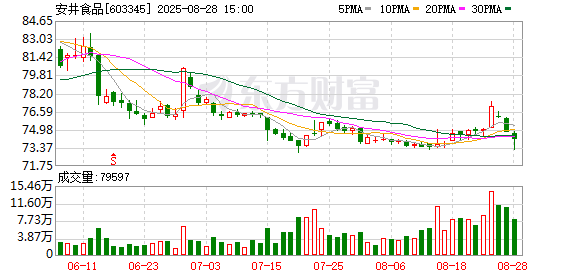
速冻龙头寒意浓 安井食品中期净利首现下滑
Guo Ji Jin Rong Bao· 2025-08-28 14:12
Core Viewpoint - Anjiu Foods reported a "revenue growth without profit growth" in its semi-annual report, with revenue slightly increasing by 0.8% year-on-year to 7.604 billion yuan, while net profit decreased by 15.79% to 676 million yuan [2][3]. Revenue and Profit Performance - The company experienced its first decline in mid-term net profit since its listing, with a significant double-digit drop highlighting profit pressure [3]. - In Q1, revenue was 3.6 billion yuan, down 4.13% year-on-year and 11.11% quarter-on-quarter, with net profit at 395 million yuan, a decline of 10.01% year-on-year [4]. - Q2 saw a revenue recovery to 4.005 billion yuan, but net profit further deteriorated to 281 million yuan, with declines exceeding 20% both year-on-year and quarter-on-quarter [5]. Cost and Margin Analysis - The increase in raw material prices, particularly for crayfish and fish paste, led to a 5.29% rise in operating costs to 6.044 billion yuan, resulting in a gross profit of 1.561 billion yuan, down 13.5% [6]. - The gross margin fell to 20.52%, a decrease of 3.39 percentage points year-on-year [6]. Competitive Landscape and Marketing Strategy - The frozen food industry is highly competitive, prompting Anjiu to increase promotional efforts, which negatively impacted gross margins [7]. - Despite profit pressures, the company maintained a substantial dividend payout of 1.425 yuan per share, totaling 473 million yuan, which accounted for 70.02% of the net profit [7]. Business Segment Performance - Anjiu's business structure showed divergence, with only the prepared dishes segment (frozen dishes) achieving growth, while other categories experienced sluggish sales [10]. - The largest segment, frozen prepared foods, generated revenue of 3.759 billion yuan, down 1.94% year-on-year, while frozen noodle and rice products saw a revenue decline of 3.89% [11]. - The prepared dishes segment grew by 9.4% to 2.416 billion yuan, becoming the sole revenue bright spot [10][11]. Future Growth and Challenges - The growth of the prepared dishes segment, which has been a core driver of Anjiu's performance, is showing signs of slowing down, with growth rates decreasing from over 100% in previous years to 9.4% in the current period [12]. - The lack of national standards for prepared dishes has been identified as a significant constraint on sustainable growth [12]. - Anjiu's recent dual listing on the Hong Kong Stock Exchange aims to accelerate its international strategy, but overseas revenue remains low at 72 million yuan, less than half of last year's total [13].