
Hard Technology

Search documents
上证指数突破3800点,续创十年新高!
Ge Long Hui· 2025-08-22 06:18
Group 1 - The core viewpoint is that the Shanghai Composite Index has successfully broken through the 3800-point mark, driven by strong performance in technology sectors such as AI and semiconductors [1] - The current market liquidity remains healthy, and investors are encouraged to maintain confidence without excessive panic [1] - The ongoing market rally is primarily driven by hard technology, and investors who have not yet positioned themselves in related sectors may consider opportunities in the brokerage sector [1] Group 2 - The brokerage industry is seen as a "bull market flag bearer," directly benefiting from increased market activity and trading volume, leading to strong earnings growth certainty [1] - From a valuation perspective, the current price-to-book (PB) ratio of the brokerage sector is around the 50th percentile over the past decade, indicating a high cost-performance ratio among high elasticity sectors, making it worthy of attention [1]
“超级LP”在松绑
FOFWEEKLY· 2025-08-12 10:19
Core Viewpoint - The article discusses the significant changes in guiding fund policies across various regions in China, highlighting a shift towards market-oriented reforms that alleviate fundraising pressures for General Partners (GPs) [4][5]. Group 1: Changes in Guiding Fund Policies - There has been a notable increase in the activity of institutional Limited Partners (LPs) in the first market, with a year-to-date rise in investment activity, showing an 8.15% month-on-month increase and a 41.12% year-on-year increase [7]. - Policy-type LPs remain the most active, accounting for 39.05% of contributions in June [8]. - Guiding funds have seen improvements in contribution ratios, with some regions allowing contributions to single sub-funds to reach 70% and even higher [8]. - The risk tolerance mechanisms have been significantly enhanced, with some regions implementing a 100% error tolerance policy [8][9]. Group 2: Long-term Capital and Fund Duration - The duration of funds has been extended, with several mother funds now having a lifespan of 15 to 20 years, addressing the industry's call for "long money" [10]. - The government has emphasized the development of long-term and patient capital, which is crucial for supporting the growth of technology and innovation sectors [10]. Group 3: Decision-Making Process for LPs - The decision-making processes for guiding funds have become less complex, facilitating GP fundraising efforts [12]. - Recent policy drafts indicate a move towards reducing or eliminating return investment ratios, further supporting the venture capital industry [13]. - Local government LPs have also streamlined their decision-making processes, allowing for quicker engagement with GPs [14][15]. Group 4: Market-Oriented Transformation - The article highlights a transformation towards a more market-oriented and professional operation model for state-owned LPs, driven by national strategic guidance and ecosystem adjustments [17]. - The shift from guaranteed funding to a shared risk and optimized process is expected to instill confidence in GPs, enabling them to invest more boldly [17].


20cm速递|科创创业ETF(588360)涨超1%,硬科技研发投入与并购活跃度受关注
Mei Ri Jing Ji Xin Wen· 2025-07-29 03:57
Group 1 - The core viewpoint is that the Science and Technology Innovation Board (STAR Market) has become a hub for "hard technology" companies in China, with total R&D investment expected to reach 168 billion yuan in 2024, a year-on-year increase of 6.4%, and a median revenue ratio of 12.67% [1] - The STAR Market is facilitating the financing of unprofitable companies through tiered management and professional institutional participation, directing funds towards hard technology sectors such as biomedicine, new energy, and semiconductors [1] - M&A activity has been robust since the beginning of 2025, with 73 new disclosed transactions completed, and 13 major transactions, nearing the total number of transactions from 2019 to 2023 [1] Group 2 - The Science and Technology Innovation and Entrepreneurship ETF (588360) tracks the Science and Technology Innovation 50 Index (931643), which selects high-growth and innovative companies from the STAR Market and the ChiNext board, covering high-tech fields like new generation information technology and biomedicine [2] - Investors without stock accounts can consider the Guotai CSI Science and Technology Innovation 50 ETF Initiated Link C (013307) and Link A (013306) [2]

开市六周年—— 科创板成长为资本市场改革“示范田”
Jing Ji Ri Bao· 2025-07-23 22:05
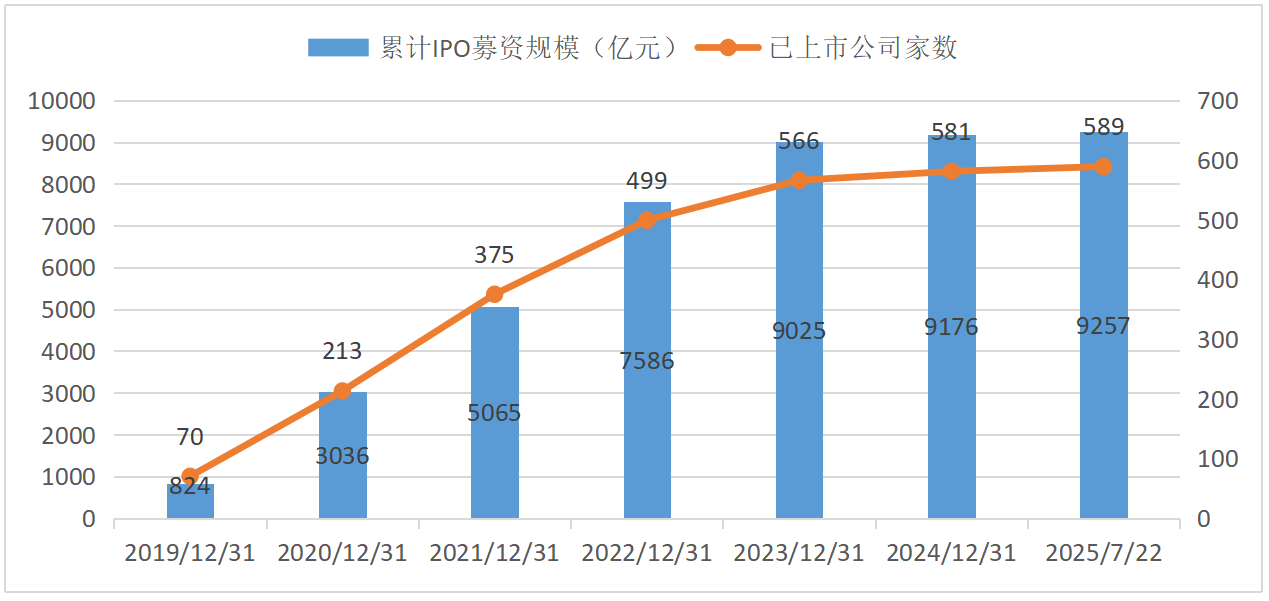
Core Insights - The Sci-Tech Innovation Board (STAR Market) has become a significant platform for "hard technology" companies, contributing to China's capital market reforms and supporting high-level technological self-reliance [1][2][3] Group 1: Support for "Hard Technology" Enterprises - Since its establishment, the STAR Market has supported 589 companies, raising a total of 925.7 billion yuan through IPOs and 186.7 billion yuan through refinancing, exceeding 1.1 trillion yuan in total [2] - The total market capitalization of the STAR Market has surpassed 7 trillion yuan, with leading companies like Haiguang Information and SMIC accounting for nearly 1.47 trillion yuan, over 20% of the total market cap [2] - The STAR Market has facilitated the transformation of technology companies from "catching up" to "leading," significantly contributing to breakthroughs in key technologies [2][3] Group 2: Reform and Innovation - The STAR Market has implemented a registration-based system, establishing a multi-faceted and inclusive listing system, which serves as a model for broader capital market reforms [4] - It has supported various types of companies, including 54 unprofitable firms and 8 with special share structures, with 22 of these unprofitable companies achieving profitability post-listing [4] - The recent "1+6" policy reform aims to expand listing standards to include fields like artificial intelligence and commercial aerospace, enhancing financing channels for cutting-edge technology firms [5] Group 3: R&D Investment and Performance - In 2024, R&D investment in the STAR Market is projected to reach 168.1 billion yuan, more than three times the net profit, with a median R&D investment to revenue ratio of 12.6% [6] - The STAR Market has fostered a culture of early-stage investment, with about 90% of companies receiving venture capital before going public [6] - Over the past five years, the compound annual growth rates for revenue and net profit of STAR Market companies have been 19% and 9%, respectively, with an average gross margin of 40% in 2024 [6] Group 4: Investor Returns and Future Outlook - 509 companies have disclosed plans for quality improvement and high returns, with over 60% offering cash dividend plans totaling 38.8 billion yuan [7] - The STAR Market aims to enhance its ecosystem by optimizing listing standards, improving transparency, and providing differentiated support for technology companies at various development stages [7] - Future initiatives include expanding financing channels and promoting international cooperation to strengthen the global competitiveness of Chinese technology firms [7]
科创板开市六周年:589家上市!1.1万亿融资!总市值破7万亿!
Guo Ji Jin Rong Bao· 2025-07-22 10:48
Core Insights - The establishment of the Sci-Tech Innovation Board (STAR Market) and the pilot registration system marks a significant institutional innovation aimed at supporting technological innovation in the capital market [2][7] - Over the past six years, the STAR Market has facilitated the listing of high-quality technology companies, raising over 1.1 trillion yuan through IPOs and refinancing [7] - The STAR Market has become the preferred venue for "hard technology" companies, with over 80% of listed firms in strategic emerging industries [8] Group 1: Market Performance - As of July 22, 2024, the STAR Market has supported 589 companies to go public, raising 9,257 billion yuan through IPOs and 1,867 billion yuan through refinancing, with a total market capitalization exceeding 70 trillion yuan [7] - The market has seen the emergence of 8 companies with a market value exceeding 100 billion yuan, including SMIC and BeiGene, and 192 companies with a market value over 10 billion yuan [7] Group 2: Investor Returns - In 2024, over 60% of companies on the STAR Market introduced cash dividend plans totaling 38.8 billion yuan, with 290 companies having a dividend payout ratio exceeding 30% [7] - 509 companies have disclosed plans for share buybacks or increases, with a total amount nearing 38 billion yuan, indicating strong confidence in long-term value [7] Group 3: Industry Focus - The STAR Market primarily focuses on six strategic emerging industries, with the electronics and biomedicine sectors being the largest, accounting for 146 and 109 companies respectively [8] - The integrated circuit sector has 120 companies along the value chain, with 35 companies holding the global number one position in their respective sub-segments [8] Group 4: R&D Investment - The total R&D expenditure for the STAR Market in 2024 is projected to be 168 billion yuan, with a median R&D revenue ratio of 12.6%, significantly higher than the A-share main board [8] - 107 companies have maintained an R&D intensity exceeding 20% for three consecutive years, leading to over 120,000 invention patents filed [8] Group 5: Talent Pool - Nearly 30% of the workforce in STAR Market companies are R&D personnel, with over 60% of founding teams comprising scientists or engineers [9] Group 6: Inclusivity and Policy Reforms - The STAR Market has established a set of inclusive listing standards that break traditional profitability thresholds, with 54 unprofitable companies and various special share structures already listed [10][11] - Recent reforms include the introduction of a growth tier and measures to support unprofitable companies, enhancing the market's inclusivity and encouraging more technology firms to pursue listings [13][14]


科创板六周年“再出发”
21世纪经济报道· 2025-07-22 04:22
Core Viewpoint - The article highlights the significant achievements and ongoing reforms of the Sci-Tech Innovation Board (STAR Market) in China over the past six years, emphasizing its role in supporting hard technology enterprises and fostering innovation in the capital market. Group 1: Achievements of the STAR Market - As of July 22, 2025, the STAR Market has 589 listed companies, raising a total of 9,257 billion yuan through IPOs and 1,867 billion yuan through refinancing, totaling over 1.1 trillion yuan [2][5][22]. - The STAR Market has become a vibrant platform for hard technology companies, with over 379 companies recognized as national "specialized and innovative" small giants, and 65 companies designated as "single champion" enterprises in manufacturing [5][22]. - The compound annual growth rates for revenue and net profit attributable to shareholders of STAR Market companies from 2019 to 2024 are 19% and 9%, respectively [5]. Group 2: Institutional Innovations - The STAR Market has implemented a series of institutional innovations, including the "1+6" policy measures aimed at enhancing the capital market's support for technological innovation and new productivity development [3][18]. - The introduction of the "STAR Growth Tier" and related reforms marks a new phase of precise support for technology innovation enterprises [3]. - The STAR Market has established a multi-dimensional regulatory framework that enhances the development environment for technology innovation companies [6]. Group 3: R&D Investment and Innovation - In 2024, the total R&D investment of STAR Market companies reached 168 billion yuan, which is over three times the net profit of the board, with a median R&D intensity of 12.6% [11][29]. - Approximately 30% of STAR Market companies have products or projects that are industry-first, and over 380 companies have products or technologies that meet international advanced standards [32]. - The STAR Market has seen significant contributions to the pharmaceutical sector, with 19 out of 20 companies listed under the fifth set of standards having their self-developed drugs or vaccines approved for sale [6][26]. Group 4: Ecosystem and Talent Attraction - The STAR Market plays a crucial role in facilitating a virtuous cycle among technology, industry, and capital, with over 60% of its founding teams comprising scientists or industry experts [14]. - Nearly 90% of STAR Market companies received venture capital investment before going public, indicating a strong early-stage investment environment [14]. - The STAR Market has developed a comprehensive index system, with 29 indices tracking its performance, and products tracking the STAR Market indices totaling nearly 260 billion yuan [14]. Group 5: Investor Returns and Corporate Governance - In 2024, 509 companies on the STAR Market disclosed plans to enhance quality and efficiency, with over 60% proposing cash dividend plans totaling 38.8 billion yuan [15]. - The STAR Market has seen a record number of share buybacks and increases in shareholding, with 470 instances of buyback plans amounting to nearly 38 billion yuan [15].
科创板开市六周年 | 从“试验田”走向“示范田” 助力“硬科技”企业崛起
Xin Hua Cai Jing· 2025-07-21 23:17
Core Insights - The Sci-Tech Innovation Board (STAR Market) has effectively served as a "testbed" for reforms in China's capital market, facilitating the listing of high-tech companies and fostering innovation in key industries [1][2][9] - Over the past six years, the STAR Market has evolved into a "demonstration field" for high-quality development, particularly in sectors like integrated circuits, biomedicine, and new energy [5][9] Group 1: Market Performance and Growth - As of now, there are 589 companies listed on the STAR Market, with a total of 9,257 billion yuan raised through IPOs and 1,867 billion yuan through refinancing, totaling over 1.1 trillion yuan [5] - The compound annual growth rates for revenue and net profit attributable to shareholders of STAR Market companies have reached 18.7% and 9.1%, respectively, over the past five years [5] - The STAR Market has seen the listing of 54 unprofitable companies and 20 companies under the fifth set of listing standards, indicating a diverse range of business models [5][10] Group 2: Innovation and R&D - The median R&D expenditure as a percentage of revenue for STAR Market companies is 12.6%, leading all A-share sectors, with 107 companies maintaining an R&D intensity above 20% for three consecutive years [6][10] - A total of 35 STAR Market companies rank first globally in their respective segments, while 124 companies hold the top position nationally [6] Group 3: Regulatory and Structural Reforms - The STAR Market has implemented a series of reforms, including a more inclusive listing standard and the introduction of a market maker system to enhance liquidity [10][12] - The recent "1+6" policy measures aim to deepen reforms, including the establishment of a growth layer and the introduction of pre-IPO review mechanisms for quality tech companies [10][11] Group 4: Future Outlook and Strategic Directions - The STAR Market is expected to continue enhancing its institutional inclusivity and adaptability, providing a more efficient growth environment for hard-tech enterprises [10][15] - The ongoing reforms are anticipated to support the integration of technology and industry innovation, contributing to the development of a multi-tiered capital market system [12][15]
【西街观察】科创板六周年,喜见硬科技上市潮
Bei Jing Shang Bao· 2025-07-21 13:01
Core Insights - The Sci-Tech Innovation Board (STAR Market) has evolved into the largest capital support platform for China's hard technology enterprises, growing from 25 initial listings to 585 [1] - The STAR Market serves as a testing ground for the registration-based reform in China's capital market, which has now expanded broadly [1] - A trend of dual listings (A+H shares) is emerging among STAR Market companies, providing new growth momentum through capital market synergy [1] Group 1 - The influx of funding significantly supports R&D efforts, increasing the success rate of technological breakthroughs [2] - Listing in Hong Kong serves as a new international platform for technology companies, enhancing their profitability and attracting long-term international investors [2] - The implementation of the "1+6" policy on the STAR Market addresses financing difficulties and high information disclosure risks for technology enterprises [2] Group 2 - The pre-review system alleviates the listing anxiety of high-tech companies, allowing unprofitable yet high-quality firms to access the capital market [3] - Hard technology enterprises in fields like biomedicine, artificial intelligence, and commercial aerospace can leverage the STAR Market for financing [3] - The STAR Market's positive impact is evident as companies like Cambricon return profits to investors, enhancing the valuation recognition of tech firms [3] Group 3 - New hard technology companies are listing for the first time while established firms are pursuing secondary listings in Hong Kong, fostering a competitive environment [4] - The diversity of industries represented on the STAR Market, including electronics, biomedicine, semiconductors, and artificial intelligence, highlights its appeal to innovative SMEs [4] - The STAR Market has become the main arena for financing technological innovation, with hard technology serving as its hallmark [4]
科创板开市六年持续深化制度创新 589家公司融资1.12万亿总市值7.35万亿
Chang Jiang Shang Bao· 2025-07-20 22:47
Core Insights - The establishment of the Sci-Tech Innovation Board (STAR Market) marks a milestone in China's capital market reform, serving as a "testbed" for the registration system and focusing on "hard technology" [1][2][3] - Over six years, the STAR Market has achieved a total market capitalization of 7.35 trillion yuan and raised 1.12 trillion yuan in financing, demonstrating its role in supporting technological innovation [1][3] Group 1: Market Performance - As of July 18, 2024, the STAR Market has 589 listed companies with a total share capital of 231.395 billion shares and an average price-to-earnings ratio of 52.35 times [3] - The total financing amount for STAR Market companies reached 1.12 trillion yuan, with initial public offerings (IPOs) contributing 864.964 billion yuan [3] Group 2: Financial Metrics - In 2024, STAR Market companies achieved total operating revenue of 1.42 trillion yuan and net profits of 475.23 billion yuan, with research and development (R&D) expenditures totaling 168.078 billion yuan, which is 2.5 times the net profit [2][4] - The median R&D expenditure as a percentage of operating revenue was 12.6%, leading all A-share sectors [4] Group 3: Innovation and Development - The STAR Market has gathered 240,000 R&D personnel, accounting for nearly 30% of total employees, and has generated over 120,000 invention patents [5] - 138 projects led or participated in by STAR Market companies have received national science and technology awards, with over 60% of companies recognized as national-level specialized and innovative enterprises [5] Group 4: Institutional Investment and Market Structure - By the first quarter of 2025, the number of active accounts held by professional institutional investors on the STAR Market exceeded 77,000, with institutional investors holding over 60% of the total market capitalization [7] - Recent reforms have introduced differentiated listing standards and improved the market's inclusivity, allowing for diverse paths for technology companies at different development stages [6][7] Group 5: Future Outlook - The STAR Market continues to deepen reforms, with new guidelines aimed at enhancing the quality of IPO reviews and supporting high-quality technology enterprises [7] - The board is positioned to play a significant role in fostering new productive forces and supporting technological self-reliance in the future [7]
从投项目到搭生态:中国创投站到“巨型基金”时代的起点?
2 1 Shi Ji Jing Ji Bao Dao· 2025-07-18 09:40
Group 1: Company Overview - Thinking Machines Lab (TML), founded by former OpenAI CTO Mira Murati, has completed a $2 billion seed funding round, achieving a valuation of $12 billion [1] - The funding round is led by A16Z, with participation from Nvidia, Accel, ServiceNow, Cisco, AMD, and Jane Street, marking the largest seed funding round in history [1][2] - TML was established only five months prior to this funding announcement [1] Group 2: Investment Landscape - The AI sector has become a significant focus in China's venture capital market, with investment in AI reaching a near 10-year peak, accounting for over 70% of early-stage and Series A investment transactions [1] - Despite the surge in AI investments, China's venture capital funding in AI is only one-fifth of that in the United States, highlighting a funding gap [1] - In 2025, the investment heat in China's AI sector is expected to continue rising, with a shift from infrastructure to diversified applications [3] Group 3: Market Dynamics - The Chinese venture capital market is entering a period of moderate recovery, with challenges in fundraising evident as the number of newly established funds decreased by 18% in the first half of 2025 [5] - Early-stage and VC investments are gaining a larger share of the investment landscape, indicating a trend towards supporting innovative startups [5] - There is a growing consensus that China is experiencing its own "Sputnik moment," marking a significant transition in technological innovation [4] Group 4: Ecosystem Development - Zhongke Chuangxing has established a new hard technology venture capital fund, raising 2.617 billion yuan, focusing on AI and hard tech projects with social and economic value [6][7] - The firm emphasizes building a comprehensive ecosystem that integrates research institutions, early-stage investment, and entrepreneurial support [7] - The approach aims to create a sustainable path for hard tech entrepreneurship in China, supported by various stakeholders including government and investment institutions [9]