
全过程人民民主

Search documents
新时代“实”字说
Ren Min Ri Bao· 2025-10-20 22:01
Core Viewpoint - The emphasis on practical action and results is a key characteristic of Xi Jinping's thought in the new era, highlighting the importance of hard work and realistic approaches to achieve national development and modernization [1][2]. Group 1: Practicality in Development - The concept of "practicality" is a guiding principle in China's new development philosophy, focusing on high-quality growth rather than merely GDP growth [2]. - The need for effective, quality, and sustainable development is emphasized, with a call for regions and departments to align their strategies within the national framework [2]. - Decision-making should be based on practical realities, adapting to changing conditions to ensure successful outcomes [2][3]. Group 2: Innovation and Exploration - Chinese-style modernization is characterized by innovative approaches to address new challenges, as seen in the evolution of the Xin'an River ecological compensation model [4]. - The importance of exploring uncharted territories and finding effective solutions to emerging problems is highlighted as essential for reform and development [4]. Group 3: Quality and Integrity - The focus on quality in governance and personal integrity is crucial, with a call for officials to embody honesty and dedication in their service to the people [6]. - The narrative stresses the need for practical actions that directly benefit the populace, aligning with the expectations of the new era [6][7]. Group 4: Methodology in Governance - Effective governance requires policies and methods that are grounded in reality, with an emphasis on thorough research and understanding of the people's needs [8]. - The importance of grassroots engagement and direct interaction with communities is underscored as a means to identify and solve problems effectively [8]. Group 5: Results and Accountability - The ultimate goal of governance is to deliver tangible benefits to the people, with a focus on accountability and results-oriented actions [11][12]. - The success of poverty alleviation efforts is cited as a testament to the effectiveness of practical governance and the commitment to serving the public [12]. Group 6: Future Directions - The call for a proactive and diligent approach to modernization is reiterated, emphasizing that achieving national rejuvenation relies on practical efforts and sustained commitment [13].
重磅!任仲平来了
中国基金报· 2025-10-20 04:25
Group 1 - The article emphasizes that the Chinese Communist Party has consistently been able to scientifically grasp historical positions and changes in the situation, formulating correct political strategies to guide the Chinese people through numerous risks and challenges, ensuring that China remains at the forefront of the times [4][5]. - The 20th Central Committee's Fourth Plenary Session aims to develop the "14th Five-Year Plan" to make top-level designs and strategic plans for the next five years, focusing on major breakthroughs in strategic tasks related to Chinese-style modernization [4][5]. - The article highlights that China's modernization has not only transformed its own development but has also changed the modernization process in developing countries, with China's five-year plans being recognized as a model of long-term strategic planning [4][5]. Group 2 - The article discusses how China has achieved unprecedented economic growth and social stability, completing the industrialization process in a few decades that took Western developed countries centuries, and lifting nearly 100 million rural poor out of poverty in just eight years [5][6]. - It points out that the Chinese government has implemented a series of policies to ensure the steady progress of Chinese-style modernization, emphasizing the importance of strategic planning and tactical precision [6][11]. - The article mentions that China's commitment to high-quality development is a fundamental principle in the new era, aiming to respond to uncertainties with the certainty of high-quality growth [9][11]. Group 3 - The article outlines China's commitment to green and low-carbon development, aiming for a 7%-10% reduction in greenhouse gas emissions by 2035 and increasing the share of non-fossil energy consumption to over 30% [9][10]. - It highlights the establishment of a complete carbon market system in China, with significant trading volumes in carbon emissions rights and voluntary greenhouse gas reduction markets [12]. - The article emphasizes that China's ecological civilization construction has achieved remarkable results, positioning the country as a global leader in sustainable development [12][13]. Group 4 - The article stresses the importance of a people-centered development approach, linking high-quality development with high-quality living standards, and recognizing the vast potential of China's large market [15][21]. - It discusses the historical changes in social contradictions and how the government is addressing the new expectations of the people for a better quality of life [16][21]. - The article notes that the income of rural residents in poverty-stricken counties has been growing at an annual rate of 7.8%, outpacing the national average [19]. Group 5 - The article highlights the importance of governance and legal frameworks in ensuring the stability and effectiveness of China's modernization efforts, including the implementation of the Private Economy Promotion Law [24][25]. - It discusses the role of the market as a scarce resource and the legal system as the best business environment, emphasizing the need for a unified national market [25][26]. - The article mentions the importance of digital governance and the use of technology to enhance governance efficiency and responsiveness [26][27]. Group 6 - The article emphasizes China's commitment to high-level opening up and peaceful development, aiming to expand its influence globally and provide new opportunities for other countries [29][30]. - It discusses China's initiatives to reduce tariffs for developing countries and its efforts to attract foreign investment, highlighting the significant contributions of foreign enterprises to China's economy [30][31]. - The article notes that China has become a global model for inclusive development, with initiatives like the Belt and Road Initiative fostering international cooperation [32][33].


人民日报任仲平文章:引领未来 中国做对了什么
Ren Min Ri Bao· 2025-10-20 00:49
Group 1 - The article emphasizes the ability of the Chinese Communist Party to navigate historical challenges and formulate effective political strategies, particularly during significant historical moments [6][9][36] - The 20th Central Committee's Fourth Plenary Session focused on the "14th Five-Year Plan" to design a strategic framework for China's development over the next five years, aiming for significant breakthroughs in modernization [6][11] - The concept of "Chinese-style modernization" is highlighted as a transformative process that not only changes China's development but also impacts the modernization processes of developing countries globally [7][8][11] Group 2 - The article discusses China's rapid industrialization and poverty alleviation achievements, noting that it has completed in decades what took Western countries centuries, showcasing unprecedented human development milestones [7][8] - China's commitment to high-quality development is presented as a response to global uncertainties, establishing itself as a stable anchor for global economic growth and a leader in green development [11][16] - The article outlines China's ambitious climate goals, including a 7%-10% reduction in greenhouse gas emissions by 2035 and a target for non-fossil energy consumption to reach over 30% of total energy consumption [11][12] Group 3 - The article highlights the importance of integrating high-quality development with high-quality living standards, emphasizing the need to meet the diverse and evolving needs of the population [19][24] - Urban development is portrayed as a key driver for high-quality growth, with initiatives aimed at improving living conditions and creating inclusive urban spaces [21][22] - The article notes the ongoing efforts in rural areas to enhance living standards and economic opportunities, with significant income growth reported in poverty-stricken regions [22][24] Group 4 - The article emphasizes the role of legal frameworks in supporting the growth of the private sector and enhancing the business environment, particularly through the implementation of the Private Economy Promotion Law [27][28] - It discusses the importance of digital governance and technological innovation in improving governance efficiency and public service delivery [29][30] - The article outlines China's commitment to high-level openness and international cooperation, particularly in trade and investment, as a means to foster global economic integration [31][32] Group 5 - The article concludes with a call for continued efforts towards modernization and national rejuvenation, emphasizing the need for strategic planning and implementation of the "14th Five-Year Plan" [40][41] - It highlights the global significance of China's modernization path and its potential contributions to global peace and development [36][37]
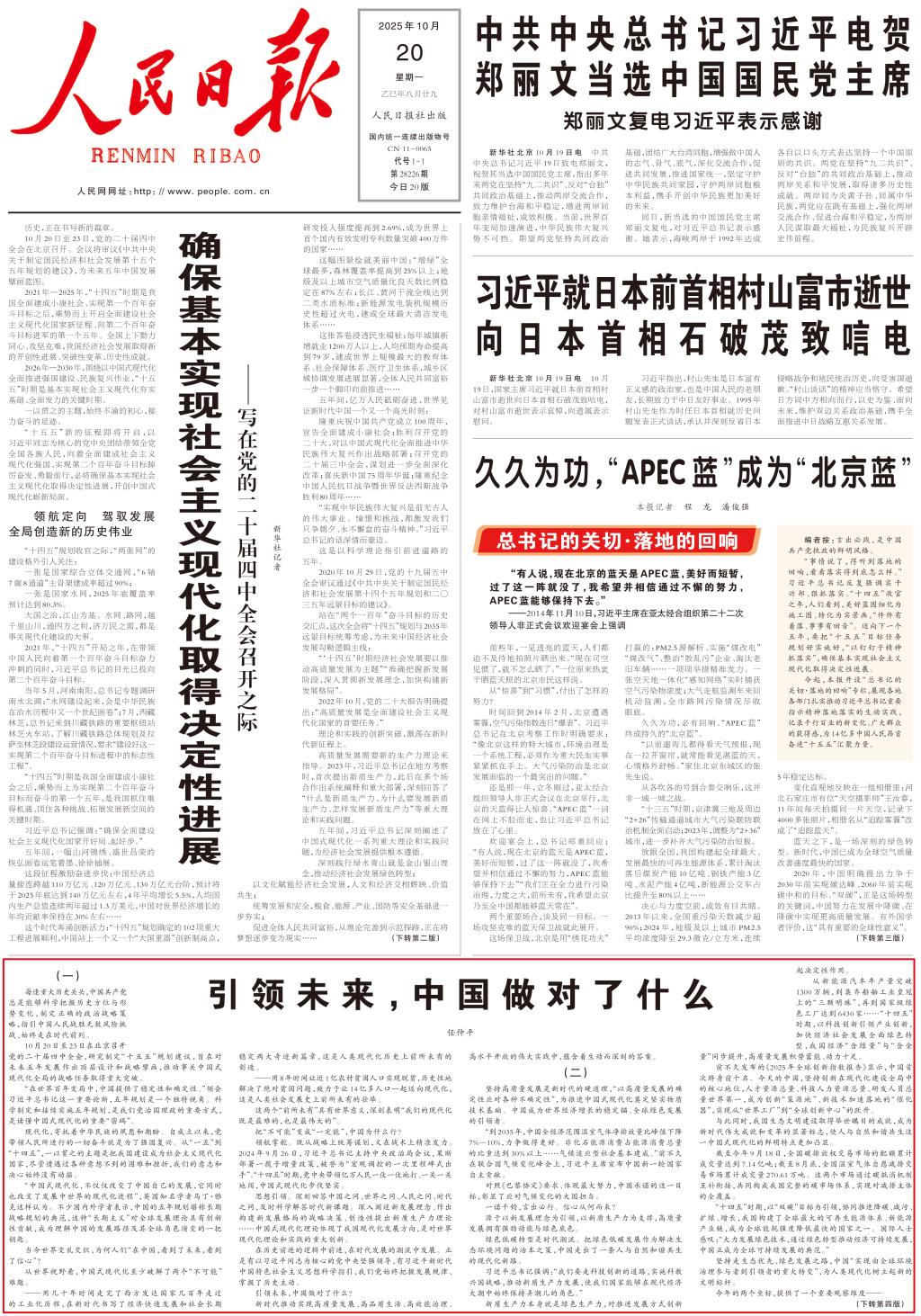
任仲平:引领未来,中国做对了什么
Ren Min Ri Bao· 2025-10-20 00:45
Group 1 - The core viewpoint emphasizes that the Chinese Communist Party has effectively navigated historical challenges and developed strategic plans to guide the nation towards modernization and stability [1][2][3] - The upcoming 14th Five-Year Plan aims to provide a comprehensive framework for China's development over the next five years, focusing on significant breakthroughs in modernization [1][2] - China's modernization is characterized by rapid industrialization and poverty alleviation, achieving unprecedented milestones in a short time [3][4] Group 2 - The concept of "Chinese-style modernization" is recognized as a transformative force not only for China but also for developing countries globally, showcasing a long-term strategic planning model [2][3] - High-quality development is identified as a fundamental principle for addressing uncertainties and establishing a solid foundation for modernization [6][7] - China's commitment to reducing greenhouse gas emissions and increasing non-fossil energy consumption reflects its leadership in global green development [7][9] Group 3 - The integration of high-quality development with high-quality living standards is crucial for mobilizing resources and enhancing the modernization process [12][13] - Urban development initiatives, such as the transformation of old neighborhoods and the promotion of affordable housing, are key to improving living conditions [14][15] - Rural revitalization efforts are ongoing, with significant income growth reported in poverty-stricken areas, indicating progress in achieving balanced regional development [15][17] Group 4 - The governance model in China emphasizes the importance of legal frameworks and institutional advantages in fostering a stable and prosperous environment for development [19][20] - The implementation of laws supporting the private economy and foreign investment reflects China's commitment to creating a favorable business environment [19][25] - The ongoing expansion of high-level openness and international cooperation is seen as essential for China's modernization and global economic integration [24][26] Group 5 - China's approach to modernization is characterized by a commitment to peaceful development and global cooperation, positioning itself as a stabilizing force in international relations [28][29] - The emphasis on sustainable development and ecological harmony is a distinctive feature of Chinese-style modernization, setting a new standard for global environmental governance [9][11] - The vision for the future includes a strong focus on innovation and technology as drivers of economic growth and modernization [8][11]
小小“说事亭” 和美大民生
He Nan Ri Bao· 2025-10-19 23:35
Core Points - The article highlights the establishment and significance of the "talking pavilion" in Jianye Community, which serves as a platform for residents to voice their concerns and suggestions directly to local representatives [2][3] - The initiative has led to improved communication between residents and local government, resulting in timely responses to community issues [3][4] - The "talking pavilion" has successfully resolved various community problems, enhancing residents' satisfaction and engagement in local governance [8] Summary by Sections Community Engagement - Residents now have a direct channel to express their issues, leading to quicker resolutions compared to previous experiences [3] - The pavilion has become a hub for discussing both major and minor community concerns, fostering a sense of community involvement [5][6] Problem Resolution - Specific instances of community issues, such as road repairs and electrical outages, were addressed through collaborative efforts initiated at the pavilion [4][6] - The involvement of local representatives in monitoring and facilitating solutions has been crucial in ensuring project success [4] Democratic Participation - The initiative has redefined residents' understanding of democracy, emphasizing that it is accessible and participatory at the community level [8] - Since its inception in December 2022, the program has collected over 370 suggestions and resolved more than 290 community issues, achieving a satisfaction rate of over 98% [8]
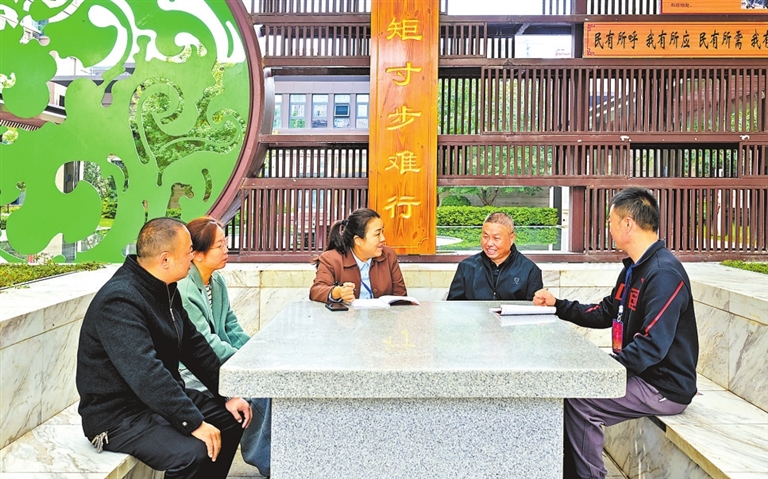
引领未来,中国做对了什么
Ren Min Ri Bao· 2025-10-19 22:30
Group 1 - The core viewpoint emphasizes that the Chinese Communist Party has effectively navigated historical challenges and developed strategic plans to guide the nation towards modernization and stability in a changing global landscape [1][2][3] - The upcoming 14th Five-Year Plan aims to provide a comprehensive framework for China's development over the next five years, focusing on significant breakthroughs in modernization [1][2] - China's modernization is characterized by rapid industrialization and poverty alleviation, achieving unprecedented milestones in a short time frame [3][4] Group 2 - The concept of "Chinese-style modernization" is recognized as a transformative force not only for China but also for developing nations globally, contributing to new development theories [2] - High-quality development is identified as a fundamental principle for addressing uncertainties and establishing a solid foundation for modernization [6][7] - China's commitment to reducing greenhouse gas emissions and increasing non-fossil energy consumption reflects its leadership in global green development [7][9] Group 3 - The integration of high-quality development with high-quality living standards is crucial for mobilizing resources and enhancing the nation's growth potential [12][13] - Urban development initiatives, such as the transformation of old neighborhoods and the promotion of affordable housing, are key to improving living conditions and fostering community engagement [14][15] - Rural revitalization efforts are ongoing, with significant income growth reported in poverty-stricken areas, indicating progress in achieving balanced regional development [15][16] Group 4 - The governance model in China emphasizes the importance of legal frameworks and institutional reforms to support economic growth and stability [19][20] - The promotion of a unified market and the establishment of favorable conditions for foreign investment are essential for sustaining economic momentum [25][26] - China's proactive approach to international cooperation and trade, particularly with developing nations, highlights its role as a global economic leader [24][27] Group 5 - The commitment to peaceful development and global cooperation positions China as a stabilizing force in international relations [28][29] - The vision for modernization includes a focus on sustainable practices and technological innovation, aiming to set a new standard for global development [11][22] - The strategic goals for the next decade emphasize the urgency of achieving modernization milestones and the importance of collective efforts under the leadership of the Communist Party [31][32]
领航中国式现代化|发展全过程人民民主
Xin Hua She· 2025-10-19 02:36
Core Viewpoint - The article emphasizes the importance of developing a comprehensive system of people's democracy in China, integrating the leadership of the Party, the people's ownership, and the rule of law to enhance the democratic political system and support the modernization of socialism [1] Group 1 - The decision made at the 20th Central Committee's Third Plenary Session focuses on the development of a whole-process people's democracy, ensuring the organic unity of Party leadership, people's ownership, and the rule of law [1] - Since the 18th National Congress, the central leadership under Xi Jinping has strengthened the system of people's ownership, promoting broader and more effective development of people's democracy [1] - The continuous improvement of whole-process people's democracy has invigorated socialist democratic politics, laying a solid democratic foundation for the modernization of socialism and the great rejuvenation of the Chinese nation [1]
我市人民法庭守护助力乡村振兴 服务直达田间 绘就更美“枫”景
Zhen Jiang Ri Bao· 2025-10-18 23:28
Group 1 - The core viewpoint emphasizes the role of local courts in supporting rural revitalization through conflict resolution and legal assistance [1][2][4] - The establishment of a "no litigation village" initiative is highlighted, with local courts adapting their strategies to promote harmony and resolve disputes effectively [2][3] - The integration of environmental protection and legal enforcement is showcased, with specific cases demonstrating the courts' commitment to ecological justice [4][5] Group 2 - The courts have implemented innovative mechanisms, such as involving local representatives in judicial processes, to enhance community engagement and transparency [6][7] - Data indicates that over the past three years, local courts have received a significant volume of civil and commercial cases, reflecting their active role in maintaining social stability [8]
坚持推进民主法治建设 为高质量发展夯基固本
Xin Hua She· 2025-10-18 15:17
Group 1 - The core viewpoint emphasizes the importance of socialist democracy and the rule of law as essential components for high-quality development in China during the "14th Five-Year Plan" period [1][12] - The central government, led by Xi Jinping, has deepened its understanding of the laws governing democratic political development, promoting a comprehensive approach to people's democracy [3][17] - The system of people's democracy has been increasingly refined, enhancing the effectiveness of governance and supporting high-quality development [4][9] Group 2 - The "14th Five-Year Plan" has seen significant public participation, with over 311.3 million suggestions collected for the "15th Five-Year Plan," showcasing a high level of engagement in the democratic process [2][5] - The establishment of grassroots legislative contact points has facilitated the direct transmission of public ideas to the highest legislative bodies, acting as a catalyst for high-quality development [4][5] - The implementation of the Private Economy Promotion Law reflects the commitment to protect the legitimate rights of private enterprises, demonstrating the role of law in supporting economic growth [7][10] Group 3 - The legal framework has been strengthened with the introduction and modification of essential laws, contributing to a more comprehensive legal system that meets the needs of economic and social development [9][10] - The integration of law into economic and social governance has been emphasized, ensuring that legal protections are in place for various sectors, including foreign investment and environmental protection [16][17] - The ongoing efforts to enhance the rule of law are seen as vital for maintaining stability and supporting the modernization of governance in China [11][16]
坚持推进民主法治建设 为高质量发展夯基固本——“十四五”时期经济社会发展实践与启示述评之五
Xin Hua She· 2025-10-18 14:20
Group 1 - The core viewpoint emphasizes the importance of socialist democracy and the rule of law as essential components for high-quality development in China during the "14th Five-Year Plan" period [1][12] - The Chinese government has made significant progress in enhancing the system of people's democracy, which has been crucial for addressing risks and challenges while ensuring the welfare of the people [1][4] - The "14th Five-Year Plan" period has seen the establishment of 54 grassroots legislative contact points, facilitating the direct transmission of public ideas to the highest legislative body, thus acting as a catalyst for high-quality development [4][5] Group 2 - The "14th Five-Year Plan" has witnessed a total of 49 political consultation meetings, effectively gathering consensus and promoting scientific decision-making [4][5] - The implementation of the Private Economy Promotion Law has been a significant achievement in the rule of law during the "14th Five-Year Plan" period, showcasing the government's commitment to protecting the legitimate rights of private enterprises [7][10] - The legal framework has been continuously improved, with new laws and amendments addressing urgent social needs and enhancing the legal system's effectiveness [9][10] Group 3 - The government has actively sought public opinions on various legislative proposals, with nearly 19,000 participants providing feedback on 80 legal drafts since the 14th National People's Congress [5][6] - The establishment of democratic consultation mechanisms has allowed for broader public participation in governance, ensuring that major administrative decisions align with public sentiment [6][14] - The rule of law has played a vital role in supporting economic and social development, with a focus on creating a market-oriented, law-based, and international business environment [8][10] Group 4 - The "14th Five-Year Plan" period has been marked by a strategic focus on integrating the rule of law into economic and social development, ensuring a balance between order and vitality [15][16] - The government has committed to enhancing the legal supply quality, making law a solid protector of people's well-being and contributing to a more just and efficient judicial system [15][16] - The ongoing efforts in democratic and legal reforms are expected to provide robust institutional support for national development and the rejuvenation of the nation [12][16]