
供应链调整

Search documents
Watts Water(WTS) - 2025 Q1 - Earnings Call Transcript
2025-05-08 14:02
Financial Data and Key Metrics Changes - The company reported first quarter sales of $558 million, down 2% on both a reported and organic basis, primarily due to fewer shipping days and ongoing weakness in Europe [13][14] - Adjusted operating income reached a record $106 million, increasing by 2%, with adjusted operating margins at 19%, up 80 basis points [16][18] - Adjusted earnings per share rose to $2.37, reflecting a 2% increase compared to the previous year [16][18] - Free cash flow for the quarter was $46 million, up from $37 million in the same quarter last year [17][18] Business Line Data and Key Metrics Changes - Americas organic sales decreased by 1%, while reported sales remained flat, benefiting from the Icon acquisition which added $5 million [13][14] - Europe experienced a 9% decline in organic sales and a 12% drop in reported sales, attributed to fewer shipping days and weakness in new construction markets [14][16] - APMEA sales increased by 9% on a reported basis and 13% on an organic basis, driven by growth in China, the Middle East, and Australia [14][16] Market Data and Key Metrics Changes - The company anticipates continued weakness in Europe due to a slowdown in new construction amid economic challenges [10][11] - The Americas market is expected to show slight improvement, while Europe is projected to decline compared to initial forecasts [19][20] Company Strategy and Development Direction - The company is focusing on vertical integration and manufacturing close to customers in the U.S. to mitigate tariff impacts [7][12] - A proactive approach to productivity savings through automation and lean initiatives is being implemented [8] - The company is maintaining its full-year organic sales and adjusted operating margin outlook despite macroeconomic uncertainties [9][23] Management's Comments on Operating Environment and Future Outlook - Management expressed confidence in navigating the current trade environment and expects to manage costs effectively through their OneWatts performance system [24][25] - The outlook for the second half of 2025 remains cautious due to potential demand impacts from tariffs and economic conditions [10][11] Other Important Information - The company announced a 21% increase in dividends starting in June, reflecting strong cash flow and a healthy balance sheet [6][18] - The search for a new CFO is ongoing, with the current CFO remaining in position to ensure a smooth transition [13] Q&A Session Summary Question: Opportunities to gain market share and margin - Management highlighted their strategy of manufacturing products regionally, which positions them favorably in the current tariff environment [31][33] Question: Pacing of price increases and potential tariff reductions - The company implemented annual price increases in January and additional tariff-related increases in March and May [35][36] Question: Front half versus back half margin and revenue expectations - Management indicated that the cautious outlook for the second half is due to uncertainty surrounding tariffs and potential demand impacts [44][90] Question: Weaker guidance for Europe - The management noted that the guidance reflects destocking in the heat pump market and uncertainty in new construction [61] Question: Integration of recent acquisitions - Integration efforts with recent acquisitions are ahead of schedule, with positive synergy tracking [63] Question: Raw material supply issues - Management acknowledged some raw material supply constraints but emphasized that tariffs are the primary concern impacting pricing [67][68] Question: Capacity and utilization of U.S. manufacturing facilities - The company has not fully utilized its North American manufacturing footprint and plans to expand shifts as needed without significant capital expenditures [79] Question: Margin expectations for the Americas - Management aims for a year-over-year margin increase of 30 to 50 basis points while continuing to invest in the business [92]

苹果首次对关税表态!库克称iPhone不涨价,但只是暂时
Sou Hu Cai Jing· 2025-05-02 16:29
Core Insights - Apple reported Q2 FY2025 earnings with total revenue of $95.36 billion, a 5% year-over-year increase, and net profit of $24.78 billion, also up 5% [2] - iPhone revenue reached $46.84 billion, slightly above last year's $45.96 billion, exceeding market expectations, while revenue from Greater China declined by 2% to $16.00 billion [2] - In Q1 2025, Apple achieved a 19% market share in the global smartphone market, surpassing Samsung's 18%, primarily due to the iPhone 16 series and the iPhone 16e launch [2] Financial Performance - Total revenue for Q2 FY2025 was $95.36 billion, with a net profit of $24.78 billion, both reflecting a 5% increase year-over-year [2] - iPhone revenue was $46.84 billion, compared to $45.96 billion in the same quarter last year, indicating a stable performance [2] Market Challenges - In China, Apple's performance is declining, with a 9% year-over-year drop in shipments to 9.8 million units, resulting in a market share decrease to 13.7%, ranking fifth behind Xiaomi, Huawei, OPPO, and vivo [4] - The company faces pressure from local brands benefiting from government subsidies and competitive pricing, which could further erode Apple's market share in China [8] Tariff Implications - CEO Tim Cook indicated that if the U.S. maintains high tariffs, Apple may need to adjust global pricing strategies, potentially increasing iPhone prices in North America by 24% [6] - Apple has expedited supply chain adjustments, planning to source most iPhones sold in the U.S. from India and gradually shift production of iPads, Macs, Apple Watches, and AirPods to Vietnam [6] Future Outlook - The upcoming iPhone 17 series launch in four months will be critical for Apple to maintain pricing stability amid tariff pressures [8] - The company's ability to innovate or adjust pricing strategies will be essential to counteract the challenges posed by local competitors and tariff policies [8]



苹果(AAPL.US)Q2服务业务收入略低于预期 股价盘后下跌逾2%
智通财经网· 2025-05-01 23:18
Core Insights - Apple reported better-than-expected earnings for Q2 FY2025, with revenue of $95.4 billion and earnings per share of $1.65, surpassing market expectations of $94.66 billion and $1.63 respectively [1] - Concerns arose regarding the slowdown in the services segment, which generated $26.65 billion, growing 11.65% year-over-year but falling short of the previous year's growth rate of 14.2% and market expectations of $26.7 billion [2] - The company announced a $100 billion stock buyback plan and increased its quarterly dividend by 4% to $0.26 per share, reflecting confidence in future cash flows [3] Revenue Breakdown - iPhone remains the largest revenue source with $46.84 billion, slightly above the expected $45.84 billion, and showing a year-over-year growth of nearly 2% [1] - Mac revenue reached $7.95 billion, growing nearly 7% year-over-year, while iPad revenue increased by 15% to $6.4 billion, benefiting from the launch of the new iPad Air [1] - Wearables and accessories, including Apple Watch and AirPods, saw a revenue decline of 5% to $7.52 billion [2] Regional Performance - Revenue from Greater China was $16 billion, showing a slight decline year-over-year, but remained stable when excluding currency effects, with sales accelerating quarter-over-quarter [3] - The Americas market performed strongly, with nearly 8% year-over-year growth [3] Supply Chain and Strategic Adjustments - Apple is actively adjusting its global supply chain, with over half of iPhones for the U.S. market now produced in India, and most Macs, iPads, AirPods, and Apple Watches sourced from Vietnam [2] - The company plans to procure $19 billion worth of chips domestically in the U.S., emphasizing the diversification of its supply chain to enhance resilience [2]
Kadant(KAI) - 2025 Q1 - Earnings Call Transcript
2025-04-30 15:00
Financial Data and Key Metrics Changes - Revenue in Q1 2025 declined by 4% compared to the same period last year, primarily due to weaker capital shipments in the Industrial Processing segment [11][19] - Adjusted EBITDA decreased by 8% to $48 million, with an adjusted EBITDA margin of 20%, down from 21% in Q1 2024 [11][21] - Free cash flow increased by 15% to $19 million in Q1 2025 compared to $16.6 million in Q1 2024 [22] - GAAP EPS decreased by 3% to $2.04, while adjusted EPS decreased by 12% to $2.10, exceeding the high end of guidance by $0.05 [21][22] Performance by Business Segment - **Flow Control Segment**: Bookings increased by 6% to $100 million, with Q1 revenue up 7% to $92 million, driven by strong demand for Fluid Handling products [12][13] - **Industrial Processing Segment**: Q1 revenue declined by 15% to $90 million, primarily due to a significant drop in capital shipments, although aftermarket parts revenue made up a record 80% of total revenue in this segment [14][15] - **Material Handling Segment**: Revenue was slightly up to $57 million, with aftermarket parts comprising 65% of Q1 revenue, while overall bookings remained flat [15][17] Market Data and Key Metrics Changes - Aftermarket parts bookings represented 74% of total bookings, reaching a record $190 million, benefiting from a large installed base [11][12] - The company noted that the geopolitical climate and trade uncertainties have introduced transitory headwinds, particularly affecting the Industrial Processing segment [13][17] Company Strategy and Industry Competition - The company is assessing supply chain vulnerabilities due to tariffs and exploring alternative supply sources to mitigate impacts [7][8] - Management emphasized the importance of maintaining high levels of customer support while adapting to changing economic circumstances [8][18] - The company expects strong performance in the Flow Control segment despite geopolitical challenges, while the Industrial Processing segment faces more uncertainty [13][17] Management's Comments on Operating Environment and Future Outlook - Management indicated that the uncertainty from tariffs has delayed capital equipment orders, but they remain confident in the long-term fundamentals of their markets [9][18] - The company anticipates that the second half of 2025 will be significantly stronger than the first half, with a revised revenue guidance of $1.02 billion to $1.04 billion [30][31] - Management acknowledged that while there is a healthy level of quote activity for capital equipment, customers are delaying orders due to uncertainty [29][63] Other Important Information - The company expects incremental material costs of approximately $5 million to $6 million due to tariffs, impacting adjusted EPS by $0.32 to $0.39 [28][30] - The effective tax rate for Q1 was 24.3%, influenced by tax benefits related to equity awards [21] Q&A Session Summary Question: Insights on order book and potential deferrals - Management noted that while there is a pause in project timing, discussions and activity levels remain strong, with no projects canceled [36][38] Question: Impact of tariffs on discretionary capital projects - Management indicated that while tariffs create uncertainty, significant project cancellations are rare, and they expect projects to eventually move forward [50][52] Question: Guidance on capital bookings needed for a strong second half - Management stated that a 15% to 20% increase in capital order flow is necessary to achieve a strong second half, with ongoing discussions on several projects [58][60] Question: Understanding the impact of tariffs on pricing and margins - Management confirmed that they are implementing surcharges to mitigate tariff impacts, but the timing of these adjustments may vary [73][76] Question: Expectations for capital project recovery in the back half of the year - Management emphasized the need for capital bookings to materialize in Q2 to support revenue expectations for the second half of 2025 [78][79]

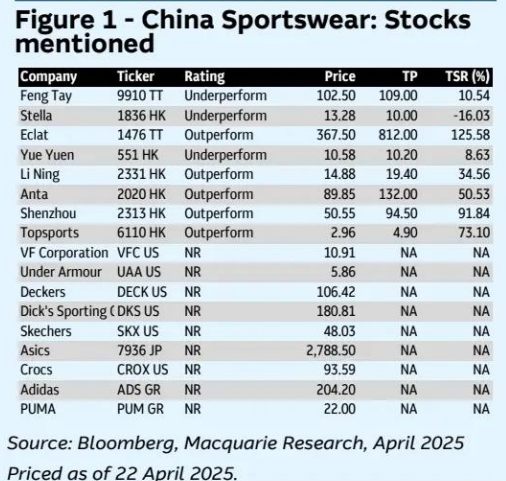
关税上调怎么破?麦格理深度解析运动装产业链:本土品牌迎战略机遇期
Zhi Tong Cai Jing· 2025-04-29 01:47
Group 1 - Macquarie's tariff scenario analysis indicates that Original Equipment Manufacturers (OEMs) with higher profit margins have more room to withstand potential adverse factors, but price adjustment mechanisms, shifts in procurement locations, and weak end-demand may compress OEM profit margins [1] - The analysis shows that the new tariff burden may be shared across the supply chain, significantly impacting OEM earnings due to their already thin profit margins [1][6] - The domestic competition pressure faced by Chinese sports brands is manageable, with Anta Sports being favored due to controllable risks of oversupply in sports shoe production [2][8] Group 2 - The analysis of the impact of tariffs on the footwear value chain reveals that the retail price distribution among upstream and downstream parties is crucial, with a hypothetical increase in tariffs from 15% to 25% leading to price adjustments across the supply chain [13][15] - International brands are actively adjusting their supply chain strategies to mitigate risks from tariff increases, with Adidas and Puma adopting localized sourcing models to reduce reliance on Chinese production for the U.S. market [7][11] - Emerging procurement locations such as India and Indonesia are gaining traction, with lower labor costs compared to Vietnam and China, making them attractive for brands looking to diversify their supply chains [23]
美国贸易代表:如果我们有公司感受到供应链调整带来的痛苦,我们就必须采取相应措施。
news flash· 2025-04-08 16:06
Core Viewpoint - The U.S. Trade Representative emphasizes the need for appropriate measures if companies experience pain from supply chain adjustments [1] Group 1 - The U.S. Trade Representative indicates that companies feeling the impact of supply chain changes must be addressed [1]