
创业带动就业

Search documents
技能培训班开到家门口,北京多区打出促就业“组合拳”
Xin Jing Bao· 2025-05-27 12:09
Core Insights - The article highlights the launch of a skills training program for residents in Shunyi District, focusing on the profession of organizing and storage, which is gaining popularity in the job market [1][2][3] Group 1: Training Programs - The training program, organized by the Shunyi District Human Resources and Social Security Bureau, aims to enhance labor skills and promote quality employment through various initiatives such as vocational training and job fairs [1][4] - The employment service station in Guangming Street offers a range of skills training, including video editing, live streaming, baking, and organizing, with professional instructors providing hands-on guidance [2][3] - The training for organizing and storage professionals includes modules on space planning, item classification, and client communication skills, utilizing real-life scenarios for practical application [3] Group 2: Employment Services - The employment service station serves as a direct resource for residents to find job opportunities, offering self-service job selection and hosting small recruitment fairs [4] - Shunyi District has established 24 employment service stations across various neighborhoods, enhancing accessibility to employment services for residents [4] - The district has been recognized for its employment initiatives, receiving significant funding to support job creation and training programs [4][9] Group 3: Job Market Trends - The profession of organizing and storage has been officially recognized in the national occupational classification, reflecting its growing demand and the potential for flexible, lucrative job opportunities [2][3] - The article notes that the overall employment situation in Beijing remains stable, with a low urban unemployment rate and significant job creation efforts targeting youth and other key demographics [9]
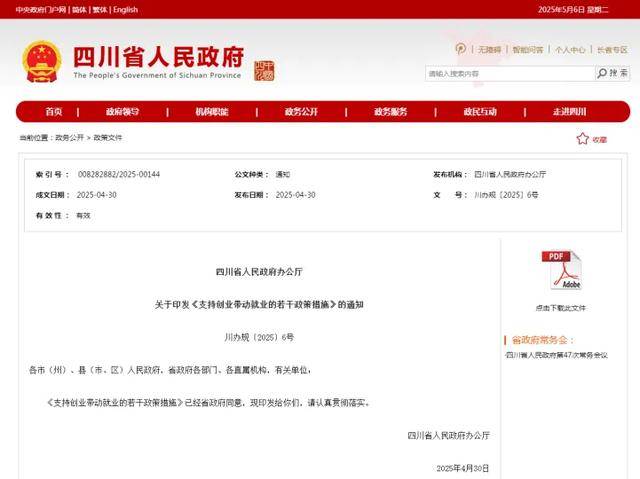
四川将实施6大行动 扶持创业55万人带动就业170万人
Zhong Guo Chan Ye Jing Ji Xin Xi Wang· 2025-05-23 00:38
Core Viewpoint - The Sichuan Provincial Government has issued a set of policy measures aimed at supporting entrepreneurship and job creation, set to take effect on May 1, 2025, with a goal to issue 15 billion yuan in entrepreneurial guarantee loans, support 550,000 entrepreneurs, and create 1.7 million jobs over the next three years [1][2]. Group 1: Policy Measures Overview - The policy measures include the development of a three-year action plan to implement six major actions and complete 28 tasks [1]. - The main objectives are to provide entrepreneurial support to various groups, including 220,000 university graduates, 230,000 migrant workers, and 100,000 researchers and returnees [2]. Group 2: Six Major Actions - **Head Goose Cultivation Action**: Focuses on supporting youth entrepreneurship through four tasks [2]. - **Quality Empowerment Action**: Aims to train 110,000 individuals through four tasks related to entrepreneurial awareness [2]. - **Service Upgrade Action**: Seeks to improve the entrepreneurial environment and train 18,500 entrepreneurial instructors through six tasks [2]. - **Nest Building Action**: Plans to cultivate over 100 provincial entrepreneurial incubation parks and build over 500 entrepreneurial buildings and rural areas through five tasks [2]. - **Chain Strengthening Action**: Targets to host over 6,000 entrepreneurial service activities through four tasks [2]. - **Policy Safeguarding Action**: Aims to issue 15 billion yuan in entrepreneurial guarantee loans through five tasks [2].


十五条新政支持创业带动就业 自五月一日起施行
Si Chuan Ri Bao· 2025-05-09 08:37
Group 1 - The core policy document aims to support entrepreneurship and job creation through various financial and service measures [1] - The personal loan limit for entrepreneurial guarantee loans has been increased from 300,000 to 500,000 yuan, and for small and micro enterprises from 4 million to 6 million yuan [2] - The coverage of entrepreneurial subsidies has been expanded to include recent graduates, unemployed individuals, returning migrant workers, and self-employed veterans [2] Group 2 - New financial support policies include special loans for stabilizing and expanding employment, with tax reductions for companies hiring specific groups [3][4] - Companies hiring impoverished individuals, long-term unemployed, and self-employed veterans can receive tax deductions for three years [4] - Special loans will be provided to companies that do not reduce their workforce significantly, with favorable terms for small and micro enterprises [4] Group 3 - The new policy emphasizes expanding entrepreneurial training to all laborers with entrepreneurial needs, focusing on emerging industries and local economic demands [5] - Training will include support for rural e-commerce and small-scale economic entities, encouraging returnees to start businesses [5] Group 4 - A platform for connecting entrepreneurial resources will be established, including various innovation and entrepreneurship competitions [6] - The Sichuan Science and Technology Innovation Platform will provide comprehensive services for entrepreneurs, including policy information and project showcases [6] Group 5 - The policy introduces support for entrepreneurs who have failed, including unemployment registration and timely employment services [7]
四川出台支持创业带动就业若干政策 创业担保贷款额度最高600万元
Sou Hu Cai Jing· 2025-05-08 01:17
Group 1 - The new measures increase the personal loan limit for entrepreneurial guarantee loans from 300,000 yuan to 500,000 yuan, and for small and micro enterprises from 4 million yuan to 6 million yuan [1] - The measures provide interest-free, collateral-free, and guarantee-free startup loans ranging from 30,000 to 100,000 yuan for eligible youth aged 18 to 40 who start a business within three years in Sichuan [1] - The entrepreneurial subsidy policy has been optimized to cover recent graduates, unemployed individuals, returning migrant workers, and self-employed veterans, with subsidies of up to 10,000 yuan based on business operation duration and scale [1] Group 2 - The measures encourage returning and local entrepreneurship, providing support for new agricultural entities such as family farms and cooperatives, with applicable small and micro enterprise support policies [2] - There are specific subsidies for overseas returnees who start businesses in Sichuan, with funding of up to 300,000 yuan based on the category of the enterprise [2] - The measures also strengthen tax and financial support for entrepreneurs [3]
四川出台新政!支持返乡入乡创业
Sou Hu Cai Jing· 2025-05-07 05:16
Group 1: Financial Support for Entrepreneurship - The new measures increase the personal loan limit for entrepreneurial guarantee loans from 300,000 yuan to 500,000 yuan, and for small and micro enterprises from 4 million yuan to 6 million yuan, with local finance covering the interest subsidy for amounts exceeding national limits [2] - A youth entrepreneurship promotion plan is implemented, providing interest-free, collateral-free, and mortgage-free startup loans ranging from 30,000 to 100,000 yuan for eligible individuals aged 18 to 40 who start a business in Sichuan within three years [2] - The entrepreneurship subsidy policy is optimized to cover recent graduates, unemployed individuals, returning migrant workers, and self-employed veterans, with subsidies of 5,000 yuan for businesses operating for over six months and up to 10,000 yuan for those operating for over 18 months based on various factors [2] Group 2: Enhancing Entrepreneurial Support System - The measures aim to enhance entrepreneurial training by expanding coverage to all laborers with entrepreneurial needs and implementing differentiated training subsidies [3] - Encouragement is given to develop specialized entrepreneurial training programs aligned with key industrial chains and emerging industries, focusing on sectors like the silver economy and international tourism [3] - Support is provided for rural e-commerce and new employment forms, with a focus on developing small-scale economic entities such as specialty shops and workshops [3] Group 3: Support for Key Groups and Talent Development - The measures encourage returning entrepreneurs to establish family farms, cooperatives, and agricultural enterprises, with access to small and micro enterprise support policies [4] - Local governments are incentivized to provide subsidies for hiring unemployed individuals or recent graduates, purchasing agricultural machinery, and establishing elderly care services [4] - Talent recruitment for entrepreneurial enterprises is integrated into local talent programs, with preferential support in various areas for those meeting employment generation criteria [4]

四川制定15条措施支持创业带动就业
Sou Hu Cai Jing· 2025-05-05 23:05
Core Viewpoint - Sichuan Province has introduced a comprehensive set of 15 policy measures aimed at supporting entrepreneurship and job creation, effective from May 1, 2025, to December 31, 2027 [1][2]. Group 1: Financial Support Measures - The policy provides interest-free, collateral-free, and guarantee-free startup loans ranging from 30,000 to 100,000 yuan for eligible youth aged 18-40 who start businesses within three years in Sichuan [1][2]. - The individual loan limit for entrepreneurial guarantee loans has been increased from 300,000 yuan to 500,000 yuan, and the limit for small and micro enterprises has been raised from 4 million yuan to 6 million yuan [1][4]. - Commercial banks are encouraged to establish special loans for stabilizing and expanding employment for small and micro enterprises, providing timely support for non-repayable renewals [1][4]. Group 2: Tax and Financial Incentives - The policy includes tax incentives for individual businesses and tax reductions for enterprises that expand their workforce, along with the issuance of special loans to stabilize employment [2][4]. - The coverage of entrepreneurial subsidies has been expanded to include recent graduates, unemployed individuals, returning migrant workers, and self-employed veterans, with a segmented subsidy approach based on business scale and employment numbers [2][4]. Group 3: Entrepreneurial Support System - The measures emphasize enhancing entrepreneurial training, focusing on key industrial chains and emerging sectors, and developing specialized training programs for various entrepreneurial needs [2][5]. - A resource matching platform for entrepreneurs will be established, and support will be provided for the construction of incubation facilities, encouraging large enterprises to share resources with small and medium-sized enterprises [2][5]. Group 4: Implementation and Coordination - Local governments are required to fulfill their responsibilities, improve the entrepreneurial work coordination mechanism, increase funding, and enhance the entrepreneurial service system [3][4]. - The policy aims to create a supportive environment for entrepreneurship by promoting awareness and optimizing operational processes for policy implementation [3][4].
一季度全省创业担保贷款十点七八亿元,同比增长百分之十八点三 融资门槛降低 创业活力提升
Si Chuan Ri Bao· 2025-05-04 01:33
Group 1 - The personal loan limit for entrepreneurship has been increased from 300,000 yuan to 500,000 yuan, and the limit for small and micro enterprises has been raised from 4 million yuan to 6 million yuan [1][2] - In the past three years, a total of 3.04 billion yuan in entrepreneurial subsidies and 16.951 billion yuan in entrepreneurial guarantee loans have been issued, supporting 967,000 self-employed individuals and creating 1.62 million jobs [1][2] - In the first quarter, the total amount of entrepreneurial guarantee loans in the province reached 1.078 billion yuan, representing a year-on-year increase of 18.3% [1] Group 2 - The provincial government has emphasized the importance of youth entrepreneurship and has implemented a comprehensive package of policies to support it, including funding, training, talent development, and services [2][3] - A provincial, municipal, and county-level team of entrepreneurial guidance experts has been established to provide comprehensive intellectual support to young entrepreneurs, with 3,071 experts currently available [3] - The entrepreneurial atmosphere in universities has encouraged many students to start their own businesses, with institutions providing free office space and operational funding for entrepreneurial teams [4]
四川:十五条新政支持创业带动就业
Sou Hu Cai Jing· 2025-05-02 01:16
Group 1: Policy Measures - The personal application limit for entrepreneurial guarantee loans has been increased from 300,000 yuan to 500,000 yuan, and the limit for small and micro enterprises has been raised from 4 million yuan to 6 million yuan [1][2] - The coverage of entrepreneurial subsidies has been expanded to include college graduates within five years of graduation, unemployed individuals, returning migrant workers, and self-employed veterans [2][4] - A total of 15 new policies have been introduced to enhance financial support, tax incentives, and optimize entrepreneurial services, effective from May 1 [1][2] Group 2: Financial Support - The new policies provide significant financial support to entrepreneurs, including interest-free loans ranging from 30,000 to 100,000 yuan for eligible youth aged 18 to 40 starting businesses within three years [2][3] - Companies hiring specific groups, such as poverty alleviation participants and long-term unemployed individuals, can benefit from tax reductions for three years [3] - Special loans for stabilizing and expanding employment will be offered to businesses that do not lay off employees or reduce their workforce significantly [3] Group 3: Training and Resources - The new policies will enhance entrepreneurial training for all laborers with entrepreneurial needs, focusing on emerging industries and local economic demands [4][5] - A platform called "Sichuan Sci-Tech Innovation Platform" will be established to provide comprehensive services for entrepreneurs, including policy information, financing connections, and project showcases [6] - Support for failed entrepreneurs will be increased, including unemployment registration and timely employment services [6]
人社部:1—3月全国城镇新增就业308万人 就业形势保持总体稳定
Yang Shi Wang· 2025-04-29 08:35
Core Viewpoint - The human resources and social security departments have made significant progress in employment stability and job creation amidst complex domestic and international challenges in 2023 Group 1: Employment Statistics - In the first quarter, 3.08 million new urban jobs were created, an increase of 50,000 year-on-year [1] - The urban survey unemployment rate in March was 5.2%, a decrease of 0.2 percentage points from the previous month [1] Group 2: Job Creation Initiatives - Implementation of plans to expand job opportunities in key sectors and support employment for specific groups through policy support, training, and services [1] - A comprehensive entrepreneurial support system has been established, enhancing the quality of entrepreneurship through training, services, incubation, and activities [2] - The maximum credit limit for small and micro enterprises has been increased from 300 million to 500 million, with individual entrepreneurs also included in the support [2] Group 3: Policy Implementation - Employment subsidies, social insurance reductions, and other policy benefits have been effectively utilized, resulting in a cost reduction of 45.6 billion for enterprises due to a temporary decrease in unemployment insurance rates [2] - A new round of unemployment insurance policies has been introduced to support job retention and creation [2] Group 4: Focus on Key Demographics - A national video conference was held to promote employment for college graduates, addressing the record-high number of graduates and structural employment challenges [3] - Over 1200 employers provided more than 50,000 job openings during a spring recruitment event for college graduates, with nearly 120,000 graduates attending [3] - A total of 56,000 recruitment events have been organized, offering 37 million job openings to various labor groups [3] Group 5: Skills Training Initiatives - The "Skills Illuminate the Future" training initiative has been launched, focusing on key demographics and sectors with high employment demand [4] - The program aims to subsidize over 10 million training sessions annually, enhancing the skills of the workforce to improve employment prospects [4]
山东出台创业街区试点建设指引
Da Zhong Ri Bao· 2025-04-23 00:59
Core Viewpoint - The "Guidelines for the Pilot Construction of Entrepreneurial Streets" aim to scientifically and normatively promote the construction of entrepreneurial streets, providing precise and convenient services for entrepreneurs, enhancing the quality of entrepreneurship, and promoting high-quality and full employment [1][2]. Group 1: Entrepreneurial Streets Concept - Entrepreneurial streets are defined as areas characterized by significant industrial features, a concentration of young entrepreneurs, and diverse new business consumption scenarios [1]. - The construction of these streets will involve establishing "Entrepreneurial Empowerment Centers" that integrate policy consultation, entrepreneurial guidance, and resource matching into a "one-stop" service [1]. Group 2: Service System for Entrepreneurs - A comprehensive service system will be constructed to provide all-around support for entrepreneurs, including dynamic demand lists for financing, talent, and policy needs [2]. - Resources from various departments will be integrated to publish policy information, entrepreneurial incubation, training, and practical event information [2]. - Collaboration with universities, financial experts, and entrepreneurial mentors will provide professional guidance such as project diagnosis and market analysis [2]. Group 3: Differentiated Services and Financing - Differentiated services will be offered based on the different development stages of enterprises, covering business establishment, management, technology upgrades, and market expansion [2]. - A diversified financing channel will be established, including entrepreneurial guarantee loans, commercial loans, and equity financing [2]. Group 4: Expected Outcomes - The pilot construction of entrepreneurial streets is a significant measure for Shandong Province to deepen the "Entrepreneurship Qilu" initiative, aiming to gather policies, funds, and talents to create a new entrepreneurial model of "street + incubation + ecology" [2]. - It is expected to cultivate a number of high-growth entrepreneurial entities and significantly enhance the employment-driving effect of entrepreneurship [2].