反洗钱监管

Search documents
反洗钱监管升级,8月起黄金珠宝现金交易超10万需亮身份
Di Yi Cai Jing· 2025-07-02 11:36
Core Points - The article discusses the implementation of the "Management Measures for Anti-Money Laundering and Anti-Terrorist Financing in the Precious Metals and Gemstone Industry" by the People's Bank of China, effective from August 1, which aims to strengthen anti-money laundering regulations in this sector [1][2][6] Group 1: Regulatory Changes - The threshold for reporting large cash transactions has been raised from 50,000 RMB to 100,000 RMB, requiring institutions to report any single or cumulative cash transactions that meet or exceed this amount [2][6] - The new regulations apply to all entities engaged in precious metals and gemstones trading within China, regardless of the scale of their operations [2][3] Group 2: Customer Due Diligence - Institutions are required to conduct thorough customer due diligence for cash transactions reaching or exceeding 100,000 RMB, including verifying customer identity and monitoring transaction patterns [3][6] - Records of transactions and customer identity must be retained for at least 10 years after the business relationship ends [3] Group 3: Industry Characteristics and Risks - The precious metals and gemstones industry is identified as a high-risk area for money laundering and terrorist financing due to its high value density, liquidity, and the potential for anonymous transactions [4][6] - Experts emphasize that the new regulations will help fill existing regulatory gaps and enhance financial risk prevention in the industry [4][6] Group 4: Future Implications - The implementation of these measures is seen as a response to international standards and a necessary step to maintain financial security in China [7] - Ongoing attention is needed to ensure compliance among small and medium-sized enterprises and to adapt to evolving money laundering techniques [7]
现金买黄金宝石超过10万元需上报,反洗钱监管持续升级中
Jin Shi Shu Ju· 2025-07-02 06:14
Core Points - The People's Bank of China has issued the "Management Measures for Anti-Money Laundering and Anti-Terrorist Financing for Precious Metals and Gemstone Practitioners," which outlines the anti-money laundering obligations for practitioners in this sector [1] - The new regulations will take effect on August 1, 2025, and require institutions to establish internal controls, conduct customer due diligence, report large and suspicious transactions, and enhance money laundering risk management [1][2] - The measures highlight the high-risk nature of precious metals and gemstones for money laundering and terrorist financing due to large transaction amounts and high cash transaction ratios [1][2] Summary by Sections Regulatory Framework - The regulations apply to traders engaged in the spot trading of precious metals and gemstones within China, including gold, silver, platinum, diamonds, and jade [2] - Even small-scale or ancillary businesses involved in precious metals and gemstones must comply with anti-money laundering obligations [2] Customer Due Diligence - Institutions are required to complete customer due diligence before or after transactions, especially when transaction amounts reach 100,000 yuan or there are reasonable suspicions of money laundering [2] - A risk-based approach will be adopted, with heightened scrutiny for high-risk institutions and simplified procedures for low-risk entities [2] Operational Requirements - Institutions must establish a comprehensive anti-money laundering management system, appoint dedicated personnel, and conduct regular money laundering risk assessments, with a maximum assessment cycle of three years [2] - Customer identity information and transaction records must be retained for at least ten years, and services must be halted for entities on terrorist lists or UN sanctions [3] Legal Accountability - A mechanism for accountability is established for regulatory personnel, self-regulatory organization staff, and practitioners, with severe violations potentially leading to judicial referral [3]


财政部就会计师事务所反洗钱监管征求意见
Di Yi Cai Jing· 2025-05-20 10:03
Core Points - The revised Anti-Money Laundering Law in China now includes specific non-financial industries, such as accounting firms, under its regulatory framework [1][2] - The draft management measures for anti-money laundering in accounting firms were released for public consultation, aiming to strengthen and standardize their anti-money laundering efforts [1][2] Group 1: Regulatory Framework - The draft management measures outline 30 provisions detailing the anti-money laundering obligations, supervision, and legal responsibilities of accounting firms [1][2] - The inclusion of accounting firms in the anti-money laundering framework is a response to the evolving methods of money laundering that bypass traditional financial institutions [1] Group 2: Implementation Requirements - The draft specifies requirements for internal control systems, risk assessments, and customer due diligence for accounting firms [2] - Accounting firms must refuse transactions or terminate business relationships if they identify a high risk of money laundering [2] - Obligations include reporting suspicious transactions to the Chinese Anti-Money Laundering Monitoring and Analysis Center through the Chinese Institute of Certified Public Accountants [2] Group 3: Oversight and Accountability - Responsibilities for oversight are assigned to provincial-level finance departments, the People's Bank of China, and industry associations regarding anti-money laundering efforts in accounting firms [2] - Legal consequences are established for accounting firms that violate anti-money laundering obligations, as well as for personnel involved in anti-money laundering activities who breach regulations [2]
沈建光:欧盟加密资产监管的重点与影响
Di Yi Cai Jing· 2025-03-30 13:54
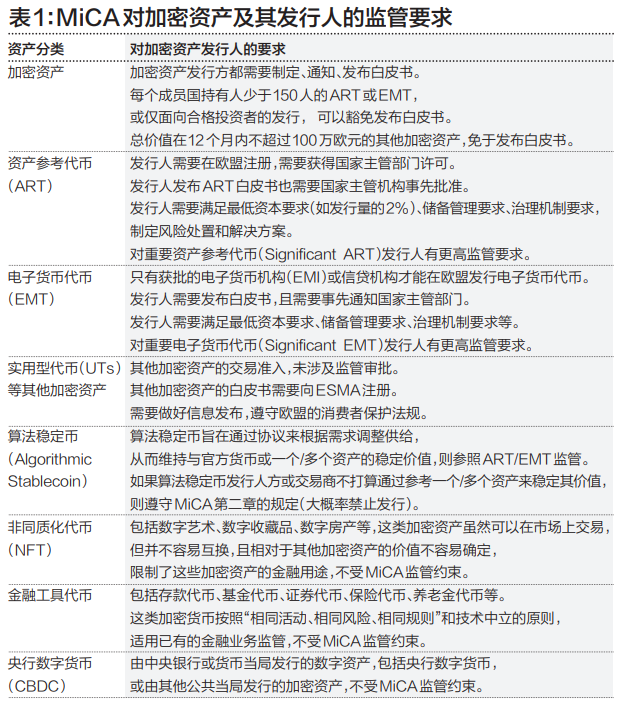
Core Viewpoint - The implementation of the Markets in Crypto-Assets Regulation (MiCA) in Europe starting in 2025 will significantly promote the compliant development of the global crypto asset market and lead to the formulation of regulatory policies in other countries, as well as the establishment of a global governance coordination system [1][2]. Group 1: Regulatory Framework - MiCA, officially released in June 2023, will fully come into effect on December 30, 2024, covering 27 EU member states and 3 EEA countries, addressing fragmentation and regulatory arbitrage in crypto asset regulation [1][3]. - MiCA categorizes crypto assets into three main types: Electronic Money Tokens (EMT), Asset-Referenced Tokens (ART), and Utility Tokens (UTs), with fully decentralized crypto assets excluded from regulation [3][4]. - The regulation provides detailed requirements for the definition, issuance, management, and anti-money laundering (AML) measures related to crypto assets, making it the most comprehensive crypto asset regulation globally [1][3]. Group 2: Issuer and Service Provider Requirements - All crypto asset issuers must prepare and publish a white paper, with exemptions for certain small issuances and qualified investors [5]. - ART issuers must be registered in the EU and obtain permission from national authorities, while EMT issuers must be authorized as electronic money institutions [8][9]. - MiCA outlines a broad range of activities for crypto asset service providers (CASP), requiring them to register and obtain authorization from relevant authorities [9][12]. Group 3: Capital and Asset Management - MiCA emphasizes capital regulation for crypto asset issuers, requiring ART issuers to maintain a minimum capital based on their issuance scale, while EMT issuers must meet specific capital requirements [10][11]. - The regulation mandates that reserve assets for ART must be isolated from the issuer's assets and managed by qualified institutions, ensuring priority for redemption in case of issuer insolvency [14][15][16]. Group 4: Anti-Money Laundering Measures - MiCA imposes comprehensive AML requirements on crypto asset transactions, including strict KYC procedures and transaction monitoring to prevent illicit activities [19][20]. - The regulation enhances the "travel rule" for crypto assets, requiring service providers to include sender and receiver information in transactions, with stricter thresholds than previous guidelines [20]. Group 5: Global Impact - The implementation of MiCA marks a shift from "free development" to "compliant competition" in the global crypto asset market, influencing the structure of market development and regulatory trends [21][22]. - MiCA is expected to serve as a reference for other countries in formulating their crypto asset regulations, promoting a standardized approach to governance [23][24]. - The regulation is anticipated to accelerate the establishment of a global governance coordination system for crypto assets, addressing the current fragmented regulatory landscape [25][26].