
模仿学习

Search documents
端到端自动驾驶万字长文总结
自动驾驶之心· 2025-07-23 09:56
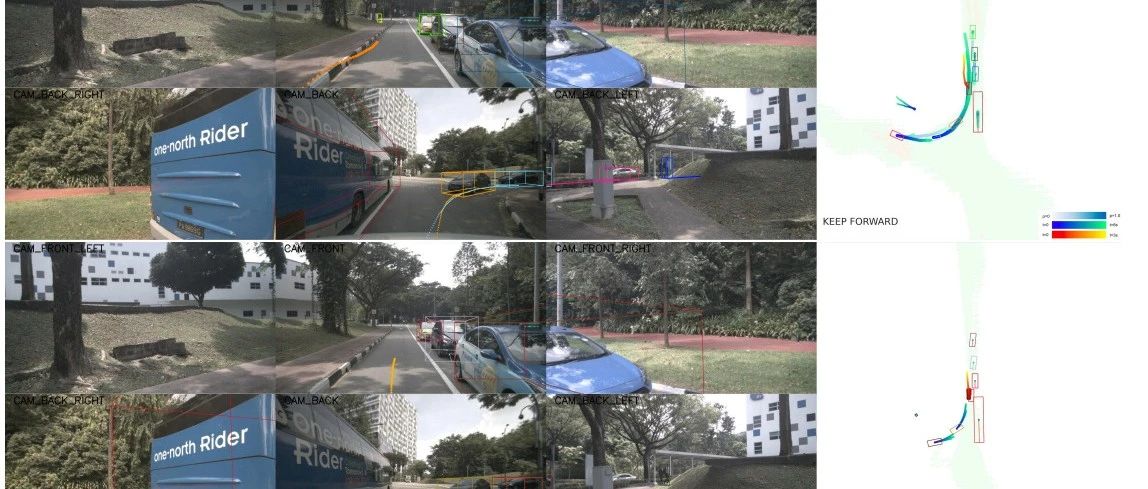
Core Viewpoint - The article discusses the current development status of end-to-end autonomous driving algorithms, comparing them with traditional algorithms and highlighting their advantages and limitations [1][3][53]. Summary by Sections Traditional vs. End-to-End Algorithms - Traditional autonomous driving algorithms follow a pipeline of perception, prediction, and planning, where each module has distinct inputs and outputs [3]. - End-to-end algorithms take raw sensor data as input and directly output path points, simplifying the process and reducing error accumulation [3][5]. - Traditional algorithms are easier to debug and have some level of interpretability, but they suffer from cumulative error issues due to the inability to ensure complete accuracy in perception and prediction modules [3][5]. Limitations of End-to-End Algorithms - End-to-end algorithms face challenges such as limited ability to handle corner cases, as they rely heavily on data-driven methods [7][8]. - The use of imitation learning in these algorithms can lead to difficulties in learning optimal ground truth and handling exceptional cases [53]. - Current end-to-end paradigms include imitation learning (behavior cloning and inverse reinforcement learning) and reinforcement learning, with evaluation methods categorized into open-loop and closed-loop [8]. Current Implementations - The ST-P3 algorithm is highlighted as an early work focusing on end-to-end autonomous driving, utilizing a framework that includes perception, prediction, and planning modules [10][11]. - Innovations in the ST-P3 algorithm include a perception module that uses a self-centered cumulative alignment technique and a prediction module that employs a dual-path prediction mechanism [11][13]. - The planning phase of ST-P3 optimizes predicted trajectories by incorporating traffic light information [14][15]. Advanced Techniques - The UniAD system employs a full Transformer framework for end-to-end autonomous driving, integrating multiple tasks to enhance performance [23][25]. - The TrackFormer framework focuses on the collaborative updating of track queries and detect queries to improve prediction accuracy [26]. - The VAD (Vectorized Autonomous Driving) method introduces vectorized representations for better structural information and faster computation in trajectory planning [32][33]. Future Directions - The article suggests that end-to-end algorithms still primarily rely on imitation learning frameworks, which have inherent limitations that need further exploration [53]. - The introduction of more constraints and multi-modal planning methods aims to address trajectory prediction instability and improve model performance [49][52].

分层VLA模型与完全端到端VLA哪个方向好发论文?
自动驾驶之心· 2025-07-23 07:32
Core Viewpoint - The article emphasizes the shift in academic research from traditional perception and planning tasks in autonomous driving to the exploration of Vision-Language-Action (VLA) models, suggesting that there are still many opportunities for research in this area [1][2]. Group 1: VLA Research Topics - The VLA model represents a new paradigm in autonomous driving, integrating vision, language, and action to enhance decision-making capabilities [2][3]. - The evolution of autonomous driving technology can be categorized into three phases: traditional modular architecture, pure visual end-to-end systems, and the emergence of VLA models [2][3]. - VLA models aim to improve interpretability and reliability by allowing the model to explain its decisions in natural language, thus increasing transparency and trust [3]. Group 2: Course Objectives and Structure - The course aims to help participants systematically master key theoretical knowledge in VLA and develop practical skills in model design and implementation [6][7]. - Participants will engage in a 12-week online group research followed by 2 weeks of paper guidance, culminating in a 10-week maintenance period for their research papers [6]. - The course will provide insights into classic and cutting-edge papers, coding implementations, and writing methodologies, ultimately assisting participants in producing a research paper draft [6][12]. Group 3: Enrollment and Requirements - The course is limited to 6-8 participants per session, targeting individuals with a foundational understanding of deep learning and basic programming skills [5][9]. - Participants are expected to have access to high-performance computing resources, ideally with multiple high-end GPUs, to facilitate their research [13][14]. - A preliminary assessment will be conducted to tailor the course content to the individual needs of participants, ensuring a focused learning experience [15]. Group 4: Course Highlights and Outcomes - The course features a "2+1" teaching model, providing comprehensive support from experienced instructors and research mentors [15]. - Participants will gain a thorough understanding of the research process, writing techniques, and submission strategies, enhancing their academic and professional profiles [15][20]. - The expected outcomes include a research paper draft, project completion certificates, and potential recommendation letters based on performance [15].
VLA之外,具身+VA工作汇总
自动驾驶之心· 2025-07-14 10:36
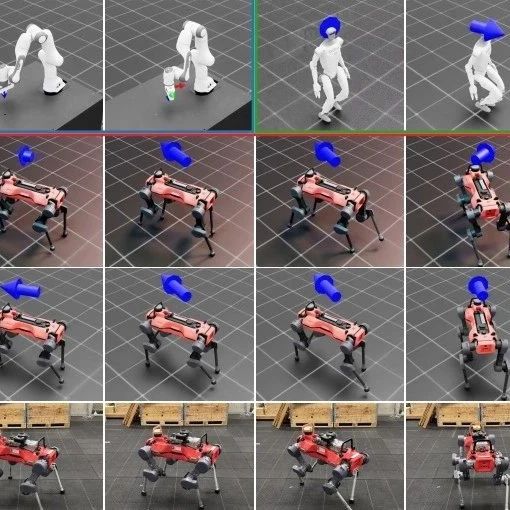
Core Insights - The article focuses on advancements in embodied intelligence and robotic manipulation, highlighting various research projects and methodologies aimed at improving robot learning and performance in real-world tasks [2][3][4]. Group 1: 2025 Research Highlights - Numerous projects are set for 2025, including "Steering Your Diffusion Policy with Latent Space Reinforcement Learning" and "Chain-of-Action: Trajectory Autoregressive Modeling for Robotic Manipulation," which aim to enhance robotic capabilities in manipulation and interaction [2]. - The "BEHAVIOR Robot Suite" aims to streamline real-world whole-body manipulation for everyday household activities, indicating a focus on practical applications of robotic technology [2]. - "You Only Teach Once: Learn One-Shot Bimanual Robotic Manipulation from Video Demonstrations" emphasizes the potential for robots to learn complex tasks from minimal demonstrations, showcasing advancements in imitation learning [2]. Group 2: Methodological Innovations - The article discusses various innovative methodologies such as "Adaptive 3D Scene Representation for Domain Transfer in Imitation Learning," which aims to improve the adaptability of robots in different environments [2]. - "Learning Dexterous In-Hand Manipulation with Multifingered Hands via Visuomotor Diffusion" highlights the focus on enhancing dexterity in robotic hands, crucial for complex manipulation tasks [4]. - "Generalizable Task-Oriented Grasping via Large-Scale Synthetic Data Generation" indicates a trend towards using synthetic data to train robots, which can significantly reduce the need for real-world data collection [7]. Group 3: Future Directions - The research agenda for 2024 and beyond includes projects like "Learning Robotic Manipulation Policies from Point Clouds with Conditional Flow Matching," which suggests a shift towards utilizing advanced data representations for improved learning outcomes [9]. - "Zero-Shot Framework from Image Generation World Model to Robotic Manipulation" indicates a future direction where robots can generalize from visual data without prior specific training, enhancing their versatility [9]. - The emphasis on "Human-to-Robot Data Augmentation for Robot Pre-training from Videos" reflects a growing interest in leveraging human demonstrations to improve robotic learning efficiency [7].
用动作分块突破RL极限,伯克利引入模仿学习,超越离线/在线SOTA
机器之心· 2025-07-14 04:08
Core Insights - Reinforcement Learning (RL) has achieved significant results across various fields, but its performance in tasks with long time spans and sparse rewards remains unsatisfactory [1][2] - Traditional RL methods often struggle with exploration efficiency in such tasks, as rewards are only received after executing long sequences of actions, making it difficult to find effective strategies in a reasonable timeframe [3][10] Method Overview - The introduction of Imitation Learning (IL) concepts into RL could potentially improve performance, particularly in scenarios with large state and action spaces where designing reward functions is challenging [4] - The proposed Q-chunking method incorporates action chunking into Temporal Difference (TD) based RL, addressing two core issues: enhancing exploration efficiency through temporally coherent action sequences and achieving faster value propagation without introducing bias from traditional n-step returns [5][12] Implementation Details - Q-chunking extends standard Q-learning to a time-extended action space, allowing the policy to predict sequences of actions over multiple steps rather than single-step actions [15] - The method includes a behavior constraint to ensure that the learned policy remains close to the offline data distribution, which is crucial for effective exploration and utilization of offline data [18][19] Experimental Results - The researchers tested Q-chunking in six sparse reward robotic manipulation tasks, demonstrating competitive performance in offline phases and high sample efficiency in online phases, particularly in challenging tasks [23][25] - Ablation studies showed that Q-chunking outperformed its variants and traditional n-step return baselines, highlighting the importance of learning in a time-extended action space [27] - The analysis indicated that action chunking leads to more temporally coherent actions, resulting in better state coverage and exploration efficiency [28][32]
Human2LocoMan:通过人类预训练学习多功能四足机器人操控
自动驾驶之心· 2025-07-04 10:27
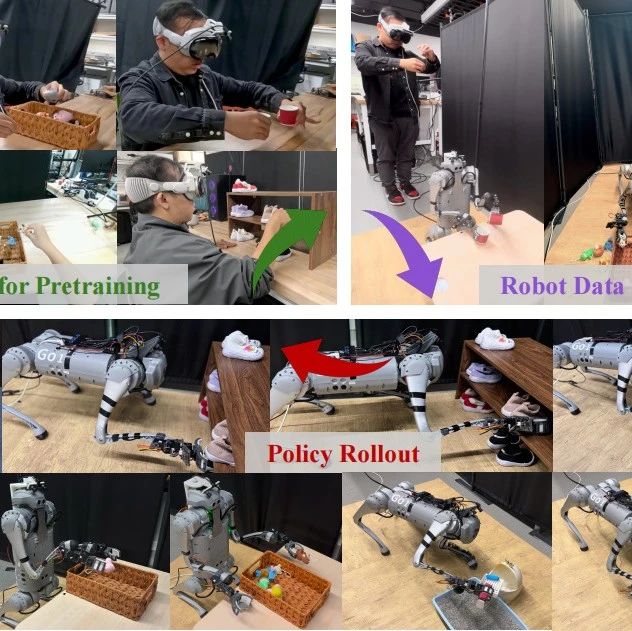
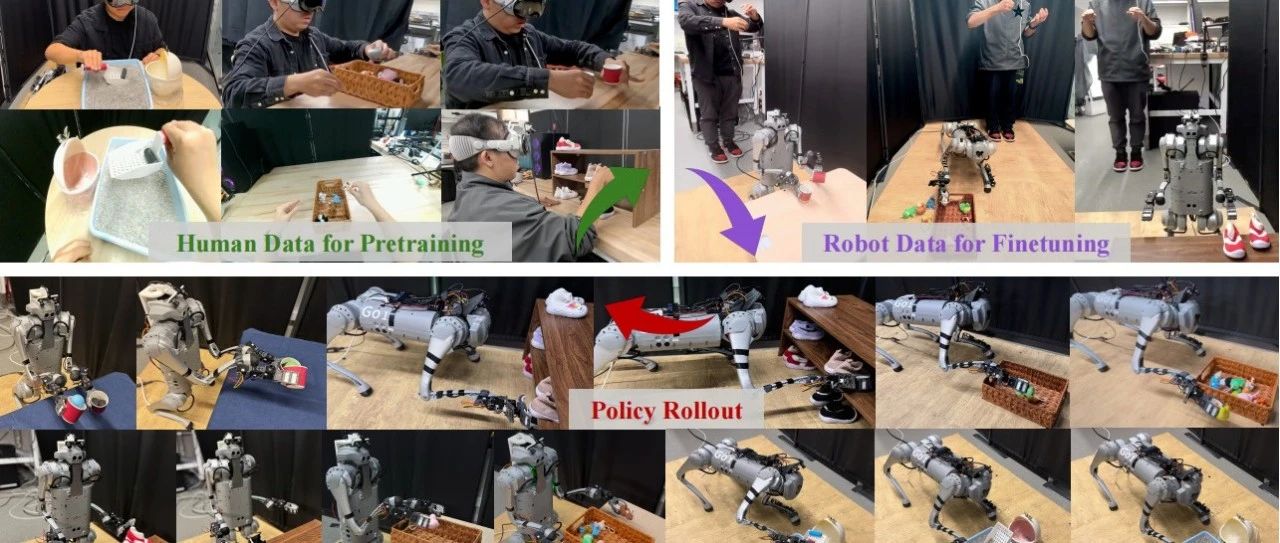
Core Insights - The article presents a novel framework called Human2LocoMan for enhancing quadrupedal robots' manipulation capabilities through human pretraining, addressing the challenges of autonomous multi-functional operations in complex environments [5][9][38] - The framework utilizes a modular cross-entity transformer architecture (MXT) to facilitate effective data collection and transfer learning from human demonstrations to robotic strategies, demonstrating significant performance improvements in various tasks [10][36] Group 1: Framework and Methodology - The Human2LocoMan framework integrates remote operation and data collection systems to bridge the action space between humans and quadrupedal robots, enabling efficient acquisition of high-quality datasets [9][38] - The system employs extended reality (XR) technology to capture human actions and translate them into robotic movements, enhancing the robot's workspace and perception capabilities [9][12] - A modular design in the MXT architecture allows for the sharing of a common transformer backbone while maintaining entity-specific markers, facilitating effective strategy transfer across different robotic entities [16][37] Group 2: Experimental Results - Experiments conducted on six challenging household tasks showed an average success rate improvement of 41.9% and an 82.7% increase in out-of-distribution (OOD) scenarios when using human data for pretraining [6][10] - The framework demonstrated robust generalization capabilities, maintaining high performance even with limited robotic data, and significantly improving task execution in both ID and OOD scenarios [37][38] - The modular design of MXT was shown to outperform traditional methods, indicating its effectiveness in leveraging human data for enhanced robotic learning and performance [33][36] Group 3: Data Collection and Efficiency - The Human2LocoMan system allows for efficient data collection, achieving over 50 robotic trajectories and 200 human trajectories within 30 minutes, showcasing its potential for rapid data acquisition in complex tasks [30] - The framework supports a variety of operation modes, including single and dual-hand tasks, and is adaptable to different object types and scenarios, enhancing its applicability across various domains [30][36]
卡耐基梅隆大学!Human2LocoMan:通过人类预训练学习多功能四足机器人操控
具身智能之心· 2025-07-03 13:36
Core Insights - The article presents a novel framework called Human2LocoMan for enhancing quadrupedal robot manipulation through human pretraining, addressing the challenges of autonomous multi-functional operations in complex environments [4][38] - The framework utilizes a modular cross-entity Transformer architecture (MXT) to facilitate effective data collection and transfer learning from human demonstrations to robotic strategies [8][38] Group 1: Framework and Methodology - The Human2LocoMan framework integrates human data collection via extended reality (XR) technology, allowing for the mapping of human actions to robotic movements, thereby enhancing the robot's operational capabilities [7][10] - A unified reference framework is established to align actions between humans and the LocoMan robot, addressing the significant differences in dynamics and control systems between the two entities [12][10] - The MXT architecture is designed to share a common Transformer backbone while maintaining entity-specific markers, enabling effective transfer learning across different robotic platforms [16][8] Group 2: Experimental Results - The experiments demonstrated an average success rate improvement of 41.9% and an 79.7% enhancement in out-of-distribution (OOD) scenarios when using the proposed framework compared to baseline methods [4][8] - Pretraining with human data resulted in a 38.6% overall success rate increase and an 82.7% improvement in OOD scenarios, showcasing the effectiveness of human data in enhancing robotic performance [8][38] - The data collection efficiency was highlighted, with over 50 robot trajectories and 200 human trajectories collected within 30 minutes, indicating the framework's potential for rapid data acquisition [26][38] Group 3: Comparative Analysis - The MXT architecture outperformed state-of-the-art (SOTA) imitation learning methods in various tasks, demonstrating superior success rates and task scores, particularly in scenarios with limited data [30][34] - The modular design of MXT facilitated better generalization and reduced overfitting compared to other architectures, such as HPT, which struggled with severe overfitting issues [36][39] - The framework's ability to maintain high performance in long-sequence tasks indicates its robustness and effectiveness in real-world applications [36][38]
具身智能领域,全球Top50国/华人图谱(含具身智能赛道“师徒关系图”)
Robot猎场备忘录· 2025-06-30 08:09
Core Viewpoint - The development of embodied intelligence technology is a leading trend in the AI and robotics sector, involving advanced techniques such as large language models (LLM), visual multimodal models (VLM), reinforcement learning, deep reinforcement learning, and imitation learning [1]. Group 1: Embodied Intelligence Technology - Embodied intelligence technology encompasses various cutting-edge techniques, including LLM, VLM, reinforcement learning, deep reinforcement learning, and imitation learning [1]. - The evolution of humanoid robots has progressed from model-based control algorithms to dynamic model control and optimal control algorithms, and currently to simulation combined with reinforcement learning [1]. - The most frequently mentioned concepts in humanoid robotics companies are imitation learning and reinforcement learning, primarily researched by academic and leading tech company teams [1]. Group 2: Academic Contributions - UC Berkeley and Stanford University are leading institutions in the AI and robotics research field, with notable alumni contributing to the embodied intelligence sector [2]. - Four prominent figures from UC Berkeley, known as the "Four Returnees," have transitioned from Tsinghua University to UC Berkeley and then to entrepreneurial ventures in embodied intelligence [2]. Group 3: Notable Individuals in the Field - Wang He and Lu Ce Wu are key representatives of individuals who graduated from Stanford University and are now involved in the embodied intelligence startup scene in China [3]. - Wang He, a 2021 PhD graduate from Stanford, is now an assistant professor at Peking University and the founder of a leading humanoid robotics startup [3]. - Lu Ce Wu, a postdoctoral researcher at Stanford, is a co-founder and chief scientist of a unicorn collaborative robotics company and a founder of an embodied intelligence startup [3]. Group 4: Global Talent Pool - The majority of the top 50 Chinese individuals in the embodied intelligence field have educational backgrounds from prestigious institutions such as UC Berkeley, Stanford, MIT, and CMU, often under the mentorship of industry leaders [4]. - A detailed mapping of the top 50 Chinese talents in the field includes their educational history, research directions, and current positions in leading tech companies or startups [5].

保姆级分享!ALOHA:低成本双臂机器人结合模仿学习经典工作
具身智能之心· 2025-06-27 08:36
Core Viewpoint - The article discusses the ALOHA system, a low-cost open-source hardware system designed for bimanual teleoperation, emphasizing its potential to perform precise manipulation tasks using affordable components and advanced learning algorithms [4][5][8]. Group 1: ALOHA System Overview - ALOHA is a low-cost system costing less than $20,000, designed to enable precise manipulation tasks using two low-cost robotic arms and 3D-printed components [7][8]. - The system utilizes end-to-end imitation learning to perform tasks by collecting real demonstrations from a custom remote operation interface [8][10]. Group 2: Challenges in Imitation Learning - Imitation learning faces challenges such as compounding errors, where small prediction errors accumulate, leading to significant deviations from expert behavior [9][12]. - The article highlights the difficulty of modeling complex physical interactions in tasks, suggesting that learning policies directly from demonstrations is more effective than modeling the entire environment [9][12]. Group 3: Action Chunking with Transformers (ACT) - The ACT algorithm addresses compounding errors by predicting sequences of actions rather than single steps, improving performance in tasks with high complexity [12][13]. - The algorithm has demonstrated an 80-90% success rate in tasks with only 10 minutes of demonstration data [12]. Group 4: Hardware Specifications - The ALOHA system is built on principles of low cost, versatility, user-friendliness, repairability, and ease of construction, utilizing ViperX 6-DoF robotic arms [17][18]. - The system is designed to perform various tasks, including precise, contact-based, and dynamic operations [20][22]. Group 5: Data Collection and Training - The system collects human demonstrations to train the policy, focusing on the leader robot's joint positions to capture the operator's intent and force feedback [23][25]. - The training process involves using a conditional variational autoencoder (CVAE) to model human data and improve learning from noisy demonstrations [33][55]. Group 6: Experimental Results - The article presents experimental results showing that action chunking and temporal ensembling significantly enhance the performance of the ACT algorithm [52][54]. - The necessity of high-frequency control is emphasized, with findings indicating that a control frequency of 50Hz allows for more precise and agile task execution [56].
SwitchVLA:无需额外数据采集,即可实时动态任务切换的轻量化VLA模型
自动驾驶之心· 2025-06-24 02:54
Core Viewpoint - The article introduces SwitchVLA, a lightweight and data-efficient method for dynamic task perception and decision-making, addressing the challenges of task switching in multi-task VLA models, achieving superior performance compared to existing methods [3][22]. Group 1: Introduction - Current mainstream multi-task VLA models struggle with task switching, defined as "Task Switching," where the model's ability to adapt to new tasks mid-execution is limited [3][5]. - SwitchVLA employs an Execution-Aware mechanism and a lightweight network architecture to facilitate task switching without the need for additional data collection [3][10]. Group 2: Background - Multi-task VLA training typically involves independent data collection for each task, leading to challenges in seamlessly transitioning between tasks [5]. - The inability of existing SOTA VLA methods to effectively handle task switching is highlighted, emphasizing the need for improved solutions [5][10]. Group 3: Methodology - SwitchVLA addresses two core problems: representing task switching without extra data collection and training an end-to-end imitation learning model that autonomously judges based on current conditions [10][12]. - The model improves task switching representation by concatenating previous task, current task, and the previous task's stage, enhancing the model's ability to perceive task transitions [12][13]. - A simplified training process categorizes tasks into three stages: before contact, during contact, and after contact, allowing for effective task switching without additional data [15][16]. Group 4: Experimental Results - Experiments demonstrate that SwitchVLA outperforms existing methods in task switching scenarios while maintaining comparable performance in single-task settings [20][22]. - The analysis of task switching failures reveals that the proposed method effectively mitigates common failure causes [20]. Group 5: Conclusion and Future Directions - SwitchVLA is positioned as a significant advancement in dynamic task management, with plans for further iterations and deployment in humanoid robots for applications in flexible industrial production and personalized commercial services [22][23].
SwitchVLA:无需额外数据采集,即可实时动态任务切换的轻量化VLA模型
具身智能之心· 2025-06-23 13:54
Core Viewpoint - The article introduces SwitchVLA, a lightweight and data-efficient dynamic task perception and decision-making method designed to address the challenges of task switching in multi-task VLA models, significantly outperforming existing state-of-the-art methods in task switching scenarios [3][18]. Group 1: Introduction - Current mainstream multi-task VLA models struggle with task switching, defined as the ability to switch from one task to another seamlessly during execution [3][5]. - The proposed Execution-Aware mechanism allows for a minimal representation of task switching, utilizing a lightweight network architecture and new training paradigms without the need for additional data collection [3][5]. Group 2: Background - Multi-task VLA models typically rely on Imitation Learning, where tasks are independently collected, leading to challenges in maintaining consistency during task transitions [5]. - The inability of existing methods to handle task switching effectively highlights a significant gap in current VLA capabilities [5]. Group 3: Methodology - SwitchVLA addresses two core issues: representing task switching without additional data collection and training an end-to-end imitation learning model that autonomously makes decisions based on current conditions [6][8]. - The model improves task switching representation by concatenating previous task, current task, and the previous task's stage, enhancing the model's ability to perceive task transitions [8][9]. Group 4: Training Process Improvements - The training process simplifies tasks into three stages: before contact, during contact, and after contact, with specific actions defined for each stage [12]. - The method allows for the training of forward, rollback, and advance actions without the need for additional data collection, demonstrating the model's efficiency [13]. Group 5: Experimental Results - Experiments show that SwitchVLA achieves comparable performance to mainstream methods in single-task scenarios while significantly outperforming them in task switching tasks [16]. - The analysis of task switching failures identified four main types, indicating that the proposed method effectively mitigates these issues [16]. Group 6: Conclusion and Future Work - SwitchVLA is positioned as a significant advancement in dynamic task management, maintaining state-of-the-art performance in single tasks while excelling in task switching [18]. - Future iterations of SwitchVLA will be deployed in TianGong humanoid robots, enhancing capabilities in flexible industrial production and personalized commercial services [19].
