
Deflation

Search documents
Garcia: A slowdown in Japan will ultimately flow back to the U.S.
CNBC Television· 2025-12-08 12:32
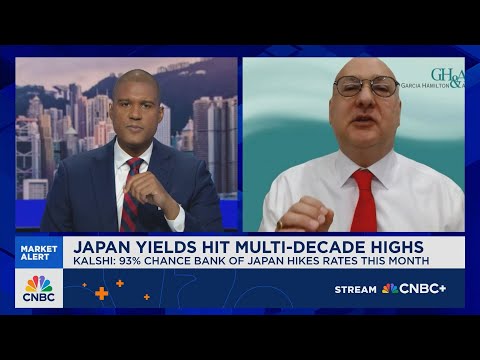
Japanese Bond Market Analysis - Japanese 30-year bond market is experiencing significant activity, with the 10 to 30-year spread nearly twice the normal spread over the last 25 years, reaching almost 160 compared to the usual 85 [2] - Japan is undergoing a normalization of its monetary policy after a period of yield curve controls and deflation [3][10] - The rise in Japanese bond yields could lead to a slowdown in the Japanese economy [7] Carry Trade Implications - Estimates suggest a $500 billion carry trade exists, and rising Japanese yields could cause capital to flow from the US back to Japan [5] - The unwinding of the carry trade is expected to continue as the US lowers interest rates and Japan raises them [10] Bond Samurai Influence - "Bond Samurai" are influencing the Japanese government to slow down quantitative tightening and adjust bond issuance towards the long end [6] - If the Japanese government doesn't heed the "Bond Samurai's" advice, rates could rise further, leading to a significant economic slowdown that could impact the US [7] US Market Impact - US real rates are approximately 100 basis points too high on the long end [11] - High US real rates could lead to a continued economic slowdown in the US unless they are lowered quickly [12]

Wall Street bets Chinese stocks will extend $2.4 trillion rally
The Economic Times· 2025-12-07 05:04
Core Viewpoint - Investor perception toward China has shifted positively, recognizing its market potential driven by technological advancements and resilience, with a growing inclination to invest in Chinese equities [1][15]. Investment Trends - Foreign long-only funds have purchased approximately $10 billion in shares in mainland China and Hong Kong through November 2023, reversing a $17 billion outflow in 2024, primarily driven by passive investors [3][15]. - Active fund managers, however, have withdrawn around $15 billion due to lingering concerns over economic slowdown and regulatory crackdowns [3][15]. Market Sentiment - Many active investors remain cautious, influenced by years of economic anxiety, despite a more business-friendly stance from authorities this year [5][15]. - The bar for investing in China remains high, especially with the US market performing well, but improving earnings and addressing deflation could change this sentiment [6][15]. Growth Potential - The bullish outlook for Chinese stocks is supported by optimism surrounding technology sectors such as chips, biopharma, and robotics, alongside hopes of overcoming deflationary pressures [8][15]. - Stocks that have been affected by economic stability concerns may present significant investment opportunities if reflation occurs [9][15]. Valuation Comparisons - Chinese stocks are considered undervalued, with the MSCI China index trading at 12 times forward earnings, compared to 15 for MSCI Asia and 22 for the S&P 500 [11][15]. Future Expectations - Analysts predict modest returns for the MSCI China index, with expectations of around 6% to 9% gains in the coming year [11][15]. - Local mutual funds and state-linked funds are also contributing to market stability, indicating that foreign investment is not the sole driver of the rally [12][15]. Savings and Market Dynamics - Chinese households hold approximately $23 trillion in deposits, which could provide a significant boost to the market as investors seek better returns amid a struggling real estate sector [13][15]. - A potential resurgence in sentiment from mainland investors could further propel market growth [14][15].


X @Anthony Pompliano 🌪
Anthony Pompliano 🌪· 2025-12-06 17:07
I sat down with @jvisserlabs to discuss the major forces driving markets today, including bitcoin’s price action, accelerating institutional adoption, the latest AI developments, internal tensions at OpenAI, and an overlooked industrial company he believes will be critical to the future economy.We wrap with a sharp look at the Fed, interest rates, deflation signals, and why easy money is still flowing through the system.Enjoy!YouTube: https://t.co/4pkAZxeUMXApple: https://t.co/FkUq7uoyxJSpotify: https://t.c ...
What Real Growth Means For Inflation
ARK Invest· 2025-12-06 01:46
If uh real growth rates start accelerating now uh we believe inflation will come down. Many people assume that growth means inflation. That's absolutely wrong.When real growth has picked up, inflation comes down mostly because of productivity gains. And as you know, we think that the productivity gains in this cycle are going to be outsized and sustainable. The convergence between and among those technologies we think is going to be highly deflationary.Deflationary in the good sense of the word word. When y ...

亚洲焦点:金价走高掩盖了通胀放缓的实际趋势-Asia in Focus_ Higher Gold Prices Mask Softer Underlying Inflation
2025-12-05 06:35
4 December 2025 | 9:17PM HKT Economics Research ASIA IN FOCUS Higher Gold Prices Mask Softer Underlying Inflation Chelsea Song +852-2978-0106 | chelsea.song@gs.com Goldman Sachs (Asia) L.L.C. Andrew Tilton +852-2978-1802 | andrew.tilton@gs.com Goldman Sachs (Asia) L.L.C. Hui Shan +852-2978-6634 | hui.shan@gs.com Goldman Sachs (Asia) L.L.C. Santanu Sengupta +91(22)6616-9042 | santanu.sengupta@gs.com Goldman Sachs India SPL Arjun Varma +91(22)6616-9043 | arjun.varma@gs.com Goldman Sachs India SPL Xinquan Chen ...

X @PancakeSwap
PancakeSwap· 2025-12-04 03:08
Monthly Recap: November 🟣27th consecutive month of CAKE supply reduction. PancakeSwap live on Monad. New Infinity integrations. Global community meetups.Here’s the tl;dr:• Another month of deflation: 27 straight months of net CAKE supply reduction• PancakeSwap on Monad: Faster trades, lower fees, and smarter liquidity provisioning with v2 + v3• Zap now live on Infinity: one-click liquidity with Zap in Infinity & v3• Global events: Nigeria, Hong Kong & Vietnam with 300+ attendees across 3 meetupsFull Kitchen ...
Economist Paul Krugman says politicians who promise lower prices are 'ignorant or lying or both'. Here’s why
Yahoo Finance· 2025-12-03 13:00
When Hasan Minhaj asked Nobel Prize-winning economist Paul Krugman whether voters should believe politicians who promise to “bring prices down,” Krugman was blunt. “Any politician who promises to bring prices way down is either ignorant or lying, or both,” he said on Minhaj’s podcast (1). Must Read It’s a blunt warning aimed squarely at the kind of sweeping affordability pledge Donald Trump has made central to his political brand. What Krugman is really saying about prices In the Minhaj interview, Kru ...
Trump Says He'll Probably Announce New Fed Chair ‘Early Next Year'
Youtube· 2025-12-02 17:19
Since last January, we've stopped inflation in its tracks. And there is still more to do. There's always more to do, but we have it down to a very good level. It's going to go down a little bit further. You want to have a little tiny bit of inflation, otherwise that's not good either.Then you have a thing called deflation. And deflation can be worse than inflation. But we have it almost we'll soon be at a perfect level.But we inherited the worst inflation. But we have 20 states that are now selling gasoline ...

Trump Says He’ll Probably Announce New Fed Chair ‘Early Next Year’
Bloomberg Television· 2025-12-02 17:19
Inflation & Economy - Inflation has been stopped in its tracks, with further reduction expected to reach a near-perfect level [1] - Some states are selling gasoline at less than $2.75 [2] - Thanksgiving turkey costs are down 33% compared to the previous administration [2] - Egg prices have decreased significantly, down by 86% [2] Federal Reserve (The Fed) - The current chairman of the Fed is perceived as incompetent and should reduce rates [3] - A new chairman of the Fed will likely be announced early next year [4]
Elon Musk says only AI and robotics can solve the ‘insanely high’ $38 trillion national debt crisis—but it would cause ‘significant deflation’
Yahoo Finance· 2025-12-01 11:50
Group 1: Musk's Political Involvement and Views on National Debt - Elon Musk's political engagement is characterized as a "very interesting side quest," involving significant financial contributions to Trump's campaign and subsequent conflicts with the White House [1] - The separation between Musk and Trump was anticipated, influenced by Musk's criticism of the One Big Beautiful Bill Act, which he believes undermines efforts to reduce government spending [2] - Musk's concerns reflect a broader anxiety among business leaders regarding the national debt, which has surpassed $38 trillion [2] Group 2: Economic Implications of National Debt - Economists express concern not about the national debt level itself, but about the rising interest payments and their effect on the debt-to-GDP ratio, a key indicator of economic health [3] - Interest payments on the national debt are projected to reach $104 billion by October 2025, accounting for 15% of total federal spending in fiscal year 2026, with total interest for FY 2025 at $1.22 trillion [4] - To improve the debt-to-GDP ratio, nations can either cut spending or stimulate economic growth, with Musk advocating for the latter through advancements in AI [4] Group 3: Musk's Perspective on AI and Economic Growth - Musk asserts that AI and robotics are crucial for addressing the U.S. debt crisis, suggesting that technological advancements will drive economic growth [5] - He highlights that current interest payments on the national debt exceed the entire U.S. military budget, indicating a critical financial situation [5] - Musk warns that the increased production from AI could lead to "significant deflation," presenting a complex challenge for the economy [6]