
新型储能

Search documents
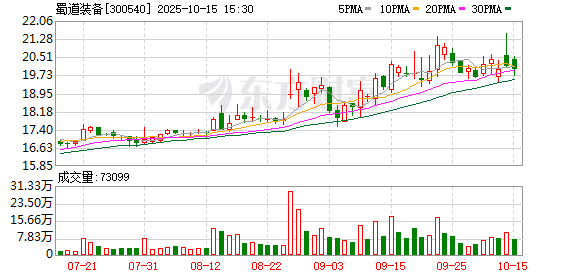
蜀道装备:公司目前在氢液化、加氢站设备等方面已具备相应的技术储备
Zheng Quan Ri Bao· 2025-10-15 07:37
Core Viewpoint - The company has developed technical reserves in hydrogen liquefaction, hydrogen refueling station equipment, hydrogen production, and liquefied storage and transportation, but hydrogen negative ion battery technology is not currently a focus area due to its significant divergence from the company's existing technology path and business direction [2] Group 1: Technology and Innovation - The company is advancing technology innovation and industrial upgrades in key areas such as cryogenic equipment and hydrogen energy equipment [2] - The company is closely monitoring policy guidance and market opportunities to achieve high-quality development [2] Group 2: Research and Development Focus - Hydrogen negative ion battery technology, which involves new energy storage materials and electrochemical systems, has not been included in the company's current R&D priorities [2]


科瑞技术中标全自动量产线 助力新型储能赛道突破
Xin Lang Cai Jing· 2025-10-15 02:57
Core Insights - The company, 科瑞技术, has successfully won a bid for a fully automated battery cell production line project for a storage client, following the successful delivery of a semi-automated production line [1] Group 1 - The new project is expected to inject critical momentum into the client's accelerated layout in the new energy storage sector [1]

逐绿向新 “十四五”时期能源转型“加速跑”
Xin Hua Wang· 2025-10-14 23:54
Core Insights - China's energy transition has achieved remarkable milestones, with national electricity generation exceeding 10 trillion kilowatt-hours in 2024, accounting for one-third of global electricity generation, and energy production equivalent to approximately 5 billion tons of standard coal, representing over one-fifth of the global total [1][2] Group 1: Energy Transition Achievements - The "14th Five-Year Plan" period is recognized as the fastest phase for China's green and low-carbon energy transition, with non-fossil energy consumption increasing by 1 percentage point annually while coal's share decreases correspondingly [2][3] - By July 2024, China's renewable energy installed capacity reached 2.17 billion kilowatts, maintaining the global lead, with wind power at 570 million kilowatts and solar power exceeding 1.1 billion kilowatts, marking a doubling since the end of the "13th Five-Year Plan" [2][3] - The share of non-fossil energy in installed capacity has historically surpassed 60%, with renewable energy generation capacity exceeding coal power for the first time in 2024 [2][4] Group 2: Regional Innovations and Models - Various regions are innovating energy development models, such as Yunnan's hydropower utilization, Sichuan's green hydrogen industry, and Tibet's solar and wind energy projects, leading to a clean energy system dominated by renewables [3] - The "pastoral photovoltaic" model in Qinghai demonstrates the integration of solar energy with livestock farming, enhancing vegetation cover and improving the livelihoods of local herders [3] Group 3: Cross-Regional Energy Transactions - The first cross-regional green electricity transaction from Tibet to Shanghai successfully delivered 7.85 million kilowatt-hours, reducing coal consumption by 24,100 tons and cutting CO2 emissions by 60,100 tons [4] - The energy transition has shifted the electricity supply structure from coal-dominated to green energy-dominated, with significant upgrades in power transmission and grid management [4][5] Group 4: Technological Innovations - Continuous technological innovation has been a driving force in the energy transition, with China holding over 40% of global renewable energy patents and achieving record advancements in solar and wind technologies [6][7] - The new energy storage capacity is projected to reach 95 million kilowatts by mid-2025, a nearly 30-fold increase over five years, providing robust support for stable electricity supply [6][7] Group 5: Energy Efficiency and Future Goals - Since the beginning of the "14th Five-Year Plan," China's energy consumption per unit of GDP has decreased by 11.6%, equivalent to reducing CO2 emissions by 1.1 billion tons [8] - New targets set for 2035 include increasing the share of non-fossil energy consumption to over 30% and achieving a total installed capacity of wind and solar power six times that of 2020 [8]
新型储能热引发抢芯潮,前9月储能相关企业注册量同比增长18.61%
Qi Cha Cha· 2025-10-14 06:15
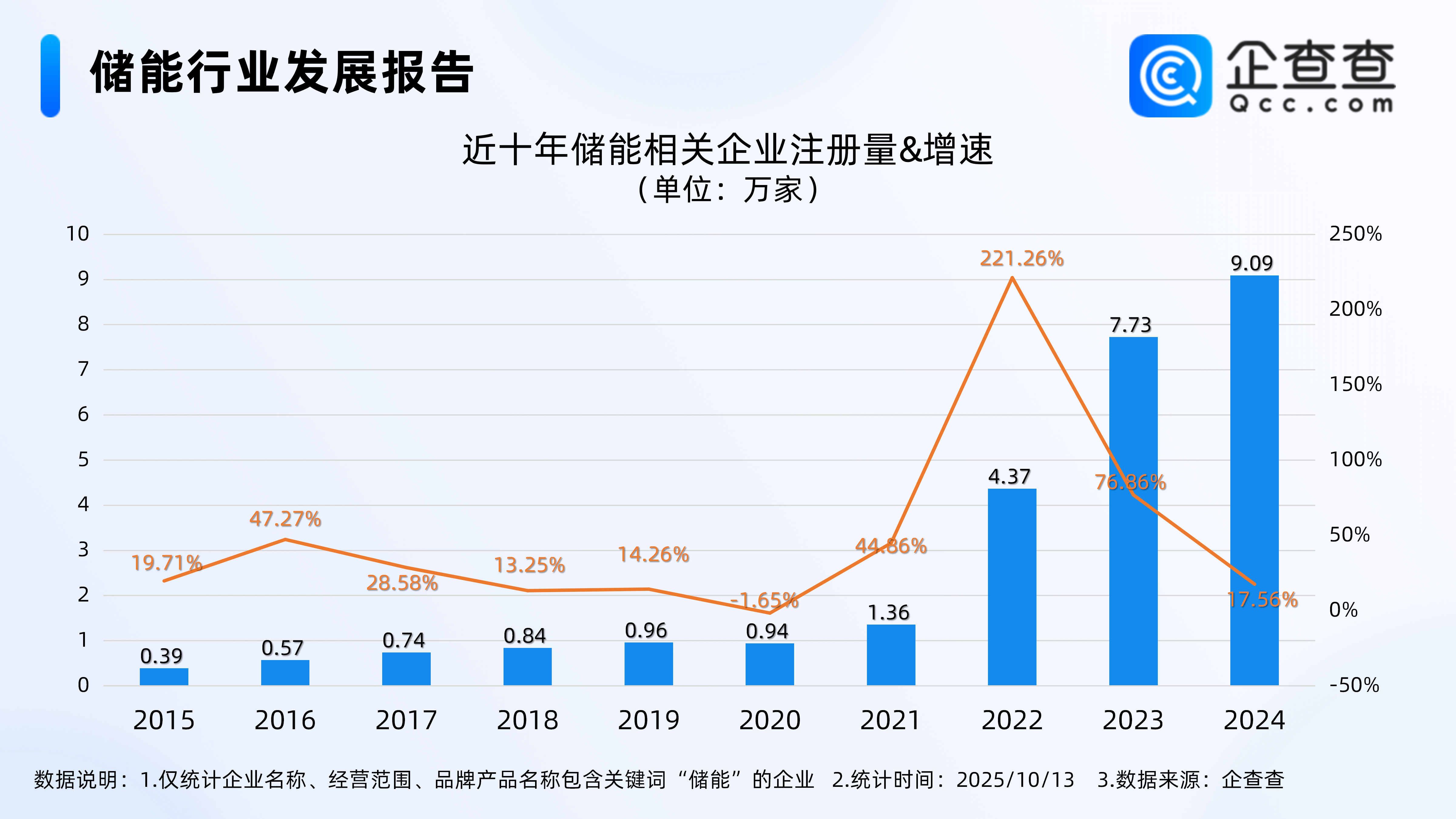
Core Insights - The demand for energy storage cells in China is currently very strong, with leading battery companies operating at full capacity and some orders extending into early next year [1] - The "New Energy Storage Scale Construction Special Action Plan" aims for a new energy storage installation capacity of over 180 million kilowatts by 2027, which is expected to drive new project investments of approximately 250 billion yuan [1] - The current surge in demand for new energy storage has led to a "chip rush," highlighting a critical period of capacity upgrades in the industry amid increasing market demand [1] Company Registration Trends - As of now, there are 314,500 energy storage-related companies in China, with a significant increase in registrations over the past decade [4] - In 2022, the total number of registered energy storage companies reached 43,700, marking a year-on-year growth of 221.26%, the highest growth rate in the past decade [4] - For 2024, it is projected that 90,900 new companies will be registered, reflecting a year-on-year increase of 17.56% [4] Company Age Distribution - Most energy storage-related companies have been established in the last three years, with those operating for 1-3 years making up 40.66% of the total [6] - Companies established within the first year and those operating for 3-5 years account for 31.39% and 11.79%, respectively [6] Geographic Distribution - The majority of energy storage-related companies are located in new first-tier cities, accounting for 24.80% of the total [11] - Companies in third-tier cities and second-tier cities represent 21.38% and 19.42% of the total, respectively [11]
新型储能热引发抢芯潮
21世纪经济报道· 2025-10-14 04:06
Core Viewpoint - The new energy storage industry in China is experiencing a "mixed expansion" in the second half of 2025, driven by policy benefits and surging demand for new energy installations, while facing challenges such as price fluctuations in the supply chain and unresolved profit models [1]. Group 1: Capital Market Dynamics - The current demand for new energy storage has led to a "chip grabbing" trend, with a critical upgrade period for battery cell capacities from 300+Ah to 500+Ah and beyond, resulting in tight supply for existing products [3]. - The price of battery cells is expected to rise due to tightened supply of raw materials like lithium carbonate, alongside strong demand, which may enhance the annual revenue expectations for battery companies [3]. - Policy changes, such as the new pricing mechanisms for energy storage, are creating significant development opportunities, with capacity pricing and compensation replacing mandatory storage requirements [4]. Group 2: Regional Disparities and Project Viability - There is a stark contrast in project development rights across regions, with some areas like Inner Mongolia seeing high demand for project rights due to favorable local policies, while other regions struggle to attract investment [4]. - A notable case in Inner Mongolia highlights the high compensation standards for independent energy storage projects, which have spurred large-scale development [4]. Group 3: Industry Challenges - Despite rising battery prices, the bidding prices for energy storage projects are declining, creating a challenging business environment due to intense competition in the downstream market [8]. - The operational revenue of energy storage stations is often below expectations, contributing to the industry's struggles, as seen in the case of Hunan Province where independent storage stations reported significant losses [9]. - The lack of a robust standard system for energy storage is hindering the industry's sustainable development, with calls for improved safety, efficiency, and performance standards [10].
化工企业豪掷14亿跨界储能
鑫椤锂电· 2025-10-13 03:02
Core Viewpoint - Binhua Co., Ltd. announced the investment in a new integrated energy project led by its wholly-owned subsidiary, Shandong Binhua New Energy Co., Ltd., with a total investment of approximately 1.421 billion yuan [1]. Group 1: Project Overview - The integrated energy project, named "Source Network Load Storage Integration Project," is located in the Beihai Economic Development Zone and Wudi County of Shandong Province [2]. - The project will include a 160MW wind farm and a 100MW photovoltaic power station, along with a 130MW/260MWh new energy storage device and a 110kV booster station, which will feature a smart energy comprehensive dispatch and control center [2]. - The project is expected to achieve an average annual utilization of 2,332.4 hours for wind power and 1,338.5 hours for photovoltaic power, indicating a high level of energy utilization efficiency within the industry [2]. Group 2: Company Background - Binhua Co., Ltd. is a well-established comprehensive chemical enterprise group founded in 1968, with core business segments including chlor-alkali, petrochemicals, new energy, new materials, and specialty chemicals [3]. - The company has developed a diversified and collaborative industrial ecosystem over several decades [3].

5年暴增30倍 我国新型储能何以高增长
Zhong Guo Chan Ye Jing Ji Xin Xi Wang· 2025-10-13 00:36
"近5年来,在'双碳'目标的指引下,我国新型储能产业从小范围科研示范走向规模化、产业化发展,中 国已经成为全球最大的新型储能市场。"在9月17-18日举行的2025世界储能大会上,宁德时代新能源科 技股份有限公司(以下简称"宁德时代")创始人、董事长曾毓群表示,当前新型储能产业正处于转型升 级的关键时期,要想实现高质量发展,必须加快构建以安全、真实、创新为导向的产业新生态。 装机规模持续高速增长 新型储能是实现"双碳"目标、构建新型电力系统的关键技术之一,近年来,我国加快推动储能产业高质 量发展,新型储能装机规模持续高速增长。 胡明介绍说,"十四五"期间,国家能源局发布56个新型储能试点项目,涵盖10余种技术路线,有力促进 新型储能关键技术和装备实现重大突破。与此同时,34个储能项目入选"国家能源领域首台(套)重大 技术装备",压缩空气储能突破30万千瓦级,GW(吉瓦)级液流电池储能、单体兆瓦级飞轮储能、构 网型储能等技术不断迭代,钠离子电池储能、动力储能等积极开展试点应用,新型储能技术呈现多元化 发展新格局。 曾毓群表示,我国目前拥有全球最完整、规模最大、技术最先进的储能产业链,全国储能相关注册企业 超过3 ...

崧盛股份(301002) - 2025年10月10日投资者关系活动记录表
2025-10-10 09:56
Group 1: Company Overview and Market Conditions - The LED driver power business is experiencing a contraction in market size due to the impact of U.S. tariffs, with demand for new installations slowing down in the first half of 2025. However, demand is expected to recover in the second half of 2025 as tariff policies ease [2]. - The global market for LED plant lighting is projected to reach $1.366 billion in 2025, with a year-on-year growth rate of 3.9% [3]. - The company’s core energy storage components are primarily sold in Europe, South Asia, and Africa, targeting energy product integrators and installers [4]. Group 2: Business Developments and Financials - The gross margin for LED driver power products in the first half of 2025 was 23.59%, with higher margins observed in high-power products compared to low-power products [10][11]. - The company has decided not to exercise the early redemption rights for its convertible bonds, with a review scheduled for December 18, 2025, should the conditions for redemption arise again [6]. Group 3: Future Prospects and Orders - The National Development and Reform Commission projects that by 2027, the new energy storage installed capacity in China will exceed 180 million kilowatts, driving direct investment of approximately 250 billion yuan [8]. - TrendForce estimates that global energy storage installations will reach 82 GW/216 GWh in 2025, representing a year-on-year growth of 28%/36% [8]. Group 4: Competitive Advantages - The company is one of the few LED driver power manufacturers with capabilities in customized R&D, large-scale manufacturing, and global supply, which enhances its competitive edge in the market [9].
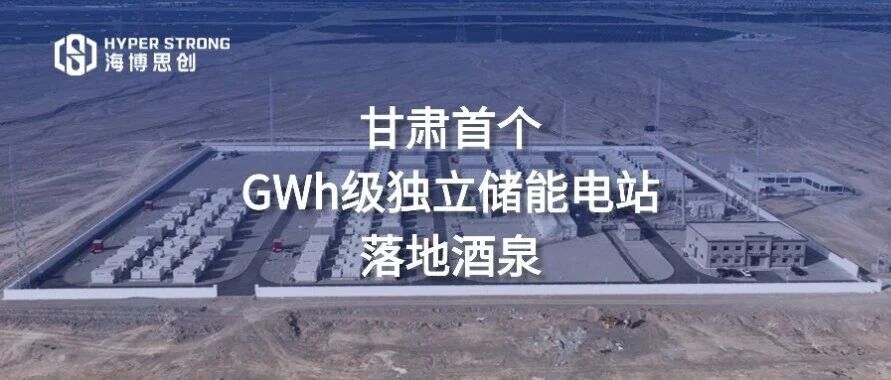
标杆案例 | 交付+运营!海博思创助力甘肃首个GWh级独立储能电站落地酒泉
海博思创· 2025-10-10 09:10
Core Insights - The article highlights the significance of the 250MW/1000MWh independent energy storage station in Jiuquan, Gansu, which aims to enhance renewable energy consumption, optimize energy structure, and improve grid stability [1][3]. Group 1: Technology and Innovation - The project utilizes the advanced 5MWh liquid cooling energy storage system from Haibo Sichuang, which integrates battery clusters, thermal management, fire safety, and control systems to reduce land use and installation complexity [3]. - The intelligent liquid cooling technology ensures optimal performance under extreme winter conditions (down to -37°C) and significant temperature fluctuations, extending the battery system's lifespan [3]. - A multi-dimensional intelligent perception system monitors the safety status of batteries and electrical systems, ensuring reliable operation through various protective measures [3]. Group 2: Project Delivery and Management - The rapid progress of the project is supported by a precise delivery system, completing the delivery of the liquid cooling system and all associated equipment in just two months [5]. - The comprehensive project management delivery system of Haibo Sichuang plays a crucial role in achieving this efficiency [5]. Group 3: Operations and Maintenance - The core of the energy storage station's operation and maintenance is its intelligent management, utilizing the Haibo AI Cloud platform for tailored maintenance solutions and rapid response capabilities [8]. - The platform's built-in AI diagnostic and warning systems ensure continuous and efficient operation of the Jiuquan energy storage station [8]. Group 4: Market Strategy and Revenue Optimization - The project leverages the Haibo AI Cloud platform and professional trading services to maximize operational value and profitability, enabling the energy storage station to better understand market dynamics [10]. - The platform supports flexible power trading, optimizing trading strategies to enhance revenue by over 20% compared to conventional models [10]. - Collaborative strategies for charging and discharging further boost the revenue potential of the energy storage system [10]. Group 5: Future Outlook - Haibo Sichuang aims to drive the transformation of the energy ecosystem with a focus on "Energy Storage + X," promoting the industrialization of new energy storage projects and contributing to the development of a new power system [12].
库存结构转变 碳酸锂波幅有望收窄
Qi Huo Ri Bao· 2025-10-10 01:16
Core Insights - The introduction of lithium carbonate futures and options has provided effective hedging tools for the lithium battery new energy industry to manage price volatility and achieve high-quality development [1] Supply and Demand Analysis - Lithium carbonate has been in a supply surplus cycle over the past two years, with prices dropping from over 200,000 yuan per ton at launch to below 100,000 yuan per ton [1] - In 2025, lithium carbonate prices are expected to initially decline due to tariff impacts and supply surplus, dropping from around 80,000 yuan to below 60,000 yuan, before rebounding due to unexpected demand and supply uncertainties [1] - The lithium battery industry has shown strong demand, with lithium carbonate production reaching record monthly highs of 81,530 tons, 85,240 tons, and 87,260 tons from July to September [2] - The production of lithium iron phosphate is projected to reach 2.1782 million tons from January to August, a year-on-year increase of 72% [2] Inventory Trends - As of late September, total lithium carbonate inventory was 136,825 tons, a decrease of 706 tons, marking the seventh consecutive week of decline [3] - Inventory is shifting from lithium salt enterprises to downstream sectors, with downstream inventories reaching new highs [3] Seasonal Demand Insights - The demand for lithium carbonate in the fourth quarter is expected to experience a peak followed by a decline, with retail sales of new energy passenger vehicles reaching 1.039 million units in September, a year-on-year increase of 9% [4] - Policies supporting the purchase of new energy vehicles are set to continue, with tax exemptions and reductions planned for 2024-2027, which may influence demand dynamics [4] Market Outlook - Despite strong supply and demand in the lithium battery industry, the tension in the lithium carbonate supply chain is expected to ease in the fourth quarter, leading to narrower price fluctuations [5]