资本回报率

Search documents
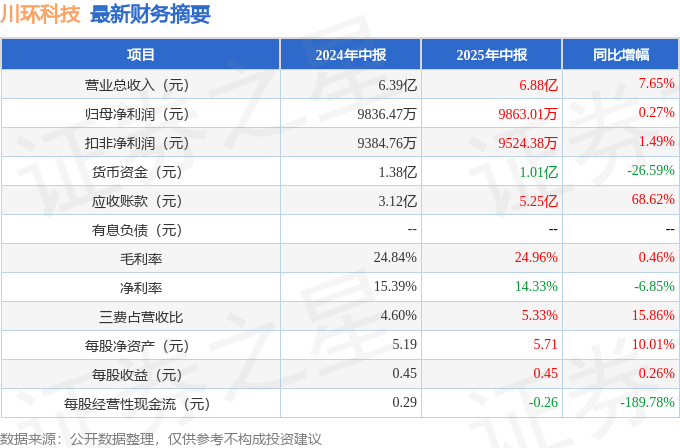
川环科技2025年中报简析:营收净利润同比双双增长,应收账款上升
Zheng Quan Zhi Xing· 2025-08-12 22:38
据证券之星公开数据整理,近期川环科技(300547)发布2025年中报。截至本报告期末,公司营业总收 入6.88亿元,同比上升7.65%,归母净利润9863.01万元,同比上升0.27%。按单季度数据看,第二季度 营业总收入3.72亿元,同比上升9.45%,第二季度归母净利润5219.45万元,同比下降3.64%。本报告期 川环科技应收账款上升,应收账款同比增幅达68.62%。 本次财报公布的各项数据指标表现尚佳。其中,毛利率24.96%,同比增0.46%,净利率14.33%,同比减 6.85%,销售费用、管理费用、财务费用总计3664.4万元,三费占营收比5.33%,同比增15.86%,每股净 资产5.71元,同比增10.01%,每股经营性现金流-0.26元,同比减189.78%,每股收益0.45元,同比增 0.26% 财务报表中对有大幅变动的财务项目的原因说明如下: 货币资金变动幅度为-56.14%,原因:本报告期销售商品、提供劳务收到的现金减少。 应收款项变动幅度为18.52%,原因:本报告期末持有客户支付融单重分类至应收账款,期末23594万元, 年初8508万元,增加15086万元。 存货变动幅度为 ...


城发环境2025年中报简析:营收净利润同比双双增长,应收账款上升
Zheng Quan Zhi Xing· 2025-08-12 22:37
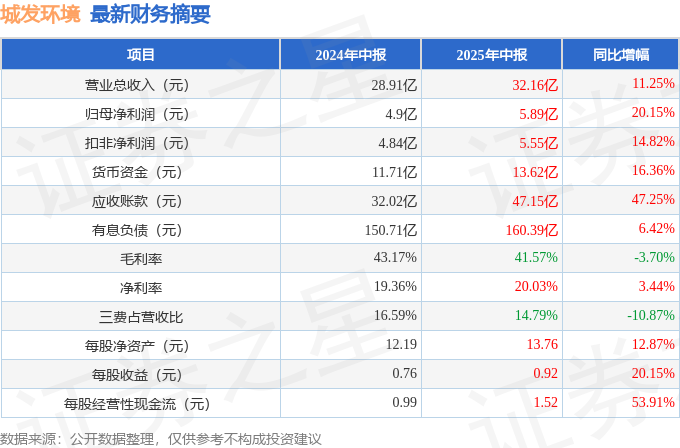
Core Insights - The company Chengfa Environment (000885) reported a total revenue of 3.216 billion yuan for the first half of 2025, representing an 11.25% year-on-year increase, and a net profit attributable to shareholders of 589 million yuan, up 20.15% year-on-year [1] Financial Performance - Total revenue for Q2 2025 reached 1.68 billion yuan, a 9.53% increase year-on-year, while net profit for the same quarter was 316 million yuan, reflecting an 18.26% year-on-year growth [1] - The gross profit margin was 41.57%, down 3.7% year-on-year, while the net profit margin improved to 20.03%, an increase of 3.44% year-on-year [1] - The company’s total operating expenses (sales, management, and financial expenses) amounted to 476 million yuan, accounting for 14.79% of revenue, a decrease of 10.87% year-on-year [1] - Earnings per share (EPS) increased to 0.92 yuan, a 20.15% rise year-on-year, and operating cash flow per share rose significantly by 53.91% to 1.52 yuan [1] Balance Sheet Highlights - Accounts receivable increased significantly by 47.25% year-on-year, reaching 4.715 billion yuan [1] - Cash and cash equivalents rose by 16.36% to 1.362 billion yuan [1] - Interest-bearing liabilities increased by 6.42% to 16.039 billion yuan, with a debt-to-asset ratio of 49.05% [4] Cash Flow Analysis - The net cash flow from operating activities surged by 53.91%, attributed to increased cash receipts from sales of goods and services [3] - Financing activities saw a substantial increase of 86.46%, driven by changes in the structure of financing activities, including the issuance of medium-term notes [3] Business Model and Market Position - The company’s return on invested capital (ROIC) was reported at 7.59%, indicating average capital returns, with a historical median ROIC of 9.03% over the past decade [3] - The company’s performance is heavily reliant on capital expenditures, necessitating close monitoring of the profitability and necessity of these investments [3] Market Expectations - Analysts project the company’s performance for 2025 to reach 1.214 billion yuan, with an average EPS forecast of 1.89 yuan [4] - The company’s accounts receivable to profit ratio stands at 413.08%, indicating potential concerns regarding cash flow management [4]

力星股份2025年中报简析:营收净利润同比双双增长,公司应收账款体量较大
Zheng Quan Zhi Xing· 2025-08-09 22:26
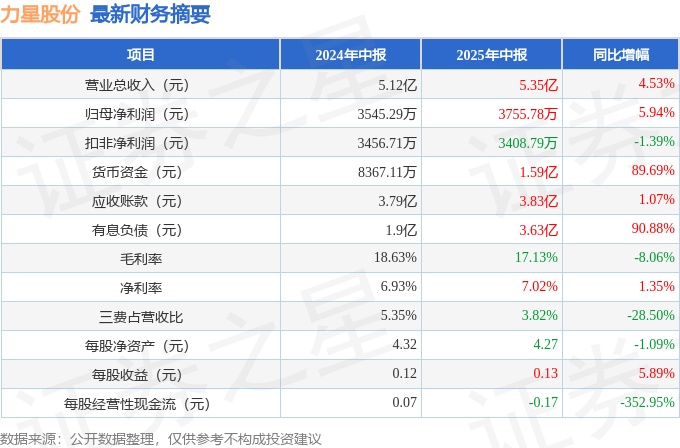
Core Viewpoint - Lixing Co., Ltd. reported a moderate increase in revenue and net profit for the first half of 2025, but faced challenges with cash flow and profitability metrics [1][3]. Financial Performance - The total revenue for the first half of 2025 reached 535 million yuan, a year-on-year increase of 4.53% [1]. - The net profit attributable to shareholders was 37.56 million yuan, up 5.94% year-on-year [1]. - In Q2 2025, the revenue was 283 million yuan, reflecting a 4.41% increase compared to the same quarter last year [1]. - The net profit for Q2 2025 was 20.43 million yuan, showing a 1.84% increase year-on-year [1]. Profitability Metrics - The gross margin decreased to 17.13%, down 8.06% year-on-year [1]. - The net profit margin improved slightly to 7.02%, an increase of 1.35% year-on-year [1]. - The total of selling, administrative, and financial expenses was 20.46 million yuan, accounting for 3.82% of revenue, a decrease of 28.5% year-on-year [1]. Cash Flow and Debt - The company reported a significant increase in cash and cash equivalents, reaching 159 million yuan, up 89.69% year-on-year [1]. - Accounts receivable stood at 383 million yuan, a 1.07% increase from the previous year [1]. - Interest-bearing debt rose to 363 million yuan, marking a 90.88% increase year-on-year [1]. Shareholder Metrics - Earnings per share (EPS) increased to 0.13 yuan, a rise of 5.89% year-on-year [1]. - The net asset value per share decreased slightly to 4.27 yuan, down 1.09% year-on-year [1]. - Operating cash flow per share was reported at -0.17 yuan, a significant decline of 352.95% year-on-year [1]. Investment Insights - The company's return on invested capital (ROIC) was reported at 4.02%, indicating weak capital returns [3]. - The historical median ROIC since the company went public is 6.59%, suggesting average investment returns [3]. - The company relies heavily on research and development for its business model, necessitating further analysis of this driving force [3]. Fund Holdings - The largest fund holding Lixing Co., Ltd. is the Jinyuan Shun'an Xinyi Mixed Initiation A fund, with a current scale of 11 million yuan [3].

晶丰明源2025年中报简析:净利润增151.67%,盈利能力上升
Zheng Quan Zhi Xing· 2025-08-08 22:39
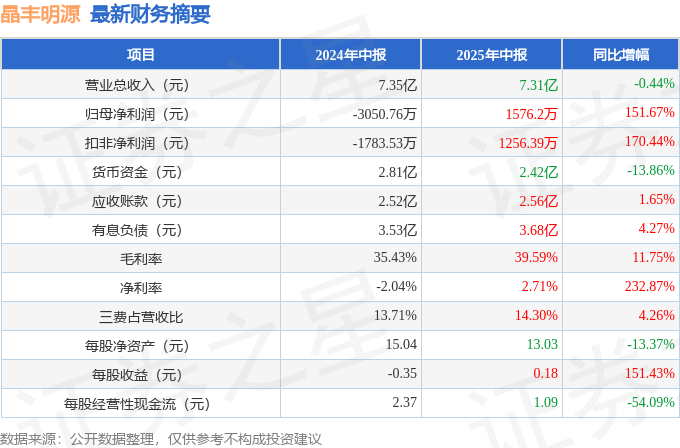
Core Viewpoint - The recent financial report of Jingfeng Mingyuan (688368) shows a slight decline in total revenue but a significant increase in net profit, indicating improved profitability despite challenges in revenue growth [1] Financial Performance Summary - Total revenue for the first half of 2025 was 731 million yuan, a decrease of 0.44% year-on-year [1] - Net profit attributable to shareholders reached 15.76 million yuan, up 151.67% year-on-year [1] - Gross margin improved to 39.59%, an increase of 11.75% year-on-year, while net margin rose to 2.71%, a significant increase of 232.87% [1] - Total expenses (selling, administrative, and financial) amounted to 105 million yuan, accounting for 14.3% of revenue, up 4.26% year-on-year [1] - Earnings per share increased to 0.18 yuan, a rise of 151.43% year-on-year [1] Key Financial Metrics - Cash flow from operating activities decreased by 53.97%, attributed to increased cash payments for goods and services [6] - Investment cash flow saw a significant decline of 148.67%, due to reduced idle funds for cash management [6] - Financing cash flow increased by 44.99%, reflecting the company's active utilization of bank credit [6] Changes in Assets and Liabilities - Long-term borrowings decreased by 100%, indicating that the company has fully repaid its long-term debt [3] - The company experienced a 68.33% increase in other receivables due to new investment intention payments [2] - The company’s cash and cash equivalents decreased by 13.86% to 242 million yuan [1] Business Model and Market Position - The company relies heavily on research and development for its business performance, which requires careful examination of the underlying drivers [13] - Historical data indicates that the company has faced challenges with a median ROIC of 11.67% since its listing, with three years of losses out of five [12] Fund Holdings - The largest fund holding Jingfeng Mingyuan is the Jiashi Frontier Innovation Mixed Fund, with 579,100 shares held [16] - The fund has shown a 59.7% increase over the past year, indicating strong market interest [16]

中国移动2025年中报简析:净利润增5.03%,盈利能力上升
Zheng Quan Zhi Xing· 2025-08-08 22:39
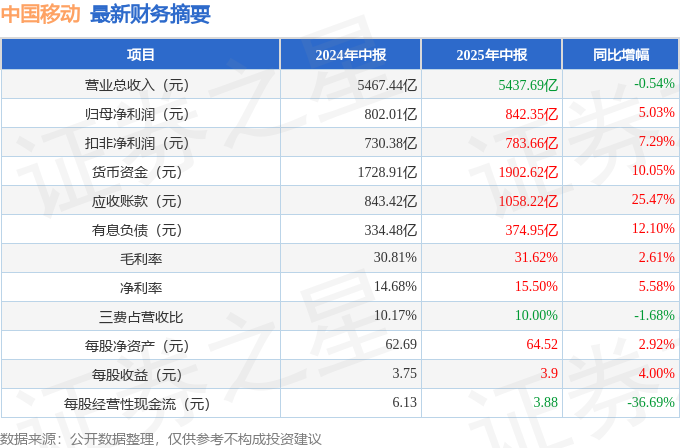
Core Insights - China Mobile reported a slight decline in total revenue for the first half of 2025, with a total revenue of 543.769 billion yuan, down 0.54% year-on-year, while net profit increased by 5.03% to 84.235 billion yuan [1] - The company's profitability improved, with a gross margin increase of 2.61% to 31.62% and a net margin increase of 5.58% to 15.50% [1] - The company has seen an increase in cash and cash equivalents, with a 10.05% rise to 190.262 billion yuan, while accounts receivable increased by 25.47% to 105.822 billion yuan [1] Financial Performance - Total revenue for Q2 2025 was 280.009 billion yuan, a decrease of 1.07% year-on-year, while net profit for the same period rose by 5.95% to 53.604 billion yuan [1] - The total of selling, administrative, and financial expenses was 54.383 billion yuan, accounting for 10.0% of revenue, a decrease of 1.68% year-on-year [1] - Earnings per share increased by 4.0% to 3.90 yuan, while operating cash flow per share decreased significantly by 36.69% to 3.88 yuan [1] Market Position and Analyst Sentiment - Analysts expect the company's performance in 2025 to reach 145.337 billion yuan, with an average earnings per share forecast of 6.72 yuan [2] - The company is held by two prominent fund managers, with notable recent increases in their holdings, particularly by a top-ranked fund manager from Huazhang Fund [2] - The largest fund holding China Mobile is the Yinhua Wealth Theme Mixed A Fund, with a current scale of 10.706 billion yuan and a recent net value decline of 0.29% [3]

华明装备2025年中报简析:营收净利润同比双双增长,盈利能力上升
Zheng Quan Zhi Xing· 2025-08-08 22:39
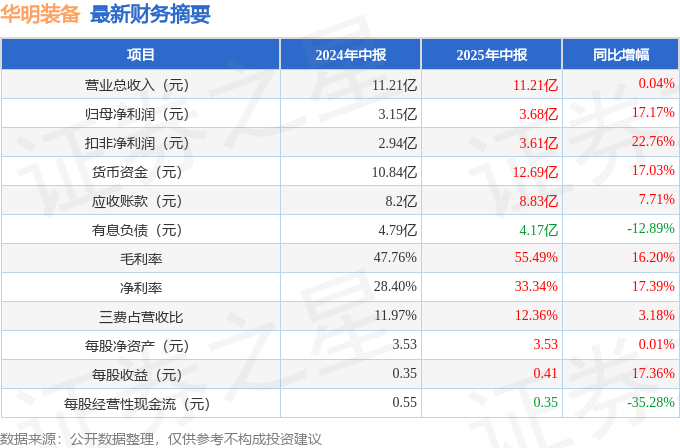
Core Viewpoint - Huaming Equipment (002270) reported a slight increase in total revenue and a significant rise in net profit for the first half of 2025, indicating improved profitability despite a decline in quarterly revenue [1][3]. Financial Performance Summary - Total revenue for the first half of 2025 was 1.121 billion yuan, a year-on-year increase of 0.04% [1]. - Net profit attributable to shareholders reached 368 million yuan, up 17.17% year-on-year [1]. - In Q2 2025, total revenue was 612 million yuan, a decrease of 8.64% compared to the same quarter last year [1]. - Q2 net profit attributable to shareholders was 197 million yuan, an increase of 5.1% year-on-year [1]. - Gross margin improved to 55.49%, reflecting a year-on-year increase of 16.2% [1]. - Net margin rose to 33.34%, with a year-on-year increase of 17.39% [1]. Cost and Expense Analysis - Total sales, management, and financial expenses amounted to 139 million yuan, accounting for 12.36% of revenue, an increase of 3.18% year-on-year [1]. - Significant changes in financial items included a 74.23% increase in accounts receivable due to settlement timing [3]. - Operating costs decreased by 14.78% due to a decline in the scale of the power engineering business [3]. - Sales expenses rose by 12.38% due to increased revenue from power equipment [3]. - Management expenses increased by 14.37% due to higher overseas personnel costs and depreciation [3]. - Financial expenses saw a drastic reduction of 144.55% due to currency appreciation and decreased interest expenses [3]. Cash Flow and Investment Insights - Operating cash flow per share decreased by 35.28% to 0.35 yuan, attributed to the maturity of receivables and reduced scale in power engineering [1][3]. - Investment cash flow saw a significant increase of 416.44% due to the recovery of investment funds [4]. - Financing cash flow increased by 32.43% due to reduced cash dividends paid [5]. Investment Metrics - The company's return on invested capital (ROIC) was 16.19%, indicating strong capital returns [6]. - The net profit margin was reported at 26.69%, suggesting high added value in products or services [6]. - Historical data shows a median ROIC of 12.77% over the past decade, with the lowest being 5.98% in 2019 [6]. Shareholder Insights - The largest fund holding Huaming Equipment is Huatai-PineBridge Convertible Bond A, with 1.3761 million shares newly entering the top ten holdings [8]. - The fund's current scale is 2.509 billion yuan, with a recent net value increase of 0.17% [8].

国光股份2025年中报简析:营收净利润同比双双增长
Zheng Quan Zhi Xing· 2025-08-08 22:38
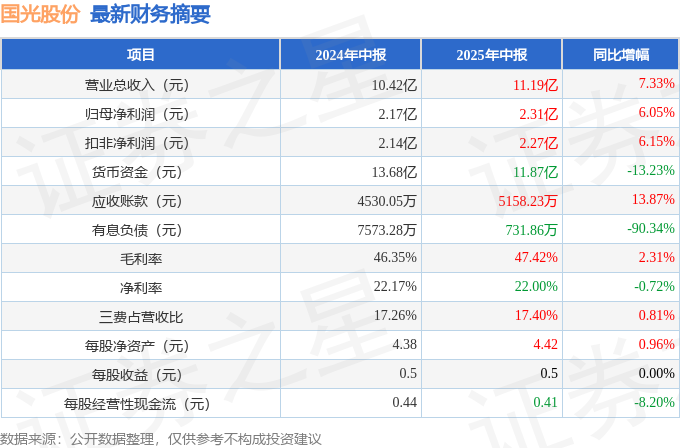
Core Viewpoint - Guoguang Co., Ltd. (002749) reported a year-on-year increase in both revenue and net profit for the first half of 2025, indicating strong financial performance and growth potential in the plant growth regulator industry [1][2]. Financial Performance - The total operating revenue for the first half of 2025 reached 1.119 billion yuan, a year-on-year increase of 7.33% [1]. - The net profit attributable to shareholders was 231 million yuan, up 6.05% year-on-year [1]. - In Q2 2025, the operating revenue was 734 million yuan, reflecting an 8.47% increase compared to the same quarter last year [1]. - The gross profit margin improved to 47.42%, an increase of 2.31% year-on-year, while the net profit margin slightly decreased to 22.00%, down 0.72% [1]. - Total expenses (selling, administrative, and financial) amounted to 195 million yuan, accounting for 17.4% of revenue, which is an increase of 0.81% year-on-year [1]. Cash Flow and Investment - The net cash flow from investment activities saw a significant decline of 978.37%, attributed to increased net expenditures on structured deposits and other financial products [2]. - The net cash flow from financing activities decreased by 47.54% due to higher cash dividend payments [2]. - The net increase in cash and cash equivalents dropped dramatically by 3959.47%, primarily due to cash dividends and expenditures on structured deposits [2]. Industry Insights - The plant growth regulator industry consists of approximately 450 companies, with a fragmented market structure that favors the development of leading firms [5]. - The industry is expected to grow faster than the average growth rate of the pesticide industry, driven by untapped markets and crop applications [7]. - The company has been actively recruiting technical service personnel, with over 300 new graduates hired in 2025, enhancing its marketing and service capabilities [5]. Market Strategy - The company aims to increase market share through continuous new product development, optimization of existing products, and enhancing service capabilities [8]. - The introduction of comprehensive solutions for crop management is designed to provide a one-stop service for customers, enhancing customer loyalty and satisfaction [8]. - The gross margin for products under the comprehensive solution model remains stable, indicating effective cost management and product positioning [8].

利和兴2025年中报简析:净利润减382.13%,公司应收账款体量较大
Zheng Quan Zhi Xing· 2025-08-08 22:38
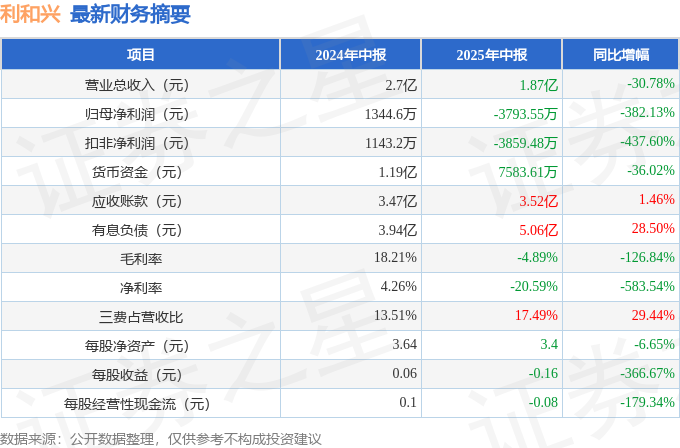
Core Insights - The company reported a significant decline in revenue and net profit for the first half of 2025, with total revenue of 187 million yuan, down 30.78% year-on-year, and a net loss of 37.94 million yuan, a decrease of 382.13% compared to the previous year [1][3]. Financial Performance - Total revenue for 2025 was 187 million yuan, compared to 274 million yuan in 2024, reflecting a 30.78% decrease [1]. - The net profit attributable to shareholders was -37.94 million yuan, a sharp decline from a profit of 13.45 million yuan in 2024, marking a 382.13% decrease [1]. - The gross margin fell to -4.89%, a decrease of 126.84% year-on-year, while the net margin dropped to -20.59%, down 583.54% [1]. - The company’s operating cash flow per share was -0.08 yuan, a decrease of 179.34% from the previous year [1]. Cost and Expense Analysis - Operating costs decreased by 11.23%, attributed to a reduction in sales revenue [4]. - Sales expenses decreased by 30.12%, due to lower personnel salaries, travel expenses, and business entertainment costs [4]. - Financial expenses increased by 31.67%, primarily due to higher interest expenses [5]. Cash Flow and Debt Situation - The net cash flow from operating activities decreased by 179.34%, indicating reduced cash inflows from operations [7]. - The net cash flow from investing activities saw a drastic decline of 8108.44%, due to increased cash outflows for investments [8]. - The net cash flow from financing activities increased by 310.28%, reflecting a rise in cash received from borrowings [9]. Business Model and Operational Insights - The company’s return on invested capital (ROIC) was only 1.3%, indicating weak capital returns, with a historical median ROIC of 14.74% since its listing [10]. - The business model relies heavily on research and marketing, necessitating a thorough examination of the underlying drivers of these activities [11]. - The company has a high accounts receivable ratio, with accounts receivable amounting to 4973.96% of net profit, raising concerns about cash flow management [12].
南亚新材2025年中报简析:营收净利润同比双双增长,应收账款上升
Zheng Quan Zhi Xing· 2025-08-08 22:38
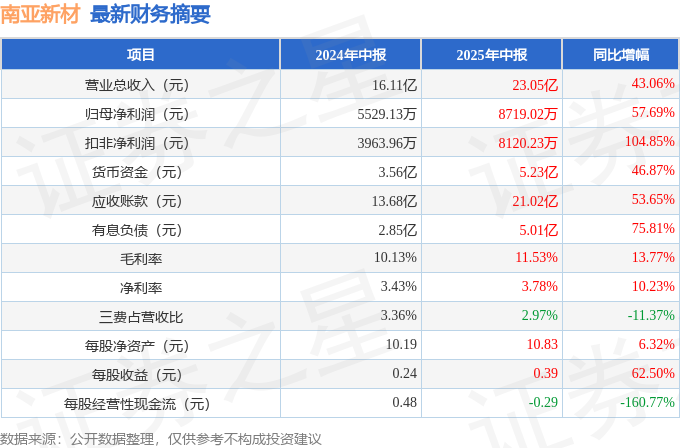
Core Viewpoint - The financial performance of Nanya New Materials (688519) for the first half of 2025 shows significant growth in revenue and net profit, indicating a strong market position and operational efficiency [1]. Financial Performance Summary - Total revenue reached 2.305 billion yuan, a year-on-year increase of 43.06% [1]. - Net profit attributable to shareholders was 87.19 million yuan, up 57.69% year-on-year [1]. - In Q2 2025, total revenue was 1.353 billion yuan, reflecting a 41.69% increase compared to the same quarter last year [1]. - Q2 net profit attributable to shareholders was 66.07 million yuan, a 46.21% increase year-on-year [1]. - Gross margin improved to 11.53%, up 13.77% year-on-year, while net margin increased to 3.78%, a 10.23% rise [1]. - Total operating expenses were 68.56 million yuan, accounting for 2.97% of revenue, down 11.37% year-on-year [1]. Balance Sheet Highlights - Accounts receivable increased by 53.65% to 2.102 billion yuan, attributed to higher sales revenue [1][2]. - Cash and cash equivalents rose by 46.87% to 523 million yuan [1]. - Interest-bearing debt increased by 75.81% to 501 million yuan [1]. Cash Flow Analysis - Operating cash flow per share was -0.29 yuan, a significant decrease of 160.77% year-on-year [1]. - The net cash flow from investing activities decreased by 347.87%, primarily due to increased cash payments for fixed and intangible assets [5]. Market and Business Strategy - The company is actively expanding its market presence both domestically and internationally, focusing on high-speed materials for server and networking applications [9]. - The company has established a technical promotion and support team overseas, particularly in Taiwan, to enhance its market penetration [9]. Investment Interest - Several funds have shown interest in Nanya New Materials, with notable holdings from various investment funds [8]. - The company is expected to achieve a net profit of 250 million yuan in 2025, with an average earnings per share forecast of 1.05 yuan [7].

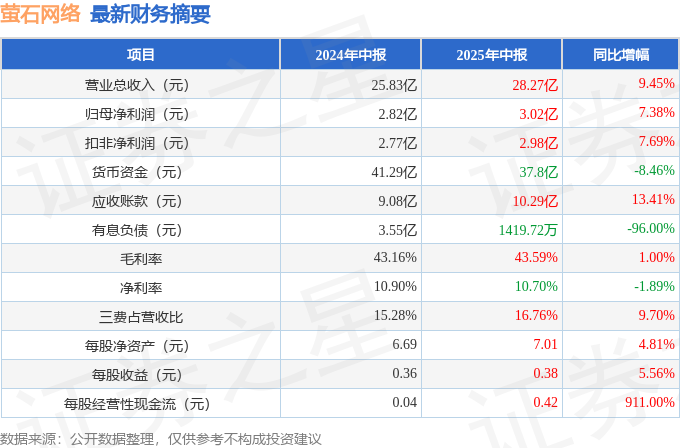
萤石网络2025年中报简析:营收净利润同比双双增长,公司应收账款体量较大
Zheng Quan Zhi Xing· 2025-08-02 23:04
Financial Performance - The company reported a total revenue of 2.827 billion yuan for the first half of 2025, representing a year-on-year increase of 9.45% [1] - The net profit attributable to shareholders reached 302 million yuan, up 7.38% year-on-year [1] - In Q2 2025, total revenue was 1.447 billion yuan, with a year-on-year growth of 7.48%, and net profit was 164 million yuan, increasing by 4.95% [1] - The gross margin was 43.59%, an increase of 1.0% year-on-year, while the net margin was 10.7%, a decrease of 1.89% [1] - The total of selling, administrative, and financial expenses was 474 million yuan, accounting for 16.76% of revenue, which is a 9.7% increase year-on-year [1] Accounts Receivable and Cash Flow - The accounts receivable amounted to 1.029 billion yuan, which is 204.24% of the net profit, indicating a significant level of receivables [1][4] - The operating cash flow per share was 0.42 yuan, showing a remarkable increase of 911.0% year-on-year [1] Investment Metrics - The company's return on invested capital (ROIC) for the previous year was 7.51%, indicating average capital returns [3] - The historical median ROIC since the company went public is 31.24%, suggesting strong investment returns historically [3] - Analysts expect the company's performance in 2025 to reach 675 million yuan, with an average earnings per share of 0.86 yuan [4] Shareholder Information - The largest fund holding shares in the company is the "招商丰盈积极配置混合A" fund, which holds 556,800 shares and has recently entered the top ten holdings [5] - The fund's current scale is 687 million yuan, with a net value of 0.6313 as of August 1, showing a 0.44% decline from the previous trading day but a 24.3% increase over the past year [5]