
元宇宙

Search documents
全球大公司要闻 | Meta拟削减元宇宙业务最高30%预算
Wind万得· 2025-12-04 22:35
Group 1 - Meta Platforms CEO Mark Zuckerberg plans to significantly reduce investment in the metaverse, with discussions of a potential 30% budget cut for the metaverse team, which includes Meta Horizon Worlds and the Quest VR division, with layoffs possible as early as January [2] - Cambricon issued a stern statement denying misleading information circulating about its products, clients, and capacity forecasts, urging investors to rely on publicly disclosed information [2] - Moore Threads officially listed on the STAR Market, raising 8 billion yuan for the development of next-generation AI training and inference chips, graphics chips, and AI SoC chips [2] - Xingfa Group secured a large order for 80,000 tons of lithium iron phosphate energy storage materials from BYD [2] - Chaoying Electronics plans to invest $100 million to expand its Thai subsidiary, increasing AI computing high-end PCB capacity [2] Group 2 - Huadian Technology submitted its IPO application to the Hong Kong Stock Exchange, intending to use the funds for production capacity expansion and R&D in high-performance PCBs for data communication and smart vehicles [4] - Tianyu Semiconductor announced the global offering results with a share price of HKD 58.00, and the Hong Kong public offering was oversubscribed 60.63 times [4] - Zhongwei Electronics' controlling shareholder is planning a change in company control, leading to a stock suspension [4] - Sun Cable's major shareholder plans to reduce its stake by up to 21.67 million shares, representing 3% of the total share capital, within three months after 15 trading days [4] Group 3 - Amazon's AWS launched the Graviton5 processor and M9G instances, with plans for C9G and R9G instances in 2026 [6] - Apple announced executive team changes, with Kate Adams set to retire and Jennifer Newstead joining as Senior Vice President [6] - Microsoft raised Office subscription prices for enterprise and government clients by up to 33% while denying a reduction in AI sales targets [6] - AT&T received FCC approval for a $1 billion acquisition of U.S. cellular spectrum licenses [6] - Chevron's 2026 capital expenditure is projected to be between $18 billion and $19 billion, focusing on U.S. production and investments related to recent acquisitions [6] Group 4 - Samsung Electronics secured over 50% of orders for NVIDIA's 2026 SOCAMM 2 chip in the semiconductor sector and is preparing for mass production of HBM4 [8] - SK Hynix is making personnel adjustments to enhance AI memory competitiveness and plans to enter the niche DRAM foundry market by 2027 [8] - Hyundai's Ulsan plant will halt electric vehicle production for the 10th time this year, reflecting demand fluctuations in the EV market [8] - LG Electronics announced the timing and theme for its CES 2026 event and is collaborating with Taboola to launch a new TV advertising solution [8] Group 5 - Brevo completed a €500 million financing round, with General Atlantic and Oakley Capital joining as shareholders, aiming for €1 billion in annual revenue by 2030 [10] - Eurostar and the German railway company signed a memorandum of understanding for a UK-Germany rail connection project [10]





隔夜美股 | 三大指数涨跌不一 Meta(META.US)涨超3.4%
智通财经网· 2025-12-04 22:33
Market Overview - The three major U.S. indices showed mixed results, with the Dow Jones down by 31.96 points (0.07%) closing at 47850.94, the Nasdaq up by 51.04 points (0.22%) at 23505.14, and the S&P 500 up by 7.40 points (0.11%) at 6857.12 [1] - European indices also experienced gains, with the German DAX30 up by 212.58 points (0.90%) at 23895.03, the UK FTSE 100 up by 23.03 points (0.24%) at 9715.10, and the French CAC40 up by 34.61 points (0.43%) at 8122.03 [1] Commodity Prices - Light crude oil futures for January 2026 rose by $0.72 to $59.67 per barrel, a 1.22% increase, while February Brent crude oil futures increased by $0.59 to $63.26 per barrel, a 0.94% rise [2] - Spot gold increased by 0.14% to $4208.73 [4] Cryptocurrency Market - Bitcoin fell by 1.2% to $92310.95, and Ethereum dropped over 1.6% to $3136.99 [3] Macroeconomic Indicators - Initial jobless claims in the U.S. decreased to 191,000, but analysts warn that this figure may be underestimated due to the Thanksgiving holiday [5] - The U.S. Treasury debt surpassed $30 trillion for the first time, with a total of $30.2 trillion in Treasury bills, notes, and bonds, reflecting a doubling since 2018 [6] - The average rate for a 30-year fixed mortgage in the U.S. fell to 6.19%, the lowest since October of the previous year, leading to a 2.5% increase in mortgage applications [6] Company News - Meta Platforms is planning to cut its metaverse budget by up to 30%, indicating a shift in strategy as the anticipated industry competition has not materialized [8] - Apple announced a significant executive reshuffle, with Jennifer Newstead set to become the new General Counsel in March 2026, succeeding Kate Adams [9] - The European Commission is seeking industry feedback on Google's proposed compliance measures to address antitrust concerns related to its advertising technology business, which has faced fines of nearly €3 billion (approximately $3.5 billion) [10]
VR has been 'pretty big disappointment' for Meta, says Mizuho's Lloyd Walmsley
Youtube· 2025-12-04 22:22
Core Insights - Meta is reportedly considering cutting the budget for its Metaverse Group by up to 30%, which has positively impacted its stock price amid concerns over high spending and recent earnings [1] - The company has raised the low end of its total expenses for the year to $116 billion, indicating a focus on managing costs [2] Budget Cuts and Focus Shift - The potential budget cut appears to be more targeted towards the Reality Labs segment rather than a blanket cut across all AR/VR initiatives, possibly closer to a 10% reduction overall [3][4] - This shift suggests that Meta is approaching its Reality Labs investments with more discipline, addressing investor concerns about operational expenditure growth and the uncertain returns from long-term projects [4][5] Investor Sentiment and Strategic Direction - Investors have been frustrated with the lack of returns from Reality Labs, which has been viewed as a "black hole" for capital, leading to a need for more stringent capital allocation decisions [5][10] - The company is pivoting its focus from the metaverse to artificial intelligence (AI), which is now seen as its primary strategic direction, as the metaverse investments have not yielded the expected consumer interest [6][7] Performance and Future Outlook - Despite heavy investments in both the metaverse and AI, Meta has managed to maintain healthy operating income growth, indicating effective management of its core business [9] - The cumulative operating income losses from Reality Labs have exceeded $80 billion since 2019, highlighting the challenges faced in the VR segment, while there may still be potential in augmented reality (AR) [11]

英指俄情报部门投毒并实施制裁,俄方回应;Meta涨超3%,现货白银一度跌超3%;寒武纪严正声明;降债超900亿元!碧桂园大消息丨每经早参
Mei Ri Jing Ji Xin Wen· 2025-12-04 22:17
1 隔夜市场 美股三大指数收盘涨跌不一,道指跌0.07%,纳指涨0.22%,标普500指数涨0.11%,热门科技股涨跌不 一,英伟达涨超2%,亚马逊、苹果跌超1%;Meta涨超3%,据报道,Meta首席执行官扎克伯格预计将 大幅削减对所谓"元宇宙"项目的投入,这一业务曾被他视为公司未来发展的方向;计算机硬件、加密矿 企涨幅居前,SanDisk涨超9%,Hut8涨近7%,戴尔科技涨超4%,惠普涨近3%;贵金属、旅游酒店、锂 矿概念股跌幅居前,美国雅保跌超5%,希尔顿酒店、皇家加勒比邮轮跌超2%。纳斯达克中国金龙指数 收涨0.39%,中概股涨跌不一,蔚来涨超4%,小鹏汽车涨超3%,百度、哔哩哔哩涨超1%,名创优品、 百胜中国跌超1%。 国际金价小幅走高,截至发稿时,现货黄金涨0.16%,报4209.45美元/盎司;COMEX期金涨0.16%,报 4239.2美元/盎司。现货白银一度跌超3%,截至发稿时跌2.35%,报57.1美元/盎司。 伦敦基本金属收盘涨跌不一,LME期铜跌0.47%报11434.00美元/吨,LME期铅涨0.85%报2016.00美元/ 吨,LME期锌涨0.65%报3085.00美元/吨,LM ...


12月5日外盘头条:特朗普收紧移民工作许可 Meta计划削减元宇宙业务投入 美联邦住房金融局长...
Xin Lang Cai Jing· 2025-12-04 21:56
Group 1 - The Trump administration announced a new policy to shorten the validity of work permits for immigrants applying for asylum or other humanitarian programs from five years to 18 months, allowing for more frequent reviews of their status [4] - The U.S. government plans to increase its stake in critical mineral companies, with over $1 billion invested in the past year, which has often boosted the stock prices of related companies [6] - Goldman Sachs has paused the issuance of a $1.3 billion mortgage bond for CyrusOne, a data center operator, following a significant outage at the Chicago Mercantile Exchange due to a cooling system failure [9] - Bank of America will allow wealth management advisors to recommend cryptocurrency investments starting January 5, marking a significant milestone in the digital asset space [11] - The Federal Housing Finance Agency (FHFA) director is under investigation for alleged abuse of power related to mortgage fraud accusations against political opponents, following a request from Senate Democrats [13] - Meta's stock price rose approximately 4% after reports indicated that the company plans to significantly cut its metaverse business budget by up to 30% [15]

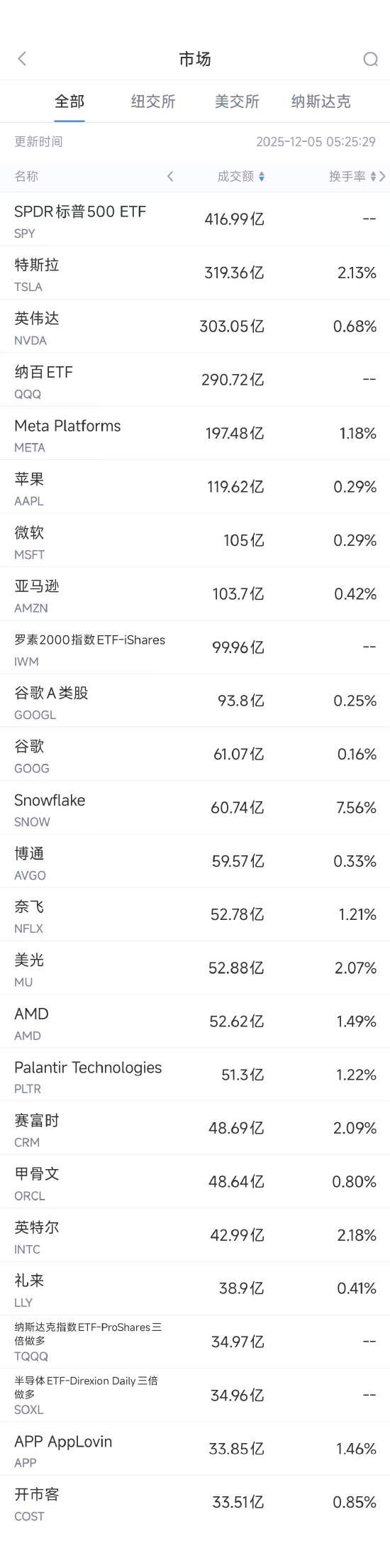
12月5日美股成交额前20:特斯拉跻身美国汽车品牌前10
Xin Lang Cai Jing· 2025-12-04 21:52
Core Insights - Tesla achieved significant progress in the annual automotive brand ranking by Consumer Reports, moving from 18th in 2024 to 10th in 2025, with Japanese brands occupying five of the top ten spots [1][9] - Nvidia's stock rose as it announced the addition of several popular games to its GeForce NOW platform, indicating ongoing growth in the gaming sector [1][10] - Meta Platforms plans to cut its metaverse business budget by up to 30%, reflecting a strategic shift away from its initial focus on social media [1][10] Company Summaries - **Tesla**: Stock increased by 1.73% with a trading volume of $31.936 billion. The brand ranked 10th in the latest Consumer Reports automotive brand ranking, a significant improvement from 18th place in 2024 [1][9] - **Nvidia**: Stock rose by 2.12% with a trading volume of $30.305 billion. The company is set to enhance its GeForce NOW platform with new game additions, showcasing its commitment to the gaming industry [1][10] - **Meta Platforms**: Stock increased by 3.43% with a trading volume of $19.748 billion. CEO Mark Zuckerberg is considering a budget cut of up to 30% for the metaverse division, marking a strategic pivot for the company [1][10] - **Amazon**: Stock decreased by 1.41% with a trading volume of $10.37 billion. The company is in discussions with the U.S. Postal Service regarding their partnership and is evaluating options before the current contract expires [2][10] - **Snowflake**: Stock fell by 11.41% with a trading volume of $6.074 billion. The company signed a $200 million multi-year AI collaboration agreement with Anthropic, which will integrate its language models into Snowflake's platform [2][10] - **Micron Technology**: Stock decreased by 3.21% with a trading volume of $5.288 billion. The company plans to exit the consumer market to focus on providing storage products for high-performance AI chip-driven computing clusters [2][11] - **Salesforce**: Stock rose by 3.66% with a trading volume of $4.869 billion. The company reported a revenue increase of 8.6% year-over-year and raised its full-year revenue guidance to between $41.45 billion and $41.55 billion [3][12] - **Intel**: Stock fell by 7.45% with a trading volume of $4.299 billion. The company decided to retain its networking and communications division, indicating a strategic shift in its long-term business outlook [4][5][12]


Stocks Settle Mixed on Higher Bond Yields
Yahoo Finance· 2025-12-04 21:34
Economic Indicators - US weekly initial unemployment claims fell by 27,000 to a 3-year low of 191,000, indicating a stronger labor market than the expected increase to 220,000 [2] - November Challenger job cuts rose by 23.5% year-over-year to 71,321, which is the highest for November in three years but lower than the expected increase of 48.0% [2] - The markets are anticipating a 91% chance of a 25 basis point rate cut at the next FOMC meeting on December 9-10 [8] Corporate Earnings and Stock Movements - Dollar General's stock rose over 14% after it raised its full-year comparable sales forecast [3][19] - Meta Platforms increased by more than 3% following CEO Zuckerberg's announcement of a potential 30% budget cut for the metaverse group [3][19] - Hormel Foods' stock rose over 3% after reporting stronger-than-expected Q4 EPS [3][20] - Science Applications International (SAIC) saw a 16% increase in stock price after reporting Q3 adjusted EPS of $2.58, exceeding consensus estimates [18] - UiPath's stock surged over 24% after reporting Q3 total revenue of $411.1 million, surpassing expectations [17] Market Performance - Stock indexes settled mixed, with the S&P 500 reaching a 3-week high, while the Dow Jones Industrial Average and Nasdaq 100 declined from their highs due to rising bond yields [5][6] - The 10-year T-note yield rose by 5 basis points to 4.11%, influenced by the drop in initial jobless claims and rising inflation expectations [5][10] International Market Developments - The Bank of Japan is likely to raise interest rates this month, leading to an 18-year high in Japan's JGB yields [4] - European government bond yields were mixed, with the 10-year German bund yield climbing to a 2-month high of 2.775% [11][12]
深夜!利好,大涨!
Zhong Guo Ji Jin Bao· 2025-12-04 16:19
Core Viewpoint - The U.S. stock market is experiencing fluctuations, with Meta's stock rising significantly due to anticipated budget cuts in its metaverse projects, which have been a source of investor skepticism [2][5][7]. Economic Data - Initial jobless claims in the U.S. fell to 191,000, the lowest level in over three years, indicating that companies are generally retaining employees despite recent layoffs [4]. - The number of layoffs announced by U.S. companies in November decreased from October but remained the highest for that month in the past three years [4]. Federal Reserve Expectations - There are increasing signs of a cooling labor market, leading to a high probability (89%) that the Federal Reserve will cut interest rates by 25 basis points in its upcoming meeting [5]. Meta's Stock Performance - Meta's stock surged nearly 4%, marking it as one of the standout performers in the market [5]. - CEO Mark Zuckerberg is expected to significantly reduce investments in the metaverse, with potential budget cuts of up to 30% for related departments [5][6]. Metaverse Project Insights - The proposed budget cuts for the metaverse are part of the company's 2026 annual budget planning, with discussions indicating a focus on reducing costs across various business lines by about 10% [6]. - The Reality Labs department, which oversees the metaverse projects, has incurred losses exceeding $70 billion since early 2021, raising concerns among analysts and investors about the sustainability of such investments [7].
深夜!利好,大涨!
中国基金报· 2025-12-04 16:12
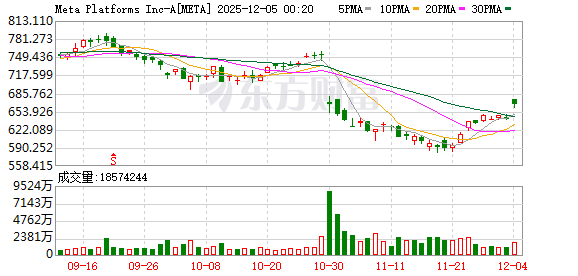
Core Viewpoint - The article discusses the recent fluctuations in the US stock market, highlighting a significant rise in Meta's stock price due to anticipated budget cuts in its metaverse projects, which have been a source of investor skepticism and financial losses for the company [1][4][8]. Market Overview - On December 4, US stock indices showed slight fluctuations, with the Dow Jones remaining stable, while the Nasdaq and S&P 500 experienced minor declines of -0.09% and -0.05% respectively [2]. - Initial jobless claims in the US fell to 191,000, the lowest level in over three years, indicating that despite recent layoffs, companies are generally retaining employees [2][3]. - The labor market is showing signs of cooling, leading to expectations that the Federal Reserve may lower interest rates by 25 basis points in its upcoming meeting [3]. Meta's Stock Performance - Meta's stock surged nearly 4%, marking it as one of the standout performers in the market [4]. - The stock reached a high of $676.10, with a trading volume of approximately 17.3 million shares and a market capitalization of $1.68 trillion [6]. Budget Cuts in Metaverse Projects - CEO Mark Zuckerberg is reportedly planning to significantly reduce the budget for metaverse-related projects by up to 30%, which includes the Meta Horizon Worlds and Quest VR devices [8]. - This budget cut is part of the company's 2026 annual budget planning and reflects a shift in focus away from the metaverse, which has been criticized as a "money-burning black hole" [8][10]. - The Reality Labs department, responsible for the metaverse initiatives, has incurred losses exceeding $70 billion since early 2021, prompting calls from analysts for a reevaluation of resource allocation [10]. Strategic Shift - Zuckerberg has increasingly shifted focus from the metaverse to generative AI products and related hardware, indicating a strategic pivot in the company's long-term vision [10].

欧盟就美国元宇宙平台公司限制性新政启动反垄断调查
Xin Hua She· 2025-12-04 16:10
Core Points - The European Commission has initiated a formal antitrust investigation into the new restrictions imposed by the Metaverse Platform Company on AI service providers accessing the WhatsApp messaging application [1] - The new policy, effective from October 2025, is believed to potentially hinder third-party AI service providers from offering services via WhatsApp in the European Economic Area, while the company's own AI service, "Meta AI," remains accessible [1] - The investigation will assess whether these actions violate EU regulations against the abuse of market dominance, with no set deadline for completion as it depends on the complexity of the case and cooperation from involved parties [1]