
基金清盘

Search documents
两个多月跌超8%,基金经理被爆在“赌”?申万菱信回应
Zhong Guo Ji Jin Bao· 2025-08-12 15:12
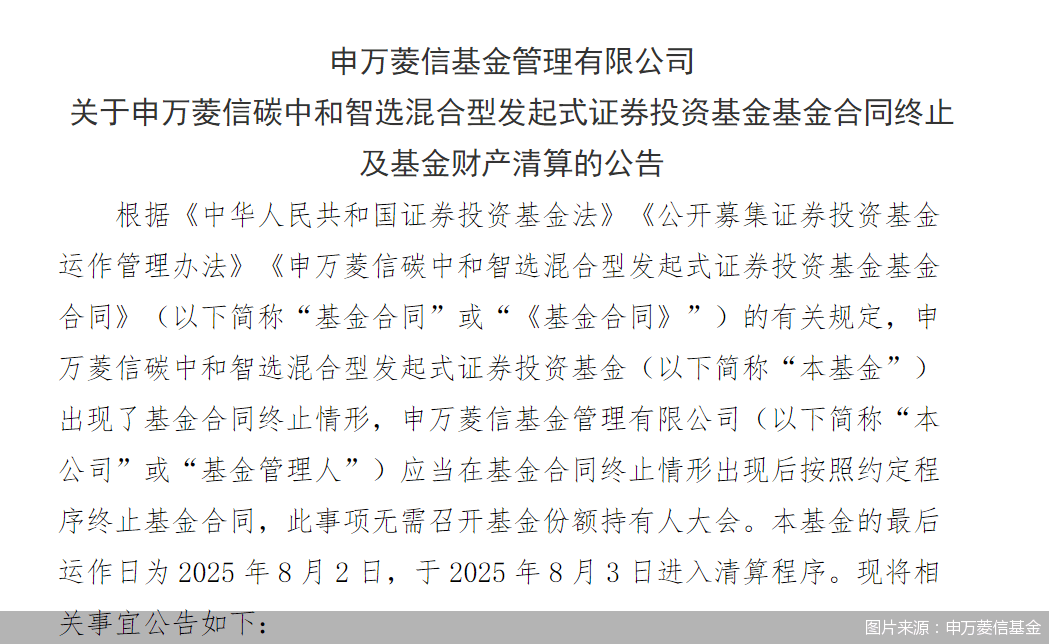
Core Viewpoint - The performance of the Shenwan Hongyuan Fund's Shenwan Lingshin Industry Select Mixed Fund has declined over 8% since its establishment, raising concerns about the fund manager's investment strategy and prompting a response from the company [1][4]. Fund Performance - The Shenwan Lingshin Industry Select Fund, established on June 3, has a unit net value of 0.9177 yuan as of August 8, reflecting a decline of over 8% since inception [4]. - The fund raised 1.219 billion yuan, making it one of the larger mixed equity funds launched in recent months [4]. - The fund's performance is benchmarked against a composite index consisting of 65% CSI 300, 10% Hang Seng Index, and 25% China Bond Index [4]. Fund Manager Background - The fund manager, Jia Chengdong, has 17 years of experience in the securities industry and has previously managed funds with significant performance records [5]. - Jia Chengdong joined Shenwan Lingshin in December 2024 after leaving China Merchants Fund, where he managed several successful funds [5]. Company Challenges - Shenwan Lingshin has faced multiple fund liquidations this year, including the Shenwan Lingshin Carbon Neutrality Mixed Fund and others, indicating potential issues within the company's product offerings [8]. - The company has struggled to maintain competitive performance and scale compared to peers like Tianhong Fund, with a current non-monetary scale of 70.324 billion yuan, ranking 59th in the public fund industry [9]. - Despite attempts to improve performance by hiring well-known fund managers, the results have not yet met expectations [9].
申万菱信否认“强迫员工买基金”,贾成东跳槽后在管产品逆势下跌
Di Yi Cai Jing Zi Xun· 2025-08-12 13:53
Core Viewpoint - The recent performance of the Shenwan Hongyuan Fund, particularly the Shenwan Hongyuan Industry Select Fund managed by Jia Chengdong, has raised concerns among investors due to significant losses despite a bullish market environment [1][2][3]. Group 1: Fund Performance - The Shenwan Hongyuan Industry Select Fund, established on June 3, 2025, has experienced a cumulative decline of over 8% by August 11, 2025, significantly underperforming the benchmark by 13.79 percentage points, while the Shanghai Composite Index rose by 8.96% during the same period [2][3]. - The fund's net asset value dropped from 0.98 yuan to 0.92 yuan within a short span, indicating volatility and poor initial performance [3]. - Investors have expressed dissatisfaction with the fund's performance, labeling it as a "bull market bear fund" and indicating intentions to redeem their investments [2][3]. Group 2: Management Background - Jia Chengdong joined Shenwan Hongyuan Fund in December 2024 and became a vice president in March 2025, shortly before managing the Shenwan Hongyuan Industry Select Fund [2][4]. - Prior to joining Shenwan Hongyuan, Jia managed 15 funds over nearly a decade, with mixed performance results, including both significant gains and losses in various products [4][5]. Group 3: Fund Liquidation Issues - Shenwan Hongyuan has faced multiple fund liquidations in 2025, with at least six funds, including the Shenwan Hongyuan Carbon Neutrality Mixed Fund and Shenwan Hongyuan Pension Target Date Fund, being terminated due to asset values falling below 200 million yuan [6]. - The company's public asset management scale has decreased to 825.57 billion yuan as of August 12, 2025, ranking 66th in the industry, down from 846.40 billion yuan at the end of 2024 [6].
浙商基金旗下浙商惠丰定开债清盘
Zhong Guo Jing Ji Wang· 2025-08-08 07:15
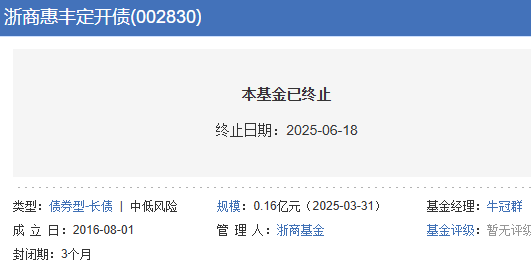
Core Viewpoint - The Zhejiang Merchants Fund has announced the liquidation of the Zhejiang Merchants Huifeng Regular Open Bond Fund due to changes in the market environment and the small scale of the fund, which was approved by the fund holders' meeting on June 16, 2025 [1][4]. Group 1: Fund Details - The Zhejiang Merchants Huifeng Regular Open Bond Fund was established on August 1, 2016, with an initial scale of 500 million yuan [4]. - As of June 17, 2025, the total number of fund shares was 7,170,299.24, with a net asset value of 1.0637 yuan per share [4]. - The cumulative unit net value of the fund on June 17, 2025, was reported to be 1.3267 yuan [4]. Group 2: Management and Governance - The last fund manager was Niu Guanqun, who joined Zhejiang Merchants Fund Management Co., Ltd. in February 2022 and has been managing public funds since June 2023 [4].

东方基金王然管理3只产品最佳回报-10%,投资者15万本金仅剩4万
Sou Hu Cai Jing· 2025-08-08 06:39
Core Insights - The performance of multiple products managed by Wang Ran, the general manager of the equity research department at Dongfang Fund, has been persistently poor, leading to significant dissatisfaction among investors [1][3] - Dongfang Fund, a long-established public fund institution, has faced challenges with a high number of "mini funds" and several equity products at risk of liquidation [1][4] Group 1: Fund Performance - Wang Ran currently manages three products with a total asset management scale of 205 million yuan, and the best return during her tenure is -10.19%, marking the worst performance of her public fund career [3] - The Dongfang Emerging Growth Mixed Fund has seen a slight increase of 0.06% this year, ranking 2133 out of nearly 2300 similar products, while the Dongfang Quality Consumption One-Year Holding Mixed A ranks 4154 out of over 4500 similar products [3] - Over the past three years, the Dongfang Emerging Growth Mixed Fund has a return rate of approximately -40%, underperforming its benchmark by about 43 percentage points [3] Group 2: Company Challenges - Dongfang Fund, established in 2004, had a public fund asset management scale of 123.405 billion yuan as of mid-year, ranking 53rd among nearly 200 public fund institutions [4] - The company faces liquidation pressure, with 11 non-initiated funds having scales below 50 million yuan, including the Dongfang Minfeng Return Ying'an Mixed Fund with less than 3 million yuan [4] - Wang Ran previously had successful tenures from 2020 to 2021, with returns ranging from 4% to 68%, but her focus on pharmaceutical stocks since mid-2021 has led to significant declines in performance and a reduction in management scale [4]

发起式接连“折戟”,申万菱信基金年内6只产品已退场
Sou Hu Cai Jing· 2025-08-04 14:06
Core Viewpoint - The recent liquidation of six funds by Shenwan Hongyuan Fund indicates potential issues in product strategy management and research capabilities within the company, raising concerns about its investment management abilities [3][4]. Fund Liquidation - Shenwan Hongyuan Fund announced the termination and liquidation of the Shenwan Hongyuan Carbon Neutrality Mixed Fund due to its asset size falling below 200 million yuan three years after its establishment [3]. - The Shenwan Hongyuan Pension Target Date 2040 Fund also faced liquidation under similar circumstances, marking a total of six fund liquidations this year, all of which were initiated funds [3][4]. - Other funds that have been liquidated include Shenwan Hongyuan Xinxiang Stable Mixed Fund, Shenwan Hongyuan Shuangxi Mixed Fund, and Shenwan Hongyuan Specialized and New Theme Mixed Fund [3]. Company Performance - As of the end of Q2 2025, Shenwan Hongyuan Fund's total assets reached 82.679 billion yuan, reflecting a quarter-on-quarter growth of 12.24% but a year-on-year decrease of 5.29% [5]. - The company ranks 66th among all public funds in terms of total assets, with its non-money market fund management size at 70.446 billion yuan, placing it 59th [5]. - Despite the recent fund liquidations, 45 out of 49 active equity funds reported positive returns, with 27 funds achieving returns exceeding 10% [6]. Strategic Recommendations - To maintain stable growth, the company should focus on improving governance structures, ensuring product strategy stability, and enhancing research capabilities [7]. - Strengthening marketing efforts for smaller existing products and improving the brand influence of its research capabilities are essential to reduce future fund liquidations [7].
年内50只主动权益基金清算 发起式基金清盘压力凸显
Huan Qiu Wang· 2025-07-18 02:59
Group 1 - The overall A-share market is experiencing a fluctuating upward trend, yet some public equity funds are facing continuous shrinkage in scale, triggering liquidation conditions [1] - As of July 16, 50 active equity funds have entered liquidation procedures this year, with initiated funds being particularly affected [1][3] - The case of Zhongyin Securities Huize Jinqi 3-Month Holding Fund highlights the challenges faced by small and medium-sized fund companies in the FOF product layout, as its net asset value was only 0.28 billion yuan, significantly below the 2 billion yuan safety line [3][4] Group 2 - The "three-year test" for initiated funds has become a primary reason for liquidation, as funds must maintain a net asset value of at least 2 billion yuan after three years to avoid termination [4] - The increase in the number of liquidated equity funds is attributed to structural market conditions, where capital is concentrated in top funds and track-type products, diminishing the appeal of smaller funds [4] - Analysts suggest that the liquidation of initiated funds should not be viewed merely as failure but as a reflection of market competition, urging fund companies to carefully assess product strategies and resource alignment [4]

清盘统计!海富通+华安基金
Sou Hu Cai Jing· 2025-07-17 08:56
Group 1 - The core issue in the industry is the ongoing rumors of mergers, particularly involving Hai Futong and Hua An Fund, which are facing significant challenges such as frequent fund liquidations and poor performance [2][15] - Hai Futong has seen a wave of fund liquidations, with seven funds being liquidated in 2025 alone, and 19 funds currently below the 50 million threshold for liquidation [5][9] - The product structure of Hai Futong is heavily skewed towards bond and money market funds, which account for 84% of its total fund size, while equity funds only total 7.891 billion [11][12] Group 2 - Hua An Fund is also struggling, with 5 funds liquidated this year and 17% of its funds below the 50 million threshold, indicating a similar trend to Hai Futong [19][16] - The performance of equity products at Hua An Fund is weak, with many fund managers reporting negative returns, raising concerns about the overall management and strategy [20][22] - The management turmoil at Hai Futong, including the recent appointment of a new chairman without prior fund industry experience, complicates the resolution of its performance issues [14][30] Group 3 - The merger rumors between Hai Futong and Hua An Fund are driven by regulatory compliance issues following the merger of their parent companies, which necessitates the integration of their fund management operations [15][19] - Both companies have similar product structures, with a significant portion of their assets in bond and money market funds, limiting their growth potential in equity markets [16][18] - The historical performance of both funds has been marred by scandals, including a recent case of insider trading involving a former Hua An Fund manager, which has further damaged investor trust [24][34]

富荣医药健康混合清盘 基金经理在管某基金两年跌38%
Sou Hu Cai Jing· 2025-07-17 08:06
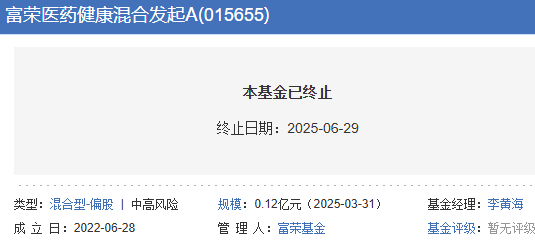
Core Viewpoint - The report from Furong Fund indicates that the Furong Medical Health Mixed Fund will enter liquidation due to its total fund size falling below 200 million RMB by June 28, 2025, which triggers the termination clause in the fund contract [1] Fund Performance Summary - The fund was established on June 28, 2022, and will cease operations on June 28, 2025, with a total fund size of 12,369,681.57 shares at the end of its operation [1] - The net asset value for Class A shares is 0.7920 RMB, with a total of 11,555,608.85 shares, while Class C shares have a net asset value of 0.7825 RMB and a total of 814,072.72 shares [1] - The fund has experienced cumulative losses of 20.8% for Class A and 21.75% for Class C over its three-year lifespan [1] Management Background - The fund has been managed by Li Huanghai since its inception, who has extensive experience in various investment roles across multiple firms [2] - Currently, Li Huanghai also manages three other funds, with only one, Furong Fuyue Mixed Fund, slightly outperforming its peers, while the other two, including Furong Value Selection Mixed Fund, have seen significant declines, with the latter down over 38% in nearly two years [2]
年内136只基金清盘 多只来自红利、医药、港股热门赛道
news flash· 2025-07-16 03:31
Group 1 - The number of fund liquidations in the year has reached 136, indicating a normalization of fund closures due to scale pressure or a decrease in the number of holders [1] - The number of liquidated funds has decreased by 50% year-on-year, despite a recovery in A-shares and Hong Kong stocks [1] - Equity funds remain the dominant type of liquidated funds, with a total of 88 funds, accounting for 65% of the closures [1] Group 2 - 33 bond funds have been liquidated, along with 14 FOF funds and 1 QDII fund [1] - Not all liquidated funds are from unpopular sectors; several popular themes such as dividends, pharmaceuticals, and Hong Kong-related funds have also been closed [1]
43只发起式基金未过三年之坎,清盘高发为何反成布局热土?
Di Yi Cai Jing· 2025-07-15 12:07
Core Insights - The rise of "initiated funds" has led to a significant number of funds facing liquidation due to not meeting the 200 million yuan threshold after three years [1][2] - Despite the high rate of liquidation, initiated funds remain a key strategy for fund companies, raising questions about their sustainability and operational costs [4][5] Group 1: Fund Liquidation Trends - As of July 15, 2023, 43 initiated funds have been liquidated this year due to failing to reach the required 200 million yuan, marking a historical high [1][2] - The average decline in value for these funds over three years is 18.65%, with nearly half experiencing a drop of over 20% [3][4] - Specific sectors like renewable energy and healthcare have seen significant performance issues, with some funds reporting cumulative returns as low as -53.43% [2][3] Group 2: Fund Company Strategies - Fund companies continue to launch initiated funds despite the risks, with over 404 such funds issued in 2023 alone [4][5] - The relatively relaxed establishment conditions for initiated funds allow companies to quickly enter niche markets and develop new fund managers [6][7] - Initiated funds serve as a "incubation" platform for new strategies and managers, providing opportunities in less recognized sectors [6][7] Group 3: Future Outlook - As of mid-July 2023, 183 initiated funds are approaching their three-year mark, with 98 of them still below the 200 million yuan threshold, indicating potential future liquidations [7] - Some initiated funds have successfully surpassed the threshold, such as the Yongying Advanced Manufacturing Fund, which has achieved a cumulative return of 82.35% [7]