
主动权益类基金

Search documents
迎接二季度 基金经理“防守一波”还是“放手一搏”
天天基金网· 2026-03-31 03:18
Core Viewpoint - Institutional investors are eager to recover excess returns, but the volatile market environment does not provide the same sense of security as early 2026 [1] Group 1: Market Sentiment and Performance - The performance of active equity funds has significantly declined, with many funds returning to their early-year levels, indicating a loss of excess returns [2] - Fund managers are focusing on recovering losses in the second quarter, with market conditions being a critical factor in determining whether the market has bottomed out [2] - A survey indicates that 93.75% of fund managers favor growth sectors, while 62.5% are optimistic about HALO strategies [3] Group 2: Investment Strategies - There is a divergence in strategies among institutional investors, with some focusing on defensive positions while others are looking for rebound opportunities [4] - Fund managers are adjusting their portfolios towards defensive assets, indicating a search for new safety margins [4] - The upcoming period is seen as a decision point, with expectations of clearer geopolitical situations and corporate earnings providing new investment insights [4] Group 3: Sector Focus and Opportunities - The market narrative is centered around AI and oil, with institutions exploring these areas for potential returns [7] - The semiconductor industry is facing supply chain challenges due to geopolitical tensions, which could impact AI-related growth [7] - Growth stocks are being viewed as potential hedging tools against economic uncertainties, with AI seen as a solution to rising costs in traditional manufacturing [7] Group 4: Broader Market Trends - Other narratives in the A-share market include rising oil prices, innovation in pharmaceuticals, and the transition from traditional energy to lithium batteries [8] - Some institutions are focusing on niche areas such as logistics, new consumption, and fiber optics to seek excess returns and act as a safe haven [8]


新基金发行品类丰富,混合基金和FOF月募集规模均创近年新高
Huan Qiu Wang· 2026-02-25 01:09
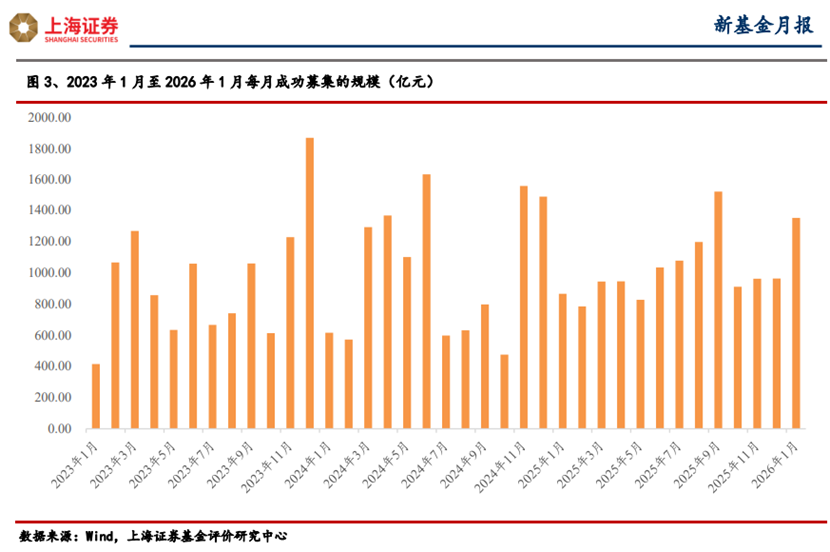
Group 1 - The core viewpoint of the article highlights a significant increase in the number of new funds launched in February, with 36 new funds expected to be issued in the first trading week after the holiday [1] - In January, a total of 169 new funds were launched, representing a month-on-month increase of 26.12% and a year-on-year increase of 106.10% due to the low base effect from the previous year [1] - The total fundraising amount in January reached 135.234 billion yuan, showing a month-on-month increase of 40.37% and a year-on-year increase of 56.31% [1] Group 2 - Mixed funds and Funds of Funds (FOF) achieved record high monthly fundraising scales, with 55 mixed funds issued in January, marking the highest issuance since January 2023 [3] - Mixed funds accounted for 32.54% of the total issuance and 41.84% of the total fundraising scale in January, primarily driven by actively managed mixed funds [3] - Several public fund institutions have indicated structural opportunities in sectors such as artificial intelligence, semiconductors, and consumer goods, anticipating significant inflows of capital by 2026 [3]
九成主动权益基金开年斩获正涨幅 机构“马”上展望权益市场
Xin Lang Cai Jing· 2026-02-18 01:39
Group 1: Market Overview - The A-share market has shown a steady upward trend since the beginning of 2026, with over 90% of actively managed equity funds achieving positive returns [2][9] - As of February 13, 2026, 4,283 out of 4,706 active equity funds reported positive growth since the start of the year, with 103 funds achieving over 20% growth [2][9] - The macroeconomic environment is expected to support the market, with a stable growth rate anticipated for the year, aiding in corporate profit recovery [3][10] Group 2: Policy and Economic Support - The domestic economic growth rate is projected to remain stable in 2026, with policies focusing on supporting demand and reducing financing barriers for private enterprises [3][10] - The government aims to promote the development of emerging industries while facilitating the digital transformation of traditional sectors [3][10] - Expectations for policy support are likely to increase post-holiday, which may enhance market liquidity and risk appetite [3][10] Group 3: Investment Opportunities - The humanoid robot sector is gaining significant attention, with several companies preparing for IPOs, indicating a maturation of the industry [5][12] - The humanoid robot market is projected to see substantial growth, with an estimated 2 million units expected in workplaces by 2035 [5][12] - Other sectors such as semiconductors, artificial intelligence, and global expansion are also attracting investment interest, with a focus on innovation and market integration [6][13][15] Group 4: Sector-Specific Insights - The humanoid robot industry has seen large-scale orders primarily from government and service sectors, with a notable decrease in core component prices [5][12] - The semiconductor industry is entering a phase of innovation, with significant investments expected to yield results in key processes and materials [7][13] - The "outbound" capability of companies is becoming a critical source of alpha, as firms successfully expand into global markets despite domestic challenges [14][15]
渤海证券研究所晨会纪要(2026.02.04)-20260204
BOHAI SECURITIES· 2026-02-04 00:31
Fixed Income Research - The net financing amount is at a historically high level, indicating that the logic of asset scarcity has dissipated. The overall change in the issuance guidance rates published by the trading association has mostly decreased by 5 to 1 basis points. In January, the issuance scale of credit bonds increased month-on-month, with only medium-term notes seeing a decrease in issuance amount, while other varieties saw increases. The net financing amount for credit bonds increased month-on-month, with medium-term notes showing a decrease, while other varieties saw increases. Corporate bonds, directional tools had negative net financing, while corporate bonds, medium-term notes, and short-term financing bonds had positive net financing [2][3]. - In the secondary market, the transaction scale of credit bonds decreased month-on-month, with transaction amounts for all varieties declining. The yield on credit bonds remained low and fluctuated, with most varieties showing a month-on-month decline in average yield. The credit spread for most varieties narrowed month-on-month, with the varieties that widened mainly concentrated in the 7-year term. Most varieties' spreads are at historical lows. From an absolute return perspective, insufficient supply and relatively strong allocation demand will continue to drive the recovery of credit bonds. Although fluctuations are inevitable due to various factors, the conditions for a comprehensive bear market in credit bonds remain insufficient. In the long run, future yields are still in a downward channel, and the strategy of increasing allocation during adjustments remains feasible [3]. Fund Research - In January, the market for actively managed equity funds saw a significant increase in issuance, with a total of 88 new funds issued, amounting to 91.48 billion yuan. The issuance of actively managed equity funds and passive equity funds was 41.70 billion units and 19.62 billion units, respectively, with a significant increase in the issuance of actively managed equity funds. Overall, the issuance market for equity funds has warmed up significantly, especially for actively managed equity funds [6][7]. - The performance of equity markets was outstanding in January, with all types of funds showing varying degrees of increase. The average increase for commodity funds was the largest at 17.92%. The growth style outperformed the value style, and the mid-cap balanced style had the largest increase at 8.99%, while the large-cap value style had the smallest increase at approximately 4.22% [8]. Industry Research - The valuation repair of the real estate chain can continue, with positive signals from the government regarding real estate policies. The market is transitioning from a large-scale expansion phase to a focus on quality improvement. The goal is to actively construct a new development model for real estate, emphasizing both short-term and long-term strategies. The sales recovery process will significantly impact bond valuations, and investors with a higher risk appetite may consider early positioning, especially in companies showing strong performance in new financing and sales recovery [4][10]. - In the paper industry, several leading companies have announced price increases for white cardboard and corrugated paper, with expected price hikes of 200 yuan/ton for white cardboard and 30-50 yuan/ton for corrugated paper. The upcoming annual maintenance period for paper companies will disrupt supply, while the approaching Spring Festival will boost packaging demand from e-commerce, food, and beverage sectors, supporting price increases [12]. - In the metals industry, the steel sector is expected to continue a weak performance due to the Spring Festival holiday, with production and demand both shrinking. The copper market is also anticipated to see inventory accumulation due to reduced production activities during the holiday, with a focus on post-holiday demand verification [13][15].
渤海证券基金月报-20260203
BOHAI SECURITIES· 2026-02-03 06:11
1. Report Industry Investment Rating - Not mentioned in the report 2. Core Viewpoints of the Report - In January, all major indices in the Shanghai and Shenzhen markets rose. The CSI 500 and ChiNext 50 led the gains, both rising by over 12%, while the SSE 50 had the smallest increase of 1.17%. Among the 31 Shenwan primary industries, 26 industries rose, with the top 5 gainers being non - ferrous metals, media, petroleum and petrochemicals, building materials, and chemicals. The declining industries were banking, household appliances, non - bank finance, transportation, and agriculture, forestry, animal husbandry, and fishery [1][14]. - In December 2025, the total number of new individual investor accounts in the market reached 2.5861 million, and the number of new institutional investor accounts was 11,100. The private securities investment fund market continued to heat up, with the newly registered scale in December increasing month - on - month to 54.174 billion yuan, and the existing scale reaching 22.15 trillion yuan [2][21][23]. - In January, 88 new funds were issued, with a total issuance scale of 91.481 billion yuan. The issuance shares of active equity funds and passive equity funds were 41.704 billion and 19.62 billion respectively, and the issuance shares of active equity funds increased significantly month - on - month. All types of funds rose to varying degrees, with commodity - type funds having the largest average increase of 17.92% [3][38]. - In January, the active equity funds increased their positions in the petroleum and petrochemical, non - ferrous metals, and basic chemical industries, and reduced their positions in the national defense and military industry, pharmaceutical biology, and computer industries. The overall position of active equity funds on January 30, 2025, was 73.88%, an increase of 0.78 percentage points from the previous month [4][54][58]. - In January, the ETF market had a net capital outflow of 841.187 billion yuan. Many ETFs related to the CSI 300 and SSE 50 indices in the broad - based index suffered significant capital outflows. Among the actively traded individual securities, gold stock ETFs, China - South Korea semiconductor ETFs, mining ETFs, industrial non - ferrous metal ETFs, and ChiNext chip design ETFs led the gains, rising by 22.5% - 39.6%, while bank ETFs, E Fund's Hong Kong Stock Connect medical ETF, automobile ETFs, Peng Hua's general aviation ETF, and Huaxia's financial real - estate ETF led the losses, falling by 4.8% - 6.4% [5][61][62]. - In January, the risk - parity model rose by 2.07%, and the risk - budget model rose by 2.39% [6][73]. 3. Summary According to Relevant Catalogs 3.1 Domestic Market Situation - In January, all major stock indices in the Shanghai and Shenzhen markets rose. The CSI 500 and ChiNext 50 led the gains, both rising by over 12%, and the SSE 50 had the smallest increase of 1.17%. Among the 31 Shenwan primary industries, 26 industries rose, and 5 industries fell. In the bond market, the ChinaBond Composite Total Return Index rose by 0.22%, and the ChinaBond Treasury, financial bond, and credit bond total return indices fluctuated between a decline of 0.09% and an increase of 0.24%. The CSI Convertible Bond Index rose by 5.82%. In the commodity market, the Nanhua Commodity Index rose by 8.61% [1][14]. - In December 2025, the total number of new individual investor accounts in the market reached 2.5861 million, and the number of new institutional investor accounts was 11,100. The private securities investment fund market continued to heat up, with the newly registered scale in December increasing month - on - month to 54.174 billion yuan, and the existing scale reaching 22.15 trillion yuan [2][21][23]. 3.2 European, American, and Asia - Pacific Market Situation - In January, most major indices in the European, American, and Asia - Pacific markets rose. In the US stock market, the S&P 500 rose by 0.29%, the Dow Jones Industrial Average rose by 1.76%, and the Nasdaq Composite rose by 0.95%. In the European market, the French CAC40 fell by 0.28%, and the German DAX rose by 0.20%. In the Asia - Pacific market, the Hang Seng Index rose by 6.85%, and the Nikkei 225 rose by 5.93% [26]. 3.3 Market Valuation Situation - In January, the valuations of all major market indices rose. In terms of the historical quantile of price - to - earnings ratio, the CSI All - Share Index led the increase, rising by 8.5 percentage points. In terms of the historical quantile of price - to - book ratio, the CSI 1000 led the increase, rising by 15.3 percentage points. Among the industries, the top five industries with the highest historical quantile of price - to - earnings ratio of the Shenwan primary index last month were real estate, electronics, chemicals, commercial trade, and comprehensive. The price - to - earnings ratio quantile of the real estate industry was at a high level, and that of the electronics industry reached 96.2%. The bottom five industries with the lowest historical quantile of price - to - earnings ratio were non - bank finance, agriculture, forestry, animal husbandry, and fishery, food and beverages, beauty care, and pharmaceutical biology. The valuation of the non - bank finance industry was close to its historical low since 2013 [31]. 3.4 Overall Situation of Public - Offering Funds 3.4.1 Fund Issuance Situation - In January, 88 new funds were issued, with a total issuance scale of 91.481 billion yuan. Among them, 36 stock - type funds were issued with a scale of 19.669 billion yuan; 36 hybrid funds were issued with a scale of 46.646 billion yuan; 4 bond - type funds were issued with a scale of 49.46 billion yuan; 10 FOF funds were issued with a scale of 18.713 billion yuan; and 2 QDII funds were issued with a scale of 15.07 billion yuan. The issuance shares of active equity funds and passive equity funds were 41.704 billion and 19.62 billion respectively, and the issuance shares of active equity funds increased significantly month - on - month [38]. 3.4.2 Fund Market Return Situation - In January, the equity market performed outstandingly, and all types of funds rose to varying degrees. Commodity - type funds had the largest average increase of 17.92%. From the perspective of fund style indices, in January, the market showed a general upward trend, and the market performance of different - style funds was differentiated. The growth style outperformed the value style, and the small - and medium - cap style outperformed the large - cap style. Overall, the mid - cap balanced style had the largest increase of 8.99%, and the large - cap value style had the smallest increase of about 4.22%. Among different - scale equity - biased public - offering funds, the mini - funds with a scale of 50 million - 100 million had the largest average increase of 7.27% and a positive return ratio of 95.25%, while the super - large funds with a scale of over 10 billion had the smallest average increase of 4.79% and a positive return ratio of 87.10% [3][42][51]. 3.4.3 Active Equity Fund Position Situation - In January, active equity funds increased their positions in the petroleum and petrochemical, non - ferrous metals, and basic chemical industries, and reduced their positions in the national defense and military industry, pharmaceutical biology, and computer industries. The overall position of active equity funds on January 30, 2025, was 73.88%, an increase of 0.78 percentage points from the previous month [4][54][58]. 3.5 ETF Fund Situation - In January, the ETF market had a net capital outflow of 841.187 billion yuan. Among them, stock - type ETFs had a net outflow of 793.799 billion yuan, cross - border ETFs had a net inflow of 30.917 billion yuan, and bond - type ETFs had a net outflow of 106.172 billion yuan. In terms of liquidity, the average daily trading volume of the overall ETF market in this period reached 604.575 billion yuan, the average daily trading volume reached 226.327 billion shares, and the average daily turnover rate was 9.17%, an increase of 2.02 percentage points from December of the previous year. Many ETFs related to the CSI 300 and SSE 50 indices in the broad - based index suffered significant capital outflows. Among the actively traded individual securities, gold stock ETFs, China - South Korea semiconductor ETFs, mining ETFs, industrial non - ferrous metal ETFs, and ChiNext chip design ETFs led the gains, rising by 22.5% - 39.6%, while bank ETFs, E Fund's Hong Kong Stock Connect medical ETF, automobile ETFs, Peng Hua's general aviation ETF, and Huaxia's financial real - estate ETF led the losses, falling by 4.8% - 6.4%. The ETFs with the largest net capital inflows were non - ferrous metal ETFs, gold ETFs, chemical ETFs, power grid equipment ETFs, and semiconductor equipment ETFs, while the ETFs with the largest net capital outflows were Huatai - Peregrine CSI 300 ETF, E Fund CSI 300 ETF, Huaxia CSI 300 ETF, SSE 50 ETF, and Harvest CSI 300 ETF [5][61][62]. 3.6 Model Operation Situation - Four types of large - scale asset allocation models were constructed using stocks, bonds, commodities, and QDII. In January, the risk - parity model rose by 2.07%, and the risk - budget model rose by 2.39%. Since 2015, the annualized return of the risk - parity model has been 4.94%, with a maximum drawdown of 2.31%, and the annualized return of the risk - budget model has been 5.13%, with a maximum drawdown of 9.80%. Next month, the asset allocation weights of the models remain unchanged. For the risk - parity model, stocks: bonds: commodities: QDII = 6%: 69%: 12%: 13%; for the risk - budget model, stocks: bonds: commodities: QDII = 14%: 49%: 8%: 29% [68][73][74].
外资公募加速布局中国市场
Zheng Quan Ri Bao· 2026-02-03 00:11
Group 1 - The core viewpoint of the articles highlights the accelerated pace of foreign investment in China's capital markets, with foreign-owned public fund institutions increasing their product offerings significantly in 2023 [1][2] - As of February 2, 2023, foreign public fund institutions have launched 6 new funds with a total fundraising scale exceeding 12.7 billion yuan, showcasing a diverse range of product types including active equity funds and passive index funds [1][2] - Morgan Stanley Fund's newly established "Morgan Shanghai-Hong Kong-Shenzhen Technology Mixed Fund" has raised 4.424 billion yuan, marking it as one of the larger actively managed equity funds launched by foreign institutions since 2025 [1][2] Group 2 - Morgan Stanley Fund has launched 2 active equity products in 2023, with the newly established fund managed by a top-performing fund manager, achieving a net value growth rate of over 69% in 2024 and over 85% in 2025 [2] - The public fund issuance market has shown signs of recovery, with investors favoring two main types of products: FOF (funds of funds) and "fixed income plus" products, as well as actively managed equity funds that have proven to generate returns [2] - Fidelity Fund has partnered with Beijing Bank Wealth Management to create a wealth management project, utilizing a multi-asset investment strategy to help investors achieve long-term wealth preservation and appreciation [2] Group 3 - Several foreign public fund institutions maintain a positive outlook on the A-share market, with expectations for continued upward movement in equity market indices [3] - Challenges in the A-share market include high valuations in certain sectors and volatility during economic transitions, while opportunities arise from a turning point in profit cycles, ongoing policy support, and improving corporate competitiveness [3] - Fidelity Fund's investment strategy focuses on selecting targets with low correlation to macroeconomic cycles, emphasizing companies with clear strategies, efficient execution, and good governance structures [3]
权益类和FOF齐发力 今年新发基金规模已超千亿元
Shang Hai Zheng Quan Bao· 2026-01-29 18:46
Group 1 - A significant amount of capital is entering the market through public funds, with new fund establishment accelerating this year, surpassing 100 billion yuan in new fund issuance [1] - As of January 29, 2025, the total issuance scale of new funds reached 110.5 billion yuan, with 110 new funds established, significantly exceeding the 83.26 billion yuan from January 2025 [1] - Equity funds have emerged as the main contributors, with 85 equity funds established this year, totaling 76.81 billion yuan, and 22 of these funds exceeding 1 billion yuan in issuance [1] Group 2 - The recent surge in new active equity funds marks the first occurrence of multiple blockbuster funds in over three years, primarily managed by high-performing fund managers [2] - FOF products have also maintained high issuance momentum, with notable funds such as the Fuguo Zhihui Stable 3-Month Holding Period Mixed Fund (FOF) raising 4.19 billion yuan [2] - Since 2025, FOF development has accelerated, with issuance surpassing 80 billion yuan, exceeding the total issuance from 2022 to 2024 [2] Group 3 - The trend of new fund issuance continues, with an increasing number of funds announcing early closure of fundraising [3] - As of January 29, 2025, there are 89 funds currently in issuance, with 57 being equity funds and 15 FOFs [3] - Additionally, 29 funds have announced upcoming issuance, predominantly consisting of equity funds and FOFs [3] Group 4 - Market sentiment remains optimistic regarding the A-share market, with a focus on artificial intelligence as a key theme for the future [4] - Despite recent outflows from ETFs, the market's risk appetite remains optimistic, supported by ample liquidity and industry themes driving market momentum [5]
证监会:主动权益类基金长期投资业绩明显低于业绩比较基准的,相关基金经理的绩效薪酬应当明显下降
Di Yi Cai Jing· 2026-01-23 13:09
Group 1 - The core viewpoint of the article is that the China Securities Regulatory Commission (CSRC) has released guidelines for the performance comparison benchmarks of publicly raised securities investment funds, emphasizing that fund managers' performance compensation should significantly decrease if the long-term investment performance of actively managed equity funds is notably lower than the benchmark [1][2]. Group 2 - The guidelines specifically address the performance evaluation of actively managed equity funds, indicating a direct link between fund performance and manager compensation [1][2].
这类产品,资金狂买!
中国基金报· 2026-01-23 01:22
Core Insights - The article highlights the strong demand for actively managed equity funds, with 38 products receiving over 500 million shares in net subscriptions, and the highest net subscription exceeding 6 billion shares [2][4]. Fund Subscription and Redemption Overview - As of the end of 2025, the total scale of funds reached 31.62 trillion shares, with a net subscription of 706.79 billion shares in the fourth quarter, reflecting a net subscription ratio of 2.29% [9]. - Various fund types, including money market, index, QDII, bond, commodity, and FOF, experienced net subscriptions, while mixed funds faced the highest net redemptions, shrinking by 82.30 billion shares [2][9]. - Despite the overall net redemptions in actively managed stock and mixed funds, several actively managed equity funds attracted significant investor interest [4]. Performance of Actively Managed Equity Funds - In the fourth quarter, 38 actively managed equity funds had net subscriptions exceeding 500 million shares, a decrease from the previous quarter, with 9 funds surpassing 1 billion shares [4]. - The top-performing fund, managed by Zhang Haiqiao, the Yongying Pioneer Semiconductor Select Mixed Fund C, attracted 6.20 billion shares in net subscriptions, with a net subscription ratio of 2126.19% [4]. - Other notable funds include the Yongying High-end Equipment Select Mixed Fund C, which received 5.22 billion shares in net subscriptions, and the Anxin Rui Jian Preferred Mixed Fund A, with 2.54 billion shares in net subscriptions [4][5]. Market Trends and Fund Types - The fourth quarter saw a strong performance in the A-share market, particularly in sectors like technology, commercial aerospace, storage chips, AI computing hardware, communication, and military industry [9]. - The bond market exhibited a "rise then fall" trend, with bond funds achieving a net subscription of 82.43 billion shares [10]. - Commodity funds experienced the highest net subscription ratio at 33.8%, with a total of 23.84 billion shares in net subscriptions, driven by rising prices of precious metals [10].

38万亿元!公募规模持续攀升 承接居民资金任重道远
Shang Hai Zheng Quan Bao· 2026-01-22 18:46
Group 1 - The public fund industry is experiencing significant growth, with total assets nearing 38 trillion yuan by the end of Q4 2025, highlighting its importance in wealth management for residents [1][3] - The total scale of public funds reached 37.64 trillion yuan, an increase of 1.18 trillion yuan from Q3 2025, with over 13,000 funds included in the statistics [1] - In response to market volatility, there has been a notable shift towards fixed-income products, with money market funds growing to approximately 15 trillion yuan and bond funds reaching 10.96 trillion yuan by the end of Q4 2025 [1] Group 2 - Active equity funds did not maintain their growth trend from the previous quarter, with ordinary stock funds decreasing by 5.38% to 5744.23 billion yuan and mixed funds declining by 2.35% to 38.2 trillion yuan [2] - Conversely, passive equity funds continued to grow, reaching 5.48 trillion yuan, an increase of over 1.4 trillion yuan [2] - Commodity funds and FOFs saw significant growth, with commodity funds increasing by over 45% to 4268.1 billion yuan and FOFs growing by 26.15% [2] Group 3 - Despite the overall decline in active management fund sizes, several high-performing funds experienced substantial growth, with some nearing 10 billion yuan in size by the end of Q4 2025 [3] - Notable funds such as Yongying High-end Equipment Mixed Fund and others saw increases of 86.3 billion yuan and over 30 billion yuan respectively, attributed to strong performance [3] - The industry is urged to balance performance with safety, transitioning from merely selling products to providing comprehensive asset allocation services to meet residents' needs [3]