
显示技术

Search documents
头豹词条报告系列:企业竞争图谱:2025年智能手机屏幕生产
Tou Bao Yan Jiu Yuan· 2025-10-09 15:08
Investment Rating - The report does not explicitly state an investment rating for the smartphone screen production industry Core Insights - The smartphone screen production industry is characterized by high technical barriers and a highly concentrated supply chain, with key materials and equipment dominated by a few international giants [4][12][14] - The market for flexible AMOLED displays is rapidly growing, with a significant increase in shipments and market share [15][40] - The industry is expected to see continued growth driven by advancements in display technologies, including foldable screens and micro-LEDs [42] Summary by Sections Industry Definition - The smartphone screen production process involves the transformation of raw materials like glass substrates, liquid crystal, OLED materials, and conductive layers into high-resolution display modules, requiring expertise in materials science, optics, and electronic engineering [5] Industry Classification - The industry can be classified by display technology (LCD, OLED, Micro-LED) and product form (flat screens, curved screens, foldable screens) [6][9][11] Industry Characteristics - High technical barriers exist due to the complexity of production processes and the need for precision equipment [13] - The supply chain is highly concentrated, with a few companies controlling the majority of the market share in key materials and equipment [14] Development History - The industry has evolved from early LCD technology to the current dominance of OLED and flexible displays, with significant technological breakthroughs expected in the future [16][20] Industry Scale - The market size of the smartphone screen production industry is projected to grow from 742.90 billion RMB in 2025 to 874.45 billion RMB by 2029, with a compound annual growth rate of 4.16% [38] Market Trends - The demand for AMOLED displays is increasing, with sales expected to reach 2,992 billion RMB by 2030, driven by their advantages in quality and energy efficiency [40] - The foldable screen market is also expanding, with a 53.1% year-on-year increase in shipments in Q1 2025 [42] Competitive Landscape - The industry is characterized by high concentration, with major players like Samsung, LG, and BOE leading the market [48][50] - Domestic manufacturers are rapidly increasing their market share, with BOE becoming a key supplier for major brands like Apple [50]

TCL科技:公司在IFA2025展示了多款创新显示技术产品
Zheng Quan Ri Bao Wang· 2025-09-17 13:43
Core Viewpoint - TCL Technology showcased multiple innovative display technology products at IFA 2025, highlighting the application of its Star Intelligence model in semiconductor display research and production [1]. Group 1 - The company presented various innovative display technologies at the IFA 2025 event [1]. - The Star Intelligence model has demonstrated good applications in semiconductor display research and production [1].

TCL华星豪赌印刷OLED,中韩“正面交锋”!
WitsView睿智显示· 2025-09-13 01:31
Core Viewpoint - TCL Technology is investing 29.5 billion yuan to build an 8.6-generation inkjet printing OLED production line in Guangzhou, aiming to meet the growing market demand for OLED displays in various applications, including IT products and gaming [2][4][10]. Investment and Production Details - The new production line will have a glass substrate size of 2290mm x 2620mm and a capacity of 22,500 sheets per month, with a planned construction period of 24 months, expected to start operations in November 2025 [3][4]. - This investment is a response to the increasing demand for OLED displays, as existing production capacities are unable to meet market needs [4][11]. Technology and Market Trends - The investment aligns with the trend of high-generation OLED production, as traditional 5.5-generation lines are not economically viable for larger IT panels due to low glass substrate utilization [4][10]. - The inkjet printing OLED technology is expected to significantly reduce production costs and improve efficiency, making it suitable for mid-size displays in the IT market [10][13]. Competitive Landscape - The global OLED market is seeing a shift, with TCL and other Chinese manufacturers aiming to challenge the dominance of Korean firms by adopting innovative technologies like inkjet printing, which bypass traditional evaporation methods [5][19]. - As of now, there are four 8.6-generation OLED production lines globally, with TCL's line being one of the largest in terms of capacity [17][18]. Future Outlook - The successful implementation of the inkjet printing OLED technology could lead to a "price revolution" in mid-size OLED panels, making them more accessible in mainstream consumer markets [16][20]. - The competition in the OLED market is expected to intensify, with various technologies coexisting, including FMM evaporation, inkjet printing, and ViP technology, each vying for market share [20][21].

京东方发布全球首款17英寸电动卷曲便携终端
WitsView睿智显示· 2025-09-12 03:16
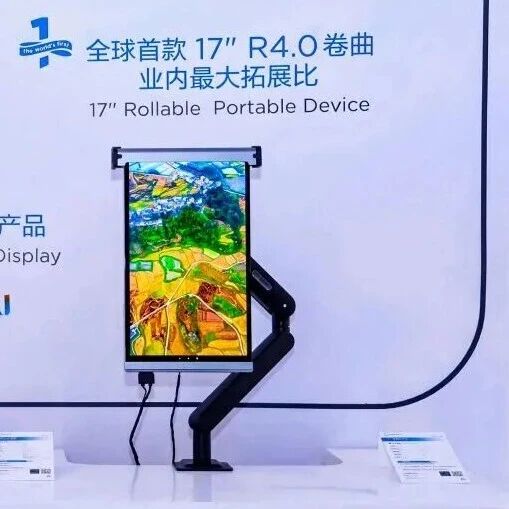
Core Viewpoint - BOE showcased over 200 innovative display technologies at the BOE IPC 2025 Global Innovation Partner Conference, highlighting advancements in flexible OLED and MLED technologies [2][4]. Group 1: Flexible OLED Technology - The world's first 17-inch rollable light terminal was introduced, measuring approximately 18 cm in length, 22 cm in width, and less than 50 microns in thickness, capable of rolling 6.5 times without creasing, and displaying a clear 3K resolution [4]. - This rollable terminal utilizes BOE's proprietary graphical technology and incorporates over 100 patents, featuring horizontal rigidity and vertical flexibility, with future applications in portable laptops and LCD TVs [4]. Group 2: MLED Technology - BOE launched the BYH Ultra P0.9 MLED product, achieving an ultra-high contrast ratio of 20,000:1 in a 10 lux environment [4]. - The new generation COG P0.9 seamless splicing display module is only 6 mm thick and weighs 12 kg/m², showcasing significant advancements in display technology [4]. Group 3: Other Display Innovations - The conference featured a 110-inch UB Cell 4.0 TV with ultra-high ambient light contrast and a 31.5-inch 8K 240Hz UB Cell monitor, emphasizing high refresh rates and dynamic range [5]. - Additional products included light-sensitive screens, eye-care tablets, and circular polarized e-sports monitors, all powered by BOE's natural light display technology [5].
海信携全球最大116吋RGB-Mini LED亮相IFA 2025,三大技术掀显示风暴
Xin Lang Cai Jing· 2025-09-06 08:14
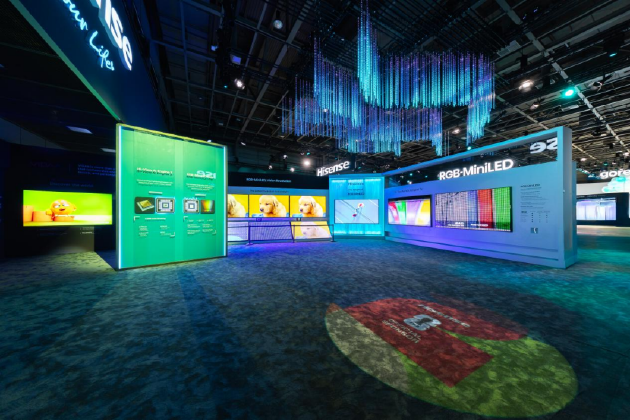
Core Viewpoint - Hisense showcased its latest display technology at the 2025 IFA in Berlin, featuring the world's largest 116-inch RGB-Mini LED TV and a range of innovative products, highlighting advancements in display technology and market leadership in large-screen televisions [1][3][7] Group 1: Product Innovations - Hisense introduced the world's first mass-produced RGB-Mini LED ultra-flagship TV, the UX, which features a 116-inch screen, achieving 100% BT.2020 color gamut and 100% color purity, along with low blue light for eye protection [3] - The U7S Pro, a new RGB-Mini LED TV, was unveiled, inheriting high color accuracy and low blue light features from the UX but at a more affordable price, making advanced display technology accessible to more households [3] - The Micro LED giant screen product offers customizable sizes up to 271 inches and features a 24mm ultra-thin body for "zero wall" installation, redefining display boundaries [4] Group 2: Laser TV Developments - Hisense presented two groundbreaking laser TV products, including the X1 Ultra, which utilizes cinema-grade technology to deliver an IMAX-like experience at home with a 120-inch foldable screen and 110% BT.2020 color gamut [4] - The world's first 100-inch rollable laser cinema can retract into a compact form, integrating seamlessly into home decor while providing a high-quality viewing experience [4] Group 3: Market Position and Future Outlook - Hisense's display technology advancements reflect a shift in the Chinese display industry from follower to leader, with a reported 58% global market share for TVs 100 inches and larger in the first half of 2025 [7]

海信携全球最大116吋RGB-Mini LED亮相德国IFA 2025 三大技术掀显示风暴
Zhong Guo Jin Rong Xin Xi Wang· 2025-09-05 13:54
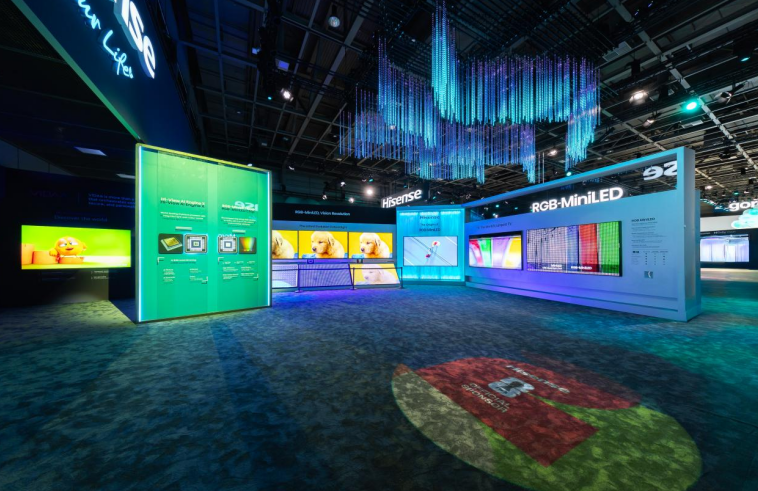
Core Viewpoint - Hisense showcased its leadership in display technology at the 2025 IFA in Berlin, presenting a range of innovative large-screen display products, including the world's largest 116-inch RGB-Mini LED TV and the first 100-inch rollable laser cinema, highlighting its advancements in RGB-Mini LED, laser display, and Micro LED technologies [1][3][5]. Group 1: Product Innovations - Hisense unveiled the world's first mass-produced RGB-Mini LED flagship TV, the UX, featuring a 116-inch screen, achieving 100% BT.2020 color gamut and 108 bits color precision, setting a new standard for LCD displays [3][4]. - The U7S Pro, a new RGB-Mini LED TV, was introduced at a more accessible price point while maintaining high color accuracy and low blue light features, making advanced display technology available to a broader audience [4]. - The Micro LED giant screen can be customized up to 271 inches and features a 24mm ultra-thin design, allowing for flexible installation and breaking traditional display size limitations [4]. Group 2: Laser Television Advancements - Hisense launched two groundbreaking laser TVs, including the X1 Ultra, which offers a 120-inch foldable screen with cinema-grade color accuracy, enhancing home viewing experiences [5]. - The world's first 100-inch rollable laser cinema was also introduced, featuring a unique design that allows the screen to retract into a compact form, integrating seamlessly into home decor [5]. Group 3: Market Position and Achievements - Hisense's performance at IFA 2025 reflects the company's transition from a follower to a leader in the global display industry, with a reported 58% market share in shipments of 100-inch and larger TVs in the first half of 2025, solidifying its position as the world's largest supplier [7].
平板显示材料企业映日科技完成辅导备案
WitsView睿智显示· 2025-09-04 09:17
Core Viewpoint - Wuhu Yingri Technology Co., Ltd. has completed the counseling filing registration with the Anhui Securities Regulatory Bureau and plans to list on the Beijing Stock Exchange, indicating a significant step towards capital market access and growth potential in the high-performance sputtering target materials sector [2]. Company Overview - Established in 2015 and headquartered in Wuhu, Anhui, Yingri Technology specializes in high-performance sputtering target materials, including ITO rotary targets, metal/alloy targets, and high-purity copper, aluminum, molybdenum, and nickel-vanadium targets for semiconductor applications [2]. - The company went public on the New Third Board in August 2025 and has over 200 patents [4]. Financial Performance - In 2023, Yingri Technology reported revenue of 522 million yuan and a net profit of 63 million yuan [4]. - The company has established a cleanroom facility of 20,000 m², with an annual production capacity of 1,200 tons for ITO rotary targets and 500 tons for metal/alloy targets [4]. Production Capacity and Expansion Plans - Yingri Technology supplies major clients such as BOE, Tianma, Huaxing Optoelectronics, Longi, and Tongwei [4]. - In 2024, the company will initiate a 300 million yuan expansion project to build a new automated production line for 6,000 tons of large-size ITO rotary targets, expected to be operational in the first quarter of 2026, which will double its total production capacity [4].

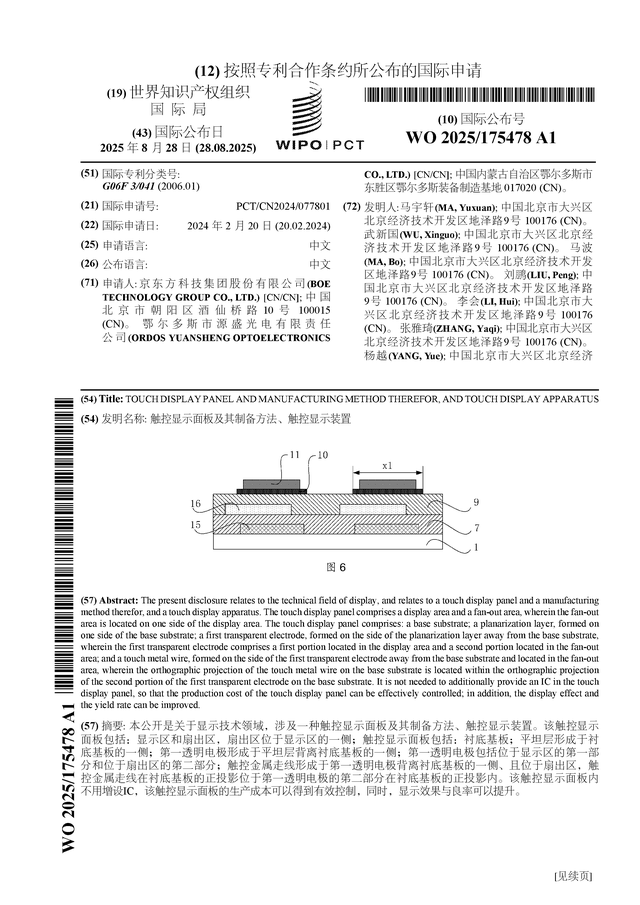
京东方A公布国际专利申请:“触控显示面板及其制备方法、触控显示装置”
Sou Hu Cai Jing· 2025-08-29 21:49
Group 1 - The core viewpoint of the news is that BOE Technology Group Co., Ltd. has made significant advancements in its patent applications and R&D investments, indicating a strong focus on innovation in the display technology sector [2]. - BOE has published 764 international patent applications this year, representing a 20.31% increase compared to the same period last year [2]. - In the first half of 2023, BOE invested 6.046 billion yuan in R&D, which is a year-on-year increase of 4.13% [2]. Group 2 - The disclosed patent relates to a touch display panel and its manufacturing method, which aims to improve production efficiency and reduce costs by eliminating the need for additional integrated circuits (ICs) [1]. - The touch display panel features a display area and a fan-out area, with specific configurations for transparent electrodes and touch metal wires to enhance display effects and yield rates [1].
龙腾光电申请双稳态液晶显示装置及控制方法专利,提高显示效果
Jin Rong Jie· 2025-08-23 12:42
Group 1 - The core viewpoint of the news is that Kunshan Longteng Optoelectronics Co., Ltd. has applied for a patent for a "dual-stable liquid crystal display device and control method," indicating innovation in display technology [1] - The patent application was filed on June 2025, and the publication number is CN120526727A, showcasing the company's ongoing efforts in research and development [1] - The dual-stable liquid crystal display device includes a touch detection unit that enhances display performance by refreshing the current image when pressed, thus improving display quality and avoiding unevenness [1] Group 2 - Kunshan Longteng Optoelectronics Co., Ltd. was established in 2005 and is located in Suzhou, primarily engaged in the manufacturing of computers, communications, and other electronic devices [2] - The company has a registered capital of 333,333.34 million RMB and has made investments in 2 enterprises, participated in 183 bidding projects, and holds 3978 patent information [2] - Additionally, the company possesses 17 trademark information and has 19 administrative licenses, indicating a robust intellectual property portfolio [2]

中国“芯”光:Micro-LED 照亮显示产业破壁之路
Feng Huang Wang Cai Jing· 2025-08-21 04:58
Core Viewpoint - The article discusses the revolutionary potential of Micro-LED technology in the display industry, highlighting Shenzhen-based Siton Technology as a leader in this field, which is transforming visual experiences and paving the way for future applications in various sectors [1][3][4]. Group 1: Micro-LED Technology Overview - Micro-LED technology represents a significant advancement in display technology, characterized by self-emitting pixels that offer high brightness (up to 10 million nits), low power consumption (10% of LCD and 50% of OLED), and exceptional response times [5][6]. - The technology is seen as a solution to the limitations of previous display technologies such as LCD and OLED, which struggle with brightness, power efficiency, and longevity [5][6]. Group 2: Development Journey of Siton Technology - Siton Technology was founded in 2018 by Dr. Liu Zhaojun and Dr. Qiu Chengfeng, combining expertise in technology and industrialization to advance Micro-LED applications [12][13]. - The company established the first Micro-LED pilot production line in Shenzhen in 2019, and has since expanded to a production base in Xiamen, with plans for mass production in 2024 [13][18]. Group 3: Market Potential and Future Outlook - The global Micro-LED market is projected to reach $1.4 billion in 2024 and $9.3 billion by 2030, indicating strong growth potential [15]. - China is emerging as a leader in Micro-LED technology, with the highest number of patent applications in 2020, and government support for new display technologies [15][16]. - Siton Technology's innovations and strong manufacturing capabilities position it well to capitalize on the growing demand for advanced display solutions across various industries, including AR, medical, and consumer electronics [8][16][19].
