折叠屏技术

Search documents
市场洞察:苹果入局在即,中国折叠:屏巨头如何守擂?
Tou Bao Yan Jiu Yuan· 2026-03-20 12:56
Investment Rating - The report does not explicitly provide an investment rating for the folding smartphone industry Core Insights - The folding smartphone market is experiencing continuous growth, with an expected shipment of over 12 million units in 2025, following a 30.8% year-on-year increase in 2024 [6][9] - Huawei holds a dominant market share of 49.8% in the Chinese folding smartphone market, followed by Honor at 20.6% and Vivo at 11.1% [10] - The introduction of Apple's folding devices is anticipated to accelerate the mainstream adoption of folding technology and redefine user experience standards [16][18] Summary by Sections Folding Smartphone Overview - Folding smartphones utilize flexible display technology and can be categorized into two-fold and three-fold devices, with the horizontal inward fold being the mainstream method [3][4] - The market share for inward folding smartphones is approximately 62%, while outward folding devices are penetrating the mid-range market [4] Shipment and Market Dynamics - China's folding smartphone shipments are projected to reach approximately 917,000 units in 2024, with a significant rebound of 52.9% in Q1 2025 due to product innovations [6][9] - The competitive landscape shows Huawei leading with significant market share, while other brands like Honor and Vivo are also making notable contributions [10] Apple's Entry into the Market - Apple's potential entry into the folding smartphone market is expected to create a "catalyst effect," pushing the industry towards mainstream adoption and enhancing supply chain optimization [16][18] - The first-year shipment of Apple's folding iPhone is estimated to be between 5 million to 7 million units, with a potential increase in the following year [19] Key Component: Hinges - Hinges are critical components in folding smartphones, affecting durability, smoothness of operation, and screen crease depth [23][24] - The water-drop hinge design is currently the market's mainstream technology, providing advantages in reducing screen pressure and improving aesthetics [24] Competitive Strategies of Chinese Manufacturers - Chinese folding smartphone manufacturers are leveraging strategies such as ecosystem integration, hardware innovation, and supply chain advantages to compete with Apple [29][30] - The focus on lightweight and long battery life is evident, with devices like the Vivo X Fold5 and Honor Magic V5 weighing around 217g and having a thickness of less than 9mm [30] - The local supply chain in China is robust, with leading manufacturers in flexible OLED and structural components enhancing cost control and product iteration speed [31]


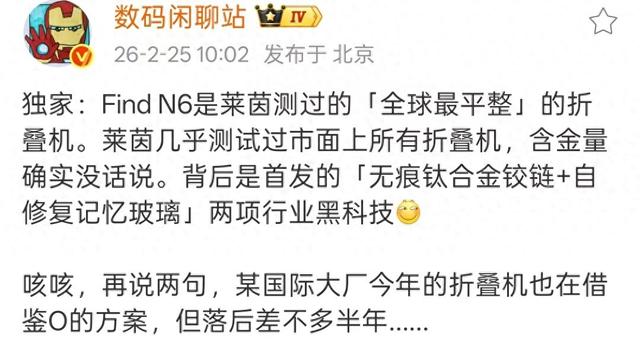
OPPO Find N6获得莱茵平整度认证,苹果折叠机或落后半年
Xin Lang Cai Jing· 2026-02-25 12:50
Group 1 - OPPO Find N6 has received the Rhein certification as the world's flattest foldable smartphone, indicating a significant achievement in addressing the core issue of screen flatness in foldable devices [1] - The success of OPPO Find N6 is attributed to its two innovative technologies: the seamless titanium alloy hinge and self-healing memory glass, which overcome the physical limitations of foldable designs and enhance screen protection and durability [2] - An important industry insight reveals that a major international manufacturer is adopting OPPO's technology for its upcoming foldable device, with a development delay of approximately six months, suggesting that Apple is likely the company in question [3] Group 2 - The adoption of OPPO's technology by a leading smartphone manufacturer highlights OPPO's transition from a "follower" to a "rule-maker" in the foldable screen technology sector, showcasing its competitive edge over international giants [3]

从“猎奇”到“信赖”:折叠屏手机用户发展洞察报告
艾瑞咨询· 2026-02-20 00:04
Core Insights - The global foldable smartphone market is experiencing continuous growth, particularly in China, driven by technological advancements and an improved supply chain, leading to product diversification [1] - China has emerged as the main growth engine for the global foldable smartphone market, with Huawei maintaining a significant market share [1][18] - User willingness to purchase foldable smartphones is increasing, with higher expectations for product functionality and experience [1] Market Overview - The global smartphone market has transitioned into a phase of stock competition since 2017, with annual shipment volumes declining by approximately 2.52%, projected to reach 1.22 billion units by 2024 [2] - The flat smartphone market has become saturated, prompting manufacturers to innovate product forms to explore the high-end market [5] Competitive Landscape - The foldable smartphone industry chain includes upstream raw material supply, midstream design and manufacturing, and downstream sales [7] - Chinese manufacturers, led by Huawei and Samsung, are driving the industry chain's collaborative progress, injecting strong momentum into the market [7][9] - Huawei's market share in China has significantly increased from 35.0% in Q1 2023 to 75.0% in Q1 2025, indicating a strengthening of its leading position [18] User Behavior and Preferences - The majority of foldable smartphone users are male and female, with a higher preference among first-tier and new first-tier city users [20] - Users predominantly use foldable smartphones priced between 5,000 to 9,000 yuan, with Huawei being the most used brand at 62.3% [22] - The key reasons for purchasing foldable smartphones include a stronger sense of technology and future appeal, with 44.7% of users citing this as a primary factor [24] Product Development and Trends - Foldable smartphones are transitioning from niche products to mainstream devices, with a focus on hardware optimization and software ecosystem development [1][43] - The hardware is evolving from merely functional to providing a comprehensive user experience, with innovations in hinge and screen technology [45] - The market is expected to see a significant shift in 2026, with foldable smartphones becoming more mainstream as user acceptance increases [15] User Satisfaction and Recommendations - Huawei leads in user satisfaction, with a higher rating than the overall market, followed by Xiaomi and Samsung [30] - The net recommendation value for Huawei and Xiaomi indicates strong user advocacy and brand loyalty [31] Future Outlook - Over 90% of consumers are considering purchasing a foldable smartphone for their next device, with a focus on reliability, battery life, and hardware specifications [41] - The transition from "novelty" to "common use" is evident, with 95.5% of consumers willing to switch to foldable smartphones in the future [47]

OPPO 折叠屏技术被苹果研究,全球销量逆势增长
Xin Lang Cai Jing· 2026-01-30 06:15
Group 1 - Apple is accelerating the development of its first foldable iPhone by purchasing OPPO's flagship foldable model, Find N5, for disassembly and research, highlighting OPPO's technological leadership in the foldable screen sector [1] - OPPO's global smartphone sales have shown strong growth, with a 7.6% year-on-year increase in Q4 2025, and a notable 10.2% growth in the Chinese market, making it the top performer in the Android segment [4] - OPPO's total sales, including OnePlus and Realme, are projected to exceed 190 million units in 2025, ranking third globally, driven by precise positioning and innovation investments in high and mid-high-end markets [4] Group 2 - The upcoming foldable iPhone is expected to feature a Samsung panel with an external screen of approximately 5.5 inches and an internal screen of about 7.8 inches, with a phased release starting in September 2026 and a price range of $2000 to $2500, facing some mass production challenges [3] - IDC indicates that the high-end market is currently the core battleground for industry innovation, and OPPO's combination of technological leadership and market recognition positions it well for future competition in the foldable screen arena [4]

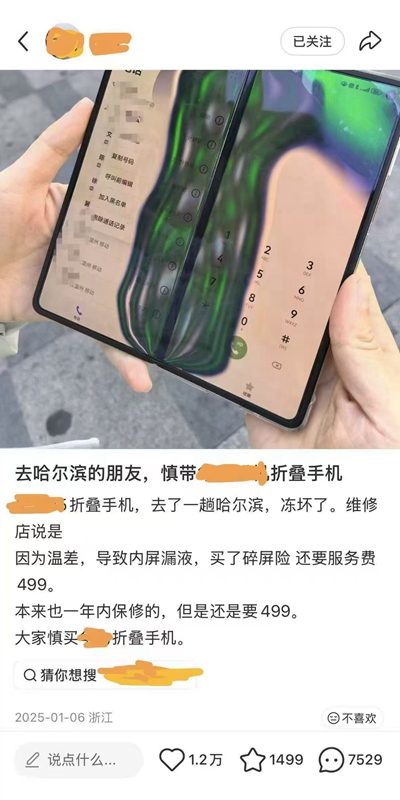
折叠屏在东北变“碎碎冰”
第一财经· 2026-01-29 15:49
Core Viewpoint - The article discusses the challenges and growth prospects of the foldable smartphone market, particularly focusing on durability issues in low temperatures and the expected increase in shipments due to Apple's entry into the market in 2026 [3][13]. Durability Issues in Low Temperatures - Foldable smartphones face durability problems in extremely low temperatures, as highlighted by a viral incident where a user's device was damaged in Harbin due to temperature fluctuations [5][11]. - The core reason for screen breakage in cold weather is attributed to the material properties of flexible OLED screens, which become brittle at low temperatures, leading to issues like delamination and liquid leakage [12]. - Recommendations for using foldable phones in cold environments include minimizing opening and closing the device outdoors and allowing it to warm up before use [12] [13]. Market Growth Predictions - Despite durability concerns, the global shipment of foldable smartphones is expected to reach 24 to 25 million units in 2026, a growth of approximately 41% to 47% from 17 million units in 2025 [14]. - The Chinese market is projected to see shipments of 12 to 13 million units in 2026, reflecting a growth of 20% to 30% from 10 million units in 2025 [14]. - The foldable smartphone market is anticipated to remain small, accounting for about 2% of the total global smartphone sales of approximately 1.15 billion units in 2026 [15]. Market Dynamics and Competitive Landscape - China has become the largest market for foldable smartphones, with local manufacturers focusing on innovation in hinge design, screen technology, and overall device performance [17]. - Major brands like Huawei, Apple, and Samsung are expected to dominate the market, with Huawei holding a significant share of around 50% in China [18]. - The competitive landscape is characterized by a clear division among leading brands, with Huawei showing a 14% increase in sales, while other brands like Honor and Vivo are facing challenges [18]. Future Observations - The introduction of Apple's foldable smartphone is anticipated to significantly influence market dynamics, with expectations for innovations in hardware and software that could enhance user experience [20]. - The ongoing "trade-in" subsidy policy in China may provide additional support for the foldable smartphone market, although rising costs present challenges for manufacturers [20].

折叠屏变“碎碎冰”难题待解,苹果“折叠大法”引领今年风向
Di Yi Cai Jing· 2026-01-29 13:46
Core Insights - The global shipment of foldable smartphones is expected to reach approximately 25 million units in 2023, with China accounting for around 13 million units [1][6] - Despite durability issues in extreme cold, the foldable smartphone market is projected to grow significantly, particularly with Apple's anticipated entry into the market [6][12] Shipment Forecast - Global foldable smartphone shipments are predicted to be between 24 million to 25 million units in 2026, representing a growth of 41% to 47% compared to 17 million units in 2025 [6] - China's foldable smartphone shipments are expected to reach 12 million to 13 million units in 2026, a 20% to 30% increase from approximately 10 million units in 2025 [6] Market Dynamics - The foldable smartphone market has maintained a shipment volume of around 17 million units annually from 2023 to 2025 [6] - The anticipated release of Apple's foldable smartphone in 2026 is expected to drive significant market growth, addressing existing issues such as screen creasing [6][12] Consumer Preferences - The market is shifting towards larger foldable devices, which are more accepted by users, while smaller foldable devices are declining in popularity due to higher costs and lower performance [7] - The average price of large foldable smartphones is around 9,000 yuan, with Apple's new models expected to exceed 10,000 yuan [7] Regional Insights - China has become the largest market for foldable smartphones, expected to hold over 40% of the global market share by 2029 [8] - Major Chinese manufacturers are focusing on innovation in hinge design, screen technology, and overall device performance to maintain competitive advantages [8] Competitive Landscape - Huawei leads the Chinese market with a 32% share, showing a 14% year-on-year growth, while Honor and Vivo are facing challenges with declining market shares [9][10] - Other brands like OPPO, Samsung, and Xiaomi have market shares ranging from 7% to 8% [10] Challenges Ahead - The industry faces rising cost pressures and the need for manufacturers to balance cost control, pricing strategies, and product planning to enhance consumer appeal [12] - The impact of Apple's new product launch on the market dynamics will be a critical observation point for 2026 [12]
AI助力,我国手机行业攀高向优
Xin Hua She· 2026-01-28 12:48
Core Insights - The Chinese smartphone market is projected to exceed 1 trillion yuan in 2025, driven by the trade-in policy for consumer goods and advancements in technology such as AI and foldable screens [1] Group 1: Market Performance - In 2025, Honor's smartphone shipments surpassed 71 million units, marking a 9% year-on-year increase [2] - From January to November 2025, the domestic smartphone shipment reached 282 million units, a 0.9% increase year-on-year, with 5G smartphones accounting for 244 million units, up 1.3% [2] - The number of new smartphone models launched in the domestic market reached 474, reflecting a 14.5% increase year-on-year [2] Group 2: Innovation and Technology - Huawei launched the industry's first wide-foldable smartphone, the Huawei Pura X, which combines the features of an e-reader and a foldable device [3] - The foldable smartphone market is expected to see shipments of 9.47 million units in 2025, a 3.3% increase [4] - Companies are focusing on differentiating factors such as satellite communication, design, battery technology, and camera capabilities to enhance product competitiveness [4] Group 3: AI Integration - AI is reshaping user experience, with new AI smartphones like the Doubao AI phone from ByteDance and ZTE expected to drive a new wave of innovation [5] - The integration of AI in smartphones is becoming a key focus for manufacturers, with advancements in systems like Huawei's HarmonyOS and Honor's Magic8 Pro [6] - By 2025, AI smartphone shipments in China are projected to exceed 118 million units, capturing 40.7% of the overall market [7] Group 4: Market Trends and Challenges - The Chinese smartphone market is entering a critical adjustment phase in 2026, characterized by total pressure and structural differentiation [8] - The high-end market is expected to expand due to innovation, while the low-end market may shrink due to price sensitivity [8] - By 2026, the market share for smartphones priced above $600 is projected to reach 35.9%, a 5.4 percentage point increase year-on-year [8] Group 5: Consumer Behavior - Emotional consumption is reshaping purchasing logic, with design and brand emotional connections becoming as important as technical performance [10] - Manufacturers are expected to invest more in differentiated designs and collaborations to meet consumer emotional value needs [10]
市场最前沿丨AI助力,我国手机行业攀高向优
Xin Hua Wang· 2026-01-28 12:28
Core Viewpoint - The Chinese smartphone industry is expected to reach a market size of over 1 trillion yuan by 2025, driven by the trade-in policy for consumer goods and advancements in AI and foldable screen technology [1]. Group 1: Market Growth and Product Innovation - In 2025, smartphone shipments in China are projected to exceed 71 million units, marking a 9% year-on-year increase [2]. - The domestic smartphone market saw a shipment of 282 million units in the first 11 months of 2025, reflecting a 0.9% year-on-year growth, with 5G smartphones accounting for 244 million units, a 1.3% increase [3]. - The number of new smartphone models launched in China reached 474, representing a 14.5% year-on-year growth [3]. Group 2: Competitive Landscape and Technological Advancements - Innovation is crucial for smartphone manufacturers to differentiate themselves in a saturated market, with Huawei launching the first wide foldable phone, the Huawei Pura X, in March 2025 [4]. - The foldable smartphone market in China is expected to see shipments reach 9.47 million units in 2025, a 3.3% increase [5]. - Key areas of differentiation include satellite communication, design, battery technology, and camera capabilities, with various brands introducing advanced features such as eSIM support and self-developed chips [6]. Group 3: AI Integration and User Experience - AI is transforming user experience, with features that allow smartphones to assist in navigation and shopping [7]. - Major manufacturers are integrating AI into their systems, with Huawei upgrading its HarmonyOS and Honor enhancing its products with AI capabilities [8]. - The AI smartphone market in China is projected to reach over 118 million units by 2025, capturing 40.7% of the overall market [10]. Group 4: Market Adjustments and Future Projections - The Chinese smartphone market is entering a critical adjustment phase in 2026, with expected declines in overall shipments due to rising component costs [11]. - The high-end smartphone market is anticipated to expand, while the low-end market may shrink, indicating a shift towards a more diversified market structure [11]. - AI smartphones are expected to become mainstream by 2026, with projected shipments of 147 million units, a 31.6% increase, representing 53% of the overall market [12]. Group 5: Consumer Behavior and Emotional Value - Emotional consumption is reshaping purchasing logic, with design and brand connection becoming as important as technical performance [13].
华为折叠屏国内份额超70%,坐等苹果入局
Guan Cha Zhe Wang· 2026-01-22 09:16
Core Insights - The Chinese foldable smartphone market is projected to see a shipment of approximately 10.01 million units in 2025, reflecting a year-on-year growth of 9.2%, contrasting with a slight decline of 0.6% in the overall smartphone market [1] - Huawei leads the market with a significant share of 71.8%, while other brands like Honor, Vivo, and OPPO have much smaller shares, indicating Huawei's dominant position [1][3] - Despite the emergence of competitive products from other manufacturers, Huawei's comprehensive product lineup and brand strength have solidified its market leadership [4][6] Market Dynamics - The foldable smartphone segment has reached a bottleneck since 2019, with manufacturers struggling to drive sales through hardware improvements alone, leading to a decline in the overall market in Q4 of the previous year [3][4] - Brand strength is increasingly influencing consumer preferences in the high-end market, with Huawei's focus on balanced capabilities and innovative designs contributing to its market share growth of over 20 percentage points in 2025 [4] - The foldable smartphone market still represents only 3.5% of total smartphone shipments in China, prompting some manufacturers to reconsider their strategies in this niche segment [4][6] Technological Innovations - Manufacturers are exploring soft-hard collaboration as a breakthrough direction, with Huawei's MateX7 focusing on AI integration rather than just hardware enhancements [6] - Other brands like OPPO and Vivo are also attempting to bridge compatibility with Apple ecosystems, indicating a trend towards cross-platform functionality [6] Future Outlook - The anticipated entry of Apple's foldable smartphone, expected to be released in the fall of 2026, is generating significant market interest, particularly regarding its potential to enhance hardware and software integration [7][8] - The overall smartphone market in China may face challenges in 2026 due to rising storage costs, which could lead to a noticeable decline in shipments [8]

图数室丨折叠屏难过山海关
Xin Lang Cai Jing· 2026-01-21 08:24
Core Viewpoint - The article discusses the challenges and market dynamics of foldable smartphones, particularly in extreme cold conditions, highlighting the gap between advanced technology and practical usability [2][3][25]. Group 1: Market Dynamics - Foldable smartphones are transitioning from niche products to mainstream consumer items, appealing to high-income, educated professionals in urban areas [2][25]. - The shipment volume of foldable smartphones in China is expected to double from 227 million units in the first half of 2023 to 442 million units in the first half of 2024, with projections nearing 500 million units by mid-2025, reflecting a year-on-year growth of 12.6% [18]. - Huawei leads the market with a 75% share, shipping 374 million units, while other brands like Honor, OPPO, Xiaomi, and Vivo are also establishing their positions [19][20]. Group 2: Technical Challenges - Foldable screens, particularly those made from flexible OLED technology, face significant issues in low temperatures, where materials can become brittle and prone to cracking [5][6]. - The normal operating temperature for most foldable smartphones is between 0°C and 35°C, while they can be stored at temperatures ranging from -20°C to 50°C when powered off [6]. Group 3: Consumer Insights - The typical user of foldable smartphones is often a married male, living in first-tier or new first-tier cities, with a bachelor's degree or higher, and an income ranging from 5,000 to 20,000 yuan [22]. - The unique value proposition of foldable smartphones, such as portability and innovative design, is attracting consumers who seek a blend of technology and quality of life [25]. Group 4: Competitive Landscape - The entry of major players like Apple, which plans to launch its first foldable smartphone in 2026, is expected to intensify competition in the foldable smartphone market [25][26]. - The market is evolving into a scenario where one company dominates while several others coexist, indicating a competitive yet fragmented landscape [20].