
智慧海关建设

Search documents
关通全球 物达八方 “十四五”期间海关年均监管进出口货物体量全球最大
Jing Ji Ri Bao· 2025-08-25 21:56
Core Insights - The article highlights the significant achievements of China's customs modernization and trade facilitation efforts during the "14th Five-Year Plan" period, showcasing the resilience and vitality of the country's foreign trade amidst global uncertainties [1][2][8]. Customs Development and Trade Facilitation - The annual supervision of import and export goods reached 5.2 billion tons, with a total value of 41.5 trillion yuan, making it the largest globally [1]. - The introduction of 40 new and expanded open ports has brought the total to 311, enhancing the country's trade infrastructure [1]. - The "One Network for All" initiative has streamlined 964 items across 25 categories, covering the entire cross-border trade chain [1][2]. Innovations in Customs Operations - In the Guangdong-Hong Kong-Macao Greater Bay Area, the "One Port Pass" regulatory model has reduced cargo transfer times from 5-7 days to 2-3 days [2]. - The establishment of a "green channel" for agricultural imports allows fresh fruits from neighboring countries to reach major markets like Guangzhou and Beijing within 7 to 30 hours [2]. - The customs authority has implemented 108 reform measures to create a more convenient, safe, and predictable trade environment across 25 cities in 17 provinces [2]. Smart Customs and Technological Integration - The integration of technology in customs operations is advancing, with a focus on big data, artificial intelligence, and automation to enhance regulatory efficiency and service levels [3][2]. - The customs modernization efforts are supported by deep integration of technological innovation with industry practices [3]. Port and Trade Capacity Expansion - The number of water transport ports has reached 125, handling over 90% of the national cargo volume, while air and land ports have also seen significant growth [4]. - By 2024, the import and export cargo volume at water ports is expected to exceed 4.3 billion tons, marking a 10% increase from the end of the "13th Five-Year Plan" [4]. - Special customs supervision areas have contributed significantly to foreign trade, accounting for one-fifth of total import and export value despite occupying less than 0.01% of the national territory [4][5]. New Trade Dynamics and Intellectual Property Protection - The emergence of new trade dynamics, such as cross-border e-commerce and overseas warehouses, has accelerated the growth of foreign trade [7]. - The export of innovative products has increased significantly, with "new three samples" exports growing 2.6 times since 2020 [7]. - Intellectual property protection has become a focal point, with nearly 20,000 new rights holders registered and close to 100,000 intellectual property records filed during the "14th Five-Year Plan" [7]. Future Directions - The customs authority plans to continue enhancing regulatory efficiency, safety, and convenience while combating smuggling and illegal activities to support China's modernization efforts [8].
全国海关“十四五”成绩单出炉 年均监管进出口货物52亿吨、货值41.5万亿元 体量全球最大 安全稳定可控
Zheng Quan Ri Bao· 2025-08-25 16:48
Core Viewpoint - The State Council's press conference highlighted the achievements of the General Administration of Customs in safeguarding national security and promoting high-quality development during the "14th Five-Year Plan" period. Group 1: Achievements in Customs Operations - The General Administration of Customs has managed an average of 5.2 billion tons of import and export goods annually, with a total value of 41.5 trillion yuan, making it the largest in the world [2] - Cumulative tax collection reached 9.7 trillion yuan through comprehensive tax management and legal enforcement [2] - The "Smart Travel Inspection" system now covers 80% of air ports, allowing for seamless and rapid customs clearance for travelers [2] Group 2: Infrastructure and Trade Facilitation - A total of 40 new and expanded open ports have been established, bringing the total to 311, creating a comprehensive open port layout across land, sea, and air [2] - The export of "new three samples" is projected to increase by 2.6 times from 2020 levels by 2024 [2] - Trade with Belt and Road Initiative partners is expected to reach 22 trillion yuan in 2024, significantly enhancing trade security and convenience [2] Group 3: Cross-Border Trade Facilitation - The General Administration of Customs has launched special actions for cross-border trade facilitation in collaboration with over 20 national ministries, resulting in 108 reform measures [3] - The comprehensive bonded zone's maintenance product catalog has been expanded, leading to an 8.7% increase in bonded maintenance business imports and exports from January to July [3] - Over 3,000 AEO (Authorized Economic Operator) enterprises have benefited from financing guarantees and credit facilities [3] Group 4: Smart Customs Development - The construction of smart customs has accelerated, with pilot projects at 63 ports showing initial success [4] - The integration of smart customs, border inspection, and maritime services has improved risk prevention and control, making customs clearance more efficient [4] - Advanced equipment and technology, such as near-infrared spectrometers and automated sampling robots, have significantly reduced customs clearance times, exemplified by a 15-hour reduction for imported iron ore [4]
新华社权威速览·非凡“十四五”|守国门促发展,保安全强合作,海关答卷来了!
Xin Hua She· 2025-08-25 11:34
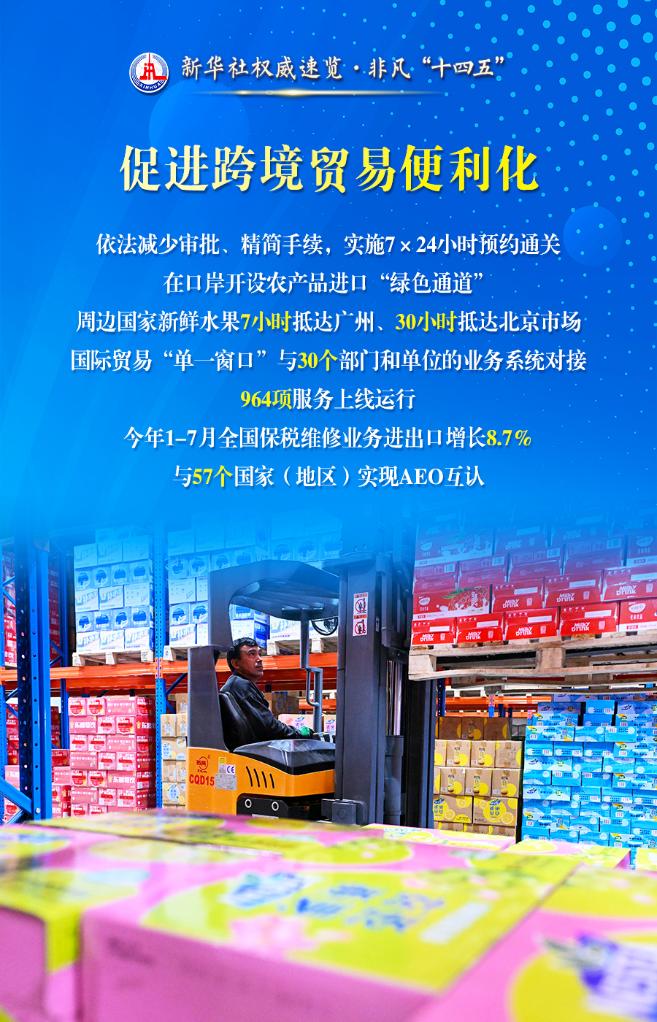
Core Viewpoint - The customs department has made significant progress in enhancing regulatory efficiency and service levels during the "14th Five-Year Plan" period, supporting high-quality development and high-level opening up [1] Group 1: Promoting Cross-Border Trade Facilitation - The customs has implemented measures to reduce approvals and streamline procedures, including 7×24 hour appointment customs clearance [2] - A "green channel" for agricultural product imports has been established at ports, allowing fresh fruits from neighboring countries to reach Guangzhou in 7 hours and Beijing in 30 hours [2] - The "single window" for international trade has integrated with the business systems of 30 departments, with 964 services launched [2] Group 2: High-Quality Development of Ports - The number of open ports for foreign trade has reached 311, with 28 border ports providing self-driving tour services [5] - Smart port pilot projects have been initiated at 63 ports, facilitating faster entry of "Made in China" products into global markets [5] Group 3: Strengthening Quarantine and Security Measures - Customs has issued 150 warning notices and disease announcements related to 46 infectious diseases, detecting 180,000 cases of infectious diseases at ports [7] - Over 5.25 million disease-carrying organisms have been intercepted, effectively preventing the entry of over 30 types of vector-borne infectious diseases [7] Group 4: Combating Smuggling Crimes - A total of 23,000 smuggling cases have been investigated, with a case value of nearly 480 billion yuan and over 60 billion yuan in tax involved [9] - 3,032 cases of drug smuggling have been filed, with 15.7 tons of various drugs seized [9] Group 5: Intellectual Property Protection - The customs has conducted the "Dragon Action" for intellectual property protection, seizing 260,000 batches of suspected infringing goods, totaling nearly 400 million items [10] - The number of new rights holders registered has reached 20,000, with nearly 100,000 intellectual property records filed [10] Group 6: Safeguarding Biological and Ecological Security - Customs has issued 140 risk warnings and prohibitory announcements, seizing over 64,000 exotic pets and 278,000 harmful organisms [11] - 1,100 cases of smuggled frozen products have been intercepted, and cooperation mechanisms have been established with 27 countries to prevent cross-border transmission of pests [11] Group 7: Promoting Special Customs Supervision Areas - The number of special customs supervision areas has increased by 19, totaling 174, with their import and export value accounting for over half of local foreign trade [13] Group 8: Ensuring Quality and Safety of Import and Export Goods - Customs has inspected over 9 million batches of import and export goods, returning over 10,000 batches of non-compliant mineral products and recycled metals [15] - 58 cases of smuggling waste have been filed, with 12,000 batches of non-compliant clothing, home appliances, and children's products detected [15] Group 9: Accelerating Smart Customs Development - Advanced inspection systems have been deployed at ports, achieving "second-level" clearance for compliant goods, with a maximum processing speed of 85,000 entries per minute [17] - A big data intelligent risk control model has been developed to assess risks in real-time for each customs declaration [17]

海关现代化建设取得长足进步
Zhong Yang Ji Wei Guo Jia Jian Wei Wang Zhan· 2025-08-25 08:18
Group 1 - The core viewpoint is that the modernization of customs has made significant progress since the "14th Five-Year Plan," enhancing regulatory efficiency and service levels, thereby supporting high-quality development and high-level openness [2][3] - Since the "14th Five-Year Plan," customs has managed an average of 5.2 billion tons of import and export goods annually, with a total value of 41.5 trillion yuan, making it the largest globally [2] - The "single window" for international trade has become a digital portal connecting China with global trade, covering 964 items across 25 categories for cross-border trade [2][3] Group 2 - The number of open ports has increased by 40, reaching a total of 311, forming a comprehensive open layout across water, land, and air [2] - The capacity of national water transport ports is expected to exceed 4.3 billion tons in 2024, marking a 10% increase from the end of the "13th Five-Year Plan" [2] - Customs has implemented a series of actions to facilitate cross-border trade, including simplifying customs processes and optimizing regulatory models [3][4] Group 3 - Customs has effectively curbed smuggling activities, particularly concerning hazardous waste, endangered species, and controlled items, through coordinated efforts with law enforcement [4] - The next steps for customs include enhancing regulatory measures, improving safety, increasing convenience, and intensifying efforts against smuggling [4]
“十四五”期间海关监管进出口货物体量全球最大
Chang Jiang Shang Bao· 2025-08-25 08:11
Core Insights - The article highlights the significant progress made by China's customs authorities in enhancing regulatory efficiency and service levels during the "14th Five-Year Plan" period, amidst increasing external uncertainties [1][2][3] Group 1: Customs Achievements - During the "14th Five-Year Plan," China's customs managed an average of 5.2 billion tons of import and export goods annually, with a total value of 41.5 trillion yuan, making it the largest globally [1] - Customs authorities seized 5.15 million items related to political, firearms, and explosive violations, detected over 180,000 cases of infectious diseases, and handled more than 200,000 batches of substandard goods [1] - A total of 9.7 trillion yuan in taxes was collected, with 23,000 smuggling cases investigated, effectively curbing smuggling activities in key areas and sectors [1] Group 2: Trade Facilitation Innovations - Significant breakthroughs in trade facilitation were achieved through institutional innovation and technological empowerment, with the "Single Window" for international trade becoming a digital gateway for global trade [2] - The "One Network for All" initiative covers 25 categories and 964 items, streamlining cross-border trade processes [2] - The number of open ports increased by 40, reaching a total of 311, establishing a comprehensive port opening layout across land, sea, and air [2] Group 3: High-Quality Development - The export of "new three samples" increased by 2.6 times compared to 2020, indicating a higher quality of exports [3] - During the "14th Five-Year Plan," 271 types of agricultural and food products were approved from 81 new countries/regions, diversifying import sources [3] - China's total goods trade is projected to reach 43.8 trillion yuan in 2024, maintaining its position as the world's largest trader for eight consecutive years [3]
我国已成为全球157个国家和地区前3大贸易伙伴
Xin Hua Cai Jing· 2025-08-25 06:17
Core Insights - China has become one of the top three trading partners for 157 countries and regions globally, highlighting the advantages of international cooperation and win-win strategies [1] Customs and Trade Development - The General Administration of Customs has emphasized institutional innovation and technological empowerment, fully enhancing the construction of smart customs [1] - Since the 14th Five-Year Plan, China has added and expanded 40 open ports, bringing the total to 311, establishing a comprehensive open layout across land, sea, and air [1] Import and Export Statistics - On average, the customs have regulated 5.2 billion tons of import and export goods annually, with a total value of 41.5 trillion yuan, making it the largest globally [1] - A total of 5.15 million pieces of prohibited items related to politics, firearms, and explosives have been seized, along with 180,000 cases of infectious diseases detected [1] - Over 200,000 batches of substandard goods have been disposed of, ensuring safety risks are kept outside the national borders [1] Export and Import Trends - China's exports have seen a significant increase in "new content," with the export of "new three samples" growing 2.6 times from 2020 to 2024 [1] - The country has diversified its import sources, adding 271 types of agricultural and food products from 81 newly admitted countries and regions during the 14th Five-Year Plan [1] - The regional structure of trade has improved, with stable quality and quantity in the eastern regions and growing momentum in the central and western regions, achieving an average annual growth rate of 7.9% in imports and exports [1]
海关总署最新公布:311个!
Zheng Quan Ri Bao Wang· 2025-08-25 05:10
Core Insights - The State Council's press conference highlighted the achievements of customs in safeguarding national security and promoting high-quality development during the "14th Five-Year Plan" period [1] Group 1: Customs Achievements - Customs has effectively safeguarded national borders, enhanced regulatory efficiency, and improved service levels, contributing significantly to high-quality development and high-level openness [1] - An average of 5.2 billion tons of goods worth 41.5 trillion yuan were regulated annually, making it the largest in the world, with a cumulative tax collection of 9.7 trillion yuan [2] - The "Smart Travel Inspection" system now covers 80% of air ports, allowing for seamless and rapid customs clearance [2] Group 2: Trade Facilitation and International Cooperation - The number of open ports has increased by 40, reaching a total of 311, establishing a comprehensive open port layout across land, sea, and air [2] - Exports of "new three samples" are projected to grow 2.6 times by 2024 compared to 2020, supporting the Belt and Road Initiative and enhancing trade security and convenience [2] - China has become one of the top three trading partners for 157 countries and regions globally [2] Group 3: Cross-Border Trade Initiatives - Customs has launched over 108 reform and innovation measures in collaboration with more than 20 national ministries, expanding to 25 cities across 17 provinces [3] - The import and export of bonded maintenance business grew by 8.7% from January to July, reflecting the adaptation to industrial transformation needs [3] - Over 3,000 AEO (Authorized Economic Operator) enterprises benefit from financing guarantees and credit facilities, with mutual recognition of AEO status established with 57 countries and regions [3] Group 4: Smart Customs Development - The construction of smart customs has accelerated, with pilot projects in 63 ports leading to initial successes in intelligent and automated operations [3] - The integration of smart customs, border inspection, and maritime services has enhanced risk prevention and control, making customs clearance more efficient [3] - The use of advanced technologies, such as near-infrared spectrometers and automated sampling robots, has significantly reduced customs clearance times by over 15 hours for imported iron ore [4]
科技赋能外贸 兰州海关智慧化助企“闯世界”
Zhong Guo Xin Wen Wang· 2025-07-22 16:02
Core Insights - The construction of a smart customs system has significantly improved operational efficiency for companies, reducing copper concentrate processing time from 18 days to approximately 8 days and customs clearance time from 5-10 days to an average of 30 hours, resulting in cost savings exceeding 100 million yuan [1][2] - Gansu's import of metal ores reached 19.77 billion yuan in the first half of the year, marking a 44% increase and accounting for 74.2% of the province's total imports, with notable increases in nickel and cobalt materials [1][2] - The "Gansu Agricultural Foreign Trade Pass" program has been instrumental in promoting Gansu's agricultural products abroad, with over 160 agricultural enterprises trained to utilize the program, enhancing the quality and efficiency of exports [3] Group 1: Smart Customs Development - The smart customs initiative has led to a reduction in logistics costs and manpower, with frontline staff reduced from 4-5 to 2 [1] - The implementation of a "joint supervision" customs model for imported copper concentrate has been a key innovation, combining technology and risk assessment to enhance regulatory efficiency [2] Group 2: Agricultural Export Support - The "Gansu Agricultural Foreign Trade Pass" app has been launched to support agricultural exports, with continuous improvements based on enterprise feedback [3] - Gansu's foreign trade totalled 35.21 billion yuan in the first half of the year, with a year-on-year growth of 33.8%, ranking second nationally [3]
通关效率再升级 太原海关上线进出境邮件“一站式”办理平台
Zhong Guo Xin Wen Wang· 2025-07-01 16:58
Core Viewpoint - The launch of the "one-stop" platform for inbound and outbound mail by Taiyuan Customs significantly enhances the efficiency and convenience of international mail customs clearance, providing a fully online and free service for users [1][2]. Group 1: Platform Features - The "one-stop" platform allows users to handle customs procedures for international mail with a single click, including tax payment and supplementary declaration [1]. - Multiple access points such as the "Zhangshanghai Customs" APP and "WeChat Mini Program" are available for users to complete the entire process online [1][2]. - The platform eliminates the need for intermediaries, simplifying the operational logic and providing a clear and intuitive interface [2]. Group 2: Impact on Users - The new platform reduces the time and cost associated with customs clearance for recipients, as they no longer need to pay intermediary fees to agents [1][2]. - Taiyuan Customs aims to enhance the overall experience and convenience for the public through this initiative, leveraging the "One Belt, One Road" framework [2].
洋浦海关实施系列服务企业创新举措
Hai Nan Ri Bao· 2025-06-05 01:35
Core Viewpoint - The Yangpu Customs has implemented innovative measures to enhance enterprise services, significantly improving customs clearance efficiency and reducing costs for businesses engaged in cross-border trade [2][3][4]. Group 1: Innovations in Customs Clearance - The "out-of-zone inspection + smart supervision" model has been adopted, allowing inspections to be conducted at the company's own warehouse, which reduces cargo damage risks and increases convenience [2]. - The new measures have led to a cost savings of over 40% for enterprises, as demonstrated by Hainan Yiwei Trading Co., Ltd. during the inspection of malachite raw materials [2]. - The introduction of a "no-paper customs clearance" system enables real-time tracking of inspection progress and results, improving efficiency by 40% compared to expectations [3]. Group 2: Technological Advancements - Yangpu Customs is leveraging technology such as mobile devices, 5G smart enforcement recorders, and electronic locks to facilitate one-stop inspection operations [3]. - The implementation of a "cloud issuance" platform allows for instant acquisition of certificates of origin, streamlining the documentation process [3]. Group 3: Focus on Specific Challenges - The customs has established a cross-border trade service team to address specific challenges faced by local enterprises, such as the perishability of fresh agricultural products and the fragility of precision instruments [3]. - Various innovative models, including "conditional release" and out-of-zone inspections, have been introduced to expedite customs clearance while ensuring safety [3]. Group 4: Future Plans - Yangpu Customs plans to continue promoting measures like "advance declaration" and "conditional release," and will actively engage in third-party inspection result recognition to further enhance cross-border trade facilitation [4].