
本地化生产

Search documents
70后学霸夫妻非洲卖纸尿裤,年收入32亿元,冲刺港股IPO
21世纪经济报道· 2025-10-16 15:16
Core Viewpoint - The article discusses the investment opportunities and market positioning of Leshu Shi, a leading player in the African diaper and sanitary napkin market, as it prepares for its IPO and expands its operations in Africa [1][4]. Company Overview - Leshu Shi, known as the "King of Diapers in Africa," is seeking to list on the Hong Kong Stock Exchange after a previous application lapsed. The company holds the largest market shares in the African baby diaper and sanitary napkin markets, with 20.3% and 15.6% respectively [1][4]. - The company is controlled by a couple who graduated from Harbin Engineering University, holding 64.42% of the shares through Century BVI [2]. Financial Performance - From 2022 to 2024, Leshu Shi's revenue increased from approximately $320 million to $454 million, with a compound annual growth rate exceeding double digits. Net profit surged from $18 million to $95.1 million, reflecting a growth rate of over five times [4]. - In the first four months of 2025, the company reported revenue of $161 million, a year-on-year increase of 15.5%, and net profit of $31.1 million, up 12.5% [4]. - The gross profit margin improved significantly from 23.0% in 2022 to 35.2% in 2024, attributed to scale effects, product structure optimization, and improved foreign exchange risk management [4]. Market Strategy - Leshu Shi has adopted a "volume-driven" strategy, with its Softcare brand diapers priced at only 8.78 cents per piece in 2024, allowing it to maintain competitive pricing while achieving high gross margins [6][5]. - The company has established local production lines in Ghana since 2018, which has helped reduce costs and enhance competitiveness [5]. Industry Context - The African market is experiencing strong population growth, with a compound annual growth rate of 1.8% for newborns from 2020 to 2024, indicating significant economic potential [9]. - China has maintained its position as Africa's largest trading partner for 16 consecutive years, with trade volume reaching $295.6 billion in 2024, reflecting a growing trend of Chinese companies investing in Africa [9][10]. Challenges and Opportunities - Despite its success, Leshu Shi faces challenges such as foreign exchange losses, which amounted to $18.3 million from 2022 to 2024, and the absence of a currency hedging policy [7]. - The Ghanaian government has initiated a "24-hour economy and export plan" to improve the business environment, which could benefit local manufacturers like Leshu Shi [12].


2025慕尼黑车展上的“中国主场”:从产品出口到生态出海
2 1 Shi Ji Jing Ji Bao Dao· 2025-09-15 13:09
Core Insights - Chinese automotive companies have significantly increased their presence at the 2025 Munich Auto Show, showcasing a larger and more active participation compared to previous years, effectively becoming the focal point of the event [1][2][5] Group 1: Participation and Exhibits - The 2025 Munich Auto Show featured 748 exhibitors, with 116 from China, accounting for nearly one-third of all overseas exhibitors, marking a 40% increase from 2023 [2] - Major Chinese automotive brands such as BYD, Xpeng, Changan, and others presented new models and technologies, positioning themselves as key players rather than mere participants [2][3] - Notable exhibits included BYD's new vehicles and fast-charging technology, Xpeng's advanced models and robotics, and Changan's new concept car, highlighting the innovation and competitiveness of Chinese brands [2][3] Group 2: Strategic Shifts - Chinese automotive companies are transitioning from simple product exports to localized production and ecosystem development in Europe, with five companies announcing plans to build factories in Europe by 2025, involving over €20 billion in investments [3][5] - Collaborations with major European automakers like Volkswagen and Stellantis are facilitating faster adaptation to local market demands for companies like Xpeng [3][4] Group 3: Supply Chain and Technology - Chinese supply chain companies are emerging as key technology providers, particularly in battery and smart technology sectors, with firms like CATL showcasing advanced battery solutions that meet significant European demand [4][5] - Innovations in smart technology were highlighted by companies such as Horizon Robotics and Heisai Technology, which presented cutting-edge products and established partnerships with global automakers [4][5] Group 4: Future Outlook - The shift towards localized production and ecosystem development is expected to enhance the long-term competitiveness of Chinese automotive companies in the global market, moving from product output to ecosystem output [5][6] - The competitive landscape between Chinese and German automotive companies is evolving, with a focus on strategic collaboration and understanding user needs as key to success in the future [6]
小鹏将在欧洲本土生产,和奔驰G级同工厂
Guan Cha Zhe Wang· 2025-09-15 07:02
Group 1 - The core point of the article is the successful local production of the first batches of Xiaopeng G6 and G9 at the Magna Graz factory, marking a significant step in Xiaopeng Motors' strategy for localizing electric vehicle production in Europe [1][3] - Xiaopeng Motors has officially announced its collaboration with Magna Steyr in Graz, Austria, to leverage existing production lines for accelerating the localization of electric vehicle manufacturing in Europe [1][6] - The Magna Graz factory, part of Magna International, is known for contract manufacturing and has produced over 4 million vehicles without having its own brand, indicating a strong capability in flexible manufacturing [3][5] Group 2 - Xiaopeng Motors is actively expanding its presence in Europe, having entered the market in 2021, with over 8,000 vehicle registrations in the first half of this year, where the G6 model contributed 67% of the sales [7][9] - The company’s overseas sales reached 18,701 units from January to July 2025, representing a year-on-year increase of 217%, highlighting the growing demand for its vehicles in international markets [9]

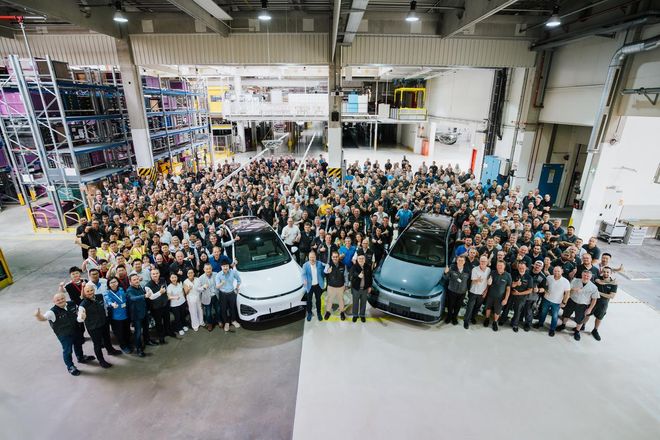
小鹏汽车开启海外本地化生产:首批新车在欧洲量产下线
Xin Lang Cai Jing· 2025-09-15 02:21
Core Insights - Xiaopeng Motors announced a deep collaboration with Magna's factory in Graz, Austria, to enhance local production of electric vehicles in Europe [1] - The first localized production project is set to launch in Q3 2025, with the initial models being Xiaopeng G6 and G9 [1] - Since entering the European market in 2021, Xiaopeng Motors has expanded its presence to over 46 countries and regions globally [1] - From January to July 2025, Xiaopeng Motors reported overseas sales of 18,701 units, marking a 217% year-on-year increase [1] Company Developments - The partnership with Magna aims to leverage existing production lines for efficient manufacturing [1] - The Graz facility will not only produce the G6 and G9 but is also expected to manufacture additional Xiaopeng models in the future [1] Market Expansion - Xiaopeng Motors began its European journey in Norway and has since achieved significant growth in international markets [1] - The substantial increase in overseas sales indicates a strong demand for Xiaopeng's electric vehicles in the European market [1]
曹力:零跑汽车预计明年上半年跻身辅助驾驶第一梯队
Xin Jing Bao· 2025-09-02 01:56
Core Insights - The company aims to enter the first tier of assisted driving by the first half of next year, leveraging self-developed core components and advanced technology [1] - The long-term goal is to become one of the top ten global automakers, targeting sales of 3 to 4 million vehicles, with a current gross margin of 14-15% deemed reasonable for sustainable growth [2] - The company emphasizes technological strength and product quality over price competition in response to domestic market price wars [3] Production and Localization - The company plans to achieve localized production of the B10 and subsequent new products in Europe by next year, utilizing partnerships to meet local tax requirements and enhance competitiveness [5] - Localized production will lead to slight cost increases due to higher European labor and manufacturing costs, but pricing will remain competitive by considering the local market dynamics [6] - Local production is seen as a necessary step as markets mature, requiring quicker responses to local demands, though not all markets will necessitate this approach [7] Research and Development - The company maintains a strong commitment to self-research and development, ensuring all core components are developed in-house to maintain competitive advantage [8] - There are plans to introduce a new D series model priced around 300,000 yuan, offering features comparable to higher-end models priced at 500,000 yuan [9]

电动载人汽车出海月报|7月出口量同比激增,出海迈入“生态输出”新阶段
Xin Lang Cai Jing· 2025-08-30 08:38
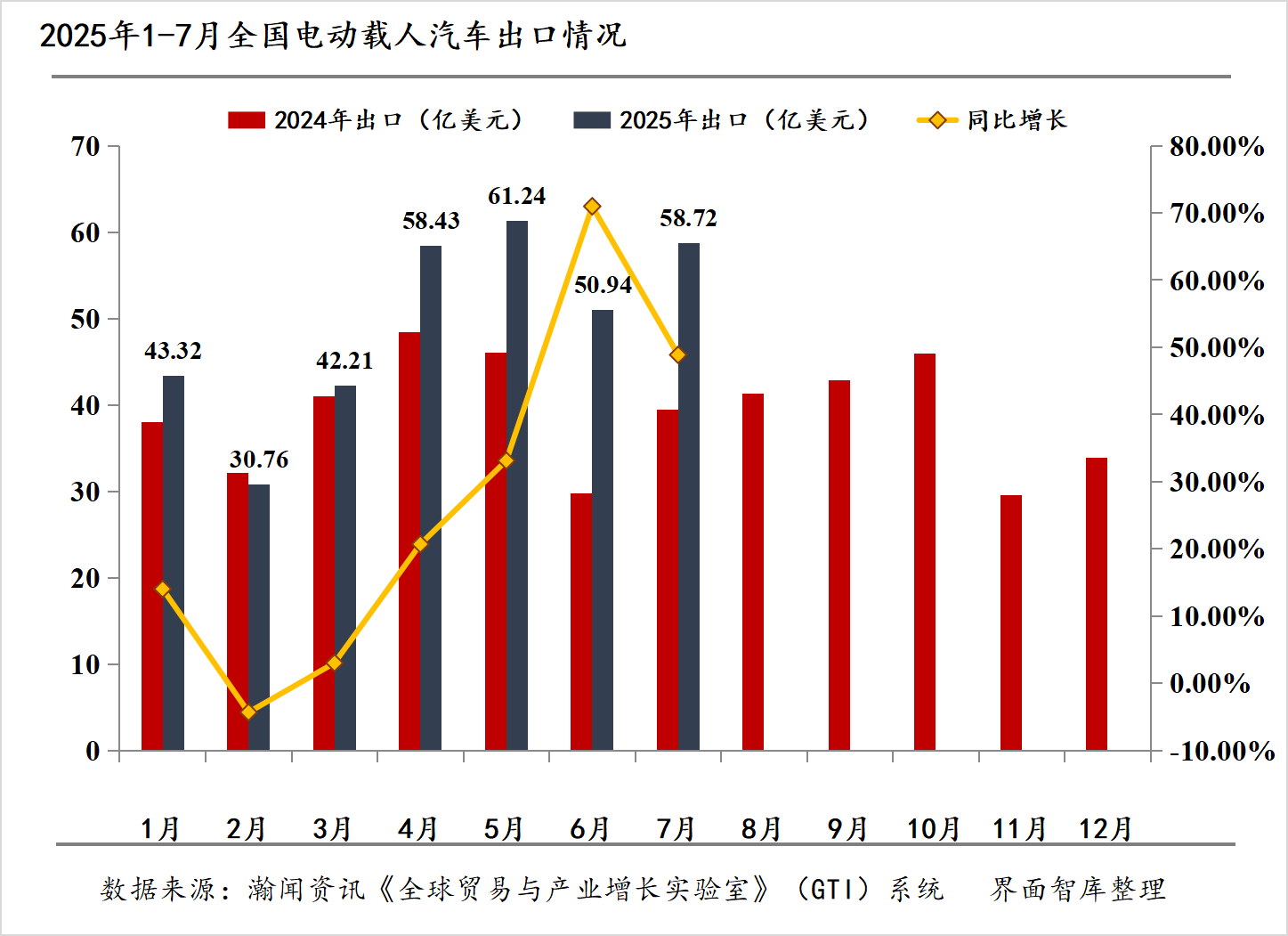
Core Insights - The article highlights the significant growth in China's electric passenger vehicle exports, with a notable increase in both export volume and value in July 2025, driven by advancements in battery technology and manufacturing processes [1][5][3] Export Performance - In the first seven months of 2025, China's total import and export value of electric passenger vehicles reached $36.583 billion, marking a 19% increase year-on-year [5] - Cumulative export value for the same period was $34.562 billion, reflecting a year-on-year growth of 25.79%, with export volume reaching 1.897 million units, up 48.58% [5] - July alone saw an export total of $5.872 billion, a 48.87% increase year-on-year and a 15.27% increase month-on-month, with a volume of 325,000 units, up 69.40% year-on-year [5][3] Price Trends - The average export price of electric passenger vehicles in July was $18,065.58, down 12.13% year-on-year, indicating a continuing downward trend in prices [5][7] - Specific price declines were noted in various vehicle types, with plug-in hybrid vehicles experiencing the largest drop [7] Market Segmentation - The passenger vehicle segment remains the core of electric vehicle exports, accounting for 99.58% of export volume and 95.52% of export value in July [7] - The bus segment showed a contrasting trend with a significant year-on-year increase in export volume (106.12%) but a month-on-month decline [9] Regional Export Dynamics - Shanghai regained its position as the top exporter of electric passenger vehicles, with a cumulative export value of $7.264 billion, despite a year-on-year decline [10][12] - Jiangsu and Shaanxi followed, with Jiangsu showing a remarkable year-on-year growth of 124.50% [10] Global Market Penetration - China's electric passenger vehicles are now exported to 166 countries and regions, with significant growth in emerging markets, particularly in Africa and South America [22][24] - The top export destinations included Belgium, the UK, and the UAE, with notable growth in exports to Argentina and Vietnam [17][19] Corporate Expansion - Chinese companies are actively expanding overseas, with BYD launching a passenger car factory in Brazil and Changan planning a factory in Europe [23][24] - The establishment of new logistics channels, such as the shipping route from Ningbo to Egypt, enhances export capabilities [23]

苹果iPhone17首次在印度全系列生产!
国芯网· 2025-08-22 14:35
Group 1 - Apple's iPhone 17 has entered mass production, with local manufacturing in India for the first time, including all four models [2] - Apple has expanded iPhone production in India across five factories, with two newly built, aiming to reduce reliance on Chinese production for the US market [4] - In the four months starting from April, India exported iPhones worth $7.5 billion, with expectations of growth from the previous fiscal year's $17 billion [4] Group 2 - Due to increased tariffs from the US, Apple has expanded its export scale from India, achieving a year-on-year growth of 53%, with exports surpassing 20 million units for the first half of 2025 [4] - Counterpoint Research attributes the expansion of Apple's export-oriented manufacturing to improved manufacturing capabilities, expanded capacity, and policy support in India [4]


美国不买中国货?这四国赚翻了!
吴晓波频道· 2025-08-20 00:29
Core Viewpoint - The article highlights a significant decline in China's exports to the United States, with a year-on-year decrease of 10.9%, leading to China dropping from the largest exporter to the third largest exporter to the U.S. [1] Export Trends - In January, the U.S. imported $43.85 billion worth of goods from China, which plummeted to $21.79 billion by May, a reduction of over $22.1 billion [1] - The decrease in imports from China does not indicate a reduction in U.S. demand; instead, the U.S. has increased imports from other countries, including Taiwan, Mexico, Vietnam, India, and Thailand [2] Top Exporting Countries to the U.S. - The top ten countries and regions that increased their exports to the U.S. by May include Taiwan, Mexico, Vietnam, India, Thailand, South Korea, the Netherlands, Belgium, Denmark, and Brazil [2] - Notably, Mexico and Vietnam have emerged as significant players, with Mexico's exports to the U.S. rising from $42.01 billion in January to $46.70 billion in May, an increase of $4.69 billion [3] Product Overlap - The top three exports from Mexico to the U.S. in May were computers, automobiles, and parts, while China's top exports to Mexico included automobiles and communication equipment, indicating a strategic overlap in product categories [4] - Similarly, Vietnam's top exports to the U.S. included computers and communication equipment, which align with China's exports to Vietnam, such as integrated circuits and flat panel displays [5][6] India's Export Dynamics - India's exports to the U.S. in May featured a diverse range of products, with communication equipment being the top category, mirroring China's leading export to India [7] Thailand's Export Profile - Thailand's exports to the U.S. also showed significant overlap with China's exports to Thailand, particularly in communication equipment and vehicle parts [8] Strategic Responses - In response to the changing trade dynamics, companies are likely to localize production and manage supply chains more effectively, with a focus on countries that are increasing their exports to the U.S. [9]

美股盘前要点 | 特朗普政府考虑入股英特尔!传英伟达为中国研发新AI芯片
Ge Long Hui A P P· 2025-08-19 12:40
Group 1 - US stock index futures showed mixed performance with Nasdaq futures down 0.11%, S&P 500 futures down 0.04%, and Dow futures up 0.13% [1] - European stock indices collectively rose, with Germany's DAX up 0.34%, UK's FTSE 100 up 0.35%, France's CAC up 0.95%, and the Euro Stoxx 50 up 0.75% [1] - Standard & Poor's Global Ratings confirmed the US sovereign credit rating at "AA+/A-1+" with a stable outlook [1] Group 2 - UBS raised its gold price target for March 2026 by $100 to $3,600 per ounce [1] - Reports indicate Nvidia is developing a new AI chip based on its latest Blackwell architecture for China, outperforming H20 [1] - The Trump administration is considering acquiring a 10% stake in Intel, potentially making it the largest shareholder; SoftBank agreed to invest $2 billion in Intel [1] Group 3 - Tesla launched a new six-seat electric SUV Model Y L in China, starting at 339,000 yuan, with expected delivery in September 2025 [1] - Gurman reported that India has achieved local production of the entire iPhone 17 series, including the Pro model [1] - Starbucks announced a 2% salary increase for all salaried employees in North America this year [1] Group 4 - Arm hired Amazon's AI chip director Rami Sinno to advance its plan for developing complete chips independently [2] - JD.com has provided social insurance for 150,000 full-time delivery riders and called for other platforms to fulfill their obligations [3] - iQIYI has hired an investment bank to arrange its secondary listing in Hong Kong, planning to submit the application in Q3 [4] - New Oriental issued a statement denying that CEO Zhou Chenggang is under investigation for related party transactions [5] Group 5 - Home Depot reported Q2 net sales of $45.28 billion, adjusted EPS of $4.68, and same-store sales growth of 1% [6] - BHP's FY2025 underlying profit fell over 25% year-on-year to $10.16 billion, slightly below expectations; the board announced a dividend of $0.60 per share, exceeding expectations [6] - Palo Alto Networks reported Q4 revenue growth of 16% year-on-year to $2.54 billion, with adjusted EPS of $0.95, exceeding expectations; optimistic guidance for Q1 [6] - XPeng Motors reported Q2 total revenue growth of 125.3% year-on-year to 18.27 billion yuan, with net loss narrowing to 480 million yuan and a gross margin of 17.3% [6]
苹果:将与三星合作推出创新芯片制造技术
Guan Cha Zhe Wang· 2025-08-07 08:40
Group 1 - Apple announced a collaboration with Samsung to introduce a groundbreaking chip manufacturing technology at a factory in Austin, Texas, aimed at optimizing power consumption and performance for Apple products, including iPhones [1] - Apple plans to invest an additional $100 billion in the U.S., bringing its total investment commitment to $600 billion over the next four years [1] - The new "American Manufacturing Plan" will involve partnerships with ten U.S. companies to produce components for Apple products sold globally [1] Group 2 - Analysts suggest that Apple's choice of Samsung is driven by the need for localized production and supply chain diversification, as Apple has previously relied entirely on Sony for image sensors in iPhones [2] - Samsung holds a 15.4% share of the global image sensor market, while Sony dominates with over 50% [2] - Samsung's spokesperson indicated that details regarding specific customers or projects related to the deal could not be confirmed [3] Group 3 - Apple is accelerating its manufacturing efforts in the U.S. through the new "American Manufacturing Plan," with initial partners including Corning, Applied Materials, and Texas Instruments [3] - This initiative follows Apple's commitment to procure U.S.-made rare earth magnets from MP Materials [3]