ASI

Search documents
X @Raoul Pal
Raoul Pal· 2025-08-07 01:55
Who knows what ChatGPT 5 brings tomorrow but it will accelerate everything again, hot on the heels of Genie 3 and Grok.There is no end to this yet but an AI god creature is the where e are headed (ASI). We just don't how fast but it's going to be faster than anyone expects but requires new breakthroughs in compute, AI models and energy meanwhile AGI is essentially here.Humans as a species are no longer the apex intelligence, except in ultra rare exceptions.But humans with AGI are currently super creatures.U ...
全球独家首测Genie 3,实验室细节曝光超震撼,AGI最后一块拼图已实现
3 6 Ke· 2025-08-06 10:13
Core Insights - The launch of Genie 3 by Google DeepMind marks a significant advancement in AI and world modeling, potentially revolutionizing the gaming industry and paving the way towards Artificial General Intelligence (AGI) [1][13][42] Group 1: Technological Advancements - Genie 3 is capable of generating consistent videos at 720p resolution in real-time, simulating interactive environments for several minutes, a leap from its predecessor Genie 2 [3][29] - The model can create interactive worlds without pre-built 3D models, using only text descriptions to add objects and characters, showcasing a new level of AI capability [7][31] - Genie 3 features a memory function that maintains the consistency of objects in the generated world, even after a brief period of distraction [20][27] Group 2: Industry Impact - The technology is expected to disrupt the gaming industry significantly, with potential applications in training AI agents in simulated environments rather than real-world scenarios, which can be slow and dangerous [13][38] - Genie 3 is seen as a potential catalyst for a new trillion-dollar industry, possibly leading to the emergence of "YouTube 2.0" or new forms of virtual reality [23][42] - The model's ability to simulate rare events could enhance training for autonomous vehicles and robotics, reducing costs associated with real-world training [29][38] Group 3: Limitations and Future Directions - Despite its advancements, Genie 3 currently lacks creativity, which is a fundamental difference between the real and virtual worlds [40] - The model faces challenges in social interactions and multi-agent scenarios, indicating areas for future improvement [17][40] - Researchers believe that an open-loop system could be developed in the future to enhance the model's capabilities [41]



美国AI投资新高潮,是最后引领工业革命的机会吗
Hu Xiu· 2025-08-03 01:46
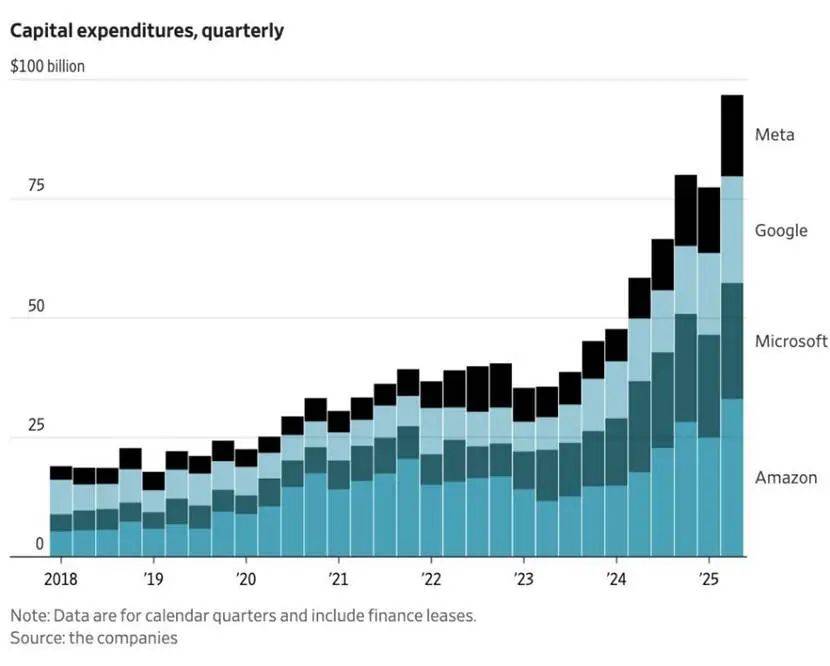
Group 1: AI Investment Surge - The AI investment surge in the U.S. is marked by significant capital expenditures from major tech companies, with each approaching annual spending of hundreds of billions [5][9][12] - Microsoft has set a capital expenditure guidance of $30 billion for the next quarter, aiming for over $120 billion for the fiscal year 2026, while Meta has increased its capital spending forecast by $30 billion [5][9] - The overall capital expenditure related to AI is projected to contribute approximately 0.7 percentage points to U.S. GDP growth by 2025 [9] Group 2: Infrastructure and Economic Impact - The massive investments in AI infrastructure are crucial for transitioning from technological breakthroughs to application revolutions, with a focus on data centers and cloud services [10][14] - The competition among cloud service providers is intensifying, with Microsoft leading in AI infrastructure development, while Amazon's AWS is experiencing slower growth [10][11] - The expansion of data centers is expected to stimulate demand in the construction and manufacturing sectors, contributing to economic growth [14][19] Group 3: Token Economy and AI Applications - The emergence of a token economy is linked to the increasing demand for computational power, with token production expected to significantly impact the software products and services industry [20][23] - OpenAI's revenue has reportedly doubled to approximately $1 billion per month, indicating a rapid shift in value from infrastructure to AI applications [24][27] - The market for tokens is experiencing exponential growth, with Google's token processing volume increasing dramatically within a month [23] Group 4: Addressing Baumol's Disease - The ongoing value transfer in the digital realm is seen as a potential solution to the structural economic issue known as "Baumol's Disease," which affects productivity growth in certain sectors [28][29] - AI is anticipated to drive productivity revolutions in traditionally low-growth sectors such as education and healthcare, potentially alleviating cost pressures [31][32] Group 5: Last Industrial Revolution - The current wave of AI investment is described as the largest infrastructure investment in the U.S. since the 19th century, surpassing the internet bubble era [40] - This investment is viewed as a pathway to the last industrial revolution, with ongoing demands for computational power and energy [41] - The integration of AI technology with industry and economy is expected to reshape labor productivity and economic structures, with implications for various job sectors [41][42]




Future-Proof: Rethinking Careers in the Age of AI | Ahmad Tabbal | TEDxISL Qatar Youth
TEDx Talks· 2025-07-01 15:32
AI Impact on Future Jobs - AI is projected to displace 300 million jobs globally, representing approximately one-third of the population in some countries [1] - Careers resistant to AI, such as those requiring strong communication skills, are expected to see a 33% increase in earnings [1] - By 2027, Artificial General Intelligence (AGI), equivalent to 100,000 people working together, is expected to be released, followed by Artificial Super Intelligence (ASI) by 2029 or 2030, equivalent to 1 million people [2] - Goldman Sachs estimates that 47% of the job market will be gone by the time current students graduate [4] - Approximately 25% of university and college graduates are currently unemployed, and this number is increasing [12] Adapting to the Age of AI - Individuals need to embrace AI collaboration and learn how to effectively use AI tools [2] - Developing a growth mindset and adaptability is crucial for leveraging AI to one's advantage [5][7] - Cross-pollinating skills, especially communication, is key to remaining relevant in the job market [9] - Focus on humanities, as AI lacks human qualities and cannot think like a human [10][11] Industry Examples - One company is now 40% run by AI in the tax and filing industry [1] - Some corporations are replacing 2 to 6 people every month with AI [1] - The trucking industry, which is essential for delivering goods, is at risk of being replaced by self-driving technology like Tesla and Wimo [2]

AI突飞猛进时代的赛博存在主义迷思|荐书
Di Yi Cai Jing· 2025-06-20 09:15
Group 1 - The book "Future of Humanity: Purpose and Meaning in the Age of Superintelligence" by Nick Bostrom explores the duality of AI advancements, presenting both utopian and dystopian perspectives on the impact of AI on humanity [2][3][4] - Bostrom, a prominent transhumanist, argues that the fate of humanity may depend on the actions of superintelligent machines, suggesting a complex relationship between humans and AI [3] - The author envisions a future where human labor becomes obsolete, leading to existential questions about purpose and meaning in a world dominated by AI, potentially resulting in a sense of purposelessness despite increased freedom [3] Group 2 - The book "Nations and Their Ruins: Ancient Greece, Archaeology, and National Imagination" by Yannis Hamilakis examines the relationship between ancient artifacts and modern Greek identity, highlighting how material heritage influences contemporary experiences and cultural narratives [6][8] - Hamilakis analyzes the operations of Greek archaeological institutions and the legal frameworks surrounding ancient artifacts, revealing significant shifts in attitudes towards heritage since Greece's independence [8] - The work emphasizes the role of archaeology in reshaping national narratives and identities, illustrating its profound and subtle impact on understanding and responding to modern global capitalism [8]

千问3的屠榜,是AI的一小步,也是阿里的一大步
Sou Hu Cai Jing· 2025-05-05 06:31
Core Insights - The release of Qwen3 has solidified Alibaba's position as a leading AI company, ending discussions about its commitment to AI investment [2] - Alibaba's aggressive investment strategy in AI and cloud infrastructure, with a planned expenditure of over 380 billion RMB in the next three years, surpasses its total investment in the past decade [5][6] - The contrasting perspectives of Alibaba's CEO and chairman reflect a balance between ambitious AI development and caution regarding excessive investment in data centers by Western tech giants [6][7] Investment Strategy - Alibaba's planned investment of over 380 billion RMB is equivalent to its cumulative profits over the last three years, indicating a significant commitment to AI development [5][6] - The investment is expected to stimulate demand for AI applications, as lower barriers to entry will encourage more businesses to adopt AI technologies [6] Technological Advancements - Qwen3, Alibaba's flagship model, demonstrates significant cost efficiency, requiring only four H20 units for deployment compared to sixteen for its competitor DeepSeek-R1 [7] - The model's ability to adapt its computational needs based on user interaction represents a critical advancement for enterprises seeking to optimize AI usage [9] Market Position - Alibaba's proactive approach in the AI sector, including early investments in open-source models and cloud technology, positions it favorably against both domestic and international competitors [11][12] - The company's AI models have been integrated into its products, enhancing their functionality and establishing a strong market presence [12] Industry Context - A report indicates that 78% of Chinese respondents are optimistic about AI development, contrasting sharply with only 35% in the U.S., highlighting differing attitudes towards AI in these markets [10] - The demand for automation in China, evidenced by the installation of over 290,000 industrial robots in 2022, underscores the country's readiness for AI applications [11] Future Outlook - The transition from model training to agent-centric development signifies a shift in the AI landscape, with Alibaba poised to leverage its cloud and AI capabilities for future growth [14] - The ongoing competition in the AI sector emphasizes the need for continuous innovation and the ability to convert technological advantages into commercial success [14]