Autonomous Driving

Search documents
Why I'm Excited (and Cautious) for Tesla Stock in 2026
The Motley Fool· 2026-02-07 09:25
Core Viewpoint - Investors are focusing on Tesla's autonomous future, particularly its robotaxi expansion, despite current weak automotive revenue [1][3] Group 1: Robotaxi Expansion - Tesla is preparing to scale its robotaxi fleet in multiple cities this year, which could lead to a rise in stock prices [1][4] - The Cybercab, designed without a steering wheel or pedals, is set to enter production this year, indicating rapid scaling of the robotaxi service [4] - Tesla plans to launch its robotaxi service in seven new cities in the first half of 2026, including Las Vegas and Miami [7] Group 2: Data and Demand - Tesla car owners are generating the equivalent of 500 years' worth of driving data daily, enhancing the full-self-driving (FSD) system [3] - The number of Tesla owners using FSD increased by 38% year over year in Q4, surpassing 1.1 million users [3] Group 3: Regulatory Hurdles - The U.S. National Highway Traffic Safety Administration (NHTSA) currently limits annual sales of vehicles without steering wheels to 2,500 units, which could hinder Tesla's Cybercab production plans [5] - The NHTSA is considering modernizing these rules due to advancements in driverless technology, but until the cap is lifted, it may delay expansion [5] Group 4: Financial Outlook - Analysts project Tesla's earnings to grow at a 35% annualized rate over the next few years as higher margins from robotaxis begin to materialize [8]



Tesla's Latest Update Changes Everything
The Motley Fool· 2026-02-07 09:05
Core Viewpoint - The company's $20 billion investment in 2026 signifies a shift in the investment narrative, moving away from traditional car company valuations to a broader vision of transportation as a service [1][2]. Investment Strategy - Tesla is committing $20 billion to build six new factories, which supports CEO Elon Musk's vision for the future of electric vehicles (EVs) and transportation [3][4]. - The investment includes a lithium refinery and a lithium iron phosphate (LFP) battery factory, aimed at producing cost-effective batteries for future models like the Cybercab [4]. Market Position and Valuation - Tesla's current market cap stands at $1.4 trillion, with a trading valuation exceeding 200 times Wall Street's earnings estimates for 2026 [4]. - The company is transitioning from being viewed solely as a car manufacturer to being perceived as a transportation-as-a-service provider, with a focus on autonomous driving [4]. Risks and Challenges - The company faces significant cash burn due to the $20 billion investment, with estimates suggesting a $6.2 billion cash outflow for 2026 [7]. - Regulatory approvals for unsupervised robotaxis and the Cybercab are still pending, which adds uncertainty to Tesla's future plans [6][10]. Future Outlook - Tesla's CFO stated that the company has $44 billion in cash and investments to support its spending, but there are risks associated with premature investments in projects like Cybercab and Optimus [8]. - The stock may appeal to investors who believe in Musk's vision for the future of transportation, despite the high-risk nature of the investment [11].
半导体销售额,1万亿美元
半导体行业观察· 2026-02-07 03:31
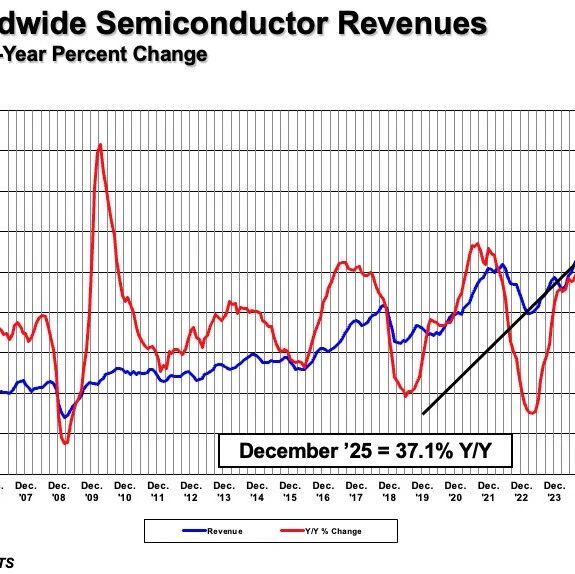
Core Viewpoint - The global semiconductor sales are projected to reach a record high of $791.7 billion in 2025, representing a 25.6% increase from $630.5 billion in 2024, driven by strong demand from emerging technologies like AI, IoT, and 6G [2][5]. Group 1: Sales Projections - In 2025, the semiconductor sales are expected to be $791.7 billion, with Q4 sales reaching $236.6 billion, a 37.1% increase from Q4 2024 and a 13.6% increase from Q3 2025 [2]. - The monthly sales data indicates that December 2025 sales will be $78.9 billion, a 2.7% increase from November 2025 [2]. Group 2: Regional Performance - Sales growth is observed across various regions: Asia-Pacific and others (45.0%), Americas (30.5%), China (17.3%), and Europe (6.3%), while Japan's sales decreased by 4.7% [5]. - In December, sales increased in the Americas (3.9%), China (3.8%), and Asia-Pacific (2.5%), but decreased in Europe (-2.2%) and Japan (-2.5%) [5]. Group 3: Product Segmentation - Logic products are projected to see a sales increase of 39.9%, reaching $301.9 billion, making it the largest product category by sales in 2025 [6]. - Memory products are expected to grow by 34.8% in 2024, reaching $223.1 billion, ranking second in sales [6].
One Analyst Thinks Tesla's Robotaxi Revenue Could Soar to $250 Billion by 2035, But Here Are 2 Things Investors Need to Know
Yahoo Finance· 2026-02-05 18:39
Core Viewpoint - Tesla is viewed as a battleground stock, but optimism is growing regarding its robotaxi fleet, with 2026 being highlighted as a potentially significant year for the company [1]. Group 1: Robotaxi Revenue Projections - Wolfe Research analyst Emmanuel Rosner projects robotaxi revenue could reach $250 billion by 2035, assuming 30% penetration of autonomous vehicles and Tesla capturing 50% market share [2]. - This revenue projection supports an estimated equity value of $2.75 trillion, which translates to approximately $900 billion when discounted to present value, equating to $250 per share for the robotaxi unit [2]. Group 2: Near-Term Challenges - Rosner anticipates high costs associated with building the robotaxi fleet and Optimus humanoid robots, which may negatively impact Tesla's earnings in the short term [3]. - The company is expected to incur losses of $500 million from the robotaxi business as it scales its fleet from around 250 vehicles to 7,200 [4]. Group 3: Market Position and Valuation - Tesla currently holds a market capitalization of $1.25 trillion, despite challenges in its core electric vehicle business and the expiration of U.S. incentives like the $7,500 federal tax credit [5]. - The stock trades at approximately 192 times forward earnings, indicating that the market has already priced in a level of success from the robotaxi initiative and potentially from Optimus [6]. Group 4: Competitive Landscape and Risks - Tesla's stock is assigned a premium due to CEO Elon Musk's strong following and the anticipated growth of the autonomous driving sector, with the company benefiting from a first-mover advantage [6]. - Potential risks include competition, challenges in scaling the robotaxi fleet, achieving fully unsupervised self-driving, and regulatory hurdles [7].
Starbucks Is Back, but Is It a Buy?
The Motley Fool· 2026-02-05 02:07
分组1: Starbucks Performance - Starbucks reported a mixed performance for the quarter, with global and US comparable store sales increasing by 4% year over year, driven by a 3% increase in traffic [2][3] - Net revenue rose approximately 6% year over year, with same store sales in China growing by 7%, indicating a turnaround in a previously struggling market [2] - The company is prioritizing long-term growth over immediate profit, investing in wages and technology, and transitioning to a licensing model in China to reduce direct stakes [2][4] 分组2: Market Sentiment and Valuation - Despite some positive indicators, there is skepticism about the sustainability of growth, with concerns that a 3% revenue growth may not justify high valuation multiples, which are around 60 on a trailing basis and 36 on a forward basis [7][11] - Analysts express caution regarding the stock's attractiveness, noting that while operational improvements are evident, the price may not be compelling for investors seeking high growth [11][10] - The market reacted positively to the earnings report, with stocks up about 4% early in trading, reflecting some investor optimism [12] 分组3: General Motors Performance - General Motors reported a net income of approximately $2.7 billion for the fiscal year, down from $6 billion the previous year, largely due to a net loss in Q4 driven by special charges related to EV capacity realignment [15][17] - Revenue for the fiscal year was about $185 billion, with growth primarily from internal combustion engine vehicles, particularly large trucks and SUVs, rather than electric vehicles [17] - GM is maintaining a strong position in the US AV market and is focusing on cost efficiencies while navigating fluctuating demand [17] 分组4: Autonomy and Buybacks - GM announced plans for Level 3 autonomy in their Cadillac Escalade by 2028, integrating advanced technology for improved safety and performance [22][19] - The company initiated a new $6 billion stock buyback program, following a $10 billion accelerated share repurchase, which has reduced the number of outstanding shares and boosted earnings per share [23][21] - Analysts note that while buybacks and dividends are positive for shareholders, the overall growth profile may not be compelling enough for new investments [24][23] 分组5: Silver and Market Dynamics - The recent interest in silver is attributed to a weak dollar, with central banks and institutional investors diversifying away from dollar-dominated assets, making precious metals cheaper for foreign investors [29][27] - There is a notable influx of retail investors in silver, leading to speculative behavior reminiscent of meme stocks, which raises concerns about potential corrections [29][30] - The dynamics of the global forex market and geopolitical factors are influencing the demand for silver, with a focus on the long-term implications of a weaker dollar [28][27]



Qualcomm(QCOM) - 2026 Q1 - Earnings Call Transcript
2026-02-04 22:47
Financial Data and Key Metrics Changes - The company reported record revenues of $12.3 billion and non-GAAP earnings per share (EPS) of $3.50 for fiscal Q1 2026, with non-GAAP EPS at the high end of guidance [6][16] - QCT revenues reached a record $10.6 billion, driven by strong performance in automotive and IoT segments [6][16] - Licensing business revenues were $1.6 billion, with an EBT margin of 77%, reflecting higher units and favorable mix [16] Business Line Data and Key Metrics Changes - QCT handset revenues reached a record $7.8 billion, benefiting from recently launched flagship smartphones [16] - QCT IoT revenues grew 9% year-over-year to $1.7 billion, driven by demand across consumer and networking products [16] - QCT Automotive revenues grew to $1.1 billion, up 15% year-over-year, driven by increased demand for Snapdragon Digital Chassis platforms [17] Market Data and Key Metrics Changes - Global consumer demand for handsets, particularly in the premium and high-tier segments, exceeded expectations, with healthy sell-through observed [6][7] - The handset industry is expected to face constraints due to memory availability and pricing, particularly DRAM, as suppliers redirect capacity to meet AI data center demand [7][18] - The company anticipates that the overall size of the handset market will be defined by memory availability throughout the fiscal year [39][69] Company Strategy and Development Direction - The company is focused on expanding its presence in the premium and high-tier smartphone segments, with a dual flagship product strategy that has been well received [8][42] - The company is investing in AI-native smartphones and intelligent wearables, positioning Snapdragon platforms as the choice for the industry [8][12] - The company aims to strengthen its leadership in automotive and robotics, with multiple design wins and collaborations with major automakers [10][22] Management's Comments on Operating Environment and Future Outlook - Management expressed confidence in the fundamentals of the handset business despite near-term challenges related to memory supply [18][39] - The company expects to return to prior growth trajectories for QCT handset revenues once memory supply conditions normalize [18] - Management remains optimistic about the long-term growth potential in automotive and IoT, with combined growth expected to outpace long-term revenue targets [21][22] Other Important Information - The company returned $3.6 billion to stockholders, including $2.6 billion in stock repurchases and $949 million in dividends [17] - The company completed the acquisition of Alphawave Semi, enhancing its data center solutions [14] Q&A Session Summary Question: What factors are driving the weakness in handset outlook beyond memory pricing? - Management indicated that the weakness is entirely related to memory availability, with strong microeconomic indicators and handset demand observed [26][27] Question: Is the automotive revenue growth driven by ADAS wins? - Management confirmed that the automotive pipeline continues to translate into revenue, with new car launches contributing to record revenues [30] Question: How is the company progressing with data center customers? - Management reported positive progress with customers, including shipping to Humane and engagement with major hyperscalers [34] Question: What is the company's strategy regarding memory shortages? - Management clarified that they do not purchase memory directly but work with customers who do, ensuring flexibility in memory sourcing [67][69] Question: How does the company plan to navigate the memory allocation challenges with larger OEMs? - Management acknowledged that larger OEMs may have better access to memory but emphasized that the issue is industry-wide and not limited to specific customers [73]

Alphabet earnings and analysis, why one strategist is underweight the Mag 7
Youtube· 2026-02-04 22:46
Market Overview - The stock market closed mixed, with the Dow up 0.5% (259 points), while the NASDAQ fell 1.5% [1][2] - The S&P 500 was down about 0.5%, but the equal-weighted S&P 500 index closed up nearly 1% at a record high [2][3] - Small-cap indices showed varied performance, with the Russell 2000 down 0.7% and the S&P 600 up 0.9% [3] Sector Performance - The Dow Jones transports surged over 2% for three consecutive days, totaling an 8% increase, a trend not seen since May 2025 [4] - The materials sector led gains, with gold and silver trades up over 2%, followed by energy, which also rose by 2% [5] - The technology sector was the biggest loser, down 2.82%, with significant declines in major tech stocks like AMD (down 17%) and Palantir (down 11%) [5][6] Alphabet's Q4 Earnings - Alphabet reported Q4 operating income of $35.93 billion, slightly below the expected $36.95 billion, with total revenue of $113.83 billion, exceeding the estimate of $111.4 billion [9][10] - Google Cloud revenue was reported at $17.66 billion, surpassing the estimate of $16.2 billion, indicating strong performance in that segment [10][24] - The company projected 2026 capital expenditures between $175 billion and $185 billion, significantly higher than the consensus estimate of $120 billion, leading to a drop in stock price by about 6% in after-hours trading [11][12] Qualcomm's Q1 Results - Qualcomm reported Q1 EPS of $3.50, exceeding estimates of $3.41, with revenue of $12.3 billion, also better than the expected $12.2 billion [34][35] - The outlook for Q2 revenue is projected between $10.2 billion and $11 billion, below the previous estimate of $11.18 billion, due to headwinds from memory shortages in the smartphone market [36][40] - Qualcomm is diversifying its business beyond smartphones, focusing on markets like PC chips and robotics [37][38] Investment Strategies - A neutral stance on equities is maintained, with an underweight position in U.S. stocks compared to international markets, driven by attractive valuations overseas [43][45] - The current market environment shows targeted selling primarily in technology, with a focus on quality investments outside the tech sector [47][48] - Concerns about future earnings growth and valuation in the tech sector, particularly among the Magnificent Seven, are leading to a cautious investment approach [53][56]

Alphabet Q4 earnings: What investors need to know
Youtube· 2026-02-04 21:55
Core Insights - Alphabet's Q4 earnings report showed operating income of $35.93 billion, slightly below the expected $36.95 billion, while revenue reached $113.83 billion, exceeding the estimate of $111.4 billion [1][3] - Google Cloud revenue was reported at $17.66 billion, surpassing the estimate of $16.2 billion, indicating strong performance in this segment [2][15] - The company projected capital expenditures (capex) for 2026 between $175 billion and $185 billion, significantly higher than the street consensus of around $120 billion, which has raised concerns among investors [2][4] Financial Performance - Q4 operating income was $35.93 billion, while revenue was $113.83 billion, both key metrics indicating overall strong performance despite some misses on expectations [1][3] - Google Cloud's revenue of $17.66 billion exceeded expectations, showcasing growth potential in this area [2][15] - The capex forecast for 2026 is notably higher than market expectations, which may impact investor sentiment [2][4] Market Reaction - Following the earnings report, Alphabet's stock experienced a decline of approximately 6% in after-hours trading, attributed to high expectations and the capex forecast [3][5] - The stock had previously risen about 80% over the past six months, indicating a significant shift in investor sentiment towards the company [3][12] - Analysts noted that the results were strong overall, but the focus on capex numbers and operating income may have contributed to the stock's volatility [8][9] Strategic Insights - The company is seen as well-positioned in the AI space, with ongoing investments in AI technologies and infrastructure, which are expected to drive future growth [4][10] - Analysts believe that Google is capitalizing on opportunities in generative AI, which could enhance its competitive position against rivals like Amazon and Microsoft [13][19] - The combination of Google Cloud, YouTube, and search capabilities is viewed as a broadening of growth drivers, providing durability to the overall business [17][21] Future Outlook - The Google Cloud opportunity is anticipated to grow significantly, with expectations of reaching a $100 billion revenue business over time [16] - Analysts express confidence in Alphabet's ability to generate strong free cash flow and compound growth rates in the coming years [20][22] - The company's investments in AI and infrastructure are expected to yield long-term benefits, positioning it favorably in the tech landscape [14][22]

With 200 Million Monthly Users, Uber Readies for Autonomous Rides
PYMNTS.com· 2026-02-04 16:07
Core Insights - The company's economics are improving, driven by mobility profits, a stable delivery business, and enhanced margins from Uber One and advertising [1][6][12] Mobility Platform - The mobility landscape is evolving, with the company acknowledging that autonomous vehicle (AV) adoption will be slow and uneven, but believes it can scale AVs without negatively impacting human-driven demand [1][4] - Uber's early deployments of AVs in Austin and Atlanta suggest that these vehicles can increase overall demand rather than cannibalizing human-driven trips [5] Financial Performance - For the fourth quarter, the company reported a 20% year-over-year revenue increase to $14.4 billion, with gross bookings rising 22% to $54.1 billion, marking the fastest growth in nearly three years [8] - Monthly active users surpassed 200 million for the first time, with trips reaching 3.8 billion in the quarter, indicating strong user engagement and growth [8][9] Delivery Business - The delivery segment has transformed significantly, now operating at a $100 billion annual bookings run rate, with fourth-quarter bookings increasing by 26% year over year [11] - Growth in delivery is attributed to various sectors, including restaurant delivery, grocery, and retail [11] Membership and Advertising - Uber One, the membership program, grew by 55% year over year to over 46 million members, contributing to more than a third of mobility bookings in the U.S. [11] - Advertising has emerged as a high-quality business for Uber, leveraging real-time marketing opportunities with minimal incremental costs [12] Leadership and Future Outlook - The company announced a leadership change in its finance team, with Balaji Krishnamurthy succeeding Prashanth Mahendra-Rajah as CFO [6] - The incoming CFO emphasized strong momentum and large free cash flows, indicating a disciplined investment approach for future growth, particularly in AV opportunities [7]


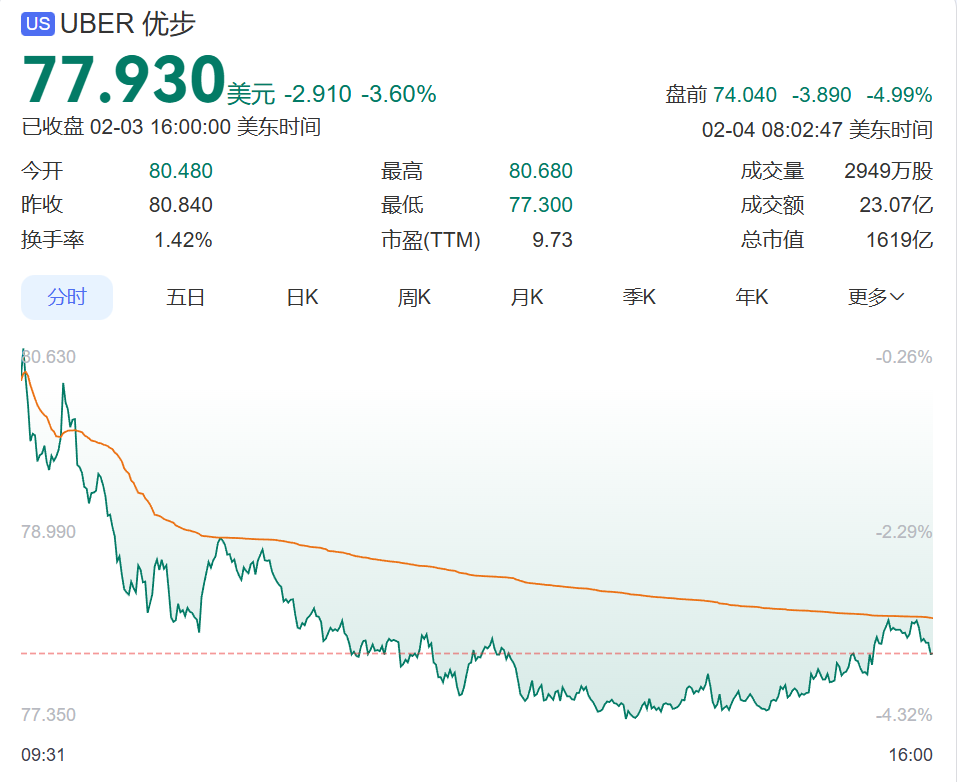
Uber盘前一度大跌10%!Q4预订量大增难抵利润忧虑,新任CFO释放“发力 Robotaxi”信号 | 财报见闻
Hua Er Jie Jian Wen· 2026-02-04 13:18
Core Insights - Uber's Q4 earnings report shows strong growth in total bookings but raises concerns due to weak profit guidance and a significant drop in net income [1][2] Financial Performance - In Q4, Uber reported a net income of $296 million, a drastic decline of 96% year-over-year [1] - The company expects adjusted earnings per share for the current quarter to be between $0.65 and $0.72, below the analyst consensus of $0.77 [1] - Total bookings for Q4 reached $54.1 billion, a 22% year-over-year increase, surpassing analyst expectations [3] Strategic Developments - Uber appointed Balaji Krishnamurthy as the new CFO, a proponent of autonomous driving technology, signaling a strategic focus on the Robotaxi business [1][4] - The company plans to expand its Robotaxi services to new markets, including Houston, Hong Kong, Madrid, and Zurich, with a goal of launching in over 10 markets globally in the coming years [6] Market Positioning - CEO Dara Khosrowshahi highlighted a healthier pricing environment due to lower insurance costs and new product launches, which could support revenue growth and margin expansion [2] - Uber's core business remains robust, with strong performance in its delivery segment during the holiday season, capturing market share from competitors [3] Competitive Landscape - Uber refuted claims that autonomous driving technology would negatively impact its business, asserting that Robotaxi services could stimulate overall growth in the ride-hailing industry [6] - The company emphasized the advantages of human drivers in situations where autonomous vehicles may face challenges, ensuring customer experience during disruptions [6]