
大数据

Search documents
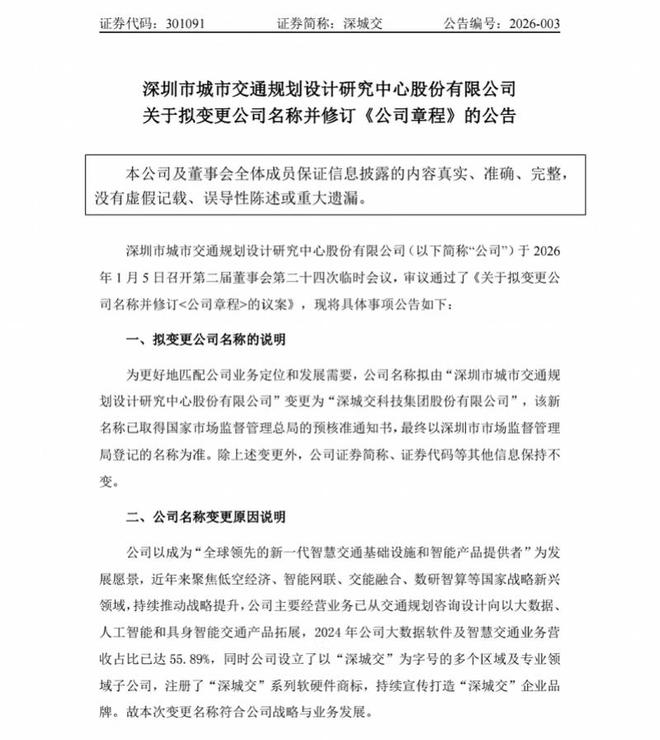
深城交拟更名"科技集团" ,凸显科技属性,适配战略转型
Nan Fang Du Shi Bao· 2026-01-15 11:37
Core Viewpoint - Shenzhen State-owned Assets' listed company Shen Cheng Jiao (301091.SZ) is changing its name to better align with its business positioning and development needs, reflecting a significant transformation in its operations towards technology-driven solutions in urban transportation [1][5]. Group 1: Name Change and Business Transformation - The company plans to change its name from "Shenzhen Urban Transportation Planning and Design Research Center Co., Ltd." to "Shen Cheng Jiao Technology Group Co., Ltd." with pre-approval from the National Market Supervision Administration [1]. - Shen Cheng Jiao has shifted from traditional transportation planning and consulting to a focus on big data, artificial intelligence, and embodied intelligence in transportation technology products [5]. - In 2024, revenue from big data software and smart transportation business accounted for 55.89% of total revenue, indicating that technology-related business has become the core revenue source [5]. Group 2: Financial Performance and Contract Growth - The company signed new contracts worth 2.58 billion yuan in 2024, representing a year-on-year growth of 49% [5]. - New business areas such as low-altitude economy and intelligent connected vehicles accounted for over 67% of new contracts, with a year-on-year increase of 138%, becoming the main driver of performance growth [5]. Group 3: Brand Development and Stability - The company has established a comprehensive brand system, creating multiple subsidiaries under the "Shen Cheng Jiao" name and registering related trademarks, laying a solid foundation for the name change [6]. - The name change will not affect the company's main business, legal entity status, governance structure, or operational stability, and existing contracts will continue to be honored as per agreements [6].


深圳“技客”故事|黄佳杰:从“00后”专科生到云计算“世界冠军”
Sou Hu Cai Jing· 2026-01-15 11:16
Core Viewpoint - Huang Jiajie, a representative from Shenzhen City Vocational College, won the gold medal in the cloud computing category at the 47th World Skills Competition, marking a significant achievement for the Chinese team in this event [1][4]. Group 1: Competition Overview - The cloud computing project at the World Skills Competition is unique as it provides real-time scoring, adding pressure to competitors [4]. - Huang faced high-level competition from engineers at major companies like Samsung and Google, as well as students from prestigious universities [4]. - Despite challenges, including unexpected changes in the competition format, Huang demonstrated strong adaptability and strategic planning, leading to his success [4][6]. Group 2: Training and Preparation - Huang trained for over five years, dedicating more than 11 hours daily to practice, focusing on various aspects of cloud computing [9]. - His training included participation in multiple competitions, which helped him build the necessary skills to compete at the national level [9][10]. - The collaboration between his school and leading tech companies provided him with a solid foundation in cloud computing, including obtaining top-level certifications [10]. Group 3: Personal Growth and Future Aspirations - After winning the championship, Huang chose to return to his alma mater as a teacher, aiming to pass on his knowledge and experience to future generations [13][14]. - He emphasizes the importance of continuous learning in the rapidly evolving field of cloud computing and encourages young people to stay updated with new technologies [15]. - Huang's commitment to education is reflected in his students' success, as they achieved gold in a provincial competition, showcasing the impact of his mentorship [14].

2026年手卓云AI拓客驱动TOB业务企业数字化转型
Jin Tou Wang· 2026-01-15 10:27
Core Insights - The article highlights the rapid growth of the digital economy, emphasizing the role of artificial intelligence and big data as key drivers for enterprise transformation [1] - Anhui Shouzhong Information Technology Co., Ltd. has emerged as a significant player in the digital service sector, providing efficient customer acquisition and conversion solutions for numerous B2B enterprises [1] Company Overview - Established on June 28, 2022, in Hefei, Anhui, the company is a technology-focused SME with a registered capital of 5 million yuan [1] - The company has a vibrant and ambitious professional team, primarily composed of young individuals, and has been steadily developing for three years [1] - Plans to expand with the establishment of a branch in Wuhan in 2024 [1] Core Business and Technology - The company's core business focuses on enterprise information data mining and AI algorithm recommendations, collaborating deeply with iFlytek in the intelligent voice industry [2] - The "Shouzhong Cloud AI Customer Acquisition System" is a key product that provides a comprehensive solution for customer acquisition and digital conversion, optimizing the entire marketing chain [2] - The company boasts a high voice recognition rate of 98.5% for its core product, enhancing communication professionalism and credibility [2] Service Philosophy - The company emphasizes a service philosophy of providing full-cycle operational support, not just selling systems, which includes 24/7 professional maintenance and rapid response to technical issues [2] - The mission is to drive sales performance through digitalization, aiming to become a trusted service provider for millions of enterprises [3] Future Outlook - The year 2026 is identified as a critical year for the application of AI technology, with increasing demand for digital transformation among enterprises [6] - The company plans to continue deepening its core technologies in AI and big data, optimizing products and services to help more enterprises overcome growth bottlenecks [6]

大数据+人工智能,大幅压缩腐败生存空间
Xin Lang Cai Jing· 2026-01-15 10:09
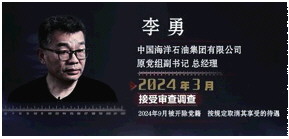
Group 1 - The article discusses the increasing efforts of China's disciplinary inspection and supervision agencies in combating cross-border corruption, utilizing big data and technology to uncover and investigate numerous cases [2][3] - A notable case involves Li Yong, former Deputy Secretary and General Manager of China National Offshore Oil Corporation (CNOOC), who is under investigation for serious corruption, with over 83% of the illicit funds originating from abroad [2][3] - The investigation into Li Yong's activities revealed a complex web of offshore accounts and companies used to conceal bribes, demonstrating the effectiveness of data analysis in tracing illicit financial flows [5][4] Group 2 - The article highlights the case of Yao Qian, former Director of the Technology Supervision Department of the China Securities Regulatory Commission, who was investigated for corruption involving virtual currencies [6][7] - Yao Qian's case illustrates the use of new forms of corruption, including the acceptance of virtual currency as bribes, with significant amounts traced back to his control through "shell accounts" [8][9] - The investigation into Yao Qian's financial activities led to the discovery of substantial funds linked to a real estate purchase, further emphasizing the role of technology in uncovering hidden corruption [8][9] Group 3 - The article also covers the case of Feng Jiang, a former official in the asset management sector, who was implicated in corrupt practices revealed through a smart regulatory system that analyzed bidding data [10][11] - The smart regulatory system identified irregularities in project bids, leading to the discovery of collusion and bribery, showcasing the power of big data and AI in enhancing oversight [11][12] - Feng Jiang's case resulted in a conviction for bribery, demonstrating the effectiveness of technology in identifying and prosecuting corrupt activities within public projects [10][11]
新媒股份:公司坚持以技术创新引领业务发展
Zheng Quan Ri Bao Wang· 2026-01-15 08:43
Core Viewpoint - The company emphasizes its commitment to technological innovation as a driving force for business development, focusing on emerging technologies and applications [1] Group 1: Technological Focus - The company is actively engaged in in-depth research and industrial cooperation on technologies such as artificial intelligence, VR video, big data, ultra-high definition, and digital copyright systems [1]

中远海科跌2.06%,成交额1.55亿元,主力资金净流出694.48万元
Xin Lang Cai Jing· 2026-01-15 06:48
Core Viewpoint - The stock of China Merchants Heavy Industry (中远海科) has experienced fluctuations, with a recent decline of 2.06% and a total market capitalization of 6.352 billion yuan. The company has seen a year-to-date stock price increase of 7.28% and a recent net outflow of funds amounting to 6.9448 million yuan [1]. Group 1: Financial Performance - As of December 31, the number of shareholders for China Merchants Heavy Industry decreased by 1.54% to 43,900, with an average of 8,457 circulating shares per person, an increase of 1.57% [2]. - For the period from January to September 2025, the company reported a revenue of 1.198 billion yuan, reflecting a year-on-year decrease of 3.85%. The net profit attributable to shareholders was 13.2706 million yuan, down 90.65% year-on-year [2]. Group 2: Shareholder and Dividend Information - Since its A-share listing, China Merchants Heavy Industry has distributed a total of 338 million yuan in dividends, with 160 million yuan distributed over the past three years [3]. - As of September 30, 2025, the top ten circulating shareholders included Hong Kong Central Clearing Limited as the third-largest shareholder with 2.0113 million shares, marking a new entry. Additionally, the Noan Active Return Mixed A fund ranked as the sixth-largest shareholder with 1.7108 million shares, also a new entry [3].

太极股份跌2.02%,成交额4.57亿元,主力资金净流入1021.64万元
Xin Lang Cai Jing· 2026-01-15 06:45
Core Viewpoint - The stock of Taiji Co., Ltd. has experienced fluctuations, with a recent decline of 2.02% on January 15, 2023, while showing a year-to-date increase of 9.02% [1] Group 1: Stock Performance - As of January 15, 2023, Taiji's stock price is reported at 26.70 CNY per share, with a trading volume of 4.57 billion CNY and a turnover rate of 2.72%, resulting in a total market capitalization of 166.40 billion CNY [1] - The stock has increased by 5.58% over the last five trading days and 16.09% over the last twenty days, but has decreased by 1.84% over the last sixty days [1] Group 2: Financial Performance - For the period from January to September 2025, Taiji Co., Ltd. achieved a revenue of 4.865 billion CNY, reflecting a year-on-year growth of 12.15%, while the net profit attributable to shareholders reached 4.0465 million CNY, marking a significant increase of 114.31% [2] Group 3: Shareholder Information - As of January 9, 2023, the number of shareholders for Taiji Co., Ltd. is reported at 55,500, a decrease of 1.28% from the previous period, with an average of 11,179 circulating shares per shareholder, which is an increase of 1.30% [2] - The company has distributed a total of 1.191 billion CNY in dividends since its A-share listing, with 284 million CNY distributed over the last three years [3]

超73亿资金,“跑了”
中国基金报· 2026-01-15 06:03
Core Viewpoint - On January 14, the A-share market experienced a significant drop, with a net outflow of over 7.3 billion yuan from stock ETFs, indicating a cooling market and a trend of investors cashing out [2][6]. Group 1: Market Performance - The total scale of stock ETFs in the market reached 5.07 trillion yuan, marking the first time it surpassed the 5 trillion yuan threshold [4]. - The total trading volume of stock ETFs on that day was 387.15 billion yuan, an increase of over 76 billion yuan compared to the previous trading day [4]. - The software, big data, and cloud computing sectors led the gains among stock ETFs, while sectors like electric grid and innovative pharmaceuticals saw significant declines [4][7]. Group 2: Fund Flows - On January 14, stock ETFs saw a net outflow of 7.33 billion yuan, with 49 ETFs experiencing inflows of over 100 million yuan [7]. - The top sectors for net inflows included computer (34.6 billion yuan), non-ferrous metals (33.8 billion yuan), and satellite industry (16.6 billion yuan) [7]. - The largest net outflows were observed in broad-based ETFs, particularly the CSI 300 and ChiNext ETFs, which saw outflows of 48.8 billion yuan and 35.6 billion yuan, respectively [9]. Group 3: ETF Performance Rankings - The top-performing ETFs by trading volume included the Software ETF (1.23 billion yuan, +6.34%), Big Data ETF (0.35 billion yuan, +6.27%), and Financial Technology ETF (2.24 billion yuan, +5.88%) [5]. - Conversely, the ETFs with the largest declines included the Electric Grid ETF and the Innovative Pharmaceuticals ETF, with many products dropping over 1.5% [4][7]. Group 4: Fund Management Insights - Leading fund companies like E Fund and Huaxia Fund reported significant inflows in their ETFs, with E Fund's Software ETF seeing a net inflow of 3.76 billion yuan and Huaxia's Non-ferrous Metals ETF attracting 9.46 billion yuan [11]. - Fund managers suggest focusing on technology sectors that have seen significant pullbacks but may have potential catalysts in the first quarter, such as humanoid robots and semiconductor sectors [11].

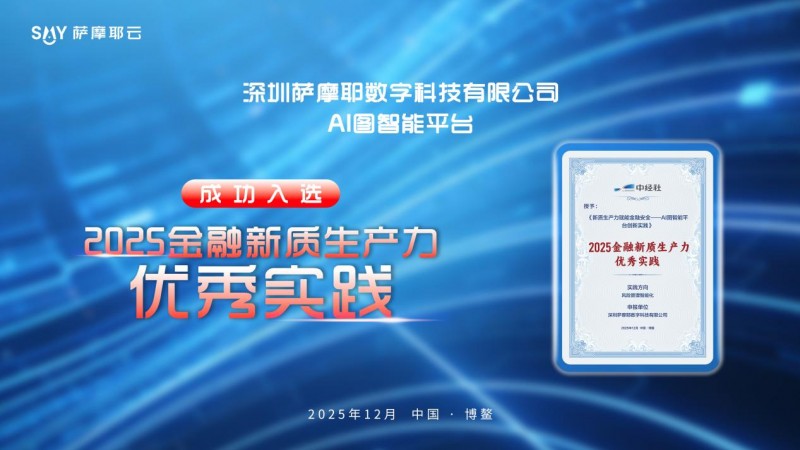
省呗再获认可,母公司萨摩耶云获“2025金融新质生产力优秀实践”
Cai Fu Zai Xian· 2026-01-15 05:03
Core Insights - The forum highlighted the recognition of Samoyed Cloud Technology Group, the parent company of Shengbei, for its advanced intelligent risk control capabilities and technological strength, being selected as an "Outstanding Practice of Financial New Quality Productivity 2025" [1][3] Group 1: Technological Advancements - The selection reflects Samoyed Cloud's deep technical strength and practical implementation capabilities in the intelligent upgrade of financial risk management and the realization of the "new quality productivity" concept [3] - The company initiated the "Orion System" upgrade project in 2023, focusing on enhancing the ability to identify associated risks and overall system stability, utilizing "AI + Graph Intelligence" as the core approach [3][4] - The system integrates a distributed graph database, NebulaGraph, to consolidate data from customers, devices, accounts, behaviors, and regions into a unified relational network, enabling early detection of collective and chain fraud characteristics [4] Group 2: Operational Efficiency - The system has significantly enhanced graph query capabilities, optimized decision-making processes, and improved rule execution efficiency by 55%, with risk control processing time reduced by half and manual review efficiency increased by nearly 30% [4] - The unified technical architecture and optimized model system have led to a reduction in operational costs by approximately 25% [4] Group 3: Recognition and Future Plans - Samoyed Cloud has been recognized by various authoritative institutions, being listed as a "specialized, refined, distinctive, and innovative" enterprise and receiving multiple awards for its contributions to digital transformation and financial technology [5] - The company plans to continue increasing technological investments, focusing on enhancing AI technology applications in risk identification, approval assistance, and risk warning, while ensuring data security and algorithm transparency [5]
网宿科技跌2.07%,成交额9.05亿元,主力资金净流出4525.65万元
Xin Lang Cai Jing· 2026-01-15 03:50
Group 1 - The core viewpoint of the news is that Wangsu Technology's stock has experienced fluctuations, with a recent decline of 2.07% and a total market value of 29.095 billion yuan [1] - As of January 15, 2023, Wangsu Technology's stock price is reported at 11.83 yuan per share, with a trading volume of 9.05 billion yuan and a turnover rate of 3.27% [1] - The company has seen a year-to-date stock price increase of 15.41%, with notable gains of 9.54% over the last five trading days and 21.21% over the last twenty days [1] Group 2 - For the period from January to September 2025, Wangsu Technology achieved operating revenue of 3.492 billion yuan, a year-on-year decrease of 3.27%, while net profit attributable to shareholders increased by 43.60% to 616 million yuan [2] - The company has distributed a total of 2.169 billion yuan in dividends since its A-share listing, with 1.338 billion yuan distributed over the past three years [3] - As of September 30, 2025, the top ten circulating shareholders of Wangsu Technology include major ETFs, with notable reductions in holdings from several funds [3]
