Capex

Search documents
Google and Anthropic ink cloud deal worth tens of billions of dollars
Youtube· 2025-10-24 16:54
Core Insights - Anthropic has entered a significant cloud deal with Google, potentially worth around $50 billion, involving the use of up to a million custom AI chips by 2026, which will add over a gigawatt of compute capacity [2][4][12] - This partnership indicates a shift in the competitive landscape of AI infrastructure, with Anthropic signaling concerns about Amazon's capabilities [4][6] - OpenAI has made larger commitments, but the Google-Anthropic deal is locked in and expected to come online next year, driven by strong enterprise demand [3][12] Company Dynamics - Anthropic's Claude currently powers over 300,000 businesses, generating revenue close to $7 billion this year [3] - Amazon remains the primary cloud provider for Anthropic, having invested $8 billion into Claude's custom supercomputer, despite recent service outages highlighting risks [6] - The competitive landscape is evolving, with Microsoft and Google gaining ground, while Amazon's dominance is diminishing [5][6] Market Trends - The upcoming hyperscaler earnings reports will focus on capital expenditures and the effectiveness of cloud business strategies [7] - Microsoft and Amazon have committed around $120 billion for the fiscal year, but OpenAI's commitment of 33 gigawatts dwarfs this figure [8][9] - The AWS outage was attributed to legacy infrastructure issues, emphasizing the need for modernization to handle new generative AI workloads [9][10] Strategic Considerations - The hyperscalers are not relying on debt for financing, which contrasts with OpenAI's approach of swapping equity for chips to support infrastructure buildout [10][11] - The Google Cloud deal with Anthropic is imminent and represents a significant step in the evolving cloud landscape [12]




Notable Capital's Jeff Richards: As long as end demand is there, tech capex will be fueled
CNBC Television· 2025-10-23 21:03
AI 行业趋势与资本支出 - AI 交易是过去 12-24 个月的热门话题,硅谷对正在发生的所有创新感到兴奋[2] - 资本支出为网络安全、云基础设施和应用层奠定了基础[2] - 终端用户对基础设施的需求依然强劲,全球财富 500 强公司以及消费者对此都有需求[4] - Chat GPT 用户已超过 8 亿,占世界人口的 10%[4][5] 私募市场与公开市场 - 私募公司(如 OpenAI 和 Anthropic)的估值持续快速增长,但由于其不透明性,难以完全掌握其发展方向[6] - 公开市场投资者难以了解这些私人公司的指标[7] - 风险投资公司希望看到更多此类公司上市,以便公开市场和分析师能够获得更多数据来了解 AI 交易的潜在价值[7][11] 风险与机遇 - 量子计算领域存在大量投机,该领域相对未经证实[9] - 风险投资是一项长期业务,投资的公司可能需要 3-10 年才能被大众所知,不确定性是业务的重要组成部分[13][14] - 许多风险投资支持的公司最终不会成功,但成功者将产生重大影响,可能成为下一个 Meta、Google 或 Amazon[17] - Anthropic 公开披露,其年度经常性收入从年初的 10 亿美元增长到夏季的 50 亿美元[15]

SoFi's Liz Thomas: This rally can continue but not without intermittent breakdowns in beta
Youtube· 2025-10-22 20:11
Group 1: Market Sentiment and Earnings - The upcoming earnings from the "Mag 7" companies are expected to significantly influence market sentiment, with a focus on guidance and spending trends [2][4][5] - There is a current breakdown in market beta, leading to increased volatility as investors react to earnings reports [2][3] - The performance of value and high-quality stocks has been strong, while momentum stocks have faced declines, indicating a shift in investor sentiment [3][4] Group 2: Capital Expenditure and Profitability - The market is looking for a "Goldilocks" scenario regarding capital expenditures (capex), where spending is expected to increase without leading to negative cash flows [5][6] - There is a concern that companies may overspend in the short term, which could create anxiety among investors [6] - The focus for 2025 will be on spending, while 2026 will shift towards actual profitability [4][5] Group 3: Company Performance and Expectations - Companies like Genova and Verdive have shown strong fundamentals, with Verdive reporting a 28% increase in total revenue and a 60% increase in orders [12][13] - Despite good earnings reports, stocks like Genova have experienced declines, highlighting the disconnect between earnings performance and stock market reactions [10][11] - The overall trajectory of stocks is expected to align with profits over time, regardless of current market sentiment [13]

U.S. Stock Futures Down Amid Commercial Loan Losses
Forbes· 2025-10-17 11:47
Market Overview - U.S. stocks experienced a decline on Thursday due to credit-quality issues announced by two regional banks, Zions Bancorporation and Western Alliance [2] - The S&P 500 index fell by 0.6%, the Nasdaq Composite decreased by 0.5%, and the Dow Jones Industrial Average dropped by 0.7% [2] Credit Quality Concerns - The problems at regional banks have raised concerns about the deterioration of commercial credit quality [3] - Automotive Credit Corp paused loan originations, and Tricolor Holdings filed for bankruptcy, which will result in losses for larger banks like JPMorgan and Fifth Third Bancorp [3] - First Brands, an automotive parts supplier, also went bankrupt in September, affecting Jefferies Financial Group due to its exposure through Point Bonita [3] Futures Market - Stock futures for major indices, including the S&P 500, Nasdaq 100, and Dow Jones, are down ahead of the market open on Friday, with S&P 500 futures falling by 0.4%, Nasdaq 100 futures down by 0.6%, and Dow Jones futures dipping by 0.1% [4]


Runway of AI spend is not something investors need to be concerned about, says ING's Anneka Treon
CNBC Television· 2025-10-15 19:18
Joining us now on set, Anukica Trion, head of global head private banking, wealth management, and investments at ING, based in the Netherlands, and you bicycled all the way here. It's amazing. It's amazing.So, so, so thank you. So, what is the European investment view of the United States markets. Because we're all debating bubble or not, you think not.We continue to see opportunity because ultimately AI bubble or not, it boils down to real dollars being spent on real capex with a very wrong very long runwa ...

Markets are probably in a bubble and that's okay, says Vista Equity's Ashley MacNeill
CNBC Television· 2025-10-07 19:52
AI Market Sentiment - The market is likely in a bubble, but recognizing the tailwinds is important, including potential Fed rate cuts, retail inflows, and AI innovation [2] - The current market situation feels similar to 1999, suggesting a potentially significant, though risky, upside [4] - It's crucial to consider the type of bubble, whether it will burst like in 1999 or inflate and deflate cyclically, with the latter being more likely given the longevity of AI technology [7] Valuation Concerns - Valuations in AI, both public and private, are in a bubble, with concerns about companies with $50 million ARR being valued at $10 billion [8] - Such companies would need to generate $1 billion in free cash flow to double an investor's money, which is a significant managerial challenge [9] - Growth expectations have been pulled forward for over a year, but this has been supported by strong growth from the MAG 7 companies, growing at 27% quarter over quarter, compared to the market at 9% and GDP at 4% [10][11] Capex and Demand - Robust capex spending is a key indicator of the health of the AI market [11] - Historically, bubbles burst when supply outstrips demand, but current metrics suggest demand for AI technology will remain strong due to its ubiquity [12][13] - As long as capex levels remain robust, it indicates that the marketplace is healthy [12]
Better market conversation is 'tier 3' AI names not seeing investor attention: Solus' Dan Greenhaus
Youtube· 2025-10-03 20:16
Market Sentiment - The current market sentiment is largely indifferent to political events such as government shutdowns, with a belief that any short-term impacts will be reversed in the medium term [2][3] - Focus remains on fundamentals, inflation, the Federal Reserve, and upcoming earnings reports, particularly from banks [3][4] Consumer Behavior - Recent reports from companies like Dicks indicate that consumer spending remains stable, despite ongoing concerns about consumer health [4] Investment Themes - The conversation around investment is shifting towards identifying tier three opportunities in the power sector, as tier one and tier two stocks have already garnered significant attention [5] - There is a prevailing theme of overinvestment in certain sectors, with notable figures like Zuckerberg suggesting that the risk lies in underinvesting rather than overinvesting [9] Market Cycle - Analysts are debating the current stage of the market cycle, with some suggesting that the market is further along than commonly perceived, potentially in the seventh inning of a capex boom [11] - There are concerns that if the capex spending is indeed nearing its peak, the current market rally may be shorter-lived than anticipated [13] Future Indicators - Key indicators to watch for potential market shifts include a decrease in capex, profit warnings, and changes in corporate financing activities, though no evidence of these changes is currently observed [14]

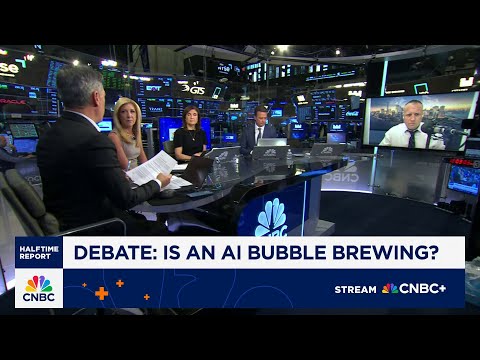
How investors can think about the potential AI market bubble
CNBC Television· 2025-10-03 18:06
I did mention that this AI bubble talk continues to lead many conversations. There's a tech conference in Italy. Goldman's David Solomon and the Amazon founder Jeff Bezos both speaking there both making some interesting headlines of the current environment.Solomon quote people are out on the risk curve because they're excited. There will be a reset, a check at some point, a draw down. Bezos quote investors have a hard time in the middle of this excitement distinguishing between the good ideas and the bad id ...
寒武纪“封王”,中国AI芯片“反攻”开始了
Xin Lang Cai Jing· 2025-10-03 07:38
Core Insights - The global capital market is experiencing a significant surge in capital expenditure (Capex) focused on AI, with tech giants heavily investing in AI computing power and AI chips becoming a crucial component of this growth [1][2] Group 1: Market Dynamics - The current market logic is driven by massive Capex plans from major tech companies, including both U.S. firms like Google, Facebook, and Microsoft, and Chinese companies such as Tencent, Alibaba, and Huawei [2] - The demand for AI computing power is expected to explode, particularly for training large models with hundreds of billions to trillions of parameters, leading to a substantial increase in the inference computing power market [2] Group 2: Competitive Landscape - The competition for AI computing power has shifted from merely focusing on the scale of training clusters to a comprehensive evaluation of energy efficiency, cost, and suitability for specific scenarios [2] - The battle for computing resources is fundamentally a contest over high-end chips, with the AI chip industry being highly complex and globally segmented [2] Group 3: Domestic Developments in China - By 2024, the penetration rate of domestic AI chip brands in China is expected to reach approximately 30%, with a shipment volume of 820,000 units, a significant increase from 15% the previous year [3] - Leading companies like Huawei HiSilicon and Cambricon are capturing vertical markets through customized ASICs, while emerging GPU manufacturers are rapidly advancing in graphics rendering [3] Group 4: Challenges and Government Support - Despite notable progress, domestic AI chip development faces challenges such as a technological gap, reliance on TSMC for sub-7nm processes, and insufficient coverage of domestic EDA tools [3] - The Chinese government is optimizing computing resource allocation through initiatives like the "East Data West Computing" project and has established special funds to support key technological breakthroughs [3] Group 5: Future Outlook - The ongoing chip battle represents not only a contest of technological capabilities but also a reshaping of the industry ecosystem, determining whether China can transition from a "follower" to a "runner" in the global AI chip arena [4]


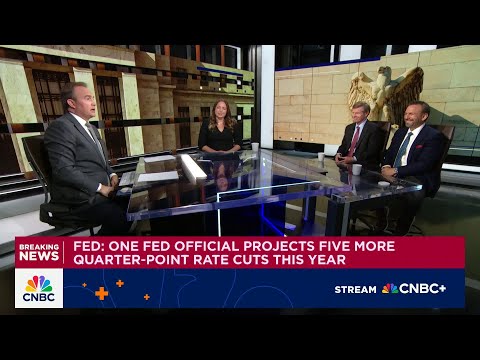
Watch CNBC's full interview with the 'Power Lunch' Fed Panel
CNBC Television· 2025-09-17 18:53
Federal Reserve Policy & Economic Outlook - The wide dispersion in views on the Federal Reserve's dot plot reflects confusion about the current state of the US economy, particularly regarding the labor market and the impact of tariffs [1][2][3] - The Federal Reserve's independence is considered tremendously important, and members are wary of appearing to be overly influenced by the administration [4][5] - The Phillips curve, which relates unemployment to wage inflation, is a key framework the Federal Reserve is using; concerns about a weakening labor market could lead to rate cuts despite inflation above 3% [6][7] - Seven members of the Federal Reserve indicated they foresee no more rate cuts this year, suggesting it may not be a proper easing cycle [32][35] Market Impact & Investment Strategies - Productivity is expected to move higher into 2026, already starting in 2025, which could support higher market multiples and is bullish for equity markets [9] - Small cap stocks, particularly the SML small cap 600 index (up 2%), tend to move at the later end of a rate cut cycle, suggesting potential opportunities in domestic American companies [10][11] - The 10-year yield remained stable at 4%, indicating the bond market has already priced in significant easing and mortgage relief may not be forthcoming [12][13] - Fiscal dominance is in play, meaning the long end of the curve (mortgages) is more sensitive to government actions (shutdown risks, budgets) than Federal Reserve actions [14][15] Uncertainties & Future Considerations - AI's impact on the labor market and the American economy is a significant uncertainty for the Federal Reserve [20][21][27][28] - A capex-driven cycle, fueled by approximately $500 billion investment in AI infrastructure, is underway, reminiscent of the 1990s [22] - Immigration levels and tariffs add to the uncertainty surrounding the economic outlook [28] - The strength and independence of the Federal Reserve as an institution are seen as positive for markets and could help hold down long-term rates [19][20][29]