
智慧城市

Search documents
华体科技: 四川华体照明科技股份有限公司2025年半年度报告
Zheng Quan Zhi Xing· 2025-08-22 16:36
Core Viewpoint - The report highlights the financial performance and operational status of Sichuan Huati Lighting Technology Co., Ltd. for the first half of 2025, indicating a decline in revenue and net profit, while emphasizing the growth potential in the smart city infrastructure sector driven by government policies and technological advancements [1][2][3]. Company Overview and Financial Indicators - The company reported a total revenue of approximately 193.25 million yuan, a slight decrease of 0.44% compared to the same period last year [2]. - The total profit for the period was a loss of approximately 21.04 million yuan, compared to a loss of 20.10 million yuan in the previous year [2]. - The net profit attributable to shareholders was approximately -25.11 million yuan, a significant increase in loss compared to -15.63 million yuan in the same period last year [2]. - The company's total assets decreased by 2.50% to approximately 1.47 billion yuan, while the net assets attributable to shareholders decreased by 2.70% to approximately 805.81 million yuan [2]. Industry Situation and Main Business - The smart streetlight sector is positioned as a core infrastructure for "new infrastructure" and "smart cities," receiving substantial support from national and local policies [3][4]. - The market for smart streetlights has been rapidly growing, with the number of urban road lighting fixtures in China increasing from approximately 17.74 million in 2010 to 34.82 million in 2023 [3]. - The company focuses on smart streetlight investment, construction, operation, and product development, aiming to become a leading provider of smart city solutions [5][6]. Business Model and Product Offerings - The company offers a range of products including smart streetlights equipped with various sensors and devices, traditional street lighting products, and software platforms for management and operation [6][7]. - The smart streetlights serve as data collection and service terminals for smart cities, integrating functionalities such as charging stations, environmental monitoring, and communication networks [6][7]. - The company has developed a comprehensive service chain that includes consulting, design, technical support, and maintenance for urban lighting and smart city services [5][6]. Competitive Advantages - The company possesses strong technical and research capabilities, with multiple research institutions focused on smart city services and urban lighting technology [12][13]. - It has established partnerships with universities to enhance innovation and product development, leading to a robust portfolio of patents and proprietary technologies [12][13]. - The company emphasizes a unique design philosophy that combines cultural customization with technological innovation, positioning itself as a leader in cultural lighting solutions [14].

时空科技: 2025年半年度报告
Zheng Quan Zhi Xing· 2025-08-22 16:36
Core Viewpoint - The report highlights the financial performance and strategic focus of Beijing New Space Technology Co., Ltd. for the first half of 2025, emphasizing the challenges faced in the night economy and smart city sectors, alongside efforts to improve cash flow and manage receivables effectively [1][3][8]. Financial Performance - The company reported a revenue of CNY 143.62 million for the first half of 2025, a decrease of 10.95% compared to CNY 161.29 million in the same period of 2024 [2][8]. - The total profit for the period was a loss of CNY 66.97 million, an improvement from a loss of CNY 82.48 million in the previous year [2][8]. - The net cash flow from operating activities increased significantly to CNY 79.70 million, up 196.98% from CNY 26.84 million in the previous year [2][8]. Business Overview - The company focuses on two main sectors: night economy and smart city development, aiming to enhance urban public infrastructure and promote nighttime tourism [3][4]. - In the night economy sector, the company has established itself as a leading service provider, integrating landscape lighting and cultural tourism [3][4]. - The smart city initiatives include the development of smart streetlights and smart parking solutions, aimed at improving urban efficiency and public service levels [4][5]. Industry Context - The night economy sector is experiencing increased competition, with various local governments implementing policies to stimulate nighttime cultural and tourism activities [6][9]. - The smart city sector is transitioning towards a more integrated development model, with a focus on digital infrastructure and innovative solutions to urban challenges [6][7]. - The report indicates a growing demand for comprehensive solutions in both sectors, driven by consumer preferences and government initiatives [6][7]. Strategic Initiatives - The company is actively managing receivables and optimizing cash flow to address the challenges posed by delayed payments from government clients [9][10]. - The successful launch of the "Guangan Night City" project demonstrates the company's capability in delivering immersive cultural experiences, attracting significant visitor numbers [9][10]. - The company is enhancing its governance and internal control systems to improve operational efficiency and compliance [10][11]. Competitive Advantages - The company has established a strong brand reputation through its involvement in major national events, showcasing its project management capabilities [11][12]. - A collaborative approach across various regions and business lines enhances market competitiveness and operational efficiency [11][12]. - The company invests in technology and innovation, developing proprietary solutions that integrate advanced lighting technologies with cultural elements [12][13].

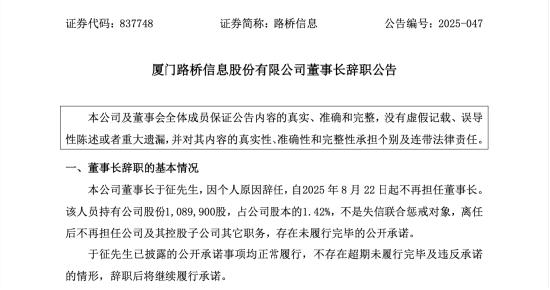
掌舵24年董事长突然请辞!路桥信息暂无接棒人,年内股价暴涨281%后何去何从?
Xin Lang Zheng Quan· 2025-08-22 12:34
Core Viewpoint - The resignation of Yu Zheng, the chairman of Xiamen Road and Bridge Information Co., Ltd., is effective immediately, and the company has not announced a successor. This change may impact the company's strategic execution and governance efficiency in the rapidly evolving digital transportation and smart city sectors [1][4]. Company Overview - Xiamen Road and Bridge Information Co., Ltd. specializes in the research and implementation of solutions in the smart transportation sector [5]. Financial Performance - For the fiscal year 2024, the company reported a revenue of approximately 240.45 million yuan, representing a year-on-year growth of 1.08%. The net profit attributable to shareholders was 22.81 million yuan, an increase of 1.13% compared to the previous year [6]. - The company's gross profit margin improved to 41.26% from 39.87% in the previous year [6]. - The basic earnings per share decreased by 11.76% to 0.30 yuan from 0.34 yuan [6]. Market Position - As of August 22, the company's stock price closed at 74.30 yuan per share, with a year-to-date increase of 281.25%, resulting in a total market capitalization of 5.702 billion yuan [8]. - The company has a PE ratio (TTM) of 246.68 and a PB ratio (MRQ) of 18.13, indicating a high valuation relative to earnings and book value [8]. Management Background - Yu Zheng has extensive experience in traffic information and intelligent construction management, having served in various roles since the late 1980s. He has been with the company since its inception and has held the position of chairman since 2015 [2][3].

荣科科技股价上涨1.25% 上半年亏损同比扩大至2723万元
Sou Hu Cai Jing· 2025-08-22 10:52
Company Overview - Rongke Technology is a high-tech enterprise established in November 2005, focusing on smart healthcare, smart city, and artificial intelligence applications [1] - The company has built an industrial integration ecosystem through capital mergers and resource integration, owning several excellent enterprises in the industry [1] Financial Performance - For the first half of 2025, the company reported operating revenue of 292 million yuan, a year-on-year decrease of 7.01% [1] - The net profit attributable to shareholders of the listed company was a loss of 27.229 million yuan, which is a significant increase in loss compared to 4.0233 million yuan in the same period last year [1] - The non-recurring net profit was a loss of 32.9098 million yuan [1] - The company recognized asset impairment provisions and asset write-offs that reduced total profit by approximately 6.25 million yuan during the reporting period [1] Market Activity - As of August 22, 2025, the latest stock price of Rongke Technology was 25.07 yuan, an increase of 0.31 yuan or 1.25% from the previous trading day's closing price [1] - The stock opened at 24.30 yuan, reached a high of 26.00 yuan, and a low of 24.30 yuan, with a trading volume of 638,209 hands and a transaction amount of 1.617 billion yuan [1] - On August 22, the net outflow of main funds was 28.2464 million yuan, accounting for 0.18% of the circulating market value [1] - Over the past five days, the cumulative net outflow of main funds was 65.6048 million yuan, accounting for 0.41% of the circulating market value [1] Industry Challenges - The company faces intensified competition in the medical informationization sector and risks related to policy compliance [1] - To address these challenges, the company is increasing its investment in research and development and expanding its national layout [1]

延华智能上涨7.2%,报7.74元/股
Jin Rong Jie· 2025-08-22 04:20
Group 1 - The core viewpoint of the article highlights the significant stock price increase of YanHua Intelligent, which rose by 7.2% to 7.74 CNY per share, with a trading volume of 5.27 billion CNY and a turnover rate of 9.91%, resulting in a total market capitalization of 55.12 billion CNY [1] - YanHua Intelligent is a leading smart city service and operation provider in China, focusing on eight major business areas including smart city top-level design, smart buildings, smart parks, smart communities, smart scenic areas, smart healthcare, data centers, and smart energy-saving solutions [1] - The company has made significant investments in R&D in big data, IoT, and cloud computing, launching the "YanHua Intelligent Cloud Platform" series of software information products and actively promoting the comprehensive digital transformation of cities [1] Group 2 - As of March 31, YanHua Intelligent had 116,300 shareholders, with an average of 6,120 circulating shares per person [1] - For the first quarter of 2025, YanHua Intelligent reported a revenue of 119 million CNY, a year-on-year decrease of 20.65%, and a net profit attributable to shareholders of -5.07 million CNY, a year-on-year decrease of 1.47% [1]

君逸数码涨2.13%,成交额3025.60万元,主力资金净流入34.57万元
Xin Lang Cai Jing· 2025-08-22 03:13
Group 1 - The core viewpoint of the news is that Junyi Digital's stock has shown significant growth since its listing, with a notable increase in trading activity and market capitalization [1][2]. - As of August 22, Junyi Digital's stock price rose by 2.13% to 23.00 CNY per share, with a total market capitalization of 3.967 billion CNY [1]. - The company has experienced a year-to-date stock price increase of 20.42%, with a 7.18% rise in the last five trading days [2]. Group 2 - Junyi Digital, established on May 16, 2002, is located in the Chengdu High-tech Zone of the Sichuan Free Trade Pilot Zone and was listed on July 26, 2023 [2]. - The company operates in the IT services sector, specifically under the sub-industry of computer IT services, and is involved in various concept sectors including geographic information and smart cities [2]. - As of July 18, the number of shareholders increased by 5.52% to 15,000, with an average of 6,601 circulating shares per shareholder, reflecting a 32.67% increase [2].
罗曼股份涨2.09%,成交额7059.59万元,主力资金净流出217.40万元
Xin Lang Cai Jing· 2025-08-22 03:11
Company Overview - Roman Technology Co., Ltd. is located at 1198 Yangshupu Road, Yangpu District, Shanghai, established on March 4, 1999, and listed on April 26, 2021 [1] - The company specializes in landscape lighting overall planning and deepening design [1] Stock Performance - As of August 22, Roman's stock price increased by 2.09%, reaching 41.12 CNY per share, with a total market capitalization of 4.482 billion CNY [1] - Year-to-date, the stock price has risen by 64.09%, with a recent decline of 1.25% over the last five trading days, a 14.44% increase over the last 20 days, and a 46.18% increase over the last 60 days [1] Financial Performance - For the period from January to March 2025, Roman achieved a revenue of 180 million CNY, representing a year-on-year growth of 49.44% [2] - The company has distributed a total of 79.446 million CNY in dividends since its A-share listing, with 27.444 million CNY distributed over the past three years [2] Shareholder Information - As of March 31, 2025, the number of shareholders decreased by 24.24% to 8,965, while the average circulating shares per person increased by 31.99% to 12,084 shares [2] - Among the top ten circulating shareholders, the "Fuguo Balanced Preferred Mixed Fund" ranks as the seventh largest shareholder, holding 2.0278 million shares, unchanged from the previous period [2] Industry Classification - Roman belongs to the Shenwan industry classification of construction decoration - specialized engineering - other specialized engineering [1] - The company is associated with several concept sectors, including smart cities, artificial intelligence, new energy vehicles, virtual reality, and small-cap stocks [1]

勘设股份跌2.38%,成交额1675.69万元,主力资金净流出91.59万元
Xin Lang Cai Jing· 2025-08-22 03:08
Core Viewpoint - The stock of Kuan She Co., Ltd. has experienced fluctuations, with a year-to-date increase of 63.15%, but a recent decline of 9.76% over the last five trading days [3]. Group 1: Stock Performance - As of August 22, Kuan She's stock price was 9.43 CNY per share, down 2.38%, with a total market capitalization of 2.887 billion CNY [1]. - The stock has seen a 5.96% increase over the last 20 days and a 23.43% increase over the last 60 days [3]. - The company has appeared on the "Dragon and Tiger List" twice this year, with the most recent net purchase of 6.681 million CNY on April 9 [3]. Group 2: Capital Flow - There was a net outflow of 915,900 CNY from main funds, with large orders buying 1.439 million CNY (8.59% of total) and selling 3.444 million CNY (20.56% of total) [2]. Group 3: Company Overview - Kuan She Co., Ltd. is located in Guiyang, Guizhou Province, and was established on April 30, 2010, with its IPO on August 9, 2017 [3]. - The company operates in the engineering consulting services sector and is part of various concept sectors including small-cap, smart city, and unmanned driving [3]. - As of August 10, the number of shareholders was 16,200, a decrease of 6.72%, with an average of 18,889 circulating shares per person, an increase of 7.20% [3]. Group 4: Financial Performance - For the first quarter of 2025, Kuan She reported a revenue of 257 million CNY, a year-on-year decrease of 2.12% [3]. - Since its A-share listing, the company has distributed a total of 662 million CNY in dividends, with 68.27 million CNY distributed over the past three years [3].

富瀚微涨2.08%,成交额1.33亿元,主力资金净流入159.73万元
Xin Lang Cai Jing· 2025-08-22 02:42
Company Overview - Shanghai Fuhang Microelectronics Co., Ltd. is located at 717 Yishan Road, Xuhui District, Shanghai, established on April 16, 2004, and listed on February 20, 2017. The company specializes in the research and sales of digital signal processing chips and provides professional technical services [1]. - The main business revenue composition is 96.84% from product sales and 3.16% from service provision [1]. Financial Performance - For the first half of 2025 (January to June), the company achieved operating revenue of 688 million yuan, a year-on-year decrease of 14.04%. The net profit attributable to the parent company was 23.02 million yuan, down 78.10% year-on-year [2]. - Since its A-share listing, the company has distributed a total of 178 million yuan in dividends, with 96.47 million yuan distributed over the past three years [3]. Stock Performance - As of August 22, the stock price increased by 2.08% to 55.95 yuan per share, with a trading volume of 133 million yuan and a turnover rate of 1.09%, resulting in a total market capitalization of 12.996 billion yuan [1]. - Year-to-date, the stock price has decreased by 4.16%, but it has increased by 5.75% over the last five trading days, 16.03% over the last 20 days, and 16.05% over the last 60 days [1]. Shareholder Information - As of July 31, the number of shareholders is 38,100, a decrease of 2.05% from the previous period, with an average of 5,749 circulating shares per person, an increase of 2.10% [2]. - As of June 30, 2025, Hong Kong Central Clearing Limited is the eighth largest circulating shareholder, holding 2.2915 million shares, an increase of 831,600 shares from the previous period [3]. Market Position - The company belongs to the Shenwan industry classification of Electronics - Semiconductors - Digital Chip Design, and is involved in sectors such as ASIC chips, security, smart cities, specialized and innovative enterprises, and machine vision [1].
和达科技涨2.03%,成交额461.48万元
Xin Lang Cai Jing· 2025-08-22 02:41
Group 1 - The core viewpoint of the news highlights the recent stock performance of HeDa Technology, which has seen a year-to-date increase of 38.95% and a 5-day increase of 5.98% as of August 22 [1] - HeDa Technology is primarily engaged in providing comprehensive solutions for the informatization of the water industry, utilizing technologies such as IoT, big data, and edge computing [1] - The company's revenue composition includes 43.26% from smart sensing terminals, 34.71% from overall solutions, 15.54% from water management systems, 5.43% from technical services, and 1.06% from other sources [1] Group 2 - As of March 31, the number of shareholders for HeDa Technology increased by 15.20% to 4,683, while the average circulating shares per person decreased by 13.20% to 22,932 shares [2] - For the first quarter of 2025, HeDa Technology reported a revenue of 38.04 million yuan, a year-on-year decrease of 51.49%, and a net profit attributable to shareholders of -14.31 million yuan, a significant decline of 1420.21% [2] - Since its A-share listing, HeDa Technology has distributed a total of 46.18 million yuan in dividends, with 16.11 million yuan distributed over the past three years [2]
