
Physical AI

Search documents
Ouster(OUST) - 2025 Q1 - Earnings Call Transcript
2025-05-08 22:00
Financial Data and Key Metrics Changes - The company reported revenue of $32.6 million for the first quarter of 2025, with a gross margin of 41%, which includes a patent royalty of $1.5 million [5][16] - Gross margin increased by 1,200 basis points year over year, reflecting higher revenues and a favorable product mix [16] - The balance sheet remains strong with $171 million in cash and equivalents and zero debt [6][18] Business Line Data and Key Metrics Changes - The industrial vertical was the largest contributor to revenue, followed by automotive, with significant deals in warehouse autonomy and robotaxi applications [16] - The company shipped approximately 4,700 sensors in the first quarter, indicating robust demand across various sectors [16] Market Data and Key Metrics Changes - The company expanded its relationship with Lazze Pico in the smart infrastructure vertical, signing its largest contract for software attached sales in Europe [6] - In the automotive sector, the company was selected by a global OEM's mobility subsidiary to supply sensors for autonomous vehicle development [7] Company Strategy and Development Direction - The company is focused on three strategic priorities for 2025: scaling the software attached business, transforming the product portfolio, and executing towards profitability [8][13] - The product portfolio is being transformed with new hardware and enhanced software capabilities, aiming to double the addressable market [12][13] Management's Comments on Operating Environment and Future Outlook - Management expressed optimism about the growth of physical AI and the adoption of LiDAR technology, noting that advancements in AI are making systems more capable and affordable [68] - The geopolitical and macroeconomic environment remains fluid, but the company does not expect tariffs to significantly impact its business [19][72] Other Important Information - The company announced the appointment of Ken Gianella as Chief Financial Officer, effective May 19, 2025 [13] - The company achieved a major milestone in collaboration with NVIDIA for its AI model, which has been trained on over 4 million labeled objects [12] Q&A Session Questions and Answers Question: On gross margins and software contribution - The company is pleased with its margin performance, trending towards the higher end of its 35% to 40% range, and will provide more clarity on software contributions when significant [24][27] Question: About new products and TAM expansion - The upcoming product releases are expected to be transformational, potentially doubling the addressable market, with positive signals from key customers [30][31] Question: Testing process with new customers - The company engages in ongoing testing with customers, which helps build long-term relationships and accelerates production orders [35][37] Question: LiDAR adoption speed - The company believes LiDAR adoption is tracking to its long-term model, with positive trends in the field of autonomy and physical AI [68] Question: Impact of tariffs on customers - There has been minimal disruption due to tariffs, and the overall trend towards automation remains strong [71][72] Question: Competitive dynamics in the market - The company has not seen consistent efforts from competitors to develop solutions in non-automotive markets, maintaining its position as a leading player [76][77]

Ouster(OUST) - 2025 Q1 - Earnings Call Presentation
2025-05-08 20:23
Financial Performance - The company reported Q1 2025 revenue of $33 million[9], a 26% increase compared to Q1 2024[24] - GAAP gross margin was 41% in Q1 2025[9, 24], up from 29% in Q1 2024[24, 30] - Non-GAAP gross margin was 46% in Q1 2025[24, 30], compared to 36% in Q1 2024[24, 30] - The company shipped over 4,700 sensors in Q1 2025[24], a 6% increase compared to Q1 2024[24] - The company's cash and equivalents stand at $171 million with no debt[9] Strategic Priorities - The company aims to capture the $19 billion smart infrastructure market opportunity[15] - The company is focused on scaling the software attached business[14] - The company is working to transform the product portfolio with new hardware and software[14, 19] - The company is executing towards profitability, aiming for 30-50% annual revenue growth and maintaining a gross margin of 35-40%[14, 21] Q2 2025 Guidance - The company expects revenue between $32 million and $35 million for Q2 2025[26]
Ginkgo Bioworks (DNA) - 2025 Q1 - Earnings Call Transcript
2025-05-06 22:32
Financial Data and Key Metrics Changes - The company achieved a reduction in annual run rate costs of $205 million between Q1 2024 and Q1 2025, surpassing the initial target of $200 million [8] - Total company adjusted EBITDA improved to negative $47 million in Q1 2025 from negative $117 million in Q1 2024 [17] - Cash burn decreased significantly to $58 million in Q1 2025 from $104 million in Q1 2024 [18] Business Line Data and Key Metrics Changes - Cell engineering revenue reached $38 million in Q1 2025, a 37% increase year-over-year, with a 10% increase to $31 million when excluding noncash revenue [11][12] - Biosecurity revenue was $10 million in Q1 2025, with a segment gross margin of 28% [13] - The number of revenue-generating programs in cell engineering increased by 32% year-over-year, totaling 123 programs [12] Market Data and Key Metrics Changes - The company has 28 government projects across cell engineering and biosecurity, with a contracted backlog exceeding $180 million [30] - The biotechnology sector is currently facing challenges in capital markets, but companies that navigate these difficulties are expected to emerge stronger [10][25] Company Strategy and Development Direction - The company aims to reach adjusted EBITDA breakeven by the end of 2026 while maintaining a cash margin of safety [5][6] - A focus on expanding the tools business to market directly to a wider range of customers, moving beyond traditional R&D solutions [7] - The company is positioning itself as a trusted R&D service provider to the U.S. government, with ongoing investments in biotechnology and biosecurity [20][30] Management's Comments on Operating Environment and Future Outlook - Management expressed optimism about the biotechnology sector's resilience and the potential for growth despite current market challenges [10][25] - The new U.S. administration is expected to continue funding biotechnology, with a focus on reducing regulations and increasing investment in critical technologies [26][30] - The company is well-positioned with over $517 million in cash and no bank debt, allowing it to navigate the current market environment effectively [9][25] Other Important Information - The company has made significant progress in restructuring efforts, achieving substantial cost reductions while maintaining service to existing customers [8][19] - The introduction of new metrics for revenue-generating programs aims to provide more useful data for analysts and improve revenue modeling [12] Q&A Session Summary Question: Is there an opportunity for data points to evolve into a SaaS cloud computing product? - Management acknowledged the potential for Ginkgo to assist large pharma companies in developing their data architecture and systems, indicating a possible opening in the SaaS space [85][86] Question: Can you provide more details on the ARPA H contract and its revenue recognition? - The ARPA H contract is a $29 million, two-year agreement, with revenue expected to be recognized over that period, significantly derisking the company's guidance for the year [92][94]

Novanta (NOVT) - 2025 Q1 - Earnings Call Transcript
2025-05-06 15:02
Financial Data and Key Metrics Changes - In Q1 2025, the company reported revenue of $233 million, reflecting organic growth of 2% and reported growth of 1% year over year [7][21] - Adjusted gross margins were 46%, consistent with expectations, and adjusted EBITDA was $50 million, showing a 1% increase year over year [24][7] - Free cash flow reached $32 million, exceeding expectations and demonstrating strong cash conversion capabilities [24][21] Business Line Data and Key Metrics Changes - The Automation Enabling Technologies segment saw sales grow by 5% year over year, driven by strength in robotics and automation [27] - The Medical Solutions segment experienced a revenue decline of 3% year over year, primarily due to a decrease in the precision medicine business unit [29] - New product sales grew strong double digits year over year, with the vitality index reaching nearly 25% of total sales in the Medical Solutions segment [30][17] Market Data and Key Metrics Changes - Sales to healthcare markets grew with strong patient procedure growth and hospital spending, driving high single-digit growth in the advanced surgery business [10] - The company expects to grow faster than the healthcare market in 2025, driven by new product launches in surgical robotics and minimally invasive surgery [11] - The industrial market is facing short-term uncertainty, but long-term growth potential remains strong in sectors like robotics and automation [16] Company Strategy and Development Direction - The company focuses on markets with long-term secular tailwinds, such as precision robotics, advanced minimally invasive surgery, and precision medicine [9] - A strategic tuck-in acquisition was completed in April 2025, with plans for further acquisitions remaining a top priority [9][20] - The company aims to mitigate tariff impacts through a multipronged strategy, including regional manufacturing and cost containment actions [14][32] Management's Comments on Operating Environment and Future Outlook - The management highlighted the current macroeconomic environment as one of the most uncertain and volatile since the early COVID pandemic days [12] - Despite challenges, the company remains confident in achieving $50 million of incremental new product revenue for 2025 [11][22] - The management expressed optimism about the company's resilience and ability to navigate near-term dynamics while focusing on long-term growth [23][47] Other Important Information - The company ended Q1 with gross debt of $392 million and a net leverage ratio of approximately 1.4 times, providing ample capacity for further acquisitions [25] - The company repurchased approximately $6 million worth of common shares in Q1 [26] - The anticipated impact of tariffs on profitability is being managed through various strategies, including price increases and sourcing adjustments [33][82] Q&A Session Summary Question: Can you provide insight into the acquisition's potential revenue contribution? - The upfront payment for the acquisition was around $66 million, with expectations for it to be slightly accretive to earnings per share in the first year [52] Question: Can you elaborate on the $20 million in annual cost savings? - The $20 million in savings will help achieve full-year EBITDA targets, with some actions being deferrals of investments that could be reinstated if demand improves [57][59] Question: What is the current trend in revenue guidance for Q2? - The company is currently trending towards the high end of the Q2 revenue guidance range, estimating revenue at $240 million [62] Question: Which end markets are experiencing deferrals in investments? - The most significant deferrals are related to US-based production to China, with additional uncertainty in life sciences and broader industrial markets [64][66] Question: How much of the revenue is tied to NIH funding? - The precision medicine business unit has exposure to NIH funding, with current declines largely attributed to funding cuts and general capital spending pullbacks in life sciences [72][75]

Novanta (NOVT) - 2025 Q1 - Earnings Call Transcript
2025-05-06 14:00
Financial Data and Key Metrics Changes - In Q1 2025, Novanta reported revenue of $233 million, reflecting organic growth of 2% and reported growth of 1% year over year [6][21] - Adjusted gross margins were 46%, consistent with expectations, while adjusted EBITDA was $50 million, showing a 1% increase year over year [24][6] - Free cash flow reached $32 million, exceeding expectations and demonstrating strong cash conversion capabilities [24][6] Business Line Data and Key Metrics Changes - Medical market sales accounted for 55% of total sales, while advanced industrial markets made up 45% [14] - The Automation Enabling Technologies segment saw sales grow by 5% year over year, driven by strength in robotics and automation [27] - The Medical Solutions segment experienced a revenue decline of 3% year over year, primarily due to a drop in the precision medicine business unit [28] Market Data and Key Metrics Changes - Sales to healthcare markets grew at a high single-digit rate, particularly in the advanced surgery business [9][10] - The precision medicine business unit faced disruptions from NIH funding cuts and tariffs, impacting overall sales [29][30] - Design wins in the automation enabling technology segment grew by strong double digits year over year, indicating robust demand despite market turbulence [16][27] Company Strategy and Development Direction - Novanta's strategy focuses on markets with long-term secular tailwinds, such as precision robotics and advanced minimally invasive surgery [7][8] - The company aims to achieve $50 million in incremental new product revenue in 2025, driven by new product launches [10][21] - The acquisition of Keyon is part of Novanta's strategy to expand into intelligent embedded software solutions [19][20] Management's Comments on Operating Environment and Future Outlook - Management acknowledged the current macroeconomic environment as uncertain and volatile, similar to the early COVID pandemic days [11] - The company is confident in its ability to navigate these challenges, citing enhanced operational scalability and resilience [12][22] - Despite short-term uncertainties, management remains optimistic about long-term growth opportunities in high-growth markets [21][40] Other Important Information - Novanta's gross debt was $392 million, with a gross leverage ratio of 1.9 times, providing capacity for further acquisitions [25] - The company repurchased approximately $6 million worth of common shares in Q1 2025 [25][26] - The vitality index for new products reached nearly 20% of total sales, indicating strong growth potential [17] Q&A Session Summary Question: Can you provide insights on the Keyon acquisition and its revenue contribution? - The upfront payment for Keyon was around $66 million, with expectations for it to be slightly accretive to earnings per share in the first year [51][52] Question: What are the sources of the $20 million in annual cost savings? - The $20 million in savings is primarily from deferrals of investments and prioritization of actions to mitigate tariff impacts [55][56] Question: How is Novanta addressing the impact of tariffs on its supply chain? - The company has implemented a tariff response playbook, which includes sourcing from second vendors and regionalizing manufacturing to mitigate costs [33][80] Question: What is the outlook for revenue in Q2 2025? - Novanta expects Q2 revenue in the range of $230 million to $240 million, trending towards the higher end of this range [41][61] Question: How much of Novanta's revenue is tied to NIH funding? - The precision medicine business unit is sensitive to NIH funding cuts, which have impacted revenue, but specific revenue percentages are difficult to quantify [70][73]
Nvidia Stock: The Week of April 14-18 in Review
The Motley Fool· 2025-04-20 19:00
Core Viewpoint - Nvidia's stock experienced significant volatility due to both positive developments in U.S. manufacturing and negative impacts from new export controls, leading to an overall decline in share price [1][4][7]. Group 1: Stock Performance - Nvidia shares dropped 8.5% last week, closing at $101.49 per share, while the S&P 500 and Nasdaq Composite indices also declined by 1.5% and 2.6%, respectively [1]. - On April 15, Nvidia stock gained 1.3% following news of plans to produce AI supercomputers in the U.S., despite the S&P 500 slipping by about 0.2% [4]. - On April 16, Nvidia stock fell 6.9% after announcing potential charges of up to $5.5 billion due to new export restrictions [7]. Group 2: Manufacturing Developments - Nvidia is collaborating with manufacturing partners to establish factories in the U.S. for AI supercomputer production, aiming to generate up to $500 billion in AI infrastructure over four years [4]. - The company has begun producing its new Blackwell chips at TSMC's facilities in Phoenix, Arizona, and is also partnering with Amkor and SPIL for packaging and testing operations [5]. - Nvidia is constructing two supercomputer manufacturing plants in Texas, with mass production expected to ramp up in the next 12-15 months [6]. Group 3: Export Controls and Financial Impact - Nvidia disclosed plans to take charges of up to $5.5 billion due to U.S. government restrictions on exporting its H20 chip to China and other countries [7][8]. - The new export controls are part of an ongoing series of restrictions that began in August 2022, affecting a significant portion of Nvidia's data center products, which account for 90.6% of total revenue [9][10]. - The H20 chip was specifically designed to comply with export controls but is now subject to a license requirement that effectively acts as a ban on exports to China [12]. Group 4: Financial Projections - Nvidia's fiscal Q1 revenue is projected to be around $38.5 billion after accounting for the $5.5 billion in charges, representing a year-over-year growth of approximately 48% [16]. - This projected revenue is slightly lower than the previous quarter's revenue of $39.33 billion, indicating potential challenges ahead [15]. - The impact of the charges is expected to significantly affect Nvidia's net income, particularly given the higher profitability of its data center platform [17]. Group 5: Long-term Outlook - Despite short-term challenges, Nvidia remains a strong long-term investment due to its leading position in the AI chip market and the massive total addressable market, even without China [19]. - The company is well-positioned to benefit from the growth of agentic AI and physical AI applications, which are in the early stages of development [19]. - Although Nvidia's stock is down 32% from its all-time high, it has still increased by 19.9% over the past year, outperforming the broader market [20].


The Best Trillion-Dollar Stock to Buy Now, According to Wall Street
The Motley Fool· 2025-04-13 07:30
Core Insights - Nvidia is currently viewed as the best trillion-dollar stock to buy, with a median target price implying a 58% upside from its current share price [2][9] - The company holds a dominant position in the AI accelerator market, with over 90% market share in data center GPUs and more than 80% in AI accelerators [3] - Nvidia's competitive edge is bolstered by its CUDA software platform, which enhances the development of AI applications [4] Company Overview - Nvidia's market capitalization stands at $2.7 trillion, with a current share price of $111 and a median target price of $175 [9] - The company also leads in adjacent data center hardware, including CPUs and networking equipment, which contributes to a superior total cost of ownership for its systems [5] - Nvidia is actively addressing headwinds from competition and export restrictions, with analysts optimistic about the demand for its GPUs due to evolving AI training techniques [6][8] Industry Trends - The demand for AI hardware, software, and services is projected to grow by 35% annually through 2030, indicating a robust market environment for Nvidia [12] - Wall Street anticipates Nvidia's earnings will increase by 38% annually through fiscal 2027, suggesting that the current valuation may be attractive for long-term investors [12] - The emergence of robotics powered by physical AI is expected to revolutionize industries, positioning Nvidia as a key player in this transformation [10]
Infineon further strengthens its number one position in automotive microcontrollers and boosts systems capabilities for software-defined vehicles with acquisition of Marvell's Automotive Ethernet business
Prnewswire· 2025-04-08 07:08
Core Viewpoint - Infineon Technologies AG is acquiring Marvell Technology's Automotive Ethernet business for US$2.5 billion to enhance its capabilities in software-defined vehicles and expand its market-leading microcontroller business [1][7]. Group 1: Acquisition Details - The acquisition price is set at US$2.5 billion in cash, and the transaction is subject to regulatory approvals [1][5]. - Marvell's Automotive Ethernet business is expected to generate revenue of US$225 – US$250 million in the 2025 calendar year with a gross margin of around 60% [3][7]. - The acquisition will be financed through existing liquidity and additional debt, with financing secured from banks [5][7]. Group 2: Strategic Fit and Market Position - The acquisition is described as a strategic fit for Infineon, enhancing its position as the global leader in semiconductor solutions for the automotive industry [2][7]. - Infineon aims to leverage Marvell's Ethernet technology to provide comprehensive solutions for software-defined vehicles, including advanced driver-assistance systems and autonomous driving [2][4]. - The deal is expected to create additional growth opportunities in adjacent fields such as humanoid robots and IoT applications [2][7]. Group 3: Customer Base and Future Growth - Marvell's Automotive Ethernet business has established relationships with over 50 automotive manufacturers, including eight of the ten leading OEMs, supported by a design-win pipeline of around US$4 billion until 2030 [3][7]. - The combination of Marvell's technology with Infineon's AURIX™ microcontroller family is anticipated to enhance product offerings in communications and real-time control [4][7]. - The acquisition is expected to yield additional cost synergies through combined R&D efforts and leveraging Infineon's production capabilities [3][7].

NVIDIA GTC 2025:GPU、Tokens、合作关系
Counterpoint Research· 2025-04-03 02:59
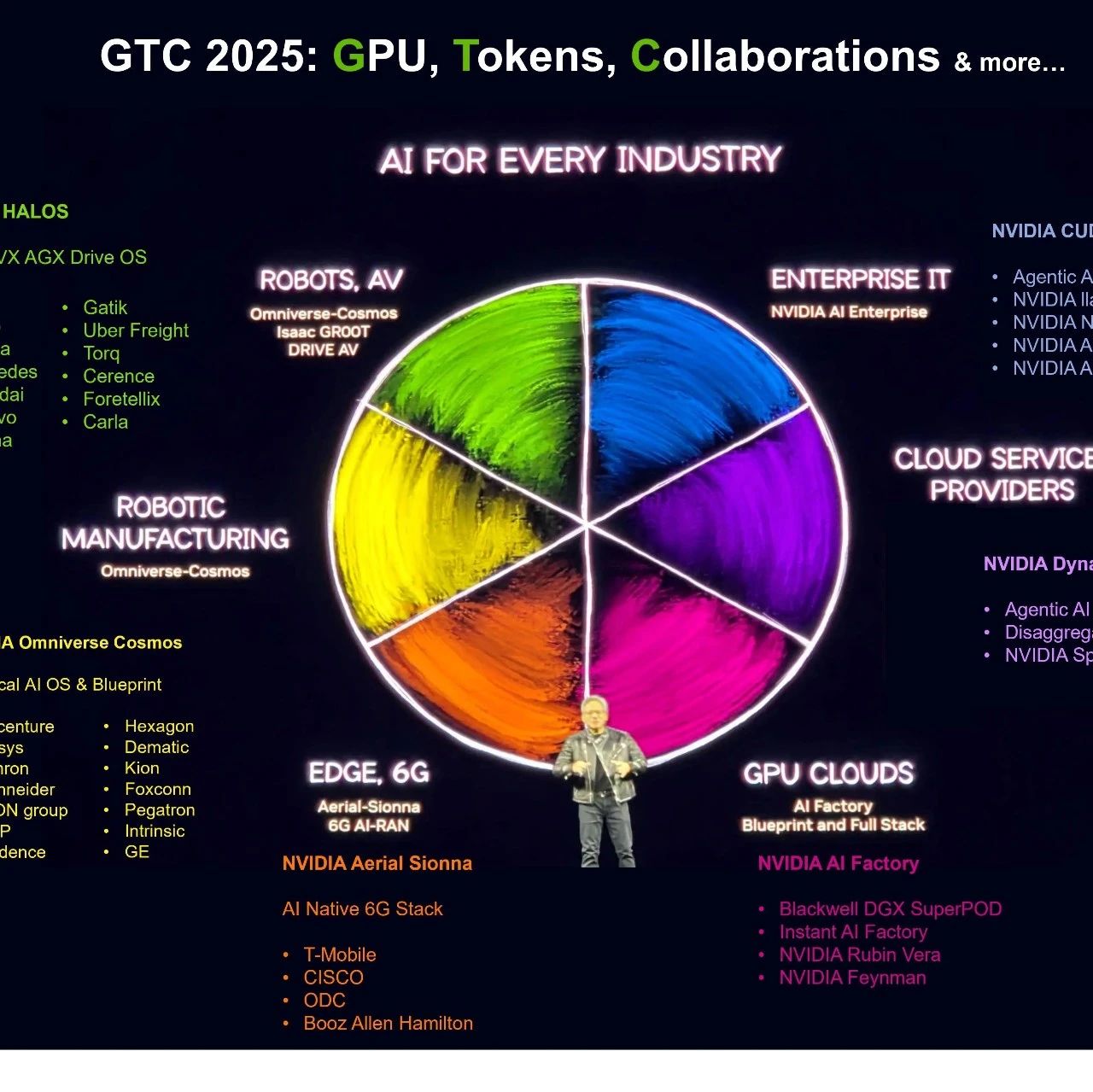
Core Viewpoint - The article discusses NVIDIA's advancements in AI technology, emphasizing the importance of tokens in the AI economy and the need for extensive computational resources to support complex AI models [1][2]. Group 1: Chip Developments - NVIDIA has introduced the "Blackwell Super AI Factory" platform GB300 NVL72, which offers 1.5 times the AI performance compared to the previous GB200 NVL72 [6]. - The new "Vera" CPU features 88 custom cores based on Arm architecture, delivering double the performance of the "Grace" CPU while consuming only 50W [6]. - The "Rubin" and "Rubin Ultra" GPUs will achieve performance levels of 50 petaFLOPS and 100 petaFLOPS, respectively, with releases scheduled for the second half of 2026 and 2027 [6]. Group 2: System Innovations - The DGX SuperPOD infrastructure, powered by 36 "Grace" CPUs and 72 "Blackwell" GPUs, boasts AI performance 70 times higher than the "Hopper" system [10]. - The system utilizes the fifth-generation NVLink technology and can scale to thousands of NVIDIA GB super chips, enhancing its computational capabilities [10]. Group 3: Software Solutions - NVIDIA's software stack, including Dynamo, is crucial for managing AI workloads efficiently and enhancing programmability [12][19]. - The Dynamo framework supports multi-GPU scheduling and optimizes inference processes, potentially increasing token generation capabilities by over 30 times for specific models [19]. Group 4: AI Applications and Platforms - NVIDIA's "Halos" platform integrates safety systems for autonomous vehicles, appealing to major automotive manufacturers and suppliers [20]. - The Aerial platform aims to develop a native AI-driven 6G technology stack, collaborating with industry players to enhance wireless access networks [21]. Group 5: Market Position and Future Outlook - NVIDIA's CUDA-X has become the default programming language for AI applications, with over one million developers utilizing it [23]. - The company's advancements in synthetic data generation and customizable humanoid robot models are expected to drive new industry growth and applications [25].
英伟达(NVDA):事件快评:GTC2025,迈向AgenticAI新时代
Guotai Junan Securities· 2025-03-19 11:13
Investment Rating - The investment rating for the company is "Buy" [1][29] Core Insights - NVIDIA held its annual GTC conference from March 17 to 21, 2025, focusing on the release of Blackwell Ultra and Vera Rubin chips, as well as advancements in Physical AI and Agentic AI [2][7] - The Blackwell Ultra chip is set to achieve a 1.5x performance increase and is expected to enter mass production in the second half of 2025, creating 50 times the revenue opportunities for data centers compared to the previous Hopper architecture [7][10] - The next-generation Vera Rubin chip will begin shipping in the second half of 2026, featuring a memory capacity 4.2 times that of the Grace CPU and a performance increase of 2 times [12][13] - NVIDIA announced a long-term technology roadmap for its AI chips, outlining a progression from Blackwell (2024) to Feynman (2028) [13] Summary by Sections Blackwell Ultra and Rubin Chip Release - The Blackwell Ultra chip will be equipped with up to 288GB of HBM3e memory and enhanced FP4 performance, achieving a 1.5x increase in FP4 inference performance [7][10] - The Blackwell Ultra NVL72 cabinet will include 72 Blackwell Ultra GPUs and 36 Grace CPUs, with a total memory of 20TB and a bandwidth of 576TB/s [10][11] Vera Rubin Chip - The Vera Rubin platform will feature a CPU with 88 cores and a memory bandwidth 2.4 times that of Grace, with overall performance expected to be 3.3 times greater than the previous generation [12][13] - The Vera Rubin Ultra chip is projected to be released in 2027, with performance capabilities reaching 900 times that of the Hopper architecture [12][13] NVIDIA Photonics and CPO System Update - NVIDIA introduced three new switch products under the "NVIDIA Photonics" platform, significantly enhancing performance and deployment efficiency compared to traditional switches [18] - The Quantum 3450-LD switch features 144 ports with a bandwidth of 115TB/s, while the Spectrum SN6800 switch has 512 ports with a bandwidth of 409.6TB/s [18] NVIDIA Dynamo Release - NVIDIA Dynamo is an open-source software designed to enhance inference performance across data centers, claiming to double the performance of standard models and increase token generation by over 30 times for specialized models [19][21]