
基金定投

Search documents
15个问题,一套避坑组合拳!基金小白也能秒变内行,拒绝当韭菜
Sou Hu Cai Jing· 2025-09-08 01:04
Core Insights - The article highlights that while fund investments have low entry barriers and are easy to operate, less than 30% of investors actually make profits due to fundamental cognitive biases [1] Group 1: Fund Types and Rules - Money Market Funds generate returns during weekends and holidays, with holiday earnings disclosed on the second business day after the holiday [2] - Bond Funds continue to earn interest during holidays, but secondary market trading is paused due to stock market closures [3] - Stock/Index Funds do not generate returns during holidays, and investors should be aware of early market closures for Hong Kong stocks [3] Group 2: Buy and Redemption Rules - For buying funds, purchases made before 15:00 are confirmed at the same day's net value, while those after are confirmed at the next day's net value [5] - For redemptions, requests before 15:00 count the same day's earnings, while those after include both the current and next day's earnings [5] Group 3: Investment Strategies - Long-term investment strategies, such as dollar-cost averaging, should not be influenced by specific days of the week, as empirical data shows minimal differences in returns [7] - Suitable funds for dollar-cost averaging include high-volatility stock funds and low-fee index funds, while avoiding low-volatility bond and money market funds [8] Group 4: Timing and Market Signals - Technical indicators like MACD and RSI can help determine the timing for one-time purchases, especially when the PE ratio of indices is low [9] - Signals from monetary policy, such as interest rate cuts, often correlate with market uptrends [10] Group 5: Fund Valuation and Costs - Net asset value does not equate to valuation; a fund with a higher net value may offer better returns than one with a lower net value [12] - Hidden costs, such as management fees and transaction costs, can significantly erode returns over time [14] Group 6: Risk Management - Funds with a continuous low scale may trigger liquidation, but investors can recover their assets at the current net value [15][16] - Understanding the nature of fund dividends is crucial, as dividends do not equate to additional earnings [18] Group 7: Cognitive Biases and Portfolio Construction - Common misconceptions include the belief that lower net values are safer, that dollar-cost averaging guarantees profits, and that frequent dividends indicate a good fund [23] - A recommended asset allocation strategy is the 50-30-20 rule, which suggests 50% in broad index funds, 30% in thematic funds, and 20% in bonds or money market funds [24]


老基民深夜写下5条血泪经验!揭露市场波动的真相与机会!
天天基金网· 2025-09-07 10:06
Core Viewpoint - The article shares five lessons learned from past market downturns, emphasizing the importance of patience, strategic investment, and emotional control during volatile periods [1]. Group 1: Lessons from Market Downturns - In a bull market, 80% of returns come from 20% of the time, indicating that missing the best days can significantly reduce annual returns [4]. - A significant market drop can present buying opportunities; for instance, a 41% profit was achieved by investing during a market panic [9]. - The best approach to market fluctuations is to avoid frequent trading and instead adopt a long-term perspective, as evidenced by better performance during periods of less active management [11]. Group 2: Investment Strategy - Maintaining a portion of stable assets (at least 20%) is crucial to weathering market downturns and preparing for future opportunities [14]. - The article suggests that successful investments often begin during severe market declines, highlighting the importance of controlling emotions rather than attempting to predict market movements [14][15].

基金A类与C类大揭秘:定投选A还是C?一文读懂省钱攻略
Sou Hu Cai Jing· 2025-09-03 00:49
Core Viewpoint - The article explains the differences between Class A and Class C mutual fund shares, focusing on their fee structures and implications for investors, particularly in the context of systematic investment plans (SIPs) Fee Structure Comparison - Class A funds charge a subscription fee ranging from 0.8% to 1.5%, which can be reduced to about 0.15% through discounts, while Class C funds have no subscription fee [1] - Class C funds incur a daily service fee of 0.2% to 0.8% per year, deducted from the fund's assets, whereas Class A funds do not have this fee during the holding period [2][3] - Both fund types impose a redemption fee for short-term holdings, with Class A typically waiving this fee after two years, while Class C may waive it after 30 days [5] Advantages of Class A for SIPs - Class A funds generally have a lower overall fee structure for long-term investments, as the subscription fee is amortized over multiple investments, while Class C's service fees accumulate continuously [7] - Class A funds help investors avoid short-term thinking, promoting a disciplined investment approach, whereas Class C's zero subscription fee may encourage frequent adjustments to investment plans [8] - Class A funds are better suited for long-term investments in volatile markets, as the fixed subscription fee is spread over more shares during market downturns, reducing the effective cost per share [12] Scenarios Favoring Class C - Class C funds are advantageous for short-term trading strategies, where the investor plans to hold for less than six months, as they avoid the upfront subscription fee [8] - For investors with smaller monthly contributions (below 500 yuan), Class C funds may be more cost-effective due to the absence of subscription fees [11] - Class C funds are suitable for cash management tools, such as money market funds, which typically have no subscription or redemption fees [15] Conclusion - The choice between Class A and Class C funds involves a trade-off between long-term cost efficiency and short-term flexibility, with Class A being more beneficial for systematic investment strategies over three years or more [14]

基金高点买入必亏?这才是最大的投资误区!
Sou Hu Cai Jing· 2025-09-02 21:49
Core Insights - The article addresses the misconception that high points in fund performance equate to losses, emphasizing the complexity of market dynamics and the importance of a rational investment framework. Group 1: Industry Fundamentals - The long-term potential of a fund is determined by the underlying industry or company, with examples like the renewable energy sector showing significant growth despite short-term fluctuations [2][4] - Key factors influencing industry performance include policy incentives, technological advancements, and sustained market demand [4] Group 2: Fund Management - Skilled fund managers can mitigate high-point risks through strategic adjustments, with active management outperforming index funds by an average of 12 percentage points over the past five years [6] - Regular investment strategies, such as dollar-cost averaging, can transform high-point risks into long-term gains, evidenced by a case where a monthly investment yielded an 18% return compared to a mere 3% for a lump-sum investment [6] Group 3: Asset Allocation - A balanced approach combining equities and bonds can create a "resilient" portfolio, with a classic allocation of 60% equity funds and 40% bond funds [8][9] - Dynamic adjustments based on market valuations can help manage risk exposure effectively, as shown by the performance differences between pure equity funds and balanced portfolios during downturns [9] Group 4: Investment Traps - Investors often mistakenly equate historical high points with future peaks, necessitating a dynamic perspective on market valuations [12] - The impact of fund fees on long-term returns is significant, with lower management fees leading to substantially higher returns over time [13] - Short-term thinking can undermine the benefits of compounding, highlighting the importance of sustained investment over longer periods [14]

每日钉一下(组合投资主动基金,有这三大优势)
银行螺丝钉· 2025-09-02 13:18
Group 1 - The article emphasizes that fund investment is a suitable method for lazy investors, highlighting the importance of preparing before starting a systematic investment plan [2][3] - It discusses the necessity of creating a well-structured investment plan and outlines four different investment methods to determine which is most suitable for individual investors [2][3] Group 2 - The article presents three major advantages of investing in a combination of active funds rather than a single fund manager [6][7] - The first advantage is the reduction of personal risk associated with individual fund managers, as changes in management can affect investment strategies and styles [8] - The second advantage is the reduction of volatility risk by diversifying across different investment styles and industries, which can help stabilize overall portfolio performance [9][10][11] - The third advantage is the provision of multiple sources of returns, including overall market returns, stock selection by fund managers, and the benefits of selecting outstanding fund managers, which can enhance overall investment returns through diversification and rebalancing strategies [12]

简单4步,帮助新手投资者开启基金|投资小知识
银行螺丝钉· 2025-09-02 13:18
Group 1 - The article emphasizes that for beginners, systematic investment plans (SIPs) are a more suitable method to start investing in funds due to the volatility risk associated with stock funds [3][4]. - A recommended approach for SIPs is to invest 20% of monthly income, for example, if the monthly income is 10,000, then invest 2,000 each month [4]. - The article suggests using resources like the "Bank Screw" public account for weekly investment insights and to identify undervalued index funds [5]. Group 2 - It is important to establish a clear investment plan, including the timing and frequency of investments, such as every Tuesday, and to choose appropriate channels for investment [6].

懒人投资必备!基金定投最全攻略:从入门到精通
Sou Hu Cai Jing· 2025-09-02 02:24
Group 1 - The core mechanism of systematic investment plans (SIPs) involves "fixed time + fixed amount + fixed target," achieving two main functions [2] - SIPs are compared to one-time investments, showing that SIPs can accumulate more low-cost shares during market downturns, leading to higher returns during market rebounds [4][5] - A practical example illustrates that a monthly investment of 1,000 yuan over six months can yield a net profit of 2,299.53 yuan, resulting in an actual return rate of 38.33% [6][10] Group 2 - Basic and enhanced strategies for SIPs include valuation strategies that adjust investment amounts based on historical price-to-earnings (PE) ratios, which can improve annualized returns [9] - Common misconceptions about SIPs include the belief that they can operate completely automatically, which is not true; regular performance reviews are necessary [14] - The article emphasizes the importance of selecting quality assets and allowing sufficient time for compound interest to work, aligning with Warren Buffett's investment philosophy [18]

关于财通资管中证同业存单AAA指数7天持有期基金在兴业银行股份 有限公司新增定期定额投资业务和转换业务的公告
Zhong Guo Zheng Quan Bao - Zhong Zheng Wang· 2025-09-01 06:42
Core Viewpoint - The announcement details the agreement between Caitong Securities Asset Management Co., Ltd. and Industrial Bank Co., Ltd. regarding the launch of regular investment and fund conversion services for the Caitong Asset Management CSI Interbank Certificate of Deposit AAA Index 7-Day Holding Period Securities Investment Fund starting from September 1, 2025 [1] Group 1: Fund Investment and Conversion Services - Starting from September 1, 2025, investors can initiate regular investment and fund conversion services for specified funds through Industrial Bank [1] - Fund conversion allows investors to transfer all or part of their holdings in one fund to another fund managed by the same management company [1] - The conversion service will only be available for funds that are registered with the same registration agency and managed by the same fund manager [2] Group 2: Fund Conversion Rules - Both funds involved in the conversion must be redeemable and subscription-eligible at the time of the conversion request [2] - The conversion price is based on the net asset value of the funds on the day the conversion request is accepted [2] - The conversion process follows a "first in, first out" principle regarding the registration dates of the fund shares [3] Group 3: Conversion Fees and Calculations - Conversion fees consist of the redemption fee from the outgoing fund and any difference in subscription fees between the incoming and outgoing funds [4] - The redemption fee is calculated based on the outgoing fund's redemption rate and the number of shares being converted [5] - The formula for calculating the conversion amount and shares is provided, ensuring transparency in the fee structure [6] Group 4: Important Notes for Investors - Investors engaging in regular investment through Industrial Bank will adhere to the same fee rates as those for subscriptions [7] - Specific rules and discount rates for the investment services will be determined by Industrial Bank [7] - Investors are encouraged to review the fund's legal documents and announcements for detailed information on risks and returns [7]

盈米小帮投顾团队-第8次信号发车
老徐抓AI趋势· 2025-08-29 04:33
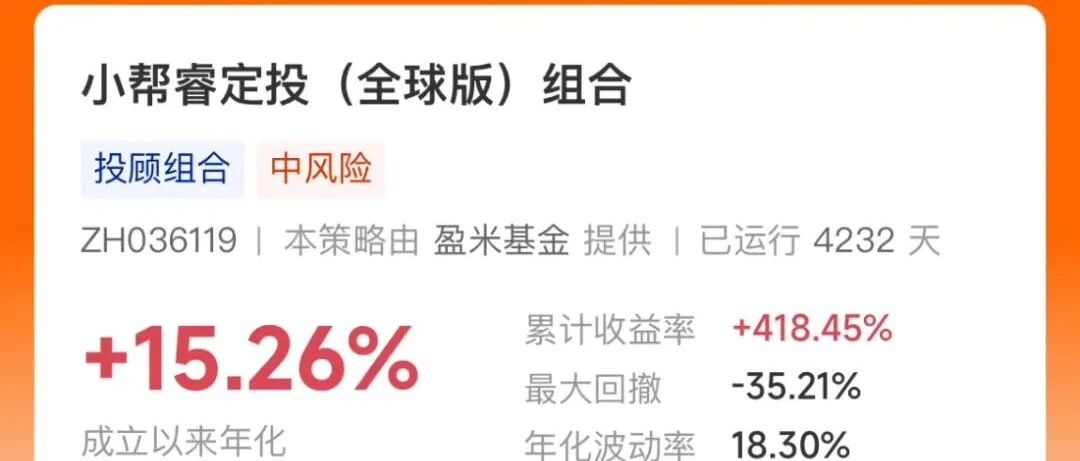
Core Viewpoint - The article highlights the significant performance of A-shares, which surged by 5.4%, contrasting with declines in US and Japanese markets, indicating a clear divergence in global asset performance [1][4][5]. Market Performance Review - A-shares: Increased by 5.4%, leading global markets [4]. - US stocks: Decreased by 1.2% [8]. - Japanese market: Declined by 2.1% [8]. - Hong Kong stocks: Rose by 2.6% [8]. - Indian market: Slight increase of 0.4% [8]. - Vietnamese market: Experienced a decline [8]. - Overall, A-shares' strong performance stands out against the backdrop of global market adjustments [5]. Investment Portfolio Performance Peace of Mind Bond - The Peace of Mind Bond portfolio achieved a modest increase of 0.26% [8]. Smart Investment Global Version - The Smart Investment Global Version portfolio rose by 0.72%, reaching a new historical high, with a cumulative return of 12% for the year [11]. Lazy Balanced Investment - The Lazy Balanced Investment portfolio increased by 0.52%, with a cumulative return of 8.36% year-to-date, surpassing its target range of 6%-8% [15]. Summary of Investment Strategies - The article emphasizes the importance of maintaining defensive strategies in global asset allocation, especially in light of the contrasting performances of A-shares and other markets [5]. - The strong performance of the investment portfolios reflects effective strategies in navigating market volatility and achieving returns above expectations [11][15].
超级股票全明星业绩翻倍 跟投用户盈利占比近100%
Zhong Guo Ji Jin Bao· 2025-08-29 03:22
Core Insights - The A-share market has shown strong performance, with the Shanghai Composite Index breaking through 3700 and 3800 points, reaching a nearly ten-year high, and the total market capitalization of the Shanghai and Shenzhen stock exchanges surpassing 100 trillion yuan [1] - The "Super Stock All-Star" strategy from China Europe Wealth has achieved a cumulative performance of 102.28%, with nearly 100% of the smart follow-up accounts being profitable [1][2] - The "Super Stock All-Star" investment plan was launched in April 2022 during a market downturn, aiming to guide investors through systematic investment strategies [2] Investment Strategy - The "Super Stock All-Star" strategy has led users to accumulate investments during market lows, achieving a real return of 26.40%, outperforming a single investment in the Super Stock All-Star by 21.52% [2] - The strategy has consistently outperformed the benchmark index over the past seven years, except for 2022, indicating its effectiveness in various market conditions [4][5] - The investment approach has been optimized following the extreme market conditions of 2022, enhancing the stability of investment performance [5][6] Strategy Upgrade - The investment strategy has been upgraded from a "single core + satellite" structure to a "double core + satellite" structure to better manage market volatility [6] - The new structure includes a balanced core that adapts to market conditions and aims to reduce portfolio volatility while maintaining exposure to structural opportunities [6][7] - The fund selection process has been thoroughly optimized to ensure better fund choices for users, enhancing the overall investment experience [7]