指数基金

Search documents
市场短期波动下,要不要卖出基金呢?|投资小知识
银行螺丝钉· 2026-03-29 13:43
Group 1 - The article discusses the impact of market fluctuations on investment strategies, particularly in relation to fund holdings during periods of volatility [3] - It references a previous market downturn in April 2025, where A-shares experienced a significant correction of 18%-19% due to concerns over inflation and interest rate policies [3] - The article emphasizes that despite short-term market fluctuations, the long-term outlook suggests a likely decrease in US interest rates, encouraging investors to hold onto their funds rather than sell [3] Group 2 - The article highlights the formula for index fund net value, which is determined by valuation, earnings, and dividends [3]


[3月13日]指数估值数据(指数基金会失效吗;港股指数估值表更新;抽奖福利)
银行螺丝钉· 2026-03-13 13:48
Core Viewpoint - The article discusses the recent fluctuations in the stock market, particularly focusing on the impact of rising oil prices and the resilience of Chinese assets amidst global market volatility. It emphasizes the advantages of low-cost index funds and the enduring principles of value investing. Market Overview - The overall market experienced a decline, with large-cap stocks slightly down and small-cap stocks declining more significantly. Both value and growth styles saw decreases, while dividend and other value styles exhibited smaller fluctuations [3]. - Global markets have been volatile due to significant increases in oil prices, with the first wave of price hikes causing larger market reactions last week, followed by a smaller impact from the second wave this week [3]. - A-shares and Hong Kong stocks showed less volatility compared to overseas markets, indicating a strong competitive advantage for Chinese assets due to stable domestic infrastructure and reduced reliance on oil [3]. Index Fund Insights - The increasing popularity of index funds raises questions about their potential effectiveness as more investors adopt them. However, the fundamental principle of index funds is low cost, which allows them to outperform non-index fund investors when considering costs [10][11]. - The article highlights that all stocks are ultimately owned by shareholders, meaning that the average return for shareholders equals the market index return, barring costs. Index funds, being among the lowest-cost market participants, can provide better actual returns [10]. - Despite the growth of index funds, there is no need to worry about them completely dominating the market due to the complexity of human behavior and the challenges many investors face in maintaining patience and discipline [12][13]. Value Investing - Value investing has proven effective in the A-share market over the long term, but only a small portion of investors consistently practice it [14][15]. - Dividend and value index funds have been present in the A-share market for over 20 years, consistently outperforming the broader market. However, as of 2026, the total scale of dividend index funds is expected to be around 200 billion, a small fraction of the overall stock fund market [16][17]. Hong Kong Market Valuation - The article provides a summary of the valuation of various Hong Kong indices, indicating that the Hang Seng Index and other indices have specific price-to-earnings (P/E) and price-to-book (P/B) ratios, which can serve as a reference for investors [21][20]. - The valuation table includes metrics such as dividend yield and return on equity (ROE) for different indices, highlighting the investment landscape in Hong Kong [21]. Personal Pension Investment Guide - A new book titled "Personal Pension Investment Guide" has been released, aimed at helping investors navigate the personal pension system introduced in China. The book has gained popularity, ranking first in sales on major platforms [24][25]. - The guide is designed to be accessible and easy to read, providing practical insights for investors looking to enhance their retirement savings while benefiting from tax deferral [25].
招商中证新能源汽车交易型开放式指数证券投资基金基金份额发售公告
Shang Hai Zheng Quan Bao· 2026-02-27 19:13
Group 1 - The core point of the news is the launch of the "Zhaoshang CSI New Energy Vehicle ETF," which has received regulatory approval and will be available for subscription from March 5 to March 13, 2026 [1][47][51]. - The fund aims to closely track its benchmark index, with a target to minimize tracking deviation and tracking error, aiming for an absolute daily tracking deviation of no more than 0.2% and an annualized tracking error of no more than 2% [49]. - The total fundraising cap for the fund is set at 2 billion RMB, and if the subscription approaches or exceeds this amount, the fundraising will be closed early [2][3]. Group 2 - Investors can subscribe to the fund through online cash subscription or offline cash subscription methods, with specific procedures outlined for each [4][62][64]. - The fund's management and custody are handled by Zhaoshang Fund Management Co., Ltd. and Zhejiang Commercial Bank, respectively [1][47]. - Investors must have a Shenzhen securities account to participate in the subscription, and those without an account must open one prior to subscribing [59][60]. Group 3 - The fund's subscription fees will be borne by investors, with a maximum commission rate of 0.3% applicable for online subscriptions [55]. - Interest generated during the fundraising period will be converted into fund shares for the investors [53][56]. - The fund's shares will be issued at a par value of 1.00 RMB each [47].

[2月27日]指数估值数据(刚开始定投基金,选什么会容易;港股指数估值表更新;抽奖福利)
银行螺丝钉· 2026-02-27 14:00
Core Viewpoint - The article discusses the current state of the stock market, focusing on index performance, investment strategies for beginners, and the importance of understanding risk tolerance in investment choices [2][11][18]. Market Overview - The major indices such as the CSI 300 and A50 experienced declines, while small-cap stocks showed slight gains. Value styles, including dividend stocks, remained relatively stable with minor increases. The ChiNext index saw a more significant drop after reaching overvaluation levels [2][4][12]. - The Hong Kong stock market opened lower but closed higher, with technology stocks also showing gains [2][29]. Investment Strategies - For new investors, starting with broad-based indices like the CSI 300 or value style indices is recommended for easier adherence to investment plans. Growth styles and thematic industry investments are more volatile and better suited for experienced investors [11][18]. - The article highlights the volatility of different investment styles: broad-based indices have an annual volatility of approximately 20-25%, while value styles exhibit about 60-70% of that volatility. For instance, if the broad market declines by 30%, a low-volatility dividend stock might only drop around 20% [4][6][12]. Performance Metrics - From 2021 to May 2024, the maximum drawdown for broad-based indices was around 40%, while value styles experienced a drawdown of about 20%. Growth styles, such as the Sci-Tech 50, faced drawdowns exceeding 60% [12][13][14]. - Since May 2024, broad-based indices have risen by 50-60% from their lows, while value styles have increased by 30-40%, and growth styles have doubled [15][16][17]. Risk Management - Investors are often prone to overestimating their risk tolerance. Starting with lower volatility investments can help individuals gauge their risk capacity more accurately [19][20]. - For those still concerned about volatility in dividend indices, increasing exposure to bond assets is suggested, leading to a more stable investment profile [21][26]. Hong Kong Market Valuation - The article provides a valuation summary for various Hong Kong indices, indicating that the overall market is currently rated around 3 stars, reflecting its valuation status [29][31]. Performance of Investment Products - The article mentions the success of the "Screw" investment advisory portfolio, which has helped investors achieve a cumulative profit of 2.72 billion yuan, with over 90% of holders making a profit [34][35].
指数基金可分为宽基和行业指数基金
Xin Lang Cai Jing· 2026-02-23 05:19
Core Viewpoint - The article discusses common types of index funds, categorizing them into broad-based and sector-specific index funds, highlighting various examples in each category [1][2]. Group 1: Broad-Based Index Funds - Common broad-based index funds include: Shanghai Stock Exchange 50, CSI 300, CSI 500, ChiNext, Dividend, Fundamental, CCTV 50, Hang Seng, H Shares, Shanghai Stock Exchange 50AH Preferred, NASDAQ 100, and S&P 500 [1][2]. Group 2: Sector-Specific Index Funds - Common sector-specific index funds include those focused on essential consumer industries, pharmaceutical industries, discretionary consumer industries, elderly care industries, banking industries, securities industries, insurance industries, financial industries, and real estate industries [2].
【收藏】投资知识篇:螺丝钉精华文章汇总2025
银行螺丝钉· 2026-02-19 13:39
Core Viewpoint - The article serves as a summary of selected articles from 2025, aimed at providing readers with a convenient way to review, share, and collect valuable content related to investment knowledge and practical insights [1][2]. Investment Knowledge and Insights - The summary includes insights on investment fundamentals, addressing common questions faced by investors during the fund investment process [2]. - Key topics covered include the development stages of index funds in the US stock market, the concept of stablecoins, and strategies for enhancing index investments [4][5]. - The article emphasizes the importance of understanding different investment products and their performance in various market conditions, including how to manage risks and optimize returns [4][5]. Investment Strategies and Performance - Highlights include the performance of various investment portfolios, such as the "螺丝钉投顾组合" which has achieved notable results over its four-year history [4]. - The article discusses the benefits of using index funds for global stock market investments and the introduction of features like automatic profit-taking to enhance investment management [4]. - It also mentions the recent high performance of the "365天投顾组合" and explores the sources of its returns, questioning whether adjustments are needed in the current market environment [4]. Practical Knowledge - The article provides practical advice on tax filing deadlines and benefits available for families, such as child-rearing subsidies [5]. - It encourages readers to stay informed about investment opportunities and market trends, including the significance of annual shareholder letters from influential investors like Warren Buffett [4][5].

上证180指数上涨0.20%,上证180ETF指数基金(530280)交投活跃
Sou Hu Cai Jing· 2026-02-13 01:47
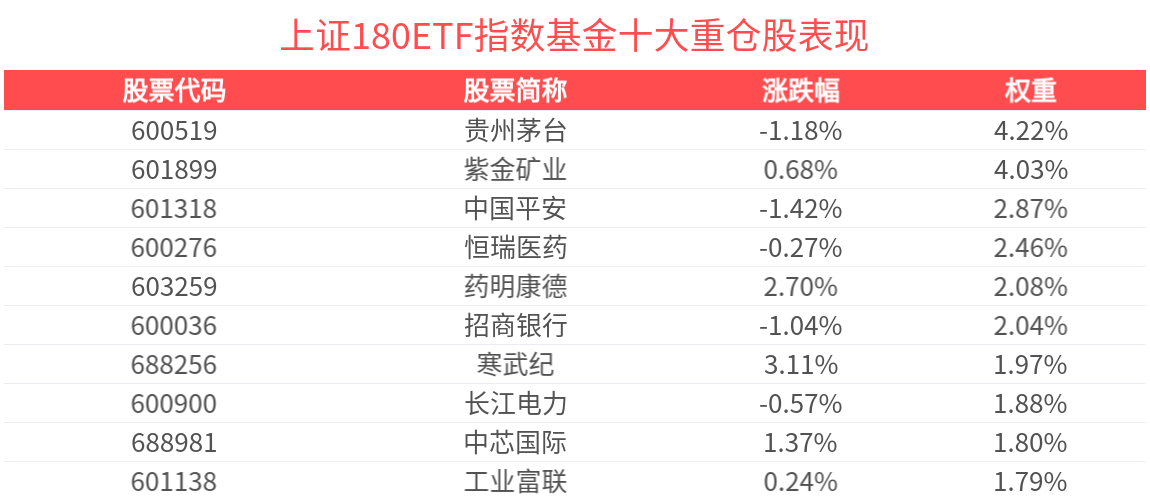
Core Insights - The Shanghai 180 Index (000010) has shown a slight increase of 0.20% as of February 12, 2026, with notable gains from stocks such as Dongfang Electric (+10.00%) and China National Offshore Oil Corporation (+9.98%) [1] - The Shanghai 180 ETF (530280) has experienced a minor decline of 0.16%, currently priced at 1.26 yuan, but has seen a cumulative increase of 1.04% over the past week [1] - The ETF has a Sharpe ratio of 1.91 since its inception, indicating a favorable risk-adjusted return [1] Performance Metrics - The Shanghai 180 ETF has a maximum drawdown of 4.28% year-to-date, with a relative benchmark drawdown of 0.06% [1] - The management fee for the ETF is set at 0.15%, while the custody fee is 0.05% [1] - The tracking error for the ETF over the past three months is 0.019%, reflecting its close alignment with the underlying index [1] Index Composition - The Shanghai 180 Index comprises 180 securities selected for their large market capitalization and liquidity, representing the core performance of Shanghai's listed companies [2] - As of January 30, 2026, the top ten weighted stocks in the index account for 24.85% of the total index weight, including major companies like Zijin Mining and Kweichow Moutai [2] - The top ten stocks by weight include: - Zijin Mining (4.03%) - Kweichow Moutai (4.22%) - China Ping An (2.87%) - Others include Hengrui Medicine, WuXi AppTec, and China Merchants Bank [3]
沪指全天窄幅震荡实现3连涨,关注A500ETF易方达(159361)、沪深300ETF易方达(510310)等投资价值
Sou Hu Cai Jing· 2026-02-11 10:43
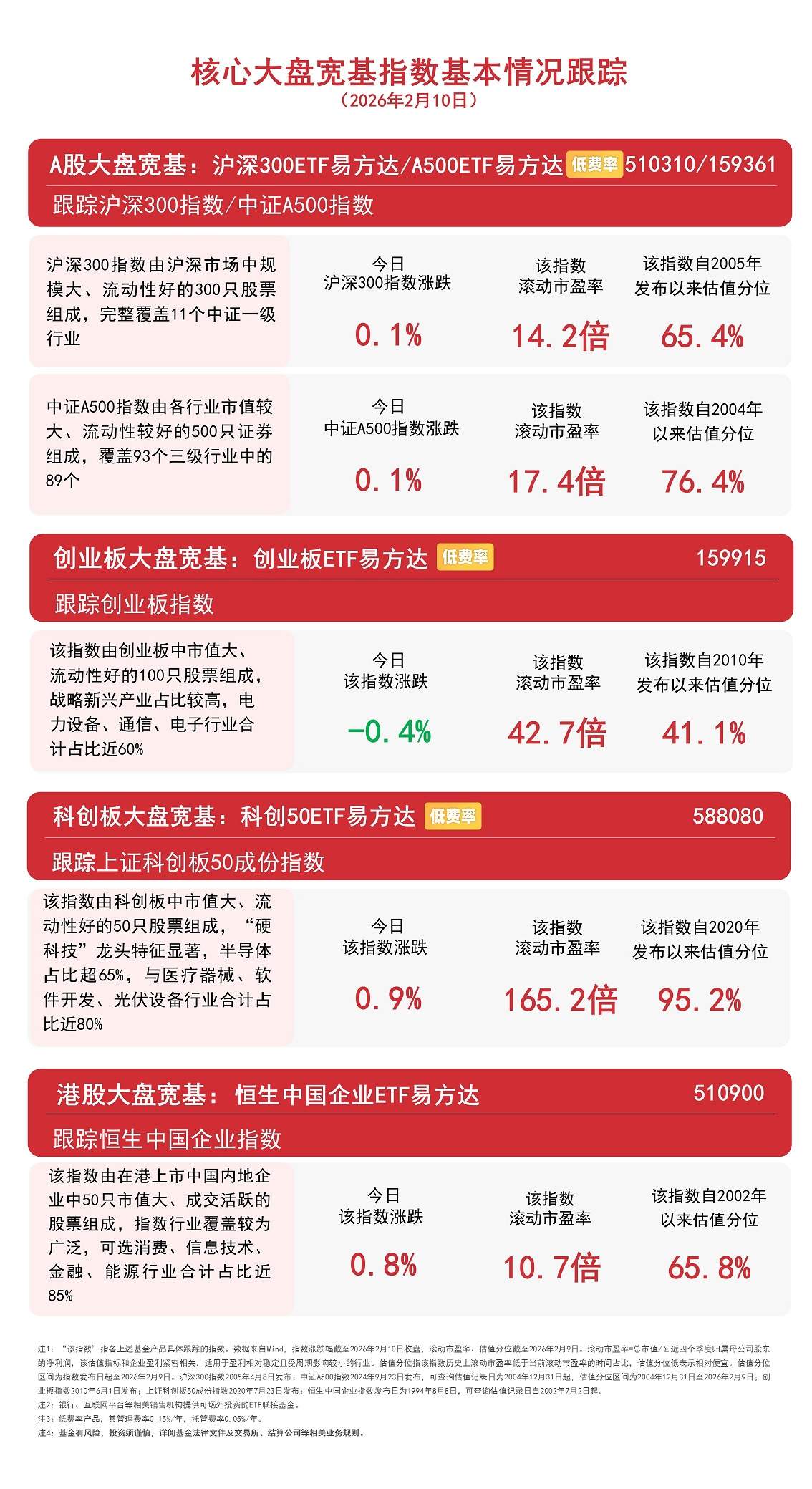
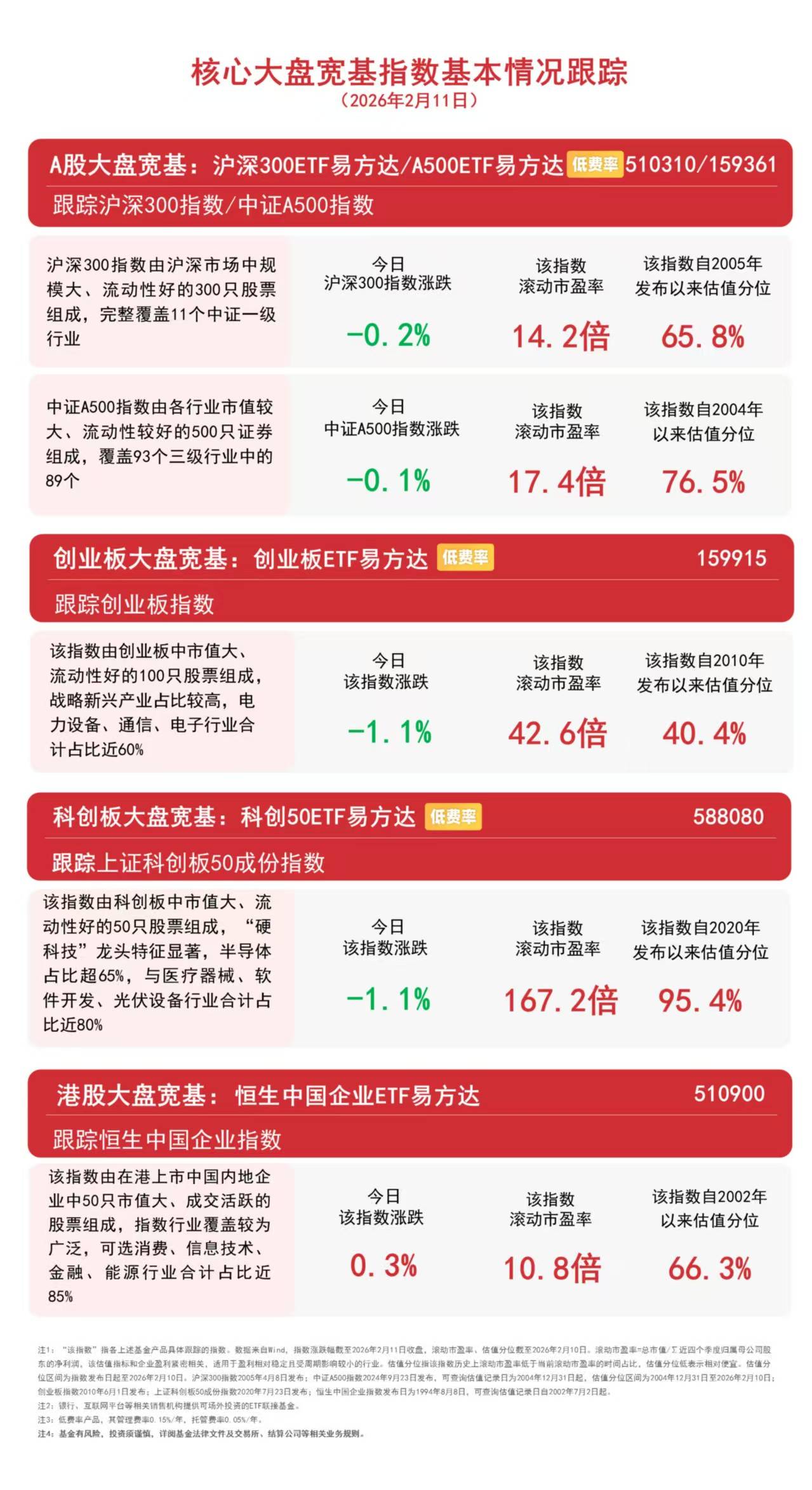
Market Performance - The A-share market showed mixed performance on February 11, with the Shanghai Composite Index rising by 0.09%, marking a three-day increase [1] - The CSI 300 Index fell by 0.2%, while the CSI A500 Index decreased by 0.1% [3][1] - The ChiNext Index and the STAR Market 50 Index both dropped by 1.1% [1] Sector Performance - Leading sectors included small metals, oil and gas extraction and services, chemical fibers, rare earth permanent magnets, steel, dyes, coal mining and processing, batteries, and cement [1] - Underperforming sectors included film and television, short drama games, education, tourism and hotels, cultivated diamonds, military equipment, CPO, and airport and shipping [1] - In the Hong Kong market, sectors such as building materials, non-ferrous metals, chemicals, real estate, and automobiles performed well, while consumer, semiconductor, and non-bank financial sectors weakened [1] Index Details - The CSI 300 Index consists of 300 stocks with good liquidity, covering 11 primary industry categories, with a rolling P/E ratio of 14.2 times [3] - The CSI A500 Index includes 500 securities with good liquidity, covering 89 out of 93 tertiary industries, with a rolling P/E ratio of 17.4 times [3] - The STAR Market 50 Index is composed of 50 stocks with significant market capitalization and liquidity, with over 65% representation from the semiconductor sector [7]
上证180指数上涨0.26%,上证180ETF指数基金(530280)备受关注
Sou Hu Cai Jing· 2026-02-11 01:41
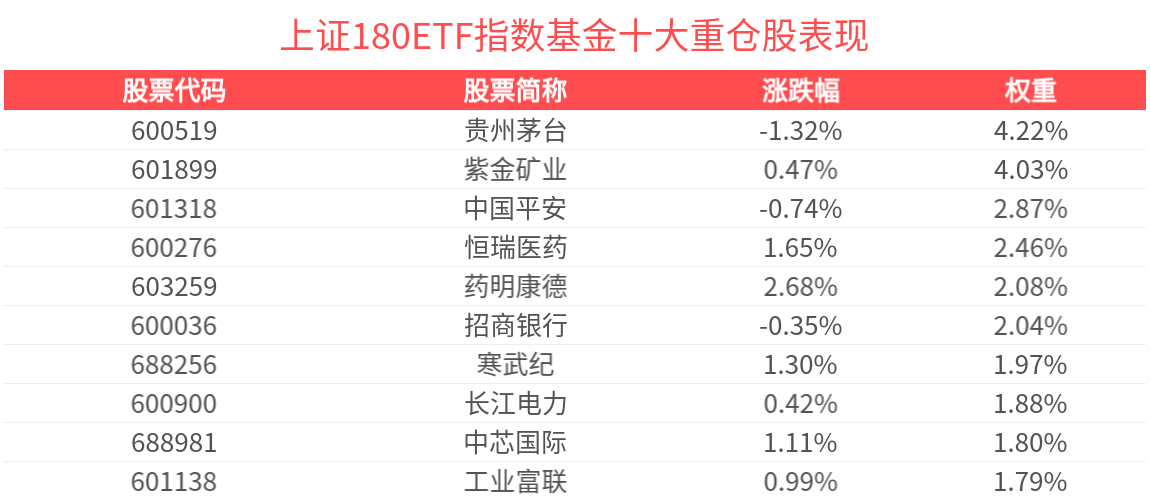
Core Viewpoint - The Shanghai 180 ETF Index Fund closely tracks the Shanghai 180 Index, which reflects the overall performance of 180 large-cap and liquid securities in the Shanghai stock market, showing a recent upward trend in both the index and the fund itself [1][2]. Performance Summary - As of February 10, 2026, the Shanghai 180 Index increased by 0.26%, with notable gains from stocks such as China Power (+9.99%) and Dongfang Electric (+8.34%) [1]. - The Shanghai 180 ETF Index Fund rose by 0.24%, with a latest price of 1.26 yuan, and has accumulated a 1.37% increase over the past week [1]. - The fund's trading volume was 23.03 thousand yuan on February 10, with an average daily trading volume of 65.87 thousand yuan over the past week [1]. Fund Size and Growth - The Shanghai 180 ETF Index Fund experienced a significant growth of 622.11 thousand yuan in size over the past year [1]. - The fund has a Sharpe ratio of 1.91 since its inception, indicating a favorable risk-adjusted return [1]. Fee Structure - The management fee for the Shanghai 180 ETF Index Fund is set at 0.15%, while the custody fee is 0.05% [1]. Tracking Accuracy - As of February 10, 2026, the tracking error of the Shanghai 180 ETF Index Fund over the past three months is 0.019%, demonstrating its effectiveness in tracking the underlying index [1]. Top Holdings - As of January 30, 2026, the top ten weighted stocks in the Shanghai 180 Index account for 24.85% of the index, including major companies like Zijin Mining and Kweichow Moutai [2]. - The top ten stocks by weight are: - Zijin Mining (4.03%) - Kweichow Moutai (4.22%) - China Ping An (2.87%) - Hengrui Medicine (2.46%) - WuXi AppTec (2.08%) - Cambricon (1.97%) - China Merchants Bank (2.04%) - Yangtze Power (1.88%) - SMIC (1.80%) - Industrial Fulian (1.79%) [3].
市场窄幅震荡,关注A500ETF易方达(159361)、沪深300ETF易方达(510310)等产品中长期配置价值
Mei Ri Jing Ji Xin Wen· 2026-02-10 22:58
Group 1 - The A-share market showed mixed performance on February 10, with the Shanghai Composite Index rising by 0.13% [1] - The sectors that performed well included film and television, short drama games, computing power leasing, education, chemical pharmaceuticals, coal mining and processing, and the China Shipbuilding Industry [1] - Conversely, sectors that saw declines included liquor, precious metals, cultivated diamonds, photovoltaic equipment, airport and shipping, batteries, and epoxy propylene [1] Group 2 - The CSI 300 Index, which consists of 300 stocks from the Shanghai and Shenzhen markets, increased by 0.1% and has a rolling price-to-earnings ratio of 14.2 times, placing it in the 65.4% valuation percentile since its inception in 2005 [2] - The CSI A500 Index, made up of 500 stocks with good liquidity across various industries, also rose by 0.1% and has a rolling price-to-earnings ratio of 17.4 times, ranking in the 76.4% valuation percentile since 2004 [2] - The ChiNext Index, which includes 100 stocks from the ChiNext market, decreased by 0.4% and has a rolling price-to-earnings ratio of 42.7 times, placing it in the 41.1% valuation percentile since its launch in 2010 [2]