
Agentic AI

Search documents
What CEOs talked about in Q3 2025: Tariff realities, data center capacity, and the agentic AI future
IoT Analytics· 2025-09-30 16:04
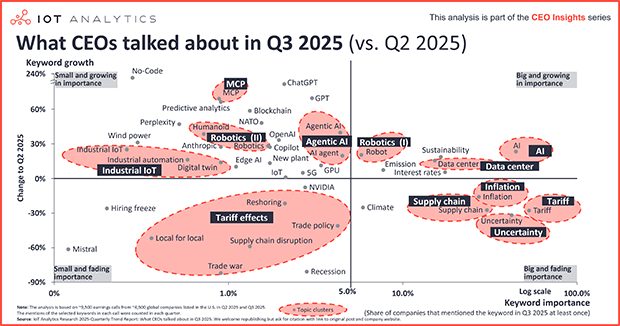
Group 1 - CEOs are increasingly prioritizing digital themes, with AI, software, and data centers being the leading topics in Q3 2025 earnings calls, reflecting a nearly doubled mention rate over the past five years [4][11][34] - Discussions around tariffs remain prevalent, cited in 53% of earnings calls, although this represents a 28% decline quarter-over-quarter, indicating a shift towards structured management of tariffs rather than mitigation [8][34] - The demand for data centers is strong, with mentions rising to 15% of earnings calls, particularly in the utilities and construction sectors, highlighting capacity constraints despite high demand [16][17] Group 2 - Agentic AI is gaining traction, with mentions rising 40% quarter-over-quarter to 4% of calls, while overall AI discussions reached 45% of calls, marking a significant increase in focus on practical applications [22][24] - Robotics, particularly humanoid applications, saw a 28% increase in mentions, with the manufacturing sector showing the highest engagement, indicating a growing interest in AI-driven robotics [28][30] - Economic growth is projected to slow, with global GDP growth expected to decrease from 3.3% in 2024 to 3.2% in 2025, influenced by factors such as tariff increases and inflation [5][6]


UiPath Inc. (PATH): A Bull Case Theory
Yahoo Finance· 2025-09-28 15:41
Core Thesis - UiPath Inc. is positioned as a key player in the agentic AI economy, focusing on execution and orchestration rather than foundational model development [2] - The stock is currently undervalued, trading at $11.57, down 86% from its peak, with significant upside potential based on valuation scenarios [4] Financial Performance - UiPath reported $357 million in revenue for Q1 FY2026, a 6% year-over-year increase, with an Annual Recurring Revenue (ARR) of $1.693 billion, reflecting a 12% growth [3] - Non-GAAP operating margins improved to 20%, and free cash flow reached $117 million, supported by a cash balance of $1.59 billion [3] Market Position and Growth - The company has seen early traction with over 15,000 attendees at product launches and 250,000 agent runs, consistently recognized as a Leader in Gartner's RPA Magic Quadrant [3] - Despite a slowdown in customer growth and net retention softening to 108%, UiPath's enterprise automation leadership remains strong [5] Valuation Insights - A conservative price-to-sales (P/S) multiple of 5.75x suggests a target price of $15.16 per share, while a bullish scenario with a 10x P/S could elevate the stock to $26.36 [4] - The current trading levels are seen as depressed and do not reflect the company's potential [4] Competitive Landscape - Concerns regarding competition are considered overstated, with developments like Anthropic's Model Context Protocol enhancing UiPath's integration capabilities [2] - The company is not among the 30 most popular stocks among hedge funds, with 42 hedge fund portfolios holding PATH at the end of Q2 [6]

放弃 CoT?Agentic 时代为什么更需要隐式推理?
机器之心· 2025-09-28 07:05
Group 1 - The article discusses the limitations of Chain of Thought (CoT) reasoning in AI, highlighting its inability to break the "1Hz" barrier and suggesting that implicit reasoning may be a more suitable approach for Agentic AI [7][8][10] - Recent studies indicate that CoT may not represent true reasoning but rather a structured pattern matching, which can lead to performance degradation in tasks requiring inductive reasoning [9][10] - The high computational cost and time consumption associated with explicit reasoning make it less viable for real-time applications, necessitating a shift towards implicit reasoning that can adapt to various task complexities [10][11] Group 2 - Implicit reasoning is gaining traction as it allows for faster processing and lower costs, making it more suitable for real-time AI applications compared to the traditional "Think-before-Speaking" (TbS) model [11][12] - The article emphasizes the need for AI agents to dynamically adjust their reasoning depth and speed based on task difficulty, which is a key capability for future AI development [10][11] - Challenges remain for implicit reasoning, particularly in high-stakes scenarios where accuracy and verifiability are paramount, such as legal document analysis and medical diagnostics [13][14]

投注“端到端”:AI驶向物理世界,阿里云加速“闭环”
第一财经· 2025-09-27 12:39
Core Viewpoint - The rise of AI is leading to a new era characterized by embodied intelligence and intelligent assisted driving, marking the beginning of a competitive landscape in the Agentic AI era [1] Group 1: End-to-End Transformation - The transition from modular to end-to-end architectures in intelligent assisted driving is a significant shift, allowing for rapid iteration and adaptation to complex scenarios [3][4] - The end-to-end architecture requires exponential growth in data volume and computational power, with current mainstream intelligent driving companies needing 10P-30P of data for single model training [4] - The embodied intelligence sector faces even greater complexity, requiring machines to understand physical laws and execute intricate actions, which presents unique challenges in data handling and computational needs [4] Group 2: Cloud Infrastructure and AI Integration - Companies are increasingly seeking a unified cloud AI infrastructure that integrates computational power, big data, and AI platforms to support embodied intelligence [5] - Alibaba Cloud has upgraded its intelligent assisted driving solutions, achieving significant efficiency improvements, such as a 2-3 times increase in task management and scheduling capabilities [7] - The integration of NVIDIA's tools into Alibaba Cloud's AI platform aims to enhance the development of embodied intelligence applications, showcasing a comprehensive support system for data processing and model training [9] Group 3: High Demand and Future Outlook - The demand for high availability and extreme communication capabilities in embodied intelligence is pushing cloud providers to innovate beyond traditional models, leading to a new "network-storage-computation integration" requirement [10] - Alibaba Cloud is positioning itself as a leader in the AI infrastructure space, with ambitions to build a super AI cloud that can support the future needs of various industries [11][12] - The future may see a limited number of super cloud computing platforms, with Alibaba Cloud aiming to be a key player through substantial investments in AI infrastructure [11]

No Curveballs in the PCE Report – But Here's What's Next
Investor Place· 2025-09-27 00:31
Economic Indicators - The Personal Consumption Expenditures (PCE) Price Index showed a month-over-month increase of 0.3%, leading to a year-over-year inflation rate of 2.7% [1] - Core PCE, excluding food and energy, rose by 0.2% month-over-month, resulting in a 12-month core rate of 2.9% [2] - Personal consumption expenditures increased at a pace of 0.6%, indicating resilience among U.S. consumers, while the personal saving rate edged up to 4.6% [3] Federal Reserve Outlook - The Federal Reserve is likely to find the PCE report mildly soothing, but core inflation remains significantly above the 2% target, complicating rate-cut decisions [4] - The Fed is balancing the need to control inflation without causing distress in the labor market, as wage growth is cooling and job creation has softened [5] - Expectations for interest rate cuts have strengthened, with the probability of two quarter-point cuts increasing from 60.5% to 63% following the PCE data release [6] Quantum Computing Developments - HSBC has reported a 34% improvement in algorithmic corporate bond trading efficiency through the use of quantum computing tools in collaboration with IBM [12] - This advancement represents a significant step in the practical application of quantum computing, showcasing its potential to solve real-world business problems [13] Investment Strategies in Quantum Computing - Investing in quantum computing is characterized by high volatility, with companies like Rigetti experiencing significant price fluctuations [15][16] - It is advised to focus on quantum companies with strong fundamentals rather than those driven by hype, as weak fundamentals can lead to stock declines [18] Agentic AI and Investment Opportunities - The introduction of AI shopping agents, which can autonomously make purchases, is being facilitated by Google's new Agent Payments Protocol [23] - Investment opportunities in agentic AI can be categorized into three main areas: platform owners like Alphabet, payment processors such as Visa and Mastercard, and infrastructure providers like Amazon and Microsoft [26][28] Broader AI Trends - The advancements in agentic AI are part of a larger trend in AI, which includes the development of physical AI capable of sensing and acting in the real world [30]

Why Morgan Stanley Turned Bullish on ServiceNow (NOW) Despite GenAI Risks
Yahoo Finance· 2025-09-26 23:15
Core Viewpoint - ServiceNow, Inc. has been upgraded by Morgan Stanley from Equalweight to Overweight, with a new price target of $1,250.00, reflecting confidence in the company's growth potential despite perceived risks [1]. Group 1: Company Performance - ServiceNow has achieved approximately 20% subscription growth, strong margins, and solid cash flow, while continuing to invest in Generative AI [2]. - The company is well-positioned for future growth due to the adoption of Now Assist, workflow integration, and the introduction of new AI products [3]. Group 2: Market Concerns - Despite its strong performance, ServiceNow's shares have underperformed the broader market due to concerns regarding government spending, tougher comparisons, and long-term risks associated with Generative AI innovation [2]. - Investors are cautious about the potential risks that Generative AI poses to traditional seat-based models and the execution risks related to transitioning to a hybrid pricing model [4]. Group 3: Future Opportunities - ServiceNow is expected to benefit from a product cycle related to Now Assist, with potential consumption-related benefits anticipated to materialize in 2026 and 2027 [4]. - The company is developing a robust workflow data fabric that connects various data sources, creating a unified engagement system across multiple business functions [4]. - A growing suite of AI-related products, such as AI Control Tower, is being introduced, emphasizing ServiceNow's commitment to product innovation and its potential to monetize opportunities in the AI space [4].

10 AI Stocks in the Spotlight This Week
Insider Monkey· 2025-09-25 18:11
Industry Insights - Companies are increasingly investing in agentic AI without fully understanding its capabilities, leading to potential waste of future investments [1] - A significant portion of organizations, only 14%, have fully adopted agentic AI technology, indicating a gap in readiness for its demands [3][4] - The current trend shows a rebranding of generative AI as agentic AI, creating confusion in the market [2] Company Highlights - Atlassian Corporation (NASDAQ:TEAM) is focusing on acquisitions to enhance its Cloud Platform, with two recent acquisitions totaling $1.61 billion expected to close by year-end [7][8] - Accenture plc (NYSE:ACN) is anticipated to report steady performance in its upcoming quarterly results, with a revenue estimate of $17.4 billion reflecting approximately 5.5% year-over-year growth [10][11] - Micron Technology, Inc. (NASDAQ:MU) is benefiting from increased demand for AI and tight supply discipline in the memory industry, leading to a price target increase to $180 [12][13][15] - Adobe Inc. (NASDAQ:ADBE) has faced challenges in AI monetization, leading to a downgrade from Overweight to Equalweight, with a revised price target of $450 [17][18][20]



Accenture completes ‘reinvention’ as generative AI revenues roll in
Yahoo Finance· 2025-09-25 13:49
Core Insights - Accenture is consolidating its business around large-scale digital transformation projects to address challenges in generating returns from investments in generative AI technologies [3] - The company is focused on alleviating the AI talent shortage faced by enterprise customers, with nearly two-thirds of executives indicating that their generative AI plans are hindered by a lack of in-house skills [4] Business Strategy - Accenture's new model aims to simplify the selling and delivery of its offerings while embedding more AI and data into its services, with nearly 80% of large deals involving multiple services [3] - The company has invested $1 billion in a skill-building platform for enterprise customers and acquired learning platform Udacity to enhance its AI talent pool [5] Talent Development - Accenture has nearly doubled its staff of AI and data professionals to 77,000 in two years, with over 550,000 employees trained in generative AI fundamentals [6] - The firm is actively upskilling employees, as evidenced by a partnership with S&P Global to train 35,000 employees in AI [5] Financial Performance - During Q4 2025, Accenture reported significant growth in its AI business, with generative and agentic AI revenues tripling to $2.7 billion and bookings nearly doubling to $5.9 billion year over year [7] - The company's total revenue grew 7% to nearly $70 billion, with revenue split almost equally between consulting and managed services [7]
CXAI Showcasing Agentic AI based Employee Experience Platform at Industry Events in October in New York, San Francisco, and Southern California
Accessnewswire· 2025-09-25 13:15
Group 1 - CXApp Inc. is actively engaging executives and clients through various conferences and exclusive events to promote thought leadership in the AI-driven employee experience market [1] - The company has announced its schedule for October, which includes industry conferences and networking events aimed at showcasing its agentic-AI based employee experience platform [1] - The focus is on demonstrating real-world applications of AI to key decision-makers and industry leaders [1]

Accenture(ACN) - 2025 Q4 - Earnings Call Transcript
2025-09-25 13:02
Financial Data and Key Metrics Changes - In fiscal year 2025, the company achieved a revenue growth of 7%, adding $5 billion in revenue, with over $80 billion in bookings [5][22] - Adjusted earnings per share (EPS) for Q4 was $3.03, reflecting a 9% growth compared to the previous year [15][21] - Free cash flow for Q4 was $3.8 billion, and for the full year, it was $10.9 billion, up 26% year over year [15][23] Business Line Data and Key Metrics Changes - Consulting revenues for Q4 were $8.8 billion, up 6% in U.S. dollars and 3% in local currency [17] - Managed services revenues for Q4 were also $8.8 billion, reflecting an 8% increase in U.S. dollars and 6% in local currency [18][23] - The capital projects business grew 49% year on year, reaching $1.2 billion [9] Market Data and Key Metrics Changes - In the Americas, revenue grew 5% in local currency, with significant contributions from banking and capital markets [18] - EMEA delivered 3% growth in local currency, driven by insurance and life sciences [18] - Asia Pacific revenues grew 6% in local currency, led by banking and capital markets [19] Company Strategy and Development Direction - The company aims to be the number one partner for the tech ecosystem, with 60% of revenue coming from partnerships with top technology companies [7] - A significant investment of $3 billion in Gen AI is expected to drive future growth, with revenue from advanced AI reaching $2.7 billion in FY25 [8][9] - The company is focusing on a three-pronged talent strategy to upskill its workforce and enhance operational efficiency [12][13] Management's Comments on Operating Environment and Future Outlook - Management expressed confidence in the company's positioning for FY26, citing strong bookings and a solid pipeline for large transformation deals [46] - The overall market conditions have not shown significant changes, and the company remains focused on delivering results [25][26] - The management highlighted the importance of AI in driving growth and productivity, emphasizing that AI is seen as expansionary rather than deflationary [48][49] Other Important Information - The company initiated a business optimization program with an expected total cost of approximately $865 million, aimed at talent rotation and divestiture of non-aligned acquisitions [16] - The company plans to return at least $9.3 billion to shareholders through dividends and share repurchases in FY26, reflecting a 12% increase from FY25 [43] Q&A Session Summary Question: Visibility on revenue growth and discretionary spending - Management indicated strong demand for large transformation deals and a solid backlog, with guidance for FY26 reflecting a range of 2% to 5% growth [46] Question: Thoughts on AI-driven productivity and potential deflationary effects - Management does not see AI as deflationary but rather as expansionary, with savings being reinvested into new priorities [48][49] Question: Balance between Gen AI and managed services - Both consulting and managed services are expected to grow in the low to mid-single-digit range, with managed services becoming increasingly strategic [54][56] Question: Details on CapEx investments - The company expects about $1 billion in CapEx for FY26, primarily for expanding real estate and leasehold improvements [63] Question: Client behavior in using Gen AI - Many clients initially attempted to implement Gen AI independently but later sought assistance for scaling, highlighting the need for change management and process reinvention [78] Question: Expected savings from the business optimization program - The company anticipates savings of over $1 billion from the optimization program, which will be reinvested in the business and workforce [81]