关联交易

Search documents
振石股份IPO:11亿分红流向实控人父子,募资39亿背后,关联依赖加剧独立性风险
Sou Hu Cai Jing· 2025-11-15 18:44
Core Viewpoint - Zhejiang Zhenstone New Materials Co., Ltd. is set to go public on November 18, 2025, with an IPO fundraising target of 3.981 billion yuan, primarily for capacity expansion and overseas layout, despite facing high debt and cash flow issues since its privatization in 2019 [1][2][4]. Financial Performance - The company has consistently reported negative net cash flow from operating activities for 2022 and 2023, amounting to -208 million yuan and -409 million yuan respectively, indicating reliance on external borrowing to support operations and dividend payments [3][4]. - Revenue declined from 5.267 billion yuan in 2022 to 4.439 billion yuan in 2024, a year-on-year decrease of 13.37%, while net profit fell from 774 million yuan to 606 million yuan, a decline of 23.43% [7]. Dividend Policy - The company has engaged in significant dividend payouts, distributing 540 million yuan in 2022 and 600 million yuan in 2023, which accounted for 69.77% and 75.95% of net profit respectively, raising concerns about prioritizing shareholder returns over debt management [2][3]. Debt Situation - Short-term borrowings increased from 1.587 billion yuan to 3.240 billion yuan between 2022 and 2025, with a liquidity gap exceeding 400 million yuan as of June 2025, indicating ongoing liquidity risks [4][5]. - Long-term borrowings rose from 830 million yuan in 2022 to 2.788 billion yuan in the first half of 2025, with a debt-to-asset ratio consistently around 71%, significantly higher than the industry average of 45%-55% [4][5]. Business Dependency - The company relies heavily on a concentrated supply chain, with over 82% of purchases from the top five suppliers, including approximately 70% from the related party China Jushi, raising concerns about operational independence [5][6]. - Sales to related parties, particularly to China National Materials Group, accounted for about 12% of total revenue, further entrenching the company's position within a closely-knit corporate structure [6]. Expansion Plans - Despite the challenging financial landscape, the company plans to use over 90% of the IPO proceeds (3.606 billion yuan) for capacity expansion, increasing total capacity from 540,000 tons in 2024 to 953,000 tons, a 76.48% increase [8]. - Historical data shows fluctuating capacity utilization rates, which declined from 91.52% in 2022 to 75.84% in 2024, indicating potential challenges in absorbing the new capacity [8].
强一股份IPO:实控人周明给自家公司供货,“左手倒右手”挪腾资产
Sou Hu Cai Jing· 2025-11-15 15:20
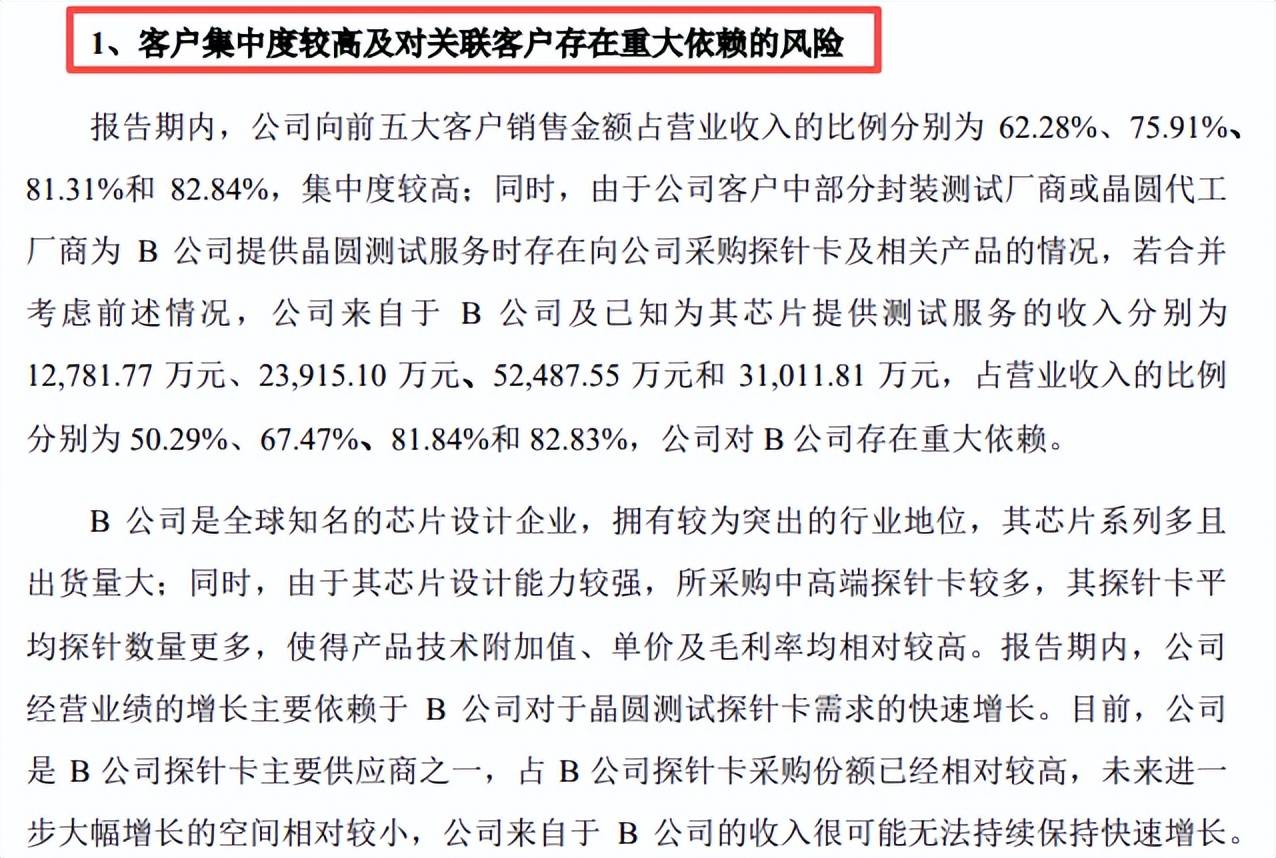
Core Viewpoint - Qiangyi Semiconductor (Suzhou) Co., Ltd. has achieved significant performance growth through technological breakthroughs and domestic substitution opportunities, but this growth is heavily reliant on related party transactions, particularly with Company B, which accounts for over 80% of its revenue [1][2][4]. Financial Performance - From 2022 to 2024, the company's operating revenue increased from 254 million to 641 million, while net profit surged from 15.62 million to 233 million, with a staggering year-on-year growth of 1149.33% in 2024 [2]. - The gross profit margin for Qiangyi's sales to Company B was significantly higher than that for other clients, with margins of 49.90%, 51.66%, 58.19%, and 61.62% over the reporting period, compared to only 35.45% for other customers [4][6]. Dependency on Related Parties - Company B has consistently been the largest customer, with revenue contributions of 50.29%, 67.47%, 81.84%, and 82.83% from 2022 to the first half of 2025, indicating a dependency increase of over 32 percentage points in three and a half years [2][4]. - Despite the high gross margins, the company has not disclosed specific details about Company B, only stating it is a globally recognized chip design enterprise with a strong market position [5]. Related Party Transactions - The actual controller, Zhou Ming, has significant control over "Nantong Yuan Zhuyuan," which became the largest supplier to Qiangyi shortly after its establishment, raising concerns about the independence and fairness of transactions [7][9]. - Qiangyi transferred certain business lines to Nantong Yuan Zhuyuan at a low price, with the asset transfer value being nearly seven times lower than the actual value, indicating potential manipulation of financial data [8][9]. Inventory and Production Capacity - Qiangyi plans to raise 1.5 billion for expansion, with 1.2 billion allocated to the development and production of probe cards, despite current sales being insufficient to absorb existing production capacity [10][12]. - The company's inventory has been increasing, with year-end balances rising from 41.52 million in 2022 to 111.72 million in the first half of 2025, and the provision for inventory depreciation has also increased significantly, indicating potential risks [13].

百川能源股份有限公司关于收到湖北证监局行政监管措施决定书的公告
Shang Hai Zheng Quan Bao· 2025-11-14 20:42
Core Viewpoint - Baichuan Energy has received an administrative regulatory measure from the Hubei Securities Regulatory Bureau due to violations related to undisclosed related party transactions involving its chairman Wang Donghai [1][2]. Group 1: Regulatory Measures - The Hubei Securities Regulatory Bureau issued a warning letter to Baichuan Energy and Wang Donghai for failing to disclose related party relationships and transactions, specifically regarding the acquisition of Zhuolu Dadi Gas Co., Ltd. and Suizhong Dadi Natural Gas Pipeline Co., Ltd. for 220 million yuan in October 2019 [1][2]. - The company is required to learn from this incident and enhance its compliance with securities laws and regulations to prevent similar occurrences in the future [2][3]. Group 2: Company Response - Baichuan Energy acknowledges the issues raised in the warning letter and commits to improving its identification of related parties and management of related transactions, as well as enhancing its information disclosure practices [3]. - The administrative measures will not affect the company's normal operations, and it will continue to fulfill its disclosure obligations in accordance with relevant laws and regulations [3]. Group 3: Board Meeting - The 12th Board of Directors of Baichuan Energy held its fifth meeting on November 13, 2025, where all seven directors attended, and the meeting complied with legal and regulatory requirements [7]. - The board approved a resolution to recognize the related party transactions that occurred in October 2019, ensuring compliance with relevant regulations [8][9]. - The resolution was passed with four votes in favor, no opposition, and three abstentions from related directors [11].

万方城镇投资发展股份有限公司第十届董事会第五次会议决议公告
Shang Hai Zheng Quan Bao· 2025-11-14 20:00
登录新浪财经APP 搜索【信披】查看更多考评等级 证券代码:000638 证券简称:*ST万方 公告编号:2025-077 万方城镇投资发展股份有限公司 第十届董事会第五次会议决议公告 本公司及董事会全体成员保证信息披露内容的真实、准确、完整,没有虚假记载、误导性陈述或重大遗 漏。 万方城镇投资发展股份有限公司(以下简称"公司")第十届董事会第五次会议通知于2025年11月13日以 通讯形式发出,会议于2025年11月14日下午14:30时在北京市朝阳区裕民路12号中国国际科技会展中心B 座12A公司会议室以通讯的方式召开,会议应到董事9名,实到9名,会议由董事长刘玉女士主持,本次 会议召开符合《公司法》及《公司章程》的相关规定。会议审议并通过了如下议案: 一、以9票同意,0票反对,0票弃权,审议通过了《关于子公司拟向关联方申请借款暨关联交易及2025 年度对外担保额度预计的议案》。 本议案已经公司2025年第二次独立董事专门会议审议通过。 本议案尚需提交公司2025年第二次临时股东会审议。 内容详见公司于本公告同日在《中国证券报》《证券时报》《上海证券报》《证券日报》及巨潮资讯网 (http://www.c ...

中国航发动力股份有限公司第十一届董事会第十次会议决议公告
Shang Hai Zheng Quan Bao· 2025-11-14 19:29
Core Viewpoint - The company, China Aviation Engine Corporation, has approved a proposal for its subsidiary, China Aviation Engine Southern Industrial Co., Ltd., to transfer up to 25 million shares of China Aviation Engine Control Co., Ltd. through a block trade to its controlling shareholder, China Aviation Engine Group Co., Ltd. [2][8] Summary by Sections Meeting Details - The 10th meeting of the 11th Board of Directors was held on November 14, 2025, with all 10 directors present, fulfilling the required quorum [1][3]. Proposal Approval - The board approved the proposal regarding the transfer of shares, with 4 votes in favor and no votes against or abstentions [3][18]. - The proposal had already been reviewed and approved by the independent directors prior to the board meeting [4][17]. Transaction Overview - The subsidiary plans to transfer up to 25 million shares of China Aviation Engine Control Co., Ltd., which represents approximately 13.78% of the total shares held by the subsidiary [8][11]. - The transaction will be conducted as a block trade and does not constitute a major asset restructuring as defined by regulations [8][15]. Related Party Information - The transaction involves China Aviation Engine Group Co., Ltd., which is the actual controller and major shareholder of the company, thus qualifying as a related party transaction [9][10]. Financial and Regulatory Aspects - The transfer price will be determined based on market conditions, with a minimum price set at 90% of the previous day's closing price [13]. - The transaction is expected to improve the cash flow and financial condition of the subsidiary without significantly impacting the company's overall operations [15].


锦盛新材关联交易事项处罚落定
Zheng Quan Ri Bao· 2025-11-14 13:39
Core Points - Zhejiang Jinsong New Materials Co., Ltd. received an administrative penalty from the China Securities Regulatory Commission for failing to disclose related party transactions in a project worth 1.2 billion yuan, which accounted for 18.6% of the company's audited net assets [2] - The company was fined 1.5 million yuan, while responsible individuals faced fines ranging from 500,000 to 1.5 million yuan [2] - The company had previously initiated a recognition process to classify the related transactions as such, which was approved by the board and shareholders [2] Summary by Sections - **Administrative Penalty**: The company was penalized for not disclosing related party transactions in a project involving Zhejiang Hongxiang Construction Engineering Co., Ltd., which was actually contracted by the nephew of the company's actual controller [2] - **Project Pricing and Review**: The project pricing was reviewed by professional institutions, confirming that the final settlement amount of approximately 1.53 billion yuan was reasonable and aligned with market prices, indicating no harm to the company's or minority shareholders' interests [3] - **Internal Governance Improvement**: Following the penalty, the company aims to strengthen internal controls and governance standards, ensuring future disclosures are accurate and timely [3]
*ST交投(002200.SZ):与关联方签订3052.9万元合同
Ge Long Hui A P P· 2025-11-14 12:52
Core Viewpoint - *ST Jiaotou (002200.SZ) has been selected for two construction projects by Yunnan Jiaotou Group Highway Construction Co., aiming to enhance business order growth and improve ongoing operational capabilities [1] Group 1: Project Details - The company will sign a specialized subcontract for two projects: "Construction Facilities Engineering along the First General Contracting Section of Mu Yuan Expressway" and "Temporary Land Reclamation and Greening Engineering for the First General Contracting Section of Mu Yuan Expressway" [1] - The total contract amounts for the projects are 24.85 million yuan and 5.679 million yuan, respectively, totaling 30.529 million yuan [1] Group 2: Related Party Transactions - The signing of the construction contracts constitutes a related party transaction, as the contracting company is a subsidiary of the company's controlling shareholder, Yunnan Provincial Transportation Investment Construction Group Co., Ltd [1] - The total amount of the related party transaction is 30.529 million yuan [1]

*ST交投:与关联方签订3052.9万元合同
Ge Long Hui· 2025-11-14 12:49
Core Viewpoint - *ST JiaoTuo (002200.SZ) has been selected for two construction projects by Yunnan Jiaotong Group's Public Construction Company, aiming to enhance business orders and improve operational capabilities [1] Group 1: Project Details - The company will sign a specialized subcontract for two projects: "Construction Facilities Engineering along the First General Contracting Section of Mu Yuan Expressway" and "Temporary Land Reclamation and Greening Engineering for the First General Contracting Section of Mu Yuan Expressway" [1] - The total contract amounts are 24.85 million yuan and 5.679 million yuan, respectively, totaling 30.529 million yuan [1] Group 2: Related Party Transactions - The signing of the construction contracts constitutes a related party transaction, as the Public Construction Company is a subsidiary of the company's controlling shareholder, Yunnan Provincial Transportation Investment Construction Group [1] - The total amount of the related party transaction is 30.529 million yuan [1]
航发动力:关于子公司中国航发南方工业有限公司拟转让其他上市公司股票暨关联交易的公告
Zheng Quan Ri Bao Zhi Sheng· 2025-11-14 12:36
Core Viewpoint - The company announced a significant transaction involving the transfer of shares between its subsidiary and its controlling shareholder, which constitutes a related party transaction [1]. Group 1 - On November 14, the company held its 11th board meeting to review the proposal for the transfer of shares [1]. - The subsidiary, China Aviation Engine Southern Industry Co., Ltd., plans to transfer up to 25 million shares of China Aviation Engine Control Co., Ltd. to its controlling shareholder, China Aviation Engine Group Co., Ltd. [1]. - This transaction is classified as a related party transaction due to the relationship between the parties involved [1].
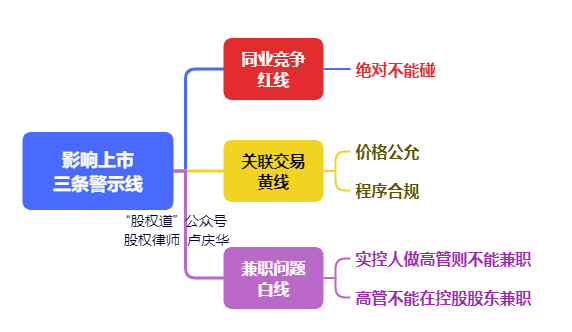
导致上市失败的关键因素,触碰到上市的三条警戒线
Sou Hu Cai Jing· 2025-11-14 11:44
Core Viewpoint - The article discusses the reasons behind the failure of many companies to go public, highlighting the importance of avoiding conflicts of interest and compliance with regulations regarding related party transactions, industry competition, and executive roles. Group 1: Industry Competition (Red Line) - Companies applying for an IPO must not engage in the same business as their controlling shareholders or related entities, even if those entities are shell companies [2][3] - An example is provided with Changyou Technology, which faced delays in its IPO due to the need to deregister a shell company that was involved in similar business activities [4] - Companies are advised to promptly deregister non-operational shell companies and address any industry competition issues to avoid future IPO complications [5] Group 2: Related Party Transactions (Yellow Line) - Related party transactions are not prohibited but must meet two criteria: fair pricing and compliance with corporate governance procedures [6][9] - An example is given of Meiai Technology, which faced scrutiny over its pricing in transactions with a related company, Tianjia Environment, leading to multiple rounds of inquiries before successfully listing [8] - Companies must ensure that related party transactions are approved by the board or shareholders to avoid regulatory issues [10] Group 3: Executive Roles and Part-time Positions (White Line) - Controlling shareholders can hold positions in other companies as long as they are not in executive roles that could compromise independence [11][12] - High-level executives are also restricted from holding positions in the controlling shareholder's other companies to protect the interests of the listed company [13][14]