MEMS探针

Search documents
广州:积极发展晶圆级、系统级、扇出型、倒装、硅通孔、Chiplet异构集成、三维等先进封装技术
Ge Long Hui· 2026-01-13 04:18
Core Viewpoint - The Guangzhou Municipal Bureau of Industry and Information Technology is soliciting opinions on policies aimed at promoting high-quality development of the integrated circuit industry during the 14th Five-Year Plan period, focusing on advanced packaging and testing technologies [1] Group 1: Policy Initiatives - The policy emphasizes the development of advanced packaging technologies such as wafer-level, system-level, fan-out, flip-chip, silicon through-hole, Chiplet heterogeneous integration, and 3D packaging [1] - It also highlights the importance of advanced wafer-level testing technologies, including pulse sequence testing, MEMS probes, and IC integrated probe cards [1] Group 2: Financial Support - The policy proposes financial support for the construction of advanced packaging and testing production lines, offering subsidies of up to 20% of the new equipment purchase amount, with a cap of 20 million yuan per project [1] - Integrated circuit packaging and testing companies are encouraged to increase investment in technological upgrades, with corresponding rewards for eligible investment projects [1]
韬盛科技科创板IPO获受理 拟募资10.58亿加码半导体测试接口国产化
Ju Chao Zi Xun· 2025-12-30 15:33
Core Viewpoint - Shanghai Taosheng Electronics Technology Co., Ltd. has officially submitted its application for listing on the Sci-Tech Innovation Board, aiming to raise 1.058 billion yuan for the construction of a semiconductor testing interface and probe production base, R&D of wafer testing probe cards, and working capital supplementation, to strengthen its leading position in high-end chip testing hardware and accelerate the domestic substitution process [1] Group 1: Company Overview - Taosheng Technology is one of the earliest companies in China to independently develop chip testing interfaces and achieve large-scale production [1] - The company focuses on the semiconductor testing interface field, with products including chip testing interfaces and probe cards, which are critical for ensuring chip quality [1] - The company has developed over 4,000 chip testing interface technology solutions and possesses independent R&D and manufacturing capabilities for high-speed, high-frequency testing probes [2] Group 2: Market Position and Achievements - According to Yole, Taosheng Technology is projected to rank first in chip testing interface revenue in China and 11th globally in 2024 [2] - The company has built a broad customer ecosystem covering the entire semiconductor industry chain, serving over 700 clients, including leading companies in AI chips and autonomous driving [2] - Taosheng Technology has developed the first domestic DSA testing interface supporting parallel testing of 512 chips for Yangtze Memory Technologies, aiding the localization of the storage industry [2] Group 3: Technological Advancements - The company is expanding into the more technically challenging wafer testing probe card field, with its MEMS probe cards already commercialized for AI chip clients [3] - Taosheng Technology has achieved breakthroughs in the storage sector, with 2D MEMS products receiving orders and 2.5D MEMS products passing stringent certifications from Yangtze Memory Technologies [3] - The company is also conducting pre-research on 3D MEMS probe card technology to cover high-end storage testing scenarios [3] Group 4: Future Outlook - Taosheng Technology aims to focus on national strategic needs, pursuing high-end and large-scale development [3] - The company plans to increase R&D investment to tackle core key technologies in high-end testing interfaces, break overseas monopolies, and accelerate the domestic substitution process [3] - The goal is to further expand market share and solidify its leading position in the industry, aspiring to become a leading brand in the global semiconductor testing interface field [3]
强一股份IPO:实控人周明给自家公司供货,“左手倒右手”挪腾资产
Sou Hu Cai Jing· 2025-11-15 15:20
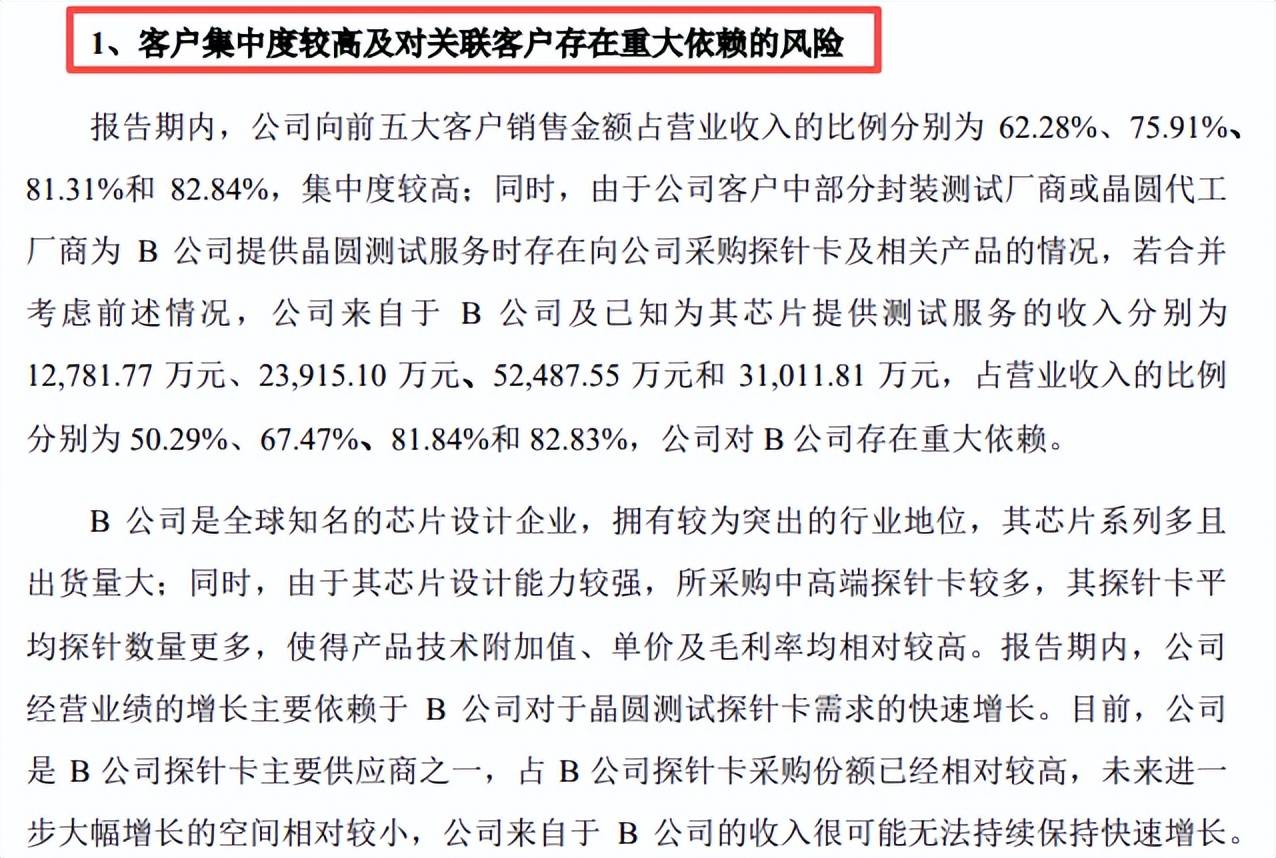
Core Viewpoint - Qiangyi Semiconductor (Suzhou) Co., Ltd. has achieved significant performance growth through technological breakthroughs and domestic substitution opportunities, but this growth is heavily reliant on related party transactions, particularly with Company B, which accounts for over 80% of its revenue [1][2][4]. Financial Performance - From 2022 to 2024, the company's operating revenue increased from 254 million to 641 million, while net profit surged from 15.62 million to 233 million, with a staggering year-on-year growth of 1149.33% in 2024 [2]. - The gross profit margin for Qiangyi's sales to Company B was significantly higher than that for other clients, with margins of 49.90%, 51.66%, 58.19%, and 61.62% over the reporting period, compared to only 35.45% for other customers [4][6]. Dependency on Related Parties - Company B has consistently been the largest customer, with revenue contributions of 50.29%, 67.47%, 81.84%, and 82.83% from 2022 to the first half of 2025, indicating a dependency increase of over 32 percentage points in three and a half years [2][4]. - Despite the high gross margins, the company has not disclosed specific details about Company B, only stating it is a globally recognized chip design enterprise with a strong market position [5]. Related Party Transactions - The actual controller, Zhou Ming, has significant control over "Nantong Yuan Zhuyuan," which became the largest supplier to Qiangyi shortly after its establishment, raising concerns about the independence and fairness of transactions [7][9]. - Qiangyi transferred certain business lines to Nantong Yuan Zhuyuan at a low price, with the asset transfer value being nearly seven times lower than the actual value, indicating potential manipulation of financial data [8][9]. Inventory and Production Capacity - Qiangyi plans to raise 1.5 billion for expansion, with 1.2 billion allocated to the development and production of probe cards, despite current sales being insufficient to absorb existing production capacity [10][12]. - The company's inventory has been increasing, with year-end balances rising from 41.52 million in 2022 to 111.72 million in the first half of 2025, and the provision for inventory depreciation has also increased significantly, indicating potential risks [13].