Tariffs

Search documents
Trump Trade War: How Tariffs Reshaped U.S. Business and Global Trade
FX Empire· 2025-12-08 13:59
Supply Chain Realignment - The share of U.S. supplier volume from China, Hong Kong, and Korea has decreased from 90% to 50% over the past decade, with this shift accelerating since the first wave of tariffs in 2018 [1] - Vietnam, Indonesia, Thailand, and India have emerged as significant beneficiaries, managing a growing share of U.S.-bound production, with supplier diversification now evenly split between North Asia and South Asia [2] Trade Dynamics - U.S. imports from China have declined by 26% year-over-year, while trade between China and Indonesia has increased by 29.2%, Vietnam by 23%, and India by 19.4% [3] - U.S. imports from Vietnam have also grown, increasing by 23% this year [3] Tariff Impact on U.S. Companies - U.S. companies are facing significant pressure from tariffs, with many firms that frontloaded inventory in early 2025 now running low, leading to rising costs and tighter cash flow [4] - The average tariff has risen from 1.5% to double digits, particularly affecting sectors like retail and generic pharmaceuticals due to their thin margins [5] Financing Needs and Trends - Over 70% of U.S. businesses surveyed reported increased cash needs compared to last year, with financing tools like HSBC's Trade Pay platform seeing a 20% increase in activity since the new tariffs were implemented in April [6] - As inventory buffers deplete, the demand for working capital is expected to continue growing [6]


X @The Wall Street Journal
The Wall Street Journal· 2025-12-08 13:31
The Trump administration is planning to announce $12 billion in aid to U.S. farmers, as the agriculture sector grapples with the fallout from President Trump’s far-reaching tariffs https://t.co/1npGQPHFA7 ...
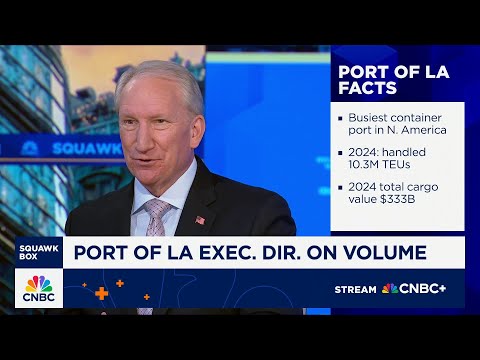
Port of LA's Gene Seroka: 2025 will be our third-best year ever for volume
CNBC Television· 2025-12-08 13:28
Port of Los Angeles Volume and Performance - Port of Los Angeles experienced a "roller coaster" year due to tariffs and trade discussions, with freight plummeting when hard policies were announced and recovering quickly when deadlines were extended [2] - The port anticipates its third-best year ever in 2025, handling approximately 1025 million 20-foot equivalent units (TEUs) [2][3] - No other port in the nation has ever crossed the 10 million TEU mark, a feat Los Angeles has now achieved three times [3] - The port's high-water mark was in 2022 at 107 million container units, following the COVID surge and increased online buying [4] - During the peak season of the past summer, the port moved more cargo than at the peak of the COVID surge without any ships backed up [15] Trade and Manufacturing Shifts - The President's efforts to increase manufacturing in the United States could potentially shift the port's volume dynamics, potentially increasing export opportunities [4][5] - A sector-specific review is needed to determine which products to manufacture in the US, how to structure supply chains, and what labor force training is required [6][7] - China's share of the port's business has decreased from approximately 60% in 2018 to 40% currently, with a continued downward trend [8][9] - Companies are increasingly sourcing from Southeast Asian countries like Vietnam, Indonesia, Malaysia, and Thailand [9] - China is now exporting its manufacturing expertise to other countries, as outlined in their 15th 5-year plan [10] Infrastructure and Future Development - Significant progress has been made in infrastructure investment over the last four to five years, including new terminals, rail and road connectors, and inland facilities [13][14] - Further infrastructure investments are still needed, including raising a bridge, bringing more terminal capacity online, and improving rail infrastructure to expedite container evacuation [15]
Tracking Tariffs: Data and Policy Updates
Yahoo Finance· 2025-12-08 12:00
Core Insights - The global trade environment has become increasingly complex, impacting procurement strategies for apparel and textile firms due to ongoing policy uncertainties [1][2] - Tariffs and trade deals significantly influence sourcing decisions and the overall supply chain, affecting raw material availability and consumer spending trends [2] Trade Environment - The trade situation has a direct effect on the entire supply chain, including raw materials, with duties and trade agreements shaping sourcing location choices [2] - A new rule announced in April provides a potential relief from tariff costs, allowing U.S. content to be exempt from duties if at least 20 percent of a product's value is derived from U.S.-produced components [3] Webinar Insights - A webinar is scheduled to discuss the current trade situation and its implications for the industry, particularly focusing on cotton [4] - Key topics will include the latest tariff developments, their impact on fiber and downstream markets, and the implications of ongoing trade deals for cotton production and shipment trends [5] - The session will also cover how importers are leveraging the U.S. content exemption and the factors influencing global cotton pricing, along with a macroeconomic outlook affecting consumer markets [5]
X @Bloomberg
Bloomberg· 2025-12-08 03:35
The Trump administration on Monday plans to unveil a long-awaited farm aid package, according to a White House official, offering $12 billion in assistance to a key base of supporters who’ve been hit hard by low crop prices and tariffs https://t.co/wOveHSSZJY ...
美国经济:降息迹象渐显-US Economics Weekly -It's beginning to look a lot like a rate cut
2025-12-08 00:41
December 5, 2025 07:00 AM GMT US Economics Weekly | North America It's beginning to look a lot like a rate cut We now expect a 25bp cut at the Dec Fed meeting, followed by two more 25bp cuts in Jan and Apr. The cut will likely be accompanied by messaging of a higher bar for cuts moving forward. Initial Black Friday reporting was better than feared, but we still expect slower real spending growth in 4Q. M Exhibit 1: We expect cuts in Dec, Jan, and Apr to a terminal target range of 3.0- 3.25% Key Takeaways | ...
美国经济:关税开始抑制实际消费支出-US Economics-Tariffs start to cool real spending
2025-12-08 00:41
Summary of Key Points from the Conference Call Industry Overview - The conference call primarily discusses the **US Economics** sector, focusing on the impact of tariffs on real spending and inflation trends in North America. Core Insights and Arguments - **Core PCE Inflation**: Core PCE inflation rose by **0.20% month-over-month (m/m)** in September, slightly below expectations of **0.22%** [2][3] - **Goods Prices**: There was an increase in goods prices, indicating a gradual passthrough of tariffs, which is expected to weigh on real goods spending, particularly in the fourth quarter (4Q) [2][5] - **Real Personal Spending**: Real personal spending was flat in September, with a tracking of **3Q real spending** up **2.7% quarter-over-quarter (q/q) seasonally adjusted annual rate (saar)** [2][19] - **Nominal Income**: Nominal income increased by **0.4%**, with labor compensation also up by **0.4%**. Real disposable personal income rose by **0.1% m/m** [2][24] - **Spending Trends**: Real goods spending fell by **0.4% m/m**, while real services spending rose by **0.2% m/m**. This indicates a shift in consumer behavior towards services amidst rising goods prices [20][21] Additional Important Details - **Tariff Impact**: The total tariff push to PCE prices has been estimated at about **30 basis points (bp)** so far, with expectations of continued inflationary pressure from tariffs into 4Q and 1Q [5][25] - **Housing Inflation**: Core services inflation decelerated, particularly in shelter inflation, which is believed to be exaggerated due to regional noise and seasonal factors [6][7] - **Airfares**: A slight underperformance in core inflation expectations was attributed to airfares, which accelerated less than anticipated [7] - **Future Projections**: The forecast for **4Q core PCE** is set at **3.0%**, slightly below the Federal Reserve's forecast of **3.1%** [8] Conclusion - The overall economic outlook indicates a cooling in real spending due to rising goods prices driven by tariffs, with expectations of slower consumption growth in the upcoming quarters. The data suggests a complex interplay between inflation, consumer behavior, and economic policy that will require close monitoring [25]
Ad Spend to Grow More Than Expected in 2025 as Tariffs Sting Less and AI Gives a Leg Up
WSJ· 2025-12-08 00:01
Core Insights - A new report from WPP Media indicates that global advertising revenue is projected to reach $1.14 trillion in the current year [1] Industry Overview - The report highlights a significant growth in global ad revenue, reflecting the increasing investment in advertising across various sectors [1]

Google reveals the top trending searches of 2025
Fox Business· 2025-12-07 20:57
Core Insights - Google has released its Year in Search 2025, highlighting significant events and cultural moments that drove search interest spikes [1][2] Group 1: Trending Searches - The top trending search in the U.S. for 2025 was Charlie Kirk, who was fatally shot during a campus event, leading to a surge in search activity [1] - Other notable searches included Netflix's "KPop Demon Hunters," the viral collectible Labubu, Apple's iPhone 17, and the "One Big Beautiful Bill Act" signed into law in July [2][8] - Additional significant search spikes were observed for New York City Mayor-elect Zohran Mamdani, the AI platform DeepSeek, the government shutdown, the FIFA Club World Cup, and tariffs [2][8] Group 2: Trending News and Events - Major news-related searches included the "One Big Beautiful Bill Act," the government shutdown, and the assassination of Charlie Kirk [8] - Other trending topics encompassed protests, natural disasters, and significant political events such as the U.S. presidential inauguration and the selection of a new Pope [8]


Trump’s Market Maelstrom: Where Policy Meets Panic (and Profit)
Stock Market News· 2025-12-07 18:00
Group 1: Tariff Implications - The Supreme Court is reviewing the legality of President Trump's tariffs, with a decision expected in early 2026, potentially affecting $90 billion in tariff revenue for fiscal year 2025 [2] - U.S. households are projected to incur an additional cost of $1,100 in 2025 due to tariffs, with an estimated income loss of $1,700 per household [3] - The apparel sector, particularly Lululemon Athletica Inc. (LULU), has seen significant stock declines, with shares down over 50% year-to-date in 2025 due to tariff impacts [3] Group 2: Market Reactions - The auto industry has experienced volatility due to tariffs, with a 25% tariff on non-compliant vehicles causing significant stock drops for major automakers like General Motors and Ford [6] - Following a potential tariff pause, automaker stocks rebounded, indicating the market's sensitivity to tariff announcements [6] - The U.S. stock market experienced a significant crash in April 2025 due to new tariff policies, with the S&P 500 dropping 4.84% [10] Group 3: Consumer Impact - New tariffs could lead to a 107% increase in prices for Italian pasta, potentially causing a pasta shortage in American supermarkets by January 2026 [9] - The meatpacking industry, dominated by major players like JBS and Tyson Foods, is under scrutiny for rising food prices, which have been exacerbated by tariff policies [8] Group 4: Overall Market Volatility - Analysts note that 2025 has been characterized by unusual market volatility driven by tariffs, rate uncertainty, and geopolitical tensions [10] - Despite significant market declines, the S&P 500 managed a 17% overall advance in 2025, showcasing the market's resilience [10] - The market's reaction to tariff announcements often involves initial declines followed by recoveries, indicating a complex relationship between policy and investor sentiment [12]