
生态治理

Search documents
近5年,三江源国家公园水源涵养量年均增长6%以上 “中华水塔”生态屏障,这样加固(生态治理中的中国智慧)
Ren Min Ri Bao· 2025-10-30 22:27
Core Viewpoint - The 20th Central Committee of the Communist Party emphasizes the importance of strengthening ecological security barriers, with specific measures taken in the Qinghai Golog Tibetan Autonomous Prefecture to protect the source of the Yangtze, Yellow, and Lancang rivers, known as the "Chinese Water Tower" [1] Group 1: Glacier Protection - The Animaqing Mountain, which has over 120 square kilometers of glaciers, provides approximately 35% of the water source for the upper reaches of the Yellow River, serving as a crucial ecological barrier for the Sanjiangyuan region [3][4] - Local measures include three-dimensional glacier monitoring and artificial water augmentation to protect glaciers, with the snow accumulation period extended and glacier melting rates effectively reduced [6] Group 2: Black Soil Desertification Control - The restoration of black soil wasteland and degraded grasslands has been a focus, with 5.1664 million acres of such areas treated in Golog Prefecture [8] - The Deerni Copper Mine has completed ecological restoration, and innovative methods have been employed to restore vegetation at high altitudes, including the use of composite soil made from local materials [7][8] Group 3: Wetland Restoration - Golog Prefecture has implemented a collaborative restoration approach for grasslands, watersheds, and wetlands, increasing the number of lakes from 4,000 to over 5,800 through continuous governance [9] - The region aims to restore 100,000 acres of wetlands during the 14th Five-Year Plan period, with an average annual increase of over 6% in water source conservation capacity in the Sanjiangyuan National Park [9]
麦草方格,方寸之间锁流沙
Ren Min Ri Bao· 2025-10-23 00:33
Core Viewpoint - The article highlights China's unique ecological governance model, particularly the innovative "wheat straw grid" method for desertification control in the Tengger Desert, showcasing effective practices and contributions to global desertification management [1][2]. Group 1: Ecological Governance Practices - The "wheat straw grid" method, developed in the 1950s, has been implemented over 430,000 acres in the Tengger Desert, significantly reversing desertification and promoting the growth of over 100 million desert plants [5][6]. - The method involves creating square grids of wheat straw to stabilize sand, reduce wind speed, and promote the formation of biological soil crust, which enhances plant growth [3][6]. - The Tengger Desert has seen a retreat of 25 kilometers due to these efforts, with a protective system established along the Baolan Railway, consisting of wheat straw grids and vegetation [5][6]. Group 2: Technological Advancements - Recent advancements in technology have led to the mechanization and automation of the wheat straw grid method, increasing efficiency by over 60% and extending the lifespan of the grids from 2 years to 5-6 years [6][7]. - The introduction of new equipment, such as multifunctional sand-fixing vehicles and drones, has improved the maintenance and implementation of the wheat straw grids [6]. Group 3: Economic and Tourism Development - The ecological restoration efforts have transformed the Tengger Desert from an ecological burden into a unique tourism resource, attracting significant visitor numbers and generating substantial revenue [8]. - In 2024, the Shapotou Scenic Area received 1.46 million visitors, resulting in a total tourism revenue of 428 million yuan, demonstrating the economic potential of integrating ecological restoration with tourism [8].

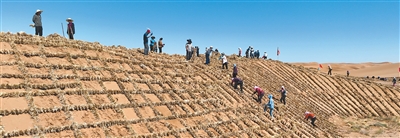
麦草方格,方寸之间锁流沙(生态治理中的中国智慧)
Ren Min Ri Bao· 2025-10-21 22:39
Core Viewpoint - The article highlights China's unique ecological governance model, particularly the innovative "wheat straw grid" method for desertification control in the Tengger Desert, showcasing successful practices in integrated ecological protection and management [1][2]. Group 1: Ecological Governance Practices - The "wheat straw grid" method, developed in the 1950s, has been instrumental in stabilizing sand and preventing desertification in the Tengger Desert, covering over 430,000 acres in Ningxia [2][4]. - The method involves creating square grids of wheat straw to trap sand, reduce wind speed, and promote the growth of vegetation, effectively reversing desertification by 25 kilometers [4][5]. Group 2: Technological Advancements - Recent advancements in technology have accelerated the formation of biological soil crusts, reducing the natural process time from approximately 10 years to about 1 year [5]. - The introduction of mechanized and automated methods, such as the use of multifunctional sand-fixing vehicles and drones, has increased efficiency in the application of the wheat straw grids by over 60% [5][6]. Group 3: Economic and Environmental Impact - The successful implementation of the wheat straw grid method has transformed the Tengger Desert from an ecological burden into a tourist attraction, with the region receiving 1.46 million visitors and generating a total tourism revenue of 428 million yuan in 2024 [7]. - The biodiversity in the area has significantly increased, with the number of plant species rising from fewer than 25 in the 1950s to over 450 today, enhancing the ecological landscape [7].
吸引50多个国家和地区的专家学者前来参观考察 麦草方格,方寸之间锁流沙(生态治理中的中国智慧)
Ren Min Ri Bao· 2025-10-21 21:50
Core Insights - The article highlights China's unique ecological governance model, particularly the innovative "straw grid" method for desertification control in the Tengger Desert, showcasing China's wisdom and solutions in ecological management [1][2]. Group 1: Ecological Governance Practices - The "straw grid" method, developed in the 1950s, involves laying straw in square patterns to stabilize sand, effectively reducing wind erosion and promoting vegetation growth [2][3]. - Over 430,000 acres of straw grids have been established in the Tengger Desert, contributing to the reversal of desertification and the growth of over 100 million sand-resistant plants [3][5]. - The successful implementation of this method has transformed the Tengger Desert from a severely sandstorm-affected area to a region with a protective ecological barrier for infrastructure like the Baolan Railway [3][6]. Group 2: Technological Advancements - Recent advancements in technology have accelerated the formation of biological soil crusts, reducing the natural process from approximately 10 years to about 1 year [5]. - The introduction of mechanized and automated methods, such as the use of multi-functional sand-fixing vehicles and drones, has increased efficiency in establishing straw grids by over 60% [5][6]. Group 3: Economic and Tourism Development - The ecological restoration efforts have transformed the Tengger Desert into a tourist attraction, with the Shapotou Scenic Area receiving 1.46 million visitors and generating a total tourism revenue of 428 million yuan in 2024 [7]. - The integration of agriculture, culture, and tourism has turned the desert from an ecological burden into a valuable tourism resource, showcasing the successful application of ecological governance [7].
真诚讲述生态治理“真招”(看台人语)
Ren Min Ri Bao· 2025-10-20 22:42
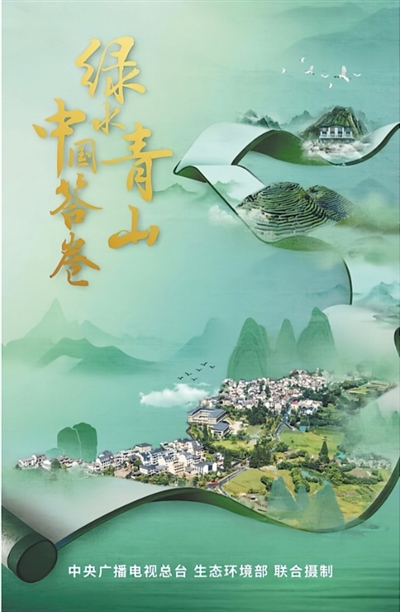
生态治理不是喊口号,得有实打实的路子。纪录片《绿水青山中国答卷》,在"两山"理念提出20年之 际,深入浙江湖州、内蒙古巴彦淖尔、四川成都等20个城市和地区,客观呈现各地治生态、谋发展的实 在事。这部片子没玩"花活",看得人心里亮堂。 湖北十堰作为南水北调关键水源地,靠植树、净水、空天地护水网络守住一泓清水;江西赣州曾是"江 南沙漠",历经二十载系统修复山水林田,最终建成生态安全屏障……实打实、成系统的举措,让观众 看清生态保护治理的"真招"。 难得的是,片子还讲出了生态故事的文化根脉。甘肃武威带着古代"铜奔马"的开拓精神治沙,在河西走 廊续写丝路绿色故事;云南昭通大山包的村民守护黑颈鹤越冬,守住了生态也留住了乡愁。它们生动说 明,生态建设不只是环境变美,更让文化有了传承的土壤。 纪录片《绿水青山中国答卷》海报。 资料图片 《 人民日报 》( 2025年10月21日 20 版) (责编:杨光宇、胡永秋) (陕西省西安市 刘海涛) ...
陕西咸阳:千年古都谱写高质量发展新篇章
Ren Min Ri Bao· 2025-10-20 22:39
Economic Development and Industrial Upgrading - Xi'an's economic development focuses on high-quality growth, with a projected GDP exceeding 300 billion yuan in 2024, reflecting a year-on-year growth rate of 6.5% [2] - The city is enhancing its industrial base with seven pillar industries, including electronic displays and equipment manufacturing, and developing 16 key industrial chains [2] - A total of 1,275 key projects have been implemented since the 14th Five-Year Plan, with investments reaching 451.79 billion yuan [2] Business Environment and Trade - Continuous optimization of the business environment through administrative reforms and a focus on foreign trade transformation has been noted, with over 120 international trade partnerships established [3] - The retail market is projected to exceed 140 billion yuan in 2024, driven by initiatives like the "old for new" consumption model [3] - E-commerce services have achieved a coverage rate of 98.24% across the city [3] Social Welfare and Community Development - The city has allocated 870 million yuan for social assistance to support low-income households [4] - A comprehensive elderly care service network is being established, with 27 service projects outlined in the 2024 plan [4] - Initiatives for child protection and education support have been implemented, including the establishment of 12 rescue centers for minors [4] Infrastructure Development - Six major projects are underway to enhance transportation networks, including highway expansions and rural road improvements [5] Ecological Governance - Xi'an is committed to ecological protection, achieving a 45-day increase in air quality days and a 14.73% improvement in air quality index [7] - Water quality management has improved, with 85.7% of river monitoring points showing good water quality [7] - The city has achieved a 100% harmless disposal rate for urban waste and medical waste [7] Cultural and Tourism Development - The city is focusing on cultural tourism as a key driver for high-quality development, with over 300 cultural tourism projects planned [8] - Major cultural sites and events have been developed, including the opening of the Zhengguo Canal site and the establishment of new tourism brands [8][9] - In 2024, the city expects to receive over 100 million tourists, bolstered by innovative marketing strategies [9] Rural Revitalization - Xi'an is prioritizing agricultural development, with a focus on grain production and the enhancement of rural industries [10] - The city has implemented a "Hundred Villages Improvement Action" to boost rural collective economies, with 248 projects supporting this initiative [12] - The average disposable income for rural residents is projected to reach 8,927 yuan in the first half of 2025 [12]
听,泉水又响了!102眼古泉复苏谱写生态回归曲
Yang Shi Xin Wen Ke Hu Duan· 2025-10-19 13:15
Core Insights - The resurgence of ancient springs across various regions has been noted, with Jinan's Baotu Spring reaching its highest underground water level since 1966 at 30.29 meters, indicating a significant recovery of local water resources [2][3]. Group 1: Water Resurgence - The revival of springs, such as the Baotu Spring in Jinan, has been a remarkable phenomenon, with 102 previously dried springs now flowing again due to rising shallow and deep groundwater levels [2]. - The Nandao Spring in Taiyuan, which had completely dried up in 1994, has resumed natural flow as of May 2023, thanks to ecological restoration efforts [4]. - In Xingtai, 16 springs have re-emerged since 2022, revitalizing the local environment and economy [5]. Group 2: Economic and Cultural Impact - The resurgence of springs has inspired local creatives, such as Liu Xinya, a designer in Jinan, who aims to incorporate the historical significance of the springs into her work [3]. - The revival of springs has led to the development of a more integrated industry in Xingtai, combining wedding photography, custom dress services, and banquet offerings into a cohesive business model [6].
新疆如何变成“塞上江南”?看博斯腾湖逆袭记
Yang Shi Xin Wen Ke Hu Duan· 2025-10-19 07:35
Core Viewpoint - The transformation of Xinjiang from a drought-prone area to a thriving seafood production region is attributed to significant water management and ecological restoration efforts, particularly around Bosten Lake [1][3]. Group 1: Environmental Changes - Xinjiang, covering over 25% of its area with desert and having the lowest annual precipitation in China, has seen a remarkable change in recent years, becoming a seafood production area [1]. - Bosten Lake, the largest inland freshwater lake in China and the main fishery production base in Xinjiang, faced ecological alarms in 2012 due to industrial pollution and low water levels [3][5]. Group 2: Water Management Initiatives - The implementation of the "Yin Kai Ji Huang" project in 2018, which diverted water from the Kuitun River to Bosten Lake, and the 2022 introduction of water diversion from the Qing Shui River, have been pivotal in restoring the lake's ecosystem [7]. - Over the past eight years, a total of 1.54 billion cubic meters of water has been diverted to Bosten Lake, equivalent to 906 "Water Cubes" [7]. Group 3: Economic Impact - The fish species in Bosten Lake have increased to over 30, with an annual fish production value expected to reach 6,000 tons, nearly doubling from previous years [5]. - Since the start of the 14th Five-Year Plan, Xinjiang has invested 158 billion yuan in water conservancy projects, resulting in a rural tap water coverage rate of 99.4% [9].

世界自然保护大会上 上海黄浦江案例首次向全球推介 用“自然疗法”消解“钢筋森林”
Jie Fang Ri Bao· 2025-10-17 01:25
Core Insights - The traditional perception of Shanghai as a "forest of steel" is being transformed by the greenery along the Huangpu River, showcasing significant ecological advancements in the region [1][2] Group 1: Ecological Developments - The Huangpu River basin has recently introduced 150 ecological composite units, each covering approximately 20 square kilometers, focusing on integrated ecological governance and utilization [1] - The "Revival Island" project aims to create a northern ecological bird island wetland space, enhancing biodiversity and ecological restoration [1] - The coastal area is undergoing planning to restore coastal ecosystems, with global design proposals being solicited [1] Group 2: International Recognition - The "Ecological Protection and Restoration Practices of the Huangpu River Basin Based on Nature-based Solutions (NbS)" was officially recognized at the World Conservation Congress (WCC) and is considered a global case study [1][4] - This case is unique as it integrates ecological thinking into urban planning, moving beyond fragmented approaches typically seen in international NbS examples [1][4] Group 3: Systematic Approach - The "Functional Integration Development and Spatial Quality Improvement Plan for the Huangpu River Coastal Area (2025-2035)" aims to extend public spaces along the river and create blue-green ecological corridors [3] - The approach emphasizes a comprehensive and context-specific strategy to address ecological challenges, linking various wetland ecosystems within the Huangpu River basin [5][6] Group 4: Urban Integration - The development of the N1 area in the South Huai region is designed to be a "coastal forest island," serving multiple functions including urban flood control and recreational space [5] - The integration of nature within urban settings is being explored, with initiatives to create pocket parks and enhance public access to natural spaces [6] Group 5: Future Directions - Shanghai aims to continue its NbS research and local practices, sharing its experiences in creating an "ecological city" that harmonizes urban development with ecological preservation [9] - The city plans to pursue regional and watershed-level NbS applications, including national integrated protection and restoration projects [9]
滋养“新疆好地方”
Ren Min Ri Bao· 2025-10-16 06:45
Group 1 - The core idea emphasizes the transformation of ecological systems into economic opportunities, showcasing the success of sustainable ecological governance in Xinjiang [1] - The implementation of various measures, including the prohibition of grazing and the restoration of vegetation, has led to a significant increase in tourism, with over 7 million visitors to the scenic area this year [1] - The concept of "green mountains and clear waters are as valuable as mountains of gold and silver" is highlighted as a guiding principle for sustainable development in the region [1] Group 2 - Systematic thinking and innovation in governance, supported by technology, are crucial for effective ecological management, with the establishment of long-term ecological water supply mechanisms in the Tarim River Basin being a notable example [2] - The application of advanced technologies, such as remote sensing and smart planting robots, has significantly improved the precision of ecological governance [2] - The involvement of local communities as beneficiaries and contributors to ecological governance is emphasized, with mechanisms in place to ensure that local herders benefit from ecological protection efforts [2] Group 3 - The unity among different ethnic groups in Xinjiang is identified as a fundamental source of the successful ecological governance efforts, fostering collaboration in environmental protection initiatives [3] - Joint actions among various ethnic communities, such as discussions on tourism development and collaborative environmental projects, have strengthened mutual understanding and respect [3] - The narrative of "protecting the green together" reflects a collective commitment to sustainable development, reinforcing the idea that unity is essential for achieving success in ecological and economic endeavors [3]