网络安全

Search documents
支持京津冀建立跨区域建设用地统筹机制
Zhong Guo Zheng Quan Bao· 2026-02-12 20:26
Group 1 - The core viewpoint of the news is the announcement of the "Modern Capital Urban Circle Spatial Coordination Plan (2023-2035)" aimed at enhancing the collaborative development of the Beijing-Tianjin-Hebei region through various reforms and innovations [1][2] - The plan emphasizes the need for a cross-regional construction land coordination mechanism to support the high-quality development of the urban circle [2] - Key areas of focus include optimizing the capital's functions, fostering innovation, achieving breakthroughs in reform and opening up, and enhancing public welfare [1][2] Group 2 - The plan aims to accelerate the construction of industrial clusters and strengthen the integration of key industries such as artificial intelligence, biomedicine, and cybersecurity [1][2] - It supports the establishment of a spatial access mechanism for major projects, streamlining the approval process to facilitate project implementation [2] - The plan promotes the integration of various development aspects, including industry, transportation, ecology, public services, and cultural tourism, into a unified spatial framework [1][3] Group 3 - Beijing will focus on the integrated development of education, technology, and talent, enhancing collaboration with Tianjin and Hebei in innovation and industrial cooperation [3] - Tianjin aims to leverage its geographical and industrial advantages to implement the planning effectively, including the establishment of advanced manufacturing and financial innovation zones [3][4] - Hebei is tasked with building a modern industrial system and fostering deep integration of innovation and industry, while developing advanced manufacturing clusters [4]
启明星辰:公司为政府、企业等多领域客户群提供网络安全保障
Zheng Quan Ri Bao Wang· 2026-02-12 12:09
Core Viewpoint - The company, Qiming Star (启明星辰), emphasizes its commitment to cybersecurity as its primary business, providing security solutions for various clients including government and enterprises [1] Group 1: Business Strategy - The strategic collaboration with China Mobile (中国移动) is a significant initiative for the company's business upgrade, aimed at integrating resources to enhance core competitiveness and expand market opportunities [1] - The revenue from China Mobile Group and its controlled enterprises accounted for 26.6% of the company's total revenue for the first nine months of 2025 [1] Group 2: Market Expansion - The related transactions with China Mobile consist of two parts: collaboration in expanding the government and enterprise market and addressing China Mobile's own cybersecurity needs [1] - The company is focused on improving the quality of related transactions, optimizing cost structures, and strengthening technological innovation to lay a foundation for long-term high-quality development [1]


启明星辰:深耕网络安全行业30年,客户广泛覆盖政府、运营商、金融、能源等政企客户
Zheng Quan Ri Bao· 2026-02-12 10:14
Group 1 - The company, Qiming Star, has been deeply engaged in the cybersecurity industry for 30 years [2] - The company's customer base includes a wide range of sectors such as government, telecommunications, finance, and energy [2]

2025中国网络安全领域有哪些大事件?权威盘点这十件入选
Nan Fang Du Shi Bao· 2026-02-12 09:21
Core Insights - The 2025 China Cybersecurity Major Events selection highlights significant incidents in the cybersecurity landscape, including extensive foreign cyberattacks on DeepSeek, the first amendment to the Cybersecurity Law, and China's signing of the United Nations Convention against Cybercrime [1][14][15] Group 1: Major Cybersecurity Events - DeepSeek faced large-scale foreign cyberattacks starting in January, attributed to organized hacker groups likely supported by governments, aiming to undermine its technological advantage [3] - The "Qinglang" series of special actions achieved decisive results by addressing eight core issues, including the spread of false information and the abuse of generative AI, marking a significant advancement in cross-departmental law enforcement and regulatory mechanisms [4][6] - The Harbin Winter Games information system experienced over 270,000 cyberattacks, primarily from the United States, highlighting the increasing cybersecurity threats during major events [7] Group 2: Cybersecurity Initiatives and Education - The inaugural "Tianshu Cup" AI safety innovation competition attracted over 1,200 youth participants, aiming to cultivate AI safety awareness and skills among the younger generation [8] - The National Virus Emergency Response Center issued a warning about a new variant of the "Silver Fox" Trojan virus, emphasizing the complexity and severity of current cybersecurity threats [9] - The "Net Clean" and "Protect Net" initiatives reported significant achievements in reducing cybercrime and enhancing the protection of critical information infrastructure [10][11] Group 3: Legislative and International Developments - China signed the United Nations Convention against Cybercrime, becoming one of the first signatories, which signifies a new era of unified global cybersecurity governance [14] - The National People's Congress passed amendments to the Cybersecurity Law, enhancing legal responsibilities and penalties for violations, reflecting the urgent need to address cybersecurity challenges in the context of AI development [15][16]
巨腾国际:相关暗网帖文披露的资讯不构成公司未披露的内幕消息
Zhi Tong Cai Jing· 2026-02-12 08:46
在发现该事件后,本集团立即采取措施查明可能存在的未经授权访问点,并采取适当行动切断其与本集 团服务器的连接。自调查开始以来,本集团已实施额外的网路安全措施,包括但不限于准备升级防火 墙、建立专用跳转服务器以进一步限制服务器访问、禁用防火墙管理服务的外部功能及尽量减少远程网 站的存取权限以防止跨网站连接。本集团亦根据网路安全顾问的建议采取其他额外的安全措施,以防止 类似攻击事件的发生,并与其资讯遭受该事件影响的客户保持联络。 巨腾国际(03336)发布公告,本集团已委聘网路安全顾问对该事件展开调查。根据调查,在进行评估的 六台主机中,有四台未经授权访问,在若干受影响的主机上发现与第三方同步及外部传输工具相关的痕 迹。根据本集团的内部调查,相关暗网帖文披露的资讯包括本集团客户提供的若干过往业务档案及本集 团内部档案,而该等资讯并不构成本公司未披露的内幕消息。 ...
巨腾国际(03336):相关暗网帖文披露的资讯不构成公司未披露的内幕消息
智通财经网· 2026-02-12 08:39
在发现该事件后,本集团立即采取措施查明可能存在的未经授权访问点,并采取适当行动切断其与本集 团服务器的连接。自调查开始以来,本集团已实施额外的网路安全措施,包括但不限于准备升级防火 墙、建立专用跳转服务器以进一步限制服务器访问、禁用防火墙管理服务的外部功能及尽量减少远程网 站的存取权限以防止跨网站连接。本集团亦根据网路安全顾问的建议采取其他额外的安全措施,以防止 类似攻击事件的发生,并与其资讯遭受该事件影响的客户保持联络。 智通财经APP讯,巨腾国际(03336)发布公告,本集团已委聘网路安全顾问对该事件展开调查。根据调 查,在进行评估的六台主机中,有四台未经授权访问,在若干受影响的主机上发现与第三方同步及外部 传输工具相关的痕迹。根据本集团的内部调查,相关暗网帖文披露的资讯包括本集团客户提供的若干过 往业务档案及本集团内部档案,而该等资讯并不构成本公司未披露的内幕消息。 ...
神州泰岳涨2.02%,成交额7.27亿元,主力资金净流入572.75万元
Xin Lang Zheng Quan· 2026-02-12 06:00
Core Viewpoint - Shenzhou Taiyue's stock has shown a mixed performance in recent trading, with a year-to-date increase of 9.38% and a recent decline over the past 20 days of 4.11% [1][2] Group 1: Stock Performance - As of February 12, Shenzhou Taiyue's stock price was 12.60 CNY per share, with a trading volume of 7.27 billion CNY and a market capitalization of 24.786 billion CNY [1] - The stock has experienced a 2.02% increase during the trading session on February 12 [1] - Year-to-date, the stock has increased by 9.38%, with a 6.24% rise over the last five trading days and an 8.81% increase over the last 60 days [1] Group 2: Financial Performance - For the period from January to September 2025, Shenzhou Taiyue reported a revenue of 4.068 billion CNY, a year-on-year decrease of 9.86%, and a net profit attributable to shareholders of 724 million CNY, down 33.77% year-on-year [2] - The company has distributed a total of 1.297 billion CNY in dividends since its A-share listing, with 372 million CNY distributed over the last three years [3] Group 3: Shareholder Information - As of January 30, the number of shareholders for Shenzhou Taiyue reached 111,100, an increase of 4.62% from the previous period, while the average number of tradable shares per shareholder decreased by 4.41% to 16,593 shares [2] - The largest circulating shareholder is Huaxia Zhongzheng Animation Game ETF, holding 56.4599 million shares, an increase of 9.6514 million shares from the previous period [3] - Other notable shareholders include E Fund's Growth Enterprise Board ETF and Southern Zhongzheng 500 ETF, with varying changes in their holdings [3]

最高900万元补助!北京工业互联网与工业软件扶持项目申报指南
Sou Hu Cai Jing· 2026-02-12 04:29
Core Insights - The policy aims to encourage independent research and development in key technologies, particularly in industrial internet, industrial software, and cybersecurity, by providing financial support to qualifying projects [1][4]. Policy Focus - The policy targets three main technology areas with seven specific directions: 1. **Key Technologies in Industrial Internet Platforms**: - Industrial intelligent algorithms, knowledge graphs, mechanism models, and microservice components [2]. 2. **Key Technologies in Industrial Software**: - Computer-aided design (CAX), electronic design automation (EDA), and product lifecycle management (PLM) [2]. 3. **New Network and Security Technologies**: - Software-defined networking (SDN), network virtualization, and core security systems [2]. Subsidy Details - The subsidy is set at 30% of the total funding received from national or municipal support, with a maximum limit of 9 million yuan per project [3]. Policy Implications - The policy emphasizes continuous technological iteration rather than one-time development, highlighting the importance of ongoing R&D capabilities [4]. - It stresses the need for practical applications of innovations, indicating that theoretical results without industrial validation will not receive support [4]. - Cybersecurity is treated as a distinct area, reflecting the growing importance of compliance and safety in smart manufacturing [4]. Application Strategy for Enterprises - Companies are advised to clearly define their technical challenges, industrialization paths, and funding usage in their project proposals [5][6]. - Prioritizing applications for national or municipal key project status is recommended to enhance eligibility for subsidies [6]. - Forming joint applications with technology and application partners is encouraged to address verification challenges [7]. - Attention to intellectual property rights is crucial, with a need to clarify core technology patents and software copyrights in proposals [8].

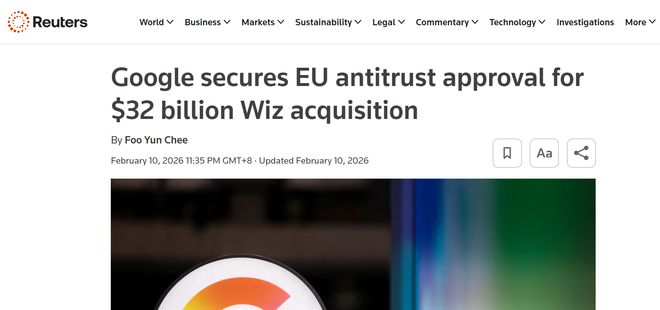
谷歌320亿美元收购Wiz获欧盟无条件批准,系其史上最大收购案
Huan Qiu Wang Zi Xun· 2026-02-12 03:31
Core Insights - Alphabet, Google's parent company, has received unconditional approval from the EU antitrust authority for its acquisition of cybersecurity company Wiz for $32 billion, marking the largest acquisition in Google's history [1][3] Group 1: Acquisition Details - The acquisition was officially announced in March of the previous year and aims to enhance Google's competitiveness in the cybersecurity and cloud computing sectors [3] - The EU antitrust authority confirmed that the transaction would not raise any competition concerns, as Google's market share in cloud infrastructure remains behind that of Amazon and Microsoft [3] Group 2: Market Impact - EU antitrust chief Teresa Ribeiro stated that customers in the market will still have reliable alternative service providers and sufficient options to switch providers, ensuring that the competitive landscape will not be adversely affected [3] - The European Commission conducted a thorough assessment of the transaction, concluding that the data acquired by Google through this acquisition does not involve commercial secrets and that other security software companies can also evaluate the relevant data, preventing market monopolization issues [3]
320亿美元买下Wiz,谷歌史上最大收购获欧盟无条件批准
Sou Hu Cai Jing· 2026-02-12 01:32
Core Viewpoint - The acquisition announced in March last year will enhance Google's position in the cybersecurity and cloud computing sectors, where it is currently competing against larger rivals Amazon and Microsoft [2] Group 1: Market Position - Google is lagging behind Amazon and Microsoft in the cloud infrastructure market share [2] - The European Commission's antitrust chief, Teresa Ribeiro, stated that customers will still have reliable alternative options and can switch service providers [2] Group 2: Regulatory Environment - The European Commission indicated that any data acquired by Google through this transaction does not involve trade secrets, and other security software companies can also evaluate it [2] - There has been increased scrutiny from regulators regarding technology sector transactions due to concerns that they may enhance the market dominance of large companies and exclude smaller competitors [2]