银行并购

Search documents
Investors will win with the Banc of California's stock, says Mendon Capital's Anton Schutz
Youtube· 2025-09-24 19:15
Group 1: Bank of California (BNC) - The company trades below book value, making it an attractive investment opportunity, especially as a large Southern California bank [2] - The bank has reduced its balance sheet and improved credit management, positioning itself for future growth [2][3] - The bank has been opportunistic with its capital, buying back stock below book value, which has enhanced its book value [3] Group 2: Home Street Bank - Home Street was recently acquired by Mechanics Bank, which has a market cap of approximately $3 billion [4] - The acquisition will lead to Home Street being added to the Russell 2000, creating significant demand for its shares [5] - The presence of private equity backing suggests potential for improved financial performance and a possible sale within the next 18 months [6] Group 3: First Horizon - First Horizon operates in attractive markets such as the Southeast, Texas, and North Carolina, which enhances its investment appeal [7] - The bank maintains a conservative culture with moderate loan growth and a stock buyback program, making it attractive to larger banks [8] - The failed merger with TD Bank was not due to First Horizon's performance, presenting a potential opportunity for investors [9]



QNB to acquire smaller rival in southeastern Pennsylvania
American Banker· 2025-09-23 21:48
Key Insight: A bank in Pennsylvania has agreed to buy an in-state rival. Supporting Data: The combined entity would exceed $2 billion of assets.Forward Look: The banks say the deal could close within the next couple of months.QNB Corp. in Quakertown, Pennsylvania, plans to acquire a neighboring bank in an all-stock deal that could close as soon as the fourth quarter, the companies said Tuesday afternoon.QNB will pay roughly $41 million to purchase The Victory Bancorp in Limerick, Pennsylvania, located appr ...

Spain’s Sabadell urges shareholders to reject BBVA’s exchange offer
Yahoo Finance· 2025-09-15 11:04
Banco Sabadell's board of directors has urged its shareholders to reject the share exchange offer made by rival bank BBVA. The board firmly believes that the offer "significantly undervalues the bank, its strategic plan and its future prospects." BBVA's proposal entails an exchange of one of its common shares plus €0.70 ($1.17) in cash for every 5.5483 Sabadell shares. Sabadell rebuffed BBVA's advances, having previously rejected merger proposals in November 2020 and May 2024. The board stated that it ...
Columbia Banking System (NasdaqGS:COLB) FY Conference Transcript
2025-09-10 16:17
Columbia Banking System FY Conference Summary Company Overview - **Company**: Columbia Banking System (NasdaqGS:COLB) - **Event**: FY Conference held on September 10, 2025 Key Points Industry and Market Trends - The banking industry is experiencing a steady state with seasonal trends impacting deposits positively, while loan growth remains challenging [6][7] - Columbia Banking System is focused on profitability rather than growth for its own sake, emphasizing disciplined customer acquisition [6][7] Acquisition of Pacific Premier Bancorp - The acquisition of Pacific Premier Bancorp is seen as a significant strategic move, accelerating Columbia's goals in Southern California by a decade [9] - The deposit base from Pacific Premier is viewed as a mirror image of Columbia's, with better pricing, enhancing overall competitiveness [9][10] - There is a high level of excitement and engagement among employees from both companies post-acquisition, with cross-business referrals already initiated [12][14] Integration and Cultural Fit - The integration process is being approached proactively, with training and engagement activities planned to ensure smooth cultural integration [14][15] - Leadership from both companies is retained, and there is confidence in the existing team to drive growth and maintain operational effectiveness [20][21] Growth Strategy and Market Position - Columbia is focusing on diversifying its customer base, particularly in the C&I (Commercial and Industrial) sector, with a strategy to target smaller, loyal customers [16][18] - The company is not under pressure to reach the $100 billion regulatory threshold quickly, as it is currently at approximately $70 billion [22][26] - Columbia aims to remix its balance sheet to improve revenue and profitability while maintaining its current size [26][28] Capital Management and Future Outlook - The company has established capital targets that remain unchanged since 2010, aiming to stay well-capitalized above regulatory requirements [45][46] - There is an expectation of capital accretion post-acquisition, with plans for potential share repurchases as capital levels stabilize [32][47] - Columbia is optimistic about growth in newer markets like Colorado and Arizona, with successful deposit and loan generation from small teams [38][40][42] Risk Management and Credit Quality - The company is cautious about adding new commercial real estate (CRE) loans, focusing instead on relationships that can drive fee income [43][44] - Credit quality remains strong, with no significant concerns regarding the inherited portfolios from previous acquisitions [43][44] Conclusion - Columbia Banking System is positioned as a consistent performer in the banking sector, with a clear focus on strategic growth, effective integration of acquisitions, and maintaining strong capital levels to support future initiatives [28][47]

Huntington targets early fourth-quarter close for Texas deal
Yahoo Finance· 2025-09-08 20:25
What to know: Huntington Bancshares in Columbus Ohio believes it could close its $1.9 billion deal for Veritex Financial in Dallas early in the fourth quarter, extending a recent trend of earlier deal completions. Deeper dive: Huntington has acquired most of the land it needs for a planned de novo expansion in North Carolina and South Carolina, and it expects branch construction in the region to accelerate in 2026. Bottom line: Growth in Texas and the Carolinas is boosting the $207.7 billion-asset region ...

Banco Bilbao Vizcaya Argentaria (BBVA) M&A Announcement Transcript
2025-09-05 11:02
Summary of Banco Bilbao Vizcaya Argentaria (BBVA) M&A Conference Call Company and Industry - **Company**: Banco Bilbao Vizcaya Argentaria (BBVA) - **Industry**: European Banking Sector Key Points and Arguments M&A Transaction Overview - BBVA announced a merger with Banco Sabadell, emphasizing the complementary strengths of both banks, particularly in the SME and retail segments [2][3] - The merger is expected to create a stronger entity with a balanced portfolio and enhanced offerings for clients [3] Financial Implications - BBVA's technology expenses in Spain have increased by 11% from 2023 to 2024, exceeding €1.1 billion, indicating high fixed costs that can be optimized post-merger [2] - The merger is projected to generate total pre-tax synergies of €900 million annually, an increase of €50 million from the original estimate [10] - Cost synergies are expected to be €835 million, with €510 million from operational savings and €325 million from personnel cost reductions [10][11] Stakeholder Benefits - The merger is anticipated to enhance lending capacity by an additional €5.4 billion, benefiting clients and society [4] - BBVA aims to provide a better offer for clients and create opportunities for employees within a leading global bank [4] Shareholder Value - BBVA's return on tangible equity was 20% in 2024, significantly higher than competitors, indicating strong profitability [7] - The merger is expected to result in a 25% increase in earnings per share (EPS) for Banco Sabadell shareholders if they accept the offer [20] - BBVA's share price has appreciated by 397% since 2019, outperforming both Banco Sabadell and the broader European banking sector [8] Offer Details - The current offer stands at one BBVA share and €0.07 for every 5.5483 shares of Banco Sabadell, reflecting a 43% increase in value since the initial announcement [15] - The offer includes a 30% premium relative to the undisturbed price and a 42% premium compared to the average closing price prior to the announcement [16] Market Dynamics - Analysts forecast an 8% upside for BBVA's share price, while Banco Sabadell's target price is below current levels, indicating potential downward pressure on Sabadell's shares [18] - The merger is seen as a unique opportunity given the current high valuations of both banks [36] Regulatory and Strategic Considerations - BBVA is seeking to align regulatory timelines between the U.S. SEC and Spanish authorities to facilitate the merger process [28] - The merger is positioned as a strategic consolidation within the market, with a focus on creating value for both banks' shareholders [65] Future Outlook - BBVA's strategic plan aims for a return on tangible equity of 22% by 2028, reinforcing its leadership in the European banking sector [9] - The timeline for realizing full synergies has been adjusted, with expectations for significant cost savings to materialize in the years following the merger [12][13] Additional Important Content - BBVA's commitment to maintaining its headquarters in key territories and supporting local communities through social initiatives [5] - The merger is framed as a "textbook transaction" that aligns with BBVA's long-term growth strategy [65] - The potential for share buybacks and capital returns to shareholders is highlighted, with excess capital expected from the TSB sale [78][80]

M&As Rise to 4-Year High in July: Here's What it Means for Banks
ZACKS· 2025-08-19 16:05
Core Insights - The regulatory environment under the Trump administration has led to an increase in mergers and acquisitions (M&A) activities, with 26 bank deals announced in July, the highest monthly total since June 2021 [1][10] - The total deal value in July reached $10.83 billion, marking the largest amount since December 2021 [1][10] Group 1: Reasons Behind M&A Upsurge - The rebound in M&A activities in the banking sector is a response to market challenges, driven by pent-up demand, improving bank stock valuations, and the desire for competitive advantage [2] - Renewed optimism for bank consolidations is fueled by proposed easing of criteria for banks to be deemed "well managed," which is crucial for M&A eligibility [3] - Faster regulatory approval timelines are encouraging larger and regional banks to explore potential deals [4] Group 2: Notable M&A Deals - Pinnacle Financial Partners and Synovus Financial Corp announced an all-stock merger deal valued at $8.6 billion, expected to close in Q1 2026, marking the largest U.S. bank M&A deal since 2021 [5][10] - The merger is projected to be 21% accretive to Pinnacle's estimated operating EPS in 2027 and is expected to be tax-free for shareholders of both companies [6] - Huntington Bancshares announced an agreement to acquire Veritex Holdings for $1.9 billion, expected to close in Q4 2025, representing the third-largest U.S. bank M&A deal announced in 2025 [7][10] Group 3: Benefits of Increased M&A Activities - Increased M&A activities are expected to lead to technology upgrades as banks combine digital platforms, which may result in temporary service disruptions but ultimately help banks grow faster and improve profitability [12] - Larger balance sheets from M&A will enable banks to compete more effectively with national players, while branch consolidation and shared technology systems can significantly lower operating costs [12] - For banks reliant on investment banking, the rise in M&A activity will boost advisory revenues, supporting overall fee income growth [13]

Northwest Bancshares(NWBI) - 2025 Q2 - Earnings Call Transcript
2025-07-30 13:30
Financial Data and Key Metrics Changes - The company reported GAAP net income of $33.7 million and earnings per diluted share of $0.26, compared to $0.24 in the same quarter of 2024, reflecting a 10% increase in earnings per share when adjusted for one-time merger-related expenses [8][9][13] - Total revenue for the second quarter was $150 million, representing a 53.5% increase year-over-year, although slightly down from $156 million in the previous quarter [14] - The net interest margin improved to 3.56%, up from an adjusted margin of 3.48% in the prior quarter [14] Business Line Data and Key Metrics Changes - Average commercial and industrial (C&I) loans increased by 19% compared to the same period last year, with average C&I loans growing by $49.1 million or 2.4% compared to the first quarter [10][16] - Non-interest income increased by $2.6 million or 9.1% quarter-over-quarter, driven by improvements in fee income [14][20] - Average loans grew by $72 million quarter-over-quarter, but were $120 million or about 1% lower than in 2024 [15][16] Market Data and Key Metrics Changes - Average deposits increased by $66 million or 0.5% quarter-over-quarter and $67 million or about 0.6% year-over-year [17] - The cost of deposits decreased by four basis points quarter-over-quarter, standing at 1.55%, which is competitive relative to peers [18] Company Strategy and Development Direction - The company is focused on optimizing operations and financial performance following the recent Pennswood acquisition, while also planning to open new financial centers in high-growth areas [7][11] - The strategy includes a shift towards commercial lending and maintaining a balanced approach between consumer and commercial portfolios [16][52] Management's Comments on Operating Environment and Future Outlook - Management expressed confidence in maintaining a net interest margin of approximately 3.50% for the remainder of the year, with expectations of achieving full cost savings from the Pennswood acquisition by 2026 [25][27] - The company anticipates continued growth opportunities despite current macroeconomic uncertainties, particularly in the commercial lending space [55] Other Important Information - The company declared a quarterly dividend of $0.20 per share to shareholders of record as of August 8, 2025 [11] - The total equity consideration for the Pennswood acquisition was $230 million, which was $30 million less than initially disclosed [12] Q&A Session Summary Question: What are the expected cost savings from the Pennswood acquisition? - Management indicated that they expect to achieve about 40% cost savings from the transaction, with approximately 75% of that expected in 2025 and the remainder in 2026 [29][30] Question: What is the initial estimate of margin accretion from the acquisition? - Management stated they are still working through purchase accounting and could not provide updated margin guidance at this time [32][35] Question: How does the company feel about the adequacy of reserves for potential losses? - Management believes they are adequately reserved for losses and expects to see opportunities for credits to repay over the next six months [45] Question: What are the prospects for deposit growth through year-end? - Management feels confident about deposit growth, especially with the addition of new Pennswood customers [47] Question: Is there a change in strategy regarding home equity and consumer loans? - Management clarified that there is no change in strategy, but they are focusing on consumer lending opportunities as market conditions allow [51][53]

California Banp(CALB) - 2025 Q2 - Earnings Call Presentation
2025-07-28 12:00
Company Overview - California BanCorp has a market capitalization of $533 million [11] - The company possesses total assets of $40 billion and deposits of $33 billion as of June 30, 2025 [11] - The company has a 5-year asset CAGR of 207% and a 5-year deposit CAGR of 234% [11] Balance Sheet and Loan Portfolio - Total loans held for investment were $30 billion at June 30, 2025, compared to $31 billion at March 31, 2025, and $19 billion at June 30, 2024 [10] - Noninterest-bearing deposits accounted for 368% of total deposits as of June 30, 2025 [10] - As of June 30, 2025, total multifamily loans amounted to $2585 million, representing 86% of total loans [66] Financial Performance - Net income for Q2 2025 was $141 million, with diluted EPS at $043 [25] - The return on average assets for Q2 2025 was 145%, and the return on average common equity was 1050% [25] - The net interest margin for Q2 2025 was 461% [25] - The efficiency ratio for Q2 2025 was 561% [25] - Non-performing assets to total assets stood at 046% for Q2 2025 [25] - The allowance for credit losses to total loans held for investment was 146% as of June 30, 2025 [25]

美股银行板块突破在即?监管松绑或成关键催化剂
Hua Er Jie Jian Wen· 2025-06-26 11:53
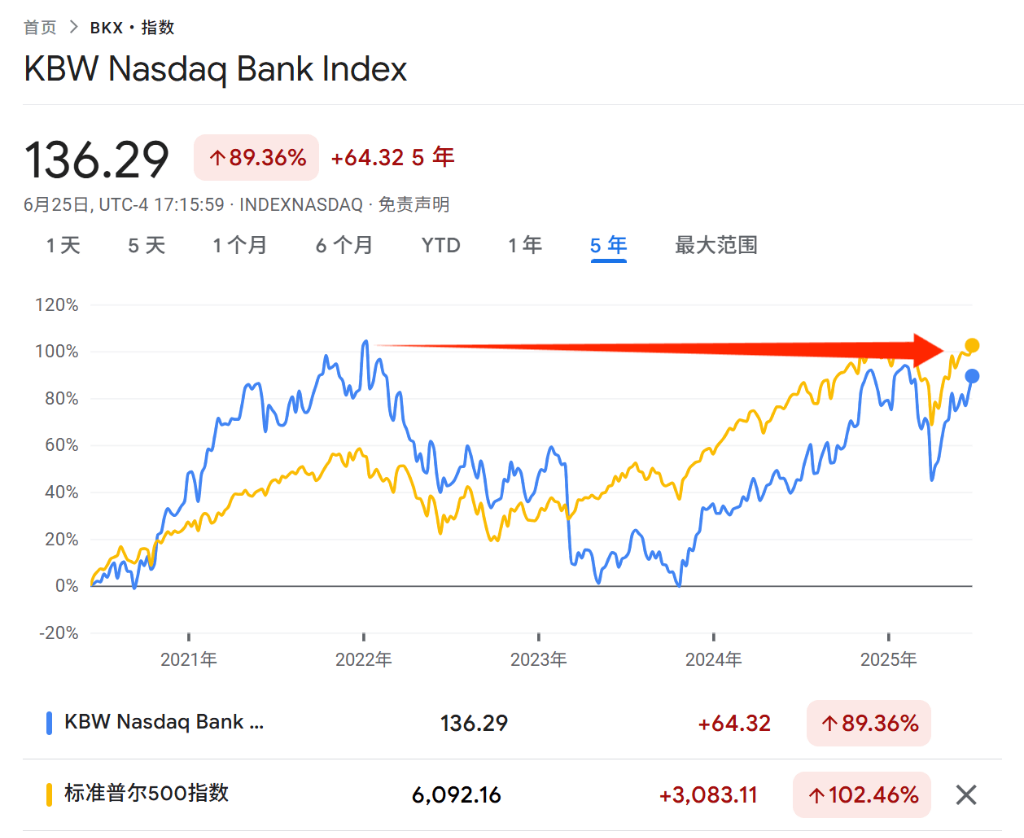
Core Viewpoint - The banking sector has lagged behind the overall market in recent years, but recent developments such as stress test results and relaxed capital rules present opportunities for upward movement in bank stocks [1][4]. Group 1: Market Performance - The KBW Bank Index is still over 7% lower than its historical high in 2022, while the S&P 500 has risen more than 30% during the same period [1]. - Analyst Mike Mayo believes that the banking sector is experiencing a significant regulatory turning point, with improved operating leverage and continuous revenue growth [4]. Group 2: Stress Tests and Capital Rules - Ian Katz from Capital Alpha Partners expects all banks to pass the upcoming stress tests, which would allow for increased stock buybacks and dividend distributions [5]. - The Federal Reserve plans to lower future testing restrictions, and the current severe scenario for the tests appears to be less stringent than last year [5]. - Regulatory reforms are underway, with the Fed's Vice Chair Michelle Bowman supporting revisions to capital rules, which may accelerate bank merger activities [5]. Group 3: M&A Speculation - Speculation around mergers and acquisitions is rising, with reports of Bank of New York Mellon potentially pursuing a large acquisition of Northern Trust Corp, which has vowed to remain independent [6]. Group 4: Challenges and Opportunities - Despite the positive outlook, there are risks that the banking sector may not keep pace with the broader market gains, influenced by economic and geopolitical factors [7]. - The Federal Reserve's policy direction remains uncertain, and high interest rates could pose risks to financial liabilities, as seen in the recent bank failures [7]. - Analysts suggest that regional banks, which rely less on trading income, may face less pressure compared to larger banks [7].